
Why Viehmoor stands out
Viehmoor is best known for its concentration of birdlife, functioning as both a breeding area and a stopover site for waterbirds and species tied to heath, mire, and open wetland habitats. The reserve's combination of wet lowland, fishponds with marginal reed belts, and dune-heath transitions creates a varied ecological patchwork within a relatively compact footprint.
Viehmoor history and protected-area timeline
Viehmoor was officially placed under nature protection (Naturschutzgebiet) on 2 August 1979, under the designation NSG BR 018. The protection formalizes the site's existing ecological value rather than creating a new reserve from scratch; its fishponds, peat-cutting hollows, and traditional land use had shaped the landscape long before designation.
Protection is administered through the Landkreis Gifhorn as the responsible lower nature protection authority, with the broader Niedersächsischer Landesbetrieb für Wasserwirtschaft, Küsten- und Naturschutz (NLWKN) providing regional coordination. The reserve is almost entirely encircled by the larger landscape protection area (Landschaftsschutzgebiet) known as Gifhorner, Winkeler und Fahle Heide and surrounding landscape parts, situating Viehmoor within a wider protection framework.
Conservation management has involved active stewardship rather than passive protection. The NABU Kreisverband Gifhorn, working through a volunteer group known as the Viehmoor-AG, has carried out ongoing habitat management work, while the NABU's species protection center at Leiferde runs guided tours into the reserve. Although the reserve today is associated with conservation, its southwestern boundary adjoins an active petroleum extraction area, illustrating the spatial tension between protection and resource use that is typical of many reserves in this part of Lower Saxony.
Viehmoor landscape and geographic character
Viehmoor's terrain is shaped directly by its glacial and postglacial history. During the last ice age, fine soil material was blown out of a shallow basin, leaving behind a flat, waterlogged lowland where a small raised-style mire could form. The sand that was carried away accumulated instead at the edges, building up an inland dune ridge that encloses the mire to the north and east and rises about three meters above the surrounding terrain.
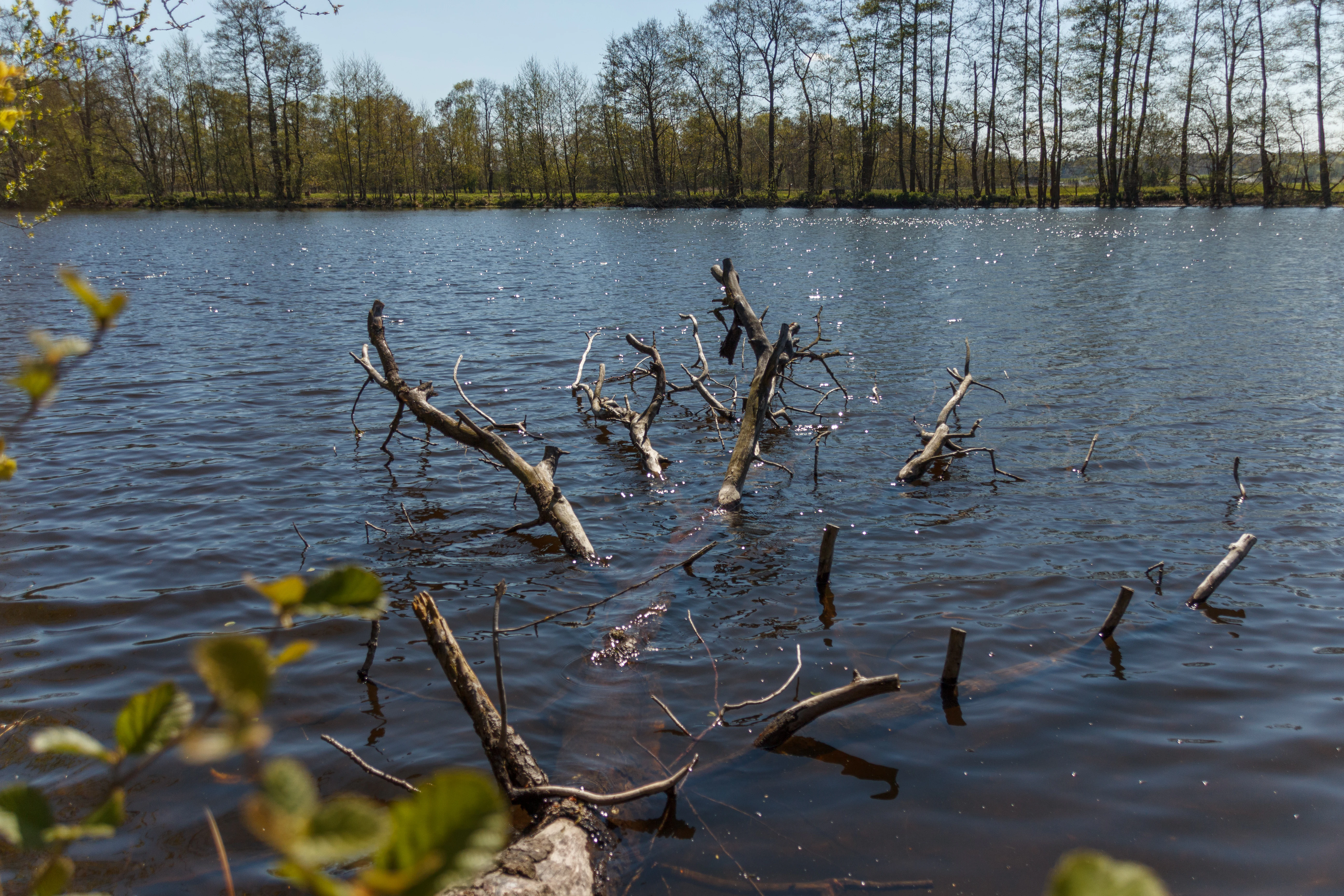
Within this setting, the landscape divides into clearly distinct zones. The western part of the reserve is governed by a chain of seven former fishponds covering roughly 36 hectares, where shallowing waters have produced reedbeds and fine sediment zones along the margins. The southern part is dominated by broad meadow areas, some only seasonally moist, others persistently damp, while the central hollows contain peat-moss quaking mats and sedge beds growing in the abandoned peat cuttings (Torfstich).
Around the edges, the drier environment of the dunes supports a different kind of landscape: patches of broom heath accented by solitary pines, mixed forest on the more stable ridges, and alder carr woodland along the wetter margins. The result is an unusually compressed landscape mosaic for an area of this size, with dry heath, woodland, open water, reed marsh, wet grassland, and mire all lying within walking distance of one another.
Viehmoor ecosystems, habitats, and plant life
The ecological character of Viehmoor is built on the coexistence of mire, wetland, and dry heath in a single reserve. Its Niedermoor, or lowland mire, sits in a groundwater-rich part of the geest and supports peat-forming plant communities, including peat moss (Sphagnum) mats that form floating quaking vegetation (Schwingrasen) over the old peat cuttings, and dense beds of bottle sedge (Schnabel-Segge).
On the margins and dunes, the ecological register shifts sharply. Here, broom heath communities have colonized the sandy soils, interspersed with single pines that give the dry areas a characteristic sparse cover. The dune ridges themselves, where soils are more stable, host mixed woodland, while along the interfaces between wet and dry zones, alder carr woodland has developed on the dampest sites.
The mosaic of open water, transitional reed marsh, wet grassland, and dry heath provides the ecological foundation for Viehmoor's importance to fauna. It is the combination of habitats, not the dominance of any single one, that explains why the reserve supports such an unusual range of species for a comparatively small protected area in intensively farmed Lower Saxony.
Viehmoor wildlife and species highlights
Viehmoor has been recognized primarily for its birdlife. The reserve functions as both a breeding area and a seasonal stopover for a wide variety of bird species, taking advantage of the range of habitats on offer: open water and reed for waterbirds, wet grassland for meadow-nesting species, and the heath, woodland, and dune edges for species tied to drier or more structurally varied terrain.
The site has particular value as a refuge for species associated with dunes, lowland mires, and wetlands, including plants and animals that have become scarce elsewhere in the surrounding agricultural landscape. Detailed surveys of the area's non-passerine birds have been published in regional ornithological literature, reflecting the level of interest the reserve commands among birders and conservation biologists.
Beyond birds, the combination of habitats supports a broader community of wetland-, mire-, and heath-dependent fauna, which is a key reason why the NABU operates a dedicated species protection center adjacent to the reserve at Leiferde and runs guided tours into the area from there.
Viehmoor conservation status and protection priorities
Viehmoor matters for conservation because it preserves, within a single contiguous protected area, several interconnected habitat types that have become increasingly fragmented in the wider north German countryside. The reserve's mosaic of inland dunes, broom heath, mixed woodland, lowland mire, peat-cutting pools, fishpond reedbeds, and wet grassland makes it functionally richer than its modest size suggests.
Protection has been in place since 1979 and is layered: the core is the Naturschutzgebiet status, and it is nearly entirely encircled by a Landschaftsschutzgebiet, extending protection into a wider buffer of heaths and farmland. The reserve is classified under the IUCN framework as a Habitat/Species Management Area (Category IV), reflecting its management orientation rather than strict non-intervention.
Management is active rather than purely protective. The local NABU association, through its Viehmoor volunteer working group, runs regular stewardship tasks on the ground. The NABU's Artenschutzzentrum Leiferde on the edge of the village focuses on species conservation and provides guided access to the reserve. At the same time, the southwestern boundary of the reserve borders an active petroleum extraction area, illustrating the ongoing challenge of balancing conservation, traditional land use, and resource extraction in the region.
Viehmoor cultural meaning and human context
The cultural context of Viehmoor is tied primarily to long-standing rural land use. The ponds in the western part of the reserve have their origins in former fish farming, while the peat-cutting hollows scattered across the mire reflect historical turf extraction for fuel and horticulture. These human uses shaped the surface of the reserve and continue to define much of its visible character, particularly the open water and quaking peat-moss mats of the central zone.
Today, the reserve is integrated into local civic life through the activities of the Naturschutzbund Deutschland, which operates a species protection center at Leiferde and uses it as a base for volunteer habitat management and guided public tours. The reserve is thus not only a habitat reserve but also a community-facing conservation site, where farming heritage, modern environmental stewardship, and public engagement come together.
Top sights and standout views in Viehmoor
Viehmoor's principal distinguishing feature is its tightly compressed mosaic of contrasting habitats: a lowland mire encircled by inland dunes, with fishpond reedbeds, wet grasslands, peat-cutting pools, broom heath, and mixed woodland all within a few hundred meters of one another. This the reserve a markedly richer conservation profile than its roughly 302-hectare footprint would suggest.
The reserve's second major highlight is its ornithological importance, with both breeding and migratory birds finding suitable habitat across the spectrum of conditions, supported by adjacent NABU-led volunteer work and a dedicated species protection center on the reserve's edge. The site's protected status since 1979 and its near-complete enclosure within a larger landscape protection area further reinforce its role as a long-standing refuge for wetland and heath-dependent wildlife within the Gifhorn district.
Best time to visit Viehmoor
Viehmoor is a habitat whose character shifts meaningfully across the seasons. Spring and early summer are the most active periods for breeding birds, when the wet meadows, reedbeds, and open water are at their most visible and the heath margins are in bloom. Late summer and autumn can be excellent for migratory waterbirds and passage species using the reserve as a stopover, while winter reveals the open structure of the dunes, heath, and partly drained meadows, when waterfowl may still be present and visibility across the open areas is greatest.
Because the reserve is managed rather than purely wilderness, the best visiting experience tends to come through guided walks organized from the NABU Artenschutzzentrum at Leiferde, which can direct visitors to the parts of the reserve most worth seeing at any given time of year. Casual visitors should treat the area as a working conservation site rather than a recreational landscape, and plan visits accordingly.