Why Beas Conservation Reserve stands out
The Beas Conservation Reserve is best known as the only known habitat in India for the endangered Indus river dolphin, a functionally blind cetacean that navigates and hunts using echolocation. The presence of this species, along with the reintroduction of gharials after a 30-year absence, was central to the area's designation as a conservation reserve and later as a Ramsar site. Equally important is the reserve's distinctive braided river landscape, where the Beas splits into multiple channels, sand bars, and islands between the Himalayan foothills and Harike Headworks. This dynamic freshwater mosaic supports an unusually rich concentration of birdlife and fish species, including threatened mahseer, hog deer, fishing cats, and smooth-coated otters.
Beas Conservation Reserve history and protected-area timeline
The Beas Conservation Reserve is a recent designation in the long history of the Beas River, but its creation reflects years of growing concern over the degradation of the river's ecosystem. The Punjab government formally declared the 185 km stretch as a conservation reserve in 2017, framing it as a legal mechanism to protect both the river's hydrological character and its biodiversity.
The reserve's significance was substantially elevated in September 2019, when it was inscribed as a Ramsar site under the 1971 Ramsar Convention on Wetlands of International Importance. This international designation brought new obligations regarding wetland management and monitoring, and confirmed the global importance of the Beas floodplain as waterbird and freshwater habitat.
A defining moment in the reserve's short history was a 2017 reintroduction programme that released 47 long-snouted gharials into the Beas, three decades after the species had disappeared from this stretch of river. More broadly, the discovery of a resident population of the Indus river dolphin, an animal long thought to have vanished from Indian waters, transformed the reserve's profile and was central to the rationale for its formal protection.
Beas Conservation Reserve landscape and geographic character
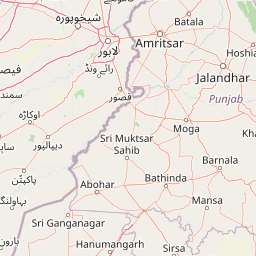
The defining landscape of the Beas Conservation Reserve is the river itself, and specifically its braided character as it leaves the Himalayan foothills and travels across northwestern Punjab. Between the foothills and the Harike Headworks, the Beas spreads into a shifting network of multiple channels separated by sand bars, midstream islands, and exposed sediment deposits.
This braided morphology produces a finely textured mosaic of aquatic and terrestrial surfaces. Sluggish side channels, seasonally flooded margins, and newly formed islands sit alongside more permanent flowing reaches, creating a wide spectrum of water depths, velocities, and shoreline conditions. The visual character of the reserve is therefore not defined by static cliffs, peaks, or forests, but by a constantly rearranged pattern of water, sand, and vegetation.
In the wider setting, the river flows through the alluvial plains of Punjab, an agricultural and human-modified landscape where the Beas corridor stands out as a relatively undisturbed linear wilderness. The juxtaposition of intensive agriculture and a dynamic, ecologically rich river system shapes much of the reserve's character and many of the environmental pressures it faces.
Beas Conservation Reserve ecosystems, habitats, and plant life
The ecosystem of the Beas Conservation Reserve is centred on the braided river and its associated wetland habitats. The combination of flowing channels, still side pools, sand bars, vegetated islands, and riparian margins produces a wide range of aquatic, semi-aquatic, and shoreline habitats within a comparatively compact geographic area.
Vegetation along the reserve includes a mosaic of aquatic plants, reed beds, grasses, shrubs, and riparian tree cover that colonise sand bars and islands as they stabilise. These habitats support an unusually rich bird community, with the reserve hosting more than 500 recorded bird species that depend on the river for foraging, breeding, and seasonal stopover habitat.
The aquatic system is similarly diverse, with more than 90 recorded fish species occupying channels that range from fast-moving central flows to shallow, sluggish margins. The ecological richness of the reserve is therefore a product of the physical complexity of the river itself, with habitat heterogeneity driving unusually high species diversity for a single river corridor.
Beas Conservation Reserve wildlife and species highlights
Wildlife is the most distinctive and globally significant feature of the Beas Conservation Reserve. The reserve hosts the only known population of the endangered Indus river dolphin, a freshwater cetacean that is functionally blind and navigates and hunts by echolocation. The continued presence of this species in the Beas, after decades during which it was believed to have vanished from India, is one of the reserve's defining conservation outcomes.
The reserve's rivers and wetlands also support more than 90 fish species, including the endangered mahseer, and more than 500 bird species that use the corridor year-round or as part of larger flyways. Mammals recorded in and around the reserve include the hog deer, the fishing cat, and the smooth-coated otter, each of which depends on robust riparian and wetland habitat.
A particularly visible conservation success has been the reintroduction of long-snouted gharials. In 2017, 47 individuals were released into the Beas, 30 years after the species had disappeared from the local river system. The presence of both the Indus river dolphin and the returning gharial population was a central reason for the area's designation as a conservation reserve and continues to shape its current wildlife significance.
Beas Conservation Reserve conservation status and protection priorities
The Beas Conservation Reserve is one of India's most significant freshwater conservation initiatives, combining a domestic conservation reserve designation with international Ramsar recognition. Declared a conservation reserve by the Punjab government in 2017 and inscribed as a Ramsar site in September 2019, the area is protected under India's Wildlife (Protection) Act and administered by the Department of Forests and Wildlife Preservation of Punjab.
The reserve's conservation profile is anchored by the protection of the Indus river dolphin population, one of the rarest freshwater mammals in South Asia, and by active species recovery efforts including the 2017 reintroduction of gharials. Restrictions on commercial fishing and netting within the reserve have already been credited with reducing indiscriminate fishing pressure, and the scientific management of the wetland is intended to maintain the integrity of the braided river system that underpins the reserve's biodiversity.
At the same time, the reserve faces ongoing environmental pressures. Urban and domestic pollution, agricultural activity along the river's course, and the fragmentation of water flow by dams, barrages, and canals all threaten the ecological coherence of the system. Future conservation work is likely to focus on maintaining ecological flows and managing surrounding land uses to preserve the integrity of the river corridor.
Top sights and standout views in Beas Conservation Reserve
The Beas Conservation Reserve is notable above all for being the only known home in India of the endangered Indus river dolphin, and for the return of long-snouted gharials after a 30-year absence. Its braided river morphology, with multiple channels, sand bars, and islands, creates a habitat mosaic rich enough to support more than 500 bird species and over 90 fish species.
The combination of a 2017 conservation reserve designation and 2019 Ramsar inscription gives the area unusually strong formal protection, while active management by the Punjab Department of Forests and Wildlife Preservation and restrictions on commercial fishing have translated that designation into on-the-ground conservation outcomes.
Best time to visit Beas Conservation Reserve
The Beas Conservation Reserve is a wetland-dominated river corridor whose character shifts with seasonal flow and waterbird activity. Cooler months, outside the peak monsoon, typically offer calmer conditions and more predictable bird observation, while the post-monsoon period often coincides with peak waterbird presence and stabilised water levels. Because the reserve is managed primarily for conservation rather than mass tourism, visitation is most meaningful for those interested in birdwatching, river ecology, and observing wildlife such as the Indus river dolphin, gharials, and otter activity along the Beas.