Mori Atlas logo
National parkCanyonlands National Park

Discover the mapped boundaries and regional geography of this iconic national park.

Canyonlands National Park: Utah's Vast Protected Landscape and Geographic Atlas

Canyonlands National Park in Utah represents a monumental protected area, deeply etched into the landscape with intricate canyons and vast, arid terrain. This page serves as a gateway to understanding its geographic scope, mapped outlines, and the unique natural context it occupies within the American Southwest. Engage with its protected status and distinct geological features through an atlas-informed perspective.

Desert LandscapeCanyon ParkColorado PlateauGeological FormationRiver ConfluenceFour Districts

Canyonlands National Park

National park

Park overview

Structured park overview, official facts, and landscape profile for Canyonlands National Park

Canyonlands National Park park facts, protected area profile, and essential visitor context
Review the core facts for Canyonlands National Park, including designation, size, terrain, visitor scale, habitats, and operating context in one park-focused overview.

About Canyonlands National Park

Canyonlands National Park represents one of the most geologically significant and visually spectacular landscapes in the United States. Located in southeastern Utah near the town of Moab, the park encompasses a vast network of canyons, mesas, buttes, and towering rock formations that have been sculpted over millions of years by the Colorado and Green Rivers and their tributaries. The park's establishment in 1964 came after years of advocacy by Bates Wilson, superintendent of Arches National Monument, who recognized the extraordinary value of this desert landscape. Secretary of the Interior Stewart Udall's aerial view of the Confluence during a flight to a Grand Canyon conference sparked the political momentum that led to the park's creation. The legislation to establish Canyonlands required balancing competing interests between nature preservationists and commercial developers, ultimately resulting in a protected area that, while significant, remains incomplete according to conservationists who hope to extend boundaries to include the natural rim formations that mark the landscape's true extent.

Quick facts and research context for Canyonlands National Park

Canyonlands National Park spans approximately 337,598 acres in southeastern Utah across San Juan, Wayne, Garfield, and Grand counties. The park is centered around the confluence of the Colorado and Green Rivers, which have carved massive canyons into the Colorado Plateau over millions of years. Four distinct districts divide the park: Island in the Sky offers panoramic views from a broad mesa; the Needles features red and white banded rock pinnacles and ancient Ancestral Puebloan dwellings; the Maze is one of the most remote and inaccessible areas in the contiguous United States; and the combined rivers district provides whitewater rafting through Cataract Canyon. The park receives approximately 818,000 visitors annually, with the majority visiting the Island in the Sky district.

Park context

Deeper park guide and search-rich context for Canyonlands National Park

Canyonlands National Park history, landscape, wildlife, and travel context
Explore Canyonlands National Park through its history, landscape character, ecosystems, wildlife, conservation priorities, cultural context, and seasonal travel timing in a structured park guide built for atlas discovery and search intent.

Why Canyonlands National Park stands out

Canyonlands is best known for its dramatic canyon landscape carved by two major river systems. The park's signature feature is the Confluence, where the Colorado and Green Rivers meet in a dramatic setting deep within the canyon. The Island in the Sky district features Mesa Arch, a stunning natural arch framing views of the White Rim Sandstone. The Needles district is famous for its distinctive red and white sandstone spires, as well as well-preserved Ancestral Puebloan stone dwellings and petroglyphs, including those at Newspaper Rock. The remote Maze district offers unparalleled solitude in one of the most inaccessible regions of the United States. Additionally, Horseshoe Canyon contains some of the oldest rock art in America, with panels created by hunter-gatherers from the Late Archaic Period predating the Ancestral Puebloans.

Canyonlands National Park history and protected-area timeline

The creation of Canyonlands National Park began in the early 1950s when Bates Wilson, then superintendent of Arches National Monument, started exploring the area south and west of Moab. After discovering what is now known as the Needles District, Wilson advocated for establishing a new national park. His explorations expanded to include the confluence of the Green and Colorado rivers, the Maze District, and Horseshoe Canyon. In 1961, Secretary of the Interior Stewart Udall flew over the Confluence during a flight to a Grand Canyon conference and became interested in Wilson's proposal. Utah Senator Frank Moss introduced legislation to create Canyonlands, attempting to satisfy both preservationists and commercial developers. Over four years, the proposal was repeatedly struck down, debated, revised, and reintroduced before passing. President Lyndon B. Johnson signed Public Law 88-590 in September 1964, establishing Canyonlands National Park. Bates Wilson became the park's first superintendent and is often called the "Father of Canyonlands." The political compromise that created the park left portions of the natural basin outside its boundaries, and conservationists continue to advocate for expanding protection to the high sandstone rims.

Canyonlands National Park landscape and geographic character

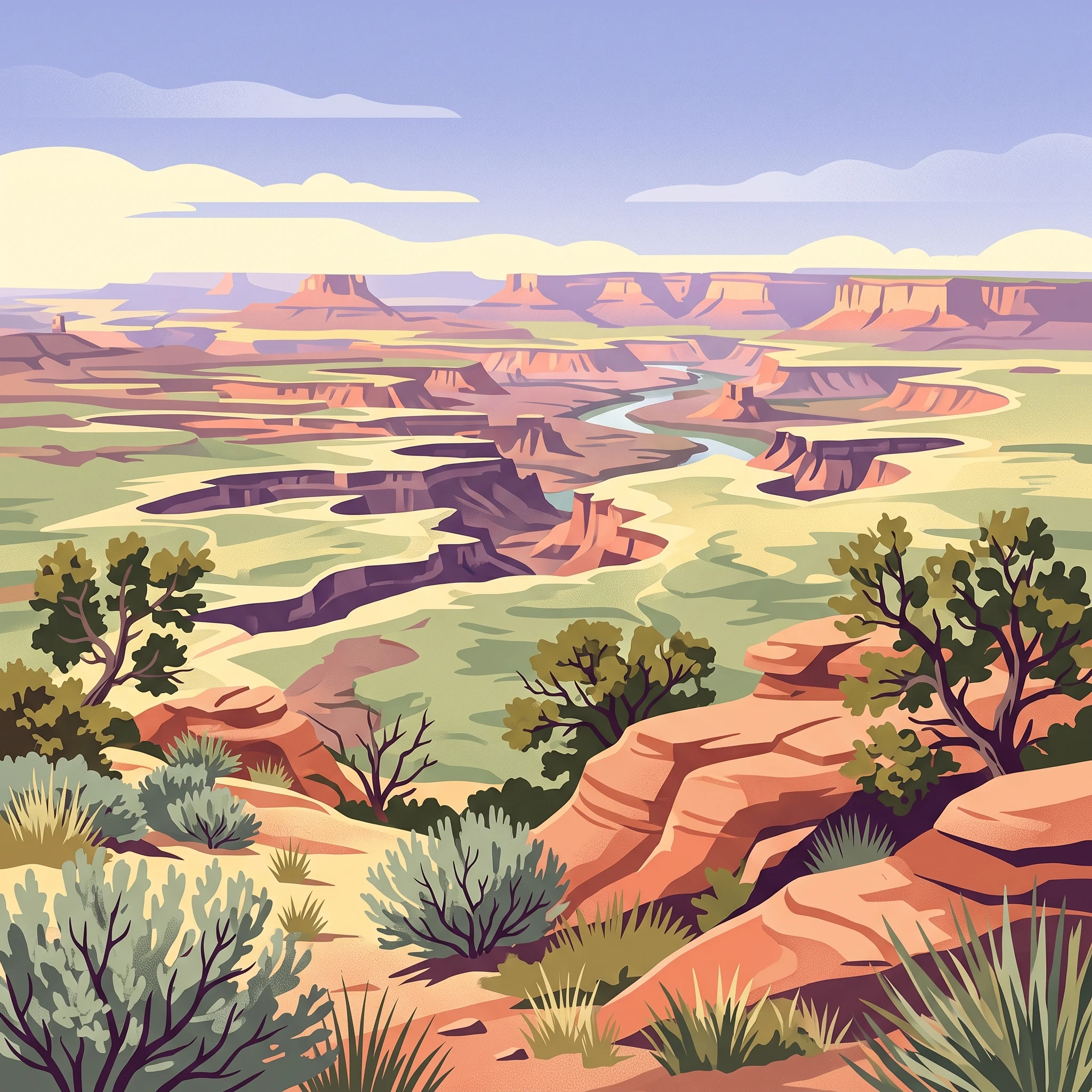
The landscape of Canyonlands National Park is defined by the massive canyon systems carved by the Colorado and Green Rivers into the Colorado Plateau. The park divides into four distinct districts separated by these rivers. Island in the Sky is a broad, level mesa in the northern section offering sweeping views of the White Rim, a sandstone bench 1,200 feet below the mesa, with the rivers another 1,000 feet below that. The Needles district, located south of Island in the Sky on the east side of the Colorado River, is named for the red and white banded rock pinnacles that dominate its scenery, along with grabens, potholes, and arches. The Maze district lies west of both rivers and represents one of the most remote and inaccessible areas in the contiguous United States. A detached northern section, Horseshoe Canyon, contains rock art panels far older than the Ancestral Puebloan structures found in the main park. The landscape features dramatically layered rock formations in colors ranging from white and orange to deep red and brown, with geological features spanning hundreds of millions of years of Earth history.

Canyonlands National Park ecosystems, habitats, and plant life

Canyonlands supports a surprising diversity of life adapted to the harsh desert environment. The park contains eleven cactus species, twenty moss species, liverworts, grasses, and wildflowers. Tree species include netleaf hackberry, Utah juniper, pinyon pine, Fremont's cottonwood, and tamarisk, while shrubs such as Mormon tea, blackbrush, four-wing saltbush, cliffrose, and snakeweed dot the landscape. The most ecologically significant feature may be cryptobiotic soil, a biological soil crust that provides nitrogen fixation and moisture retention essential for plant growth in this arid environment. A 200-acre area completely surrounded by cliffs has never been grazed by cattle and may contain the largest undisturbed grassland in the Four Corners region. The climate is cold semi-arid (Köppen BSk) with less than ten inches of annual rainfall, hot dry summers, and cold occasionally wet winters. Climate change is affecting the region through warming temperatures, more severe droughts, earlier springs, and longer fire seasons.

Canyonlands National Park wildlife and species highlights

Canyonlands National Park is home to at least 273 bird species and numerous mammals. Mammals commonly observed include desert cottontails, kangaroo rats, mule deer, elk, pronghorns, coyotes, foxes, and black bears. More elusive species include desert bighorn sheep, bobcats, cougars, badgers, ring-tailed cats, and skunks. The park supports a variety of raptors including Cooper's hawk, northern goshawk, sharp-shinned hawk, red-tailed hawk, golden and bald eagles, rough-legged hawk, Swainson's hawk, and northern harrier. Owl species include great horned owl, northern saw-whet owl, western screech owl, and Mexican spotted owl. Reptiles include eleven species of lizards and eight species of snakes, including the midget faded rattlesnake. Six amphibian species have been confirmed, including red-spotted toad, Woodhouse's toad, American bullfrog, northern leopard frog, Great Basin spadefoot toad, and tiger salamander.

Canyonlands National Park conservation status and protection priorities

Canyonlands represents a critical conservation area within the Colorado Plateau ecosystem. While the park protects a significant portion of the Canyonlands basin, conservationists note that the original legislation left portions of the natural landscape outside boundaries, and they continue advocating for expansion to include the high sandstone rims that form the natural border. The park's remote districts face different conservation challenges: the popular Island in the Sky requires visitor management through permit systems like those for the White Rim Road, while the pristine grassland area north of the Maze has been closed to the public since 1993 to maintain its nearly pristine condition. Climate change poses increasing threats through warming temperatures, drought, altered fire regimes, and changes to river flows that affect both ecosystems and recreational opportunities. The National Park Service collaborates with the US Geological Survey, indigenous tribes, and universities to develop adaptive management strategies focused on conserving biodiversity.

Canyonlands National Park cultural meaning and human context

Human presence in Canyonlands dates back thousands of years, with Ancestral Puebloans inhabiting the area and leaving well-preserved stone and mud dwellings, particularly in the Needles district. These ancient people also created rock art in the form of petroglyphs, most notably on Newspaper Rock along the Needles access road. The detached Horseshoe Canyon contains panels of rock art made by hunter-gatherers from the Late Archaic Period (2000–1000 BC), predating the Ancestral Puebloans. The images in Horseshoe Canyon, originally called Barrier Canyon, include depictions of horses dating from after 1540 AD when the Spanish reintroduced horses to America. These artifacts, dwellings, pictographs, and murals are among the oldest in America. Items and tools left by the Ancestral Puebloans were largely removed by looters over the years.

Top sights and standout views in Canyonlands National Park

Canyonlands offers several standout features that define its character. Mesa Arch at sunrise in the Island in the Sky district provides one of the most photographed scenes in the park. The Confluence of the Colorado and Green Rivers represents a dramatic meeting of two major river systems. The Needles district features distinctive sandstone spires and ancient Ancestral Puebloan dwellings. Cataract Canyon below the Confluence offers the largest whitewater rapids in North America during heavy snow years. The White Rim Road traverses the park between the rivers and Island in the Sky, providing access to remote backcountry. The Great Gallery in Horseshoe Canyon contains some of America's oldest and most significant rock art. The park's primitive character and remote wilderness atmosphere distinguish it from more developed national parks.

Best time to visit Canyonlands National Park

The best times to visit Canyonlands are spring (April through May) and fall (September through October) when temperatures are moderate and comfortable for hiking and backcountry travel. Summer months bring intense heat, often exceeding 100°F, particularly in the Needles district, making midday activity dangerous. Winter offers solitude and dramatic snow-covered landscapes but cold temperatures and limited services. The White Rim Road requires permits and is most popular in cooler months. River rafting through Cataract Canyon is best in late spring and early summer when snowmelt creates the most impressive rapids, though flow varies significantly by year. Visitors should note that river flow through the Confluence is determined by snowmelt rather than dam management, creating natural variability in whitewater conditions.
Park location guide

Geography guide, regional context, and park location map for Canyonlands National Park

Canyonlands National Park park geography, regions, and map view in United States of America
Understand where Canyonlands National Park sits in United States of America through a broader geographic reading of the surrounding landscape, nearby location context, and its mapped position within the national park landscape.

How Canyonlands National Park fits into United States of America

The United States of America is a federal presidential republic and one of the world's largest countries by area and population. It consists of 50 states across a vast territory spanning multiple time zones, with its capital in Washington, D.C. and largest city in New York City. The nation has a diverse economy, influential political system, and significant cultural and military presence globally.

Wider geography shaping Canyonlands National Park in United States of America

The United States occupies a vast territory in North America, bordered by Canada to the north and Mexico to the south. The 48 contiguous states stretch from the Atlantic to the Pacific Ocean, while Alaska occupies the northwestern region and Hawaii is an archipelago in the Pacific. The country encompasses diverse terrain including the Rocky Mountains, Appalachian Mountains, Great Plains, and extensive river systems.

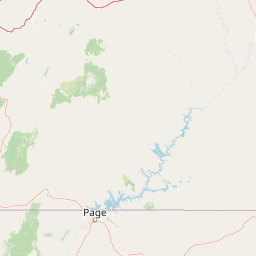
Map view of Canyonlands National Park

Use this park location map to pinpoint Canyonlands National Park in United States of America, understand its exact geographic position, and read its mapped placement within the surrounding landscape more clearly.

Pigeon | © OpenStreetMap contributors

Location context for Canyonlands National Park

Utah
Park atlas

Compare the regional spread of protected areas, tracing diverse canyon and desert landscapes of the Colorado Plateau.

Explore National Parks and Protected Areas Adjacent to Canyonlands National Park, Utah
Explore a curated selection of national parks and protected areas situated within the high desert terrain and dramatic canyon systems surrounding Canyonlands National Park. Compare their distinct geological formations, river carved landscapes, and unique wilderness characters to deepen your understanding of the broader Colorado Plateau conservation geography.
National parkUtah

Arches National Park: Utah National Park Protected Landscape Exploration

Explore mapped terrain and geographic context.

Delve into the specifics of Arches National Park, a protected national park located in Utah. This atlas-focused entry provides detailed insight into the park's protected landscape features and geographic distribution. Understand the mapped park boundaries and the unique natural terrain that shapes this significant conservation area within the United States' broader regional geography.

Area
310.31 km²
Established
1971
IUCN
II
Visitors
1.5M annual
National parkUtah

Capitol Reef National Park: Utah National Park Protected Landscape and Geography

Explore Capitol Reef National Park's mapped terrain and boundaries.

Delve into the protected landscape and geographic identity of Capitol Reef National Park, a key national park in Utah. This resource provides detailed context on its mapped terrain and regional setting, supporting a structured understanding of protected areas for atlas exploration. Discover the specific geographic features and park boundaries that define this protected natural area.

Area
978.95 km²
Established
1971
IUCN
II
Visitors
1.4M annual
National parkMontezuma County

Mesa Verde National Park: Protected Landscape Atlas and Geographic Identity

Discover the mapped terrain and regional context of this national park.

Mesa Verde National Park serves as a critical protected landscape within Montezuma County, offering distinct insights into regional geography and mapped terrain. This entry details the park's identity as a National Park, emphasizing its geographic setting and providing a foundation for atlas-driven exploration. Understand the park's place within the broader landscape context and its significance as a mapped protected area, ideal for focused geographic study.

Area
212.4 km²
Established
1906
IUCN
II
Visitors
463.1K annual
National parkMontrose County

Black Canyon of the Gunnison National Park: Protected Area Geography and Mapped Landscape

Explore the natural terrain and protected boundaries in Montrose County.

Black Canyon of the Gunnison National Park is a national park defined by its profound geological features and its status as a protected landscape. Located within Montrose County, it offers a distinct geographic profile for atlas-based exploration. Users can understand the park's mapped boundaries, its relation to the surrounding regional geography, and the unique natural terrain that defines this protected area, contributing to a structured discovery of its natural landscape identity.

Area
124.4 km²
Established
1999
IUCN
II
Visitors
357.1K annual
National parkUtah

Bryce Canyon National Park: Utah's Mapped Protected Landscape and Geographic Context

Explore the unique geology and protected boundaries of Bryce Canyon National Park.

Bryce Canyon National Park offers a distinct protected landscape within the geography of Utah, characterized by its unique geological formations. This entry provides essential context for understanding its mapped boundaries and natural terrain, serving as a vital component for atlas-based discovery of protected areas. Investigate the specific geographic setting and conservation significance of this iconic national park.

Area
145.02 km²
Established
1928
IUCN
II
Visitors
2.5M annual
National parkUtah

Zion National Park National Park: Detailed Mapped Geography and Protected Landscape Identity

Explore the mapped terrain and regional context of this Utah national park.

Zion National Park represents a key protected area within Utah, ideal for detailed geographic exploration. This canonical page offers insights into the park's specific mapped boundaries, its inherent landscape character, and its regional geographic setting. It is designed for users seeking to understand the atlas-level significance of Zion National Park as a national park entity, focusing on its protected terrain and natural geography.

Area
593.26 km²
Established
1919
IUCN
II
Visitors
4.9M annual
National parkArizona

Grand Canyon National Park: Arizona National Park Protected Landscape & Geography

Explore mapped boundaries and regional atlas context.

Grand Canyon National Park stands as a premier national park, showcasing a unique protected landscape within Arizona's diverse geography. This detailed entry focuses on the park's specific geographic identity, its mapped boundaries, and its significance within the regional atlas. Discover the contours of this protected area and its place in the natural terrain of the American Southwest.

Area
4,926.08 km²
Established
1919
IUCN
II
Visitors
4.9M annual
National parkNavajo County

Petrified Forest National Park: National Park Protected Landscape and Geographic Atlas

Explore its mapped terrain and regional park context.

Petrified Forest National Park represents a significant protected landscape within Navajo County, Arizona, offering focused insights into its unique terrain and geographic distribution. As a national park, it provides valuable data for understanding mapped park boundaries, regional landscape context, and its role within the broader atlas of protected areas. Discover the specific geographic features and natural identity that define this unique natural reserve.

Area
895.94 km²
Established
1962
IUCN
II
Visitors
644.9K annual

Common questions about visiting, size, designation, and location context for Canyonlands National Park

Canyonlands National Park FAQs for park facts, access, geography, and protected area context
Find quick answers about Canyonlands National Park, including protected-area facts, park geography, trail and visitor context, and how the park fits into its surrounding country and regional landscape.
MoriAtlas Explorer

Continue Your Protected Areas Search Across the Global Atlas

Deepen your exploration by continuing the structured search for national parks and protected areas worldwide. Utilize the comprehensive filtering capabilities to compare different conservation landscapes and refine your understanding of global park geography. Discover more about the distribution and characteristics of protected natural areas.

Global natural geography