
Mori Atlas logo
Nature reserveRezerwat przyrody Diabli Skok

A sheltered glacial gorge and botanical refuge within the Greater Poland Voivodeship regional landscape.

Rezerwat przyrody Diabli Skok: Exploring the Protected Moraine Ravine and Forest Landscape

Rezerwat przyrody Diabli Skok preserves a dramatic, steep-sided moraine gorge carved into the Równina Wałecka plain. This protected area supports an unusually cool and humid microclimate that allows montane bryophytes and old-growth beech forest to thrive far north of their typical range. Numerous springs emerge along the ravine slopes, forming the headwaters of the Rurzyca River and feeding a connected network of downstream lakes within the broader Polish lake district.

forest reservebeech forestravinemoraine landscapeglacial landscapesprings and headwaters
A flat vector illustration of a forested canyon with a central waterfall and a flowing river, framed by tall trees in the foreground.

Rezerwat przyrody Diabli Skok

Nature reserve

Park overview

Structured park overview, official facts, and landscape profile for Diabli Skok Nature Reserve

Diabli Skok Nature Reserve park facts, protected area profile, and essential visitor context

Review the core facts for Diabli Skok Nature Reserve, including designation, size, terrain, visitor scale, habitats, and operating context in one park-focused overview.

About Diabli Skok Nature Reserve

Diabli Skok Nature Reserve sits in the northwestern corner of the Greater Poland Voivodeship, in an area that geographically belongs to the Pomeranian lake district rather than the more open agricultural plains of central Wielkopolska. The protected site occupies a steep-sided ravine and the surrounding slopes in the Równina Wałecka mesoregion, a landscape shaped by glacial activity during the Pleistocene. Moraine hills, kettle lakes, and outwash plains define the broader setting; within that setting the reserve protects one small but ecologically distinctive piece of terrain.

The defining feature of the site is a deep, narrow gorge, sometimes described as a wild ravine, cut by water into the moraine substrate. The slopes are steep and shaded, and numerous springs emerge along them. Cold air collects in the bottom of the ravine and groundwater continually seeps over the surface, producing a cool, humid microclimate that contrasts with the milder conditions of the surrounding lowlands. Soils here are moist and rich in decomposing beech litter, and the combination of low temperatures, high humidity, and stable shading supports vegetation that is otherwise regarded as montane or sub-montane in character.

The reserve's forest is dominated by old and old-growth beech, mixed with other broadleaf species, and includes trees that have survived in a largely unmanaged state since well before the reserve was established. This continuity of canopy and microclimate has allowed sensitive species to persist. The reserve also functions as part of a larger water system: the springs emerging on the slopes of the gorge represent the headwaters of the Rurzyca River, which flows through a chain of lakes before continuing into the regional Gwda River system. The protected area therefore contributes both as a forest refuge and as a source of clean, cold groundwater feeding downstream wetlands.

Administratively and ecologically, Diabli Skok does not stand alone. It lies within the Pojezierze Wałeckie and Gwda Valley Protected Landscape Area, and from the southeast it borders the neighbouring Wielkopolska Dolina Rurzycy reserve. Together these sites protect a corridor of forest, springs, river, and lake habitat that gives the small gorge a regional conservation role well beyond its limited size. The Polish state first protected the ravine in 1961 as a forest nature reserve; a 2003 regulation expanded its boundaries and clarified its protection objectives, and additional revisions in 2016 updated its management framework.

Quick facts and research context for Diabli Skok Nature Reserve

The reserve was established in 1961 and expanded in 2003, currently covering around 20.97 hectares of forest habitat with an additional buffer zone of 37.27 hectares. It lies in the Gmina Jastrowie within Złotów County, in the Greater Poland Voivodeship, on the Równina Wałecka mesoregion near the shore of Lake Krąpsko Małe.

Protection and recognition

Documented terrestrial protection scope, designation history, and recognition sources

Rezerwat przyrody Diabli Skok Protection Status and Conservation Data

Rezerwat przyrody Diabli Skok maintains a documented terrestrial protection scope within the regional conservation network. Structured facts outline the official designation history, management framework, and recognized status details without external assumptions.

Protection details

Protection scope
Terrestrial
Transboundary protection
No
Buffer area
0.37 km²
Park context

Deeper park guide and search-rich context for Diabli Skok Nature Reserve

Diabli Skok Nature Reserve history, landscape, wildlife, and travel context

Explore Diabli Skok Nature Reserve through its history, landscape character, ecosystems, wildlife, conservation priorities, cultural context, and seasonal travel timing in a structured park guide built for atlas discovery and search intent.

Why Diabli Skok Nature Reserve stands out

Diabli Skok is best known for its old beech and mixed forest clinging to a steep moraine gorge, a setting that produces an unusually cool microclimate. Within this microclimate, bryophytes, liverworts, and other plants typical of mountain regions survive far north of their usual range. The reserve is also valued for the numerous springs along the slopes, which form the headwaters of the Rurzyca River and sustain downstream lakes, including Krąpsko Małe. The botanical richness of such a small area is another defining trait. Around 285 plant species have been recorded on the site, including protected vascular plants such as mezereon, Polish honeysuckle, black currant, common hepatica, lily of the valley, white water lily, and yellow water lily, alongside fungi associated with old beech woodland such as Hericium coralloides and Oudemansiella mucida.
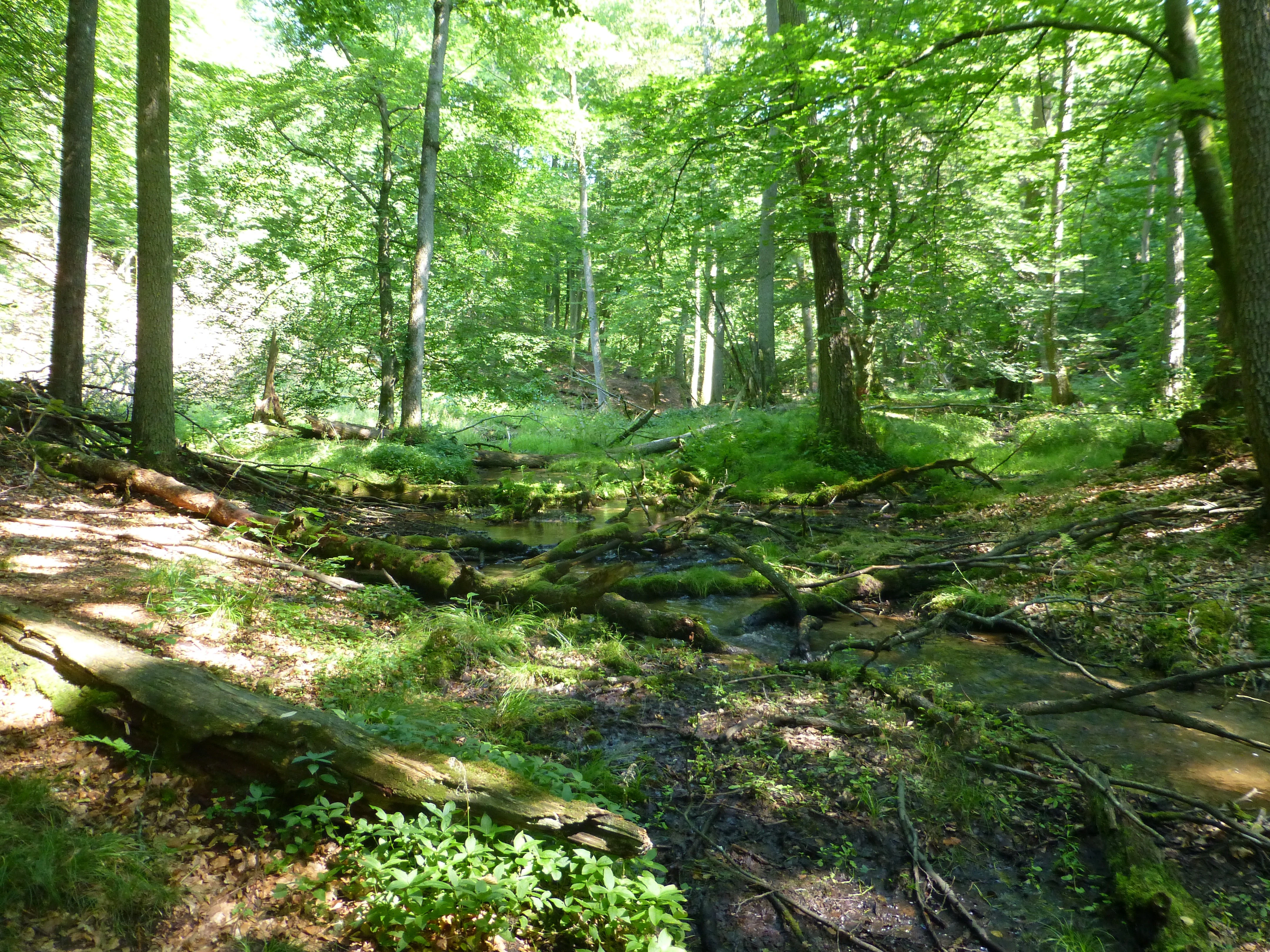
A small forest stream flowing through a dense, green deciduous forest with fallen logs and mossy ground.
A shaded stream winding through the lush forest interior of Diabli Skok Nature Reserve.

Diabli Skok Nature Reserve history and protected-area timeline

Diabli Skok was formally designated as a nature reserve on 21 October 1961, by order of the Minister of Forestry and the Wood Industry, and it was originally recorded as covering 11.62 hectares. From the start, the reserve was established to protect old-growth beech forest and the springs and bryophyte flora of the steep ravine, rather than as a general scenic reserve.

In 2001 the Governor of Greater Poland published a consolidated register of nature reserves created up to the end of 1998, which restated the legal existence of Diabli Skok. Two years later, in July 2003, a regulation by the Governor of Greater Poland significantly expanded the reserve and updated its boundary and protection objectives, with a further amendment in September 2003 refining these changes. The expansion enlarged the protected core to its current size and formalised the surrounding buffer zone of about 37.27 hectares. In February 2016 the Regional Director of Environmental Protection in Poznań issued a new order updating the reserve's legal framework to reflect modern ecological and management standards.

Across these changes, the underlying conservation rationale has remained consistent. The site has consistently been recognised not as a recreational forest but as a refuge for old-growth beech communities, montane-like bryophyte vegetation, and the springs that feed the Rurzyca River and the downstream lake chain. The history of the reserve is therefore one of progressively tighter legal protection of an increasingly understood ecological treasure.

Diabli Skok Nature Reserve landscape and geographic character

The landscape of the reserve is defined by a sharp contrast between a flat glacial plain and a dramatic, steep-sided gorge. The surrounding Równina Wałecka mesoregion is an area of low moraine hills, sandy outwash plains, and numerous lakes typical of the post-glacial Pomeranian lake district. Against this gently rolling backdrop, the reserve protects a much more rugged terrain feature: a deeply incised ravine, narrow and steep, where the slopes fall sharply from the plateau above down to the stream that runs through the bottom.

Within the ravine the land surface is irregular, with exposed slopes, slide areas, and accumulations of beech litter and moss-covered stones. The slopes themselves face in different directions, so light and moisture conditions change significantly across short distances. Numerous springs seep from the slope walls, sometimes forming small seepage channels before joining the main watercourse. The ravine opens near the shore of Lake Krąpsko Małe, giving the site an immediate hydrological as well as topographic connection to a larger lake.

Above and around the reserve, the plateau landscape is more typical of northern Poland: mixed forests, fields, and glacial landforms. A marked escarpment separates this plateau from the deeper ravine terrain, so the reserve reads in the landscape as an abrupt and locally unusual patch of sheltered forest, the kind of small-scale physiographic feature that gives the wider lake-region landscape much of its geomorphological interest.

Diabli Skok Nature Reserve ecosystems, habitats, and plant life

Ecologically, Diabli Skok belongs to the forest reserves category and specifically protects forest communities, with important subsidiary roles for spring and reed-marsh habitats along the lake edge. The official protection objective refers to preserving the complex of forest, reed, and spring ecosystems that have developed on the slopes of moraine hills and on the adjoining shore of Lake Krąpsko Małe.

The forest cover is dominated by beech, with a significant component of mixed broadleaf species. These communities are old enough that their internal structure resembles that of a natural woodland rather than a managed commercial forest: irregular age classes, abundant deadwood, and a shaded, humid interior. The combination of canopy continuity and cool microclimate has allowed a rich floor layer to develop, including mosses and liverworts that are typical of mountain forests rather than lowland Polish forests.

Spring and seepage habitats add a second ecological dimension. Cold, oxygen-rich spring water emerging along the slopes creates permanently moist, shaded conditions that sustain specialist bryophyte communities and a distinctive aquatic and wetland flora along the watercourse and near the lake outlet. Reed communities grow where the spring-fed water meets calmer lake margins. Altogether, the reserve compresses forest, spring, and wetland habitats into a small area, producing unusually high ecological diversity for its size.

Diabli Skok Nature Reserve wildlife and species highlights

The reserve's wildlife profile is shaped by its forest and spring habitat rather than by the open lake. Old-growth and old beech stands, plentiful deadwood, and consistent humidity support a rich invertebrate and fungus community. The reserve is known in particular for characteristic fungi of old beech woodland, including coral-like Hericium coralloides (soplówka bukowa) and porcelain fungus Oudemansiella mucida (monetka bukowa), along with other bracket and decomposer fungi that depend on long-established stands.

The cool, sheltered ravine also supports a wide range of mosses and liverworts, which are an essential part of the biological identity of the site. Spring vegetation in turn provides habitat for invertebrates specialised in cold, oxygen-rich water, and these invertebrates feed bats, birds, and other woodland predators that use the reserve. The lake-margin reed beds bordering the reserve provide additional nesting and feeding habitat for water birds, and the broader matrix of mature forest offers cover for typical woodland species of the lake district.

Vertebrate wildlife is not described in detail in the official record, but the structural diversity of the site suggests potential for forest birds, small mammals typical of beech forests, and bat species associated with old trees. The wildlife value of the reserve lies less in any single charismatic species than in the supporting role the habitat plays for the broader biodiversity of the Pojezierze Wałeckie region.

Diabli Skok Nature Reserve conservation status and protection priorities

Diabli Skok is a forest nature reserve, a strict category of Polish protected area focused on preserving plant communities and ecological processes rather than providing public access. The reserve's conservation objective combines scientific and educational aims: it was created and continues to be managed to preserve a complex of forest, reed-bed, and spring habitats developed on moraine slopes and on the adjoining shore of Lake Krąpsko Małe.

The site's conservation importance derives from its relict character. The combination of steep, shaded topography and abundant cold springs produces conditions under which mountain-like vegetation survives far north of its usual range. Protecting these relict populations of montane bryophytes and associated vascular plants is a key reason the ravine is shielded from logging and other direct human pressure. The surrounding buffer zone further insulates the core from external disturbance.

Regionally, the reserve forms one piece of a larger conservation network. It sits inside the Pojezierze Wałeckie and Gwda Valley Protected Landscape Area and borders the Wielkopolska Dolina Rurzycy reserve to the southeast, creating an extended corridor of forest, river, and lake habitat under protective status. This embedding in a wider protected-area network gives the small reserve a conservation relevance that exceeds its size, and reinforces the importance of its role in safeguarding the water sources and old-growth forest that sustain the broader landscape.

Diabli Skok Nature Reserve cultural meaning and human context

The name Diabli Skok translates roughly as 'Devil's Jump', a name typical of Polish folklore for dramatic natural features such as ravines, waterfalls, or deep gorges. Such names reflect a long local tradition of associating striking landforms with supernatural stories, and they signal that the ravine has been a recognised landscape feature for the surrounding rural communities for a long time before the formal establishment of the reserve.

The reserve lies within Gmina Jastrowie in Złotów County, an area with a mixed Polish and historically Kashubian cultural heritage, situated at the cultural and geographic boundary between Greater Poland and the historical Pomeranian region. Local land use around the reserve is shaped by forestry and agriculture typical of the lake district, with the ravine itself long treated as a distinctive local landmark.

Top sights and standout views in Diabli Skok Nature Reserve

Diabli Skok's standout qualities include the steep beech-clad ravine that gives the reserve its arched, gorge-like profile; the cool, humid microclimate within the gorge that supports mountain-type moss and liverwort communities rarely seen in the Polish lowlands; an abundance of springs that start the Rurzyca River and feed downstream lakes; the recorded presence of 285 plant species, including protected species such as mezereon, Polish honeysuckle, black currant, and common hepatica; old stands of beech and mixed broadleaf forest that function as a refuge for fungi and other woodland species; and the reserve's place within the Pojezierze Wałeckie and Gwda Valley Protected Landscape Area, adjoining the neighbouring Wielkopolska Dolina Rurzycy reserve.

Best time to visit Diabli Skok Nature Reserve

The reserve attracts primarily visitors interested in botany, bryology, and quiet woodland walking rather than seasonal scenery. Spring and early summer are particularly rewarding for viewing the flowering plants recorded in the reserve, including hepatica, lily of the valley, and associated ground flora. Late spring to early summer also offers warmer, drier conditions for walking the marked footpath that crosses the area, while still allowing observation of the deeply shaded, moist ravine habitat. Autumn brings fruiting fungi in the beech forest and a strong display of leaf colour along the ravine slopes. The reserve is small and ecologically sensitive, so any visit should be planned with a focus on observation from the marked footpath rather than off-trail exploration.
Monthly climate preview

Long term representative point measurements for annual temperature and precipitation cycles

Rezerwat przyrody Diabli Skok Climate Normals and Temperature Rhythms

Historical climatology records outline the measured annual temperature and precipitation rhythm across representative coordinates within Rezerwat przyrody Diabli Skok. Reviewing the complete monthly climate profile provides deeper context for long term averages without relying on live forecasts.
Annual mean8 °C
-3 °C19 °C
Jan-3°
Feb-1°
Mar
Apr
May13°
Jun16°
Jul19°
Aug19°
Sep14°
Oct
Nov
Dec-1°
Warmest month
July

18.8 °C

Coolest month
January

-2.6 °C

Wettest month
July

2.7 mm/day

Driest month
April

1.2 mm/day

Park location guide

Geography guide, regional context, and park location map for Diabli Skok Nature Reserve

Diabli Skok Nature Reserve park geography, regions, and map view in Poland

Understand where Diabli Skok Nature Reserve sits in Poland through a broader geographic reading of the surrounding landscape, nearby location context, and its mapped position within the national park landscape.

How Diabli Skok Nature Reserve fits into Poland

Poland, officially the Republic of Poland, is a Central European country spanning from the Baltic Sea in the north to the Carpathian Mountains in the south. It borders Germany, Czech Republic, Slovakia, Ukraine, Belarus, Lithuania, and Kaliningrad Oblast. The country has a temperate climate, diverse landscapes, and is known for its rich history, cultural heritage, and strong economic position within the EU.

Wider geography shaping Diabli Skok Nature Reserve in Poland

Poland occupies 312,696 km2 in Central Europe, extending from the Baltic Sea coast in the north to the Sudetes and Carpathian Mountains in the south. It borders Germany to the west, Czech Republic and Slovakia to the south, Ukraine and Belarus to the east, and Lithuania and Kaliningrad Oblast to the northeast. The landscape includes lowland plains, uplands, and mountain ranges.

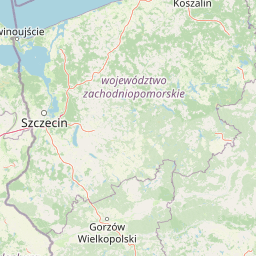
Map view of Diabli Skok Nature Reserve

Use this park location map to pinpoint Diabli Skok Nature Reserve in Poland, understand its exact geographic position, and read its mapped placement within the surrounding landscape more clearly.

Pigeon | © OpenStreetMap contributors

Location context for Diabli Skok Nature Reserve

Greater Poland Voivodeship

Examine the rugged terrain, steep beech forest ravines, and protected microhabitats of Rezerwat przyrody Diabli Skok through detailed field photography.

Visual Exploration of Rezerwat przyrody Diabli Skok: Photos, Scenery, and Landscapes

Photographic collections reveal the steep moraine gorge, old-growth beech stands, and humid microclimates that define Rezerwat przyrody Diabli Skok. Visual research clarifies the complex topography, rare mountain flora, and spring-fed headwaters shaping this protected lowland landscape.

A small forest stream flowing through a dense, green deciduous forest with fallen logs and mossy ground.

Park atlas

Compare nearby forest reserves, glacial moraine terrain, and regional park geography

Parks Near Rezerwat przyrody Diabli Skok and Surrounding Protected Landscapes

Continue exploring protected areas near Rezerwat przyrody Diabli Skok to discover adjacent forest reserves and related glacial terrain across the regional lake district. Comparing nearby natural habitats provides a broader understanding of northern lowland conservation networks and local ecological microclimates.
Nature reserveZachodniopomorskie
About 10 km away#1 closest

Southeast

Rezerwat przyrody Dolina Rurzycy: Mapped Geography and Protected Area Data

A glacial river valley reserve in the West Pomeranian landscape

Trace the ecological profile of Rezerwat przyrody Dolina Rurzycy. This entry provides map-based context for its deeply incised river valley, interconnected glacial lake chain, and rare calcareous spring communities within the Wałcz Forests region.

Area
5.547 km²
Established
2005
Relief
Upland
Climate
Temperate
A soft watercolor painting showing a wide expanse of heathland with rolling green hills, patches of low-lying vegetation, and distant pale mountains.
Nature reserveWest Pomeranian Voivodeship
About 13 km away#2 closest

North

Diabelskie Pustacie Nature Reserve: Mapping the Largest Inland Heathland in Poland

Glacial sandr plains and protected lowland habitat geography.

Located in the West Pomeranian Voivodeship, Diabelskie Pustacie Nature Reserve is defined by its wide open sandr plains and complex glacial relief. This protected site integrates dry heathlands and moist depressions within a unique post-military landscape, offering deep insights into the region's natural terrain and conservation status.

Area
9.325 km²
Established
2008
Relief
Upland
Climate
Temperate
Nature reserveZachodniopomorskie Voivodeship
About 32 km away#3 closest

Southwest

Rezerwat przyrody Mokradła koło Leśniczówki Łowiska: Protected Landscapes and Map Geography

A nature reserve located in the West Pomeranian Voivodeship

Located in the heart of the Wałeckie Lake District, this nature reserve is a concentration of transitional bogs and dystrophic lakes. The site remains a critical node in the Drawa River basin, serving as a protected landscape for rare bog mosses and peat forming processes framed by mature pine stands. Explore the mapped boundaries and natural terrain of this unique ecological refuge.

Area
1.018 km²
Established
2011
Relief
Lowland
Climate
Temperate
Nature reservePomeranian Voivodeship
About 32 km away#4 closest

Northeast

Rezerwat przyrody Dolina Gwdy: Exploring Protected River Meanders and Forested Geography

Nature reserve in Pomeranian Voivodeship

This nature reserve serves as a critical protected landscape, encompassing 425 hectares of riverine corridors along the Gwda and Czernica rivers. The area is defined by its pronounced meanders, floodplain terraces, and extensive alder swamp forests, providing a documented look at the natural terrain and hydrological evolution within the Pomeranian lake district of northern Poland.

Area
4.246 km²
Established
1998
Relief
Upland
Scope
Terrestrial
Nature reserveZachodniopomorskie
About 37 km away#5 closest

Southwest

Mszary Tuczyńskie Nature Reserve: Protected Peatland and Grassland Landscape in Poland

A rare habitat mosaic within the Zachodniopomorskie protected region

Mszary Tuczyńskie protects a highly varied mosaic of wetland, meadow, and xerothermic grassland habitats concentrated within a small area near Lake Tuczno. This nature reserve functions as a critical component of the regional conservation network, offering a concentrated look at spring fed calcareous peatlands and specialized orchid populations common to this specific lowland geography.

Area
0.072 km²
Established
1988
Relief
Lowland
Scope
Terrestrial
Watercolor painting of a tranquil lake scene with lush trees and foliage in shades of green and autumnal tones, set against a soft white background.
Nature reservePoland
About 38 km away#6 closest

Northwest

Jezioro Prosino Nature Reserve: Protected Wetland and Lake Landscape in Poland

Ecological mapping of the Drawsko Lake District

Jezioro Prosino Nature Reserve is a targeted faunistic sanctuary in the West Pomeranian Voivodeship of Poland. This protected landscape focuses on the conservation of waterbird breeding sites and delicate lakeshore vegetation zones. By integrating with the Natura 2000 network and the surrounding Drawsko Landscape Park, the reserve serves as a prime example of postglacial ecosystem management and aquatic habitat preservation.

Area
0.86 km²
Established
1988
Relief
Lowland
Climate
Temperate
Nature reserveGreater Poland Voivodeship
About 39 km away#7 closest

East

Uroczyska Kujańskie Nature Reserve: A Geographic Overview of the Krajeńskie Lakeland

Mapped protected landscapes, glacial lakes, and old-growth oak forests.

Uroczyska Kujańskie provides a rare study in post-glacial landscape architecture. Situated in the Greater Poland Voivodeship, this site links dystrophic lakes, travertine-forming spring fens, and extensive acid oak forests. Use our atlas data to understand the complex ecological boundaries and hydrological features that define this protected Natura 2000 habitat.

Area
10.182 km²
Relief
Lowland
Scope
Terrestrial
Water
Major water bodies
Watercolor painting depicting a river flowing through a forested landscape with hills in the background
National parkWest Pomeranian Voivodeship
About 40 km away#8 closest

West

Drawa National Park: Protected Landscape and River Geography in West Pomeranian Voivodeship

Explore Poland's unique lowland river and ancient forest protected area.

Drawa National Park stands as a vital protected area within West Pomeranian Voivodeship, Poland, celebrated for its exceptional natural geography. The park's core feature is the Drawa River, which carves a distinctive path with fast-flowing currents and deep valleys, presenting a landscape more akin to mountain streams than typical lowland waterways. This area protects one of Poland's most valuable lowland river corridors, featuring ancient beech and oak forests, the rare meromictic Lake Czarne, and diverse wetland habitats. MoriAtlas facilitates structured exploration of Drawa National Park's mapped terrain and protected landscape identity.

Area
115.36 km²
Established
1990
IUCN
II
Visitors
27K annual

Common questions about visiting, size, designation, and location context for Diabli Skok Nature Reserve

Diabli Skok Nature Reserve FAQs for park facts, access, geography, and protected area context

Find quick answers about Diabli Skok Nature Reserve, including protected-area facts, park geography, trail and visitor context, and how the park fits into its surrounding country and regional landscape.
MoriAtlas Explorer

Continue Your Protected Areas Search Across the Global Atlas

Deepen your exploration by continuing the structured search for national parks and protected areas worldwide. Utilize the comprehensive filtering capabilities to compare different conservation landscapes and refine your understanding of global park geography. Discover more about the distribution and characteristics of protected natural areas.

Global natural geography