
Why Duszniczki Nature Reserve stands out
Duszniczki is best known for its small but ecologically important stand of Polish larch (Larix polonica) growing within an oak, hornbeam forest, an unusual combination in the Wielkopolska lowlands and the primary reason the site was designated as a nature reserve.
Duszniczki Nature Reserve history and protected-area timeline
Duszniczki Nature Reserve was established in 1958 through an order of the Minister of Forestry and the Wood Industry, published in the Polish official gazette Monitor Polski (1958, No. 62, item 353). The order created the reserve to protect a forest fragment containing Polish larch within an oak–hornbeam matrix in the forests near Duszniki, in what is today Szamotuły County.
In the 1970s, the reserve's larch population was documented as comprising around fifteen mature trees, estimated to be roughly 120 years old and reaching heights of about 32 meters. These figures gave the small site a particular botanical interest, since Polish larch is a tree with a restricted distribution and the Duszniczki stand represented one of the northern or lowland occurrences worth documenting.
In 2001, the Voivode of Wielkopolska issued an official announcement consolidating the list of nature reserves created up to the end of 1998, including Duszniczki among the recognized protected sites of the region. This was followed by a 2010 order of the Regional Director of Environmental Protection in Poznań, which formally restated and adjusted the framework for the reserve; minor corrections to that document were published later the same year by the Voivode.
Throughout these changes, the reserve has remained a small, stable conservation unit focused on its larch-bearing forest fragment, with administratively modest surface area but consistent inclusion in regional lists of protected natural areas.
Duszniczki Nature Reserve landscape and geographic character
The landscape of Duszniczki Nature Reserve is that of the central Wielkopolska lowlands: gently undulating terrain shaped by glacial and post-glacial processes rather than dramatic relief. The reserve itself is flat to very gently rolling, and its character is defined above all by the forest that covers it.
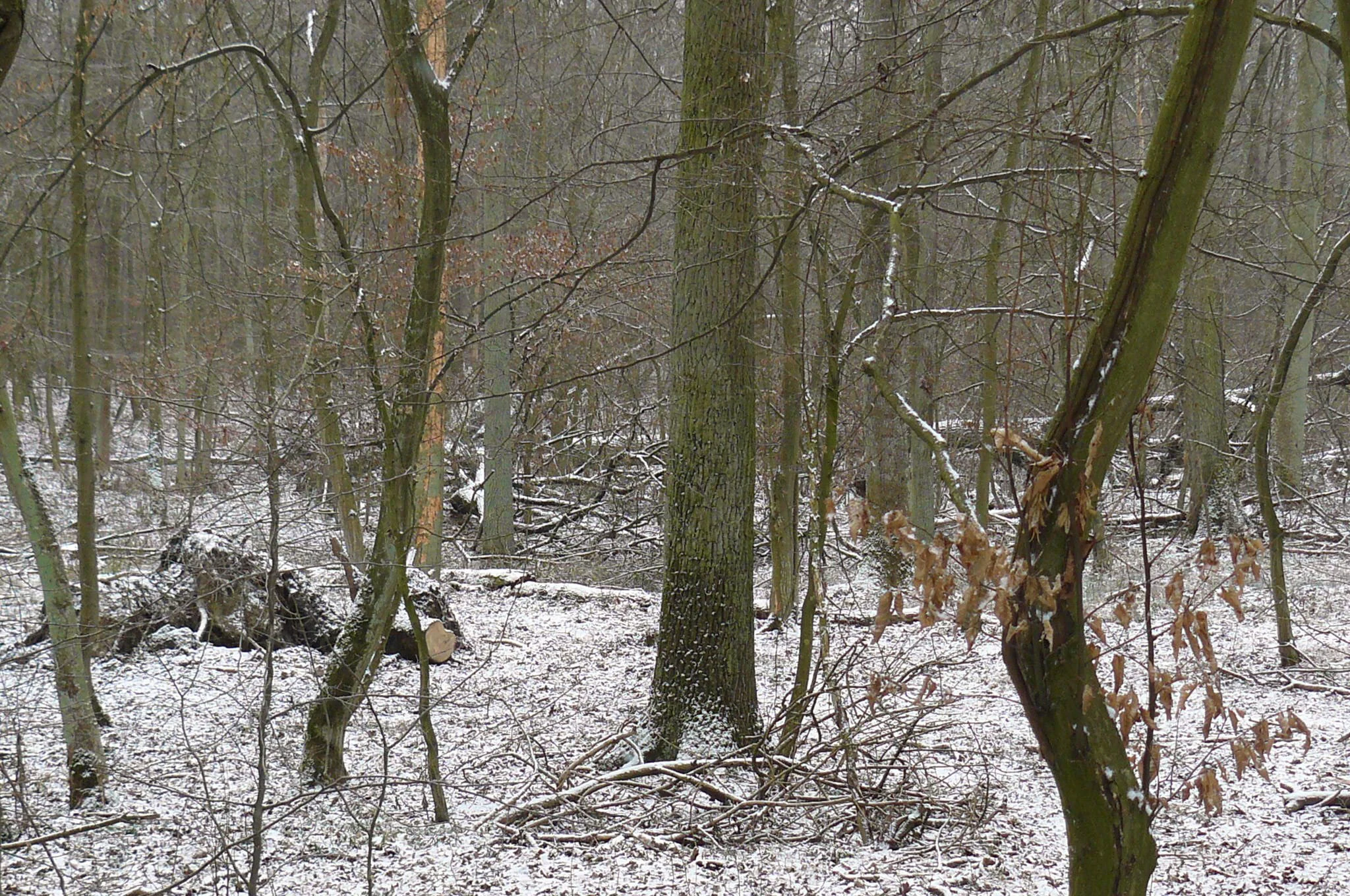
The protective tree layer is dominated by oak and hornbeam, creating a closed deciduous canopy typical of fertile lowland sites in central Europe. Within this canopy, the emergent individuals of Polish larch rise above the surrounding broadleaf trees, their deciduous needles and lighter crown structure contrasting with the otherwise uniform oak–hornbeam cover. The result is a localized but visually distinct forest mosaic in which tall conifers punctuate an otherwise broadleaf woodland.
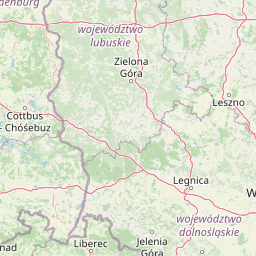
Beyond the forest interior, the reserve is bordered by managed forest stands that belong to the larger forest complex of which Duszniczki is a part. The wider regional landscape includes the agricultural plains and forested belts typical of the Szamotuły area, with small villages, forestry infrastructure, and a network of forest roads. An educational trail laid out from a nearby forester's lodge allows visitors to move from the open cultivated landscape into the denser woodland setting that the reserve protects.
Duszniczki Nature Reserve ecosystems, habitats, and plant life
Ecologically, Duszniczki is a representative example of a lowland oak–hornbeam forest community, one of the classic vegetation types of central European broadleaf woodlands. Such forests are characterized by a multi-layered structure, with oaks dominating the upper canopy, hornbeam filling the middle layer, and a rich shrub and herb layer on the forest floor during the growing season.
The defining ecological feature of Duszniczki is the presence of Polish larch among these broadleaf species. Larix polonica is a larch subspecies closely tied to Polish forests, valued both for its restricted natural range and for the genetic diversity it preserves. Its inclusion in an otherwise predominantly broadleaf setting creates a mixed community that differs from typical oak–hornbeam stands and contributes to the variety of the regional forest flora.
The reserve's very small size means it functions primarily as a refuge for the specific plant community it protects rather than as a self-contained ecosystem. Its ecological value depends on its connection to the surrounding forest complex, with which it shares species, ecological processes, and management context. This territorial relationship underscores why small forest fragments like Duszniczki are typically designated as reserves within larger forested landscapes rather than as isolated sites.
Duszniczki Nature Reserve wildlife and species highlights
Because the reserve covers only 0.77 hectares, it supports no large mammal populations of its own, but the forest fragment is integrated into the woodland fauna of the surrounding area. The oak–hornbeam–larch matrix provides nesting sites, shelters, and foraging opportunities for typical lowland forest birds, including common woodland passerines associated with mature mixed and broadleaf forests.
The forest floor and leaf litter of such oak–hornbeam stands normally support a rich invertebrate community, and the larch trees add a particular structural element that benefits certain insect and fungal groups associated with coniferous hosts. Small mammals typical of lowland Polish forests, such as rodents and shrews, can use the reserve as part of their wider territory, and the larger predator community of the forest complex would range across it without recognizing the reserve boundary.
Ecological documentation of Duszniczki has focused much more on its botanical profile, particularly the larch population, than on its fauna, and the wildlife value of the site is best understood as a contribution to the broader mosaic of forest habitats in the Szamotuły area rather than as an exceptional faunal site in its own right.
Duszniczki Nature Reserve conservation status and protection priorities
The conservation value of Duszniczki lies in the protection of a specific forest community type and, especially, in the safeguarding of the Polish larch trees that grow within it. Larix polonica has a limited natural distribution, and small outlying populations such as the one at Duszniczki are considered important for the long-term conservation of the taxon as a whole, providing genetic variation and representing additional sites beyond the main upland centers of the subspecies.
The reserve also contributes to the conservation of lowland oak–hornbeam forest, a vegetation type that has been substantially altered across central Europe by historical logging, land-use change, and shifts in forest management. Protecting a small but characteristic fragment helps preserve reference stands against which the condition of surrounding managed forests can be evaluated.
Because of its modest surface area, Duszniczki is best understood as a fine-scale conservation unit. It sits within a network of nearby reserves, including Brzęki przy Starej Gajówce, Bytyńskie Brzęki, and Huby Grzebieniskie, and together these small sites form a regional set of forest refuges connected by forest paths and hiking trails. The reserve's formal status under successive ministerial and regional orders, from 1958 to the 2010 restatement of its protection framework, reinforces its role as a legally recognized element of Poland's nature conservation system.
Top sights and standout views in Duszniczki Nature Reserve
The principal highlight of Duszniczki Nature Reserve is its small but well-documented population of Polish larch, an uncommon tree that gives the reserve its botanical identity. The site also exemplifies the classic central European oak–hornbeam forest at a compact, easily interpretable scale.
Its location within a broader Wielkopolska forest complex, its accessibility via the green Bytyń–Duszniki hiking trail, and the presence of an educational trail starting from a nearby forester's lodge all make it a useful site for learning about lowland forest diversity. The reserve is a clear example of how very small protected areas can hold disproportionate conservation value when they shelter elements of regional biodiversity that are otherwise rare.