
Why El Sira Communal Reserve stands out
El Sira Communal Reserve is best known for protecting an exceptionally biodiverse transitional zone where the Andes meet the Amazon basin, ranging from lowland tropical forest to highland rainforest across a vertical span of more than two kilometers. The Sira Mountains harbor endemic birdlife such as the Sira tanager and Sira curassow, as well as large Amazonian mammals including jaguar, South American tapir, puma, spectacled bear, and brown woolly monkey. The reserve is equally recognized for safeguarding the headwaters of the Pachitea River and major tributaries of the Ucayali and Pichis rivers, anchoring a watershed that feeds the broader Ucayali River system. The combination of indigenous-led conservation, recognized through both its communal reserve designation and inclusion in a UNESCO Biosphere Reserve, also gives the protected area a distinctive cultural and institutional character.
El Sira Communal Reserve history and protected-area timeline
El Sira Communal Reserve was formally established on June 22, 2001, as a Peruvian protected area under the country's national system of natural protected areas. Its creation reflected a growing recognition that the Sira Mountains of the Eastern Andean foothills held extraordinary ecological value, particularly as a buffer zone between the Andes and the Amazon basin, and as the source region for major tributaries of the Ucayali and Pachitea river systems.
Beyond ecological motivations, the reserve was established to acknowledge and protect the ancestral and sustainable use of natural resources by the indigenous peoples living in and around the Sira Mountains. Its designation as a communal reserve, rather than a strictly protected national park, embedded this cultural and land-use dimension directly into its institutional identity. The reserve is administered by SERNANP, Peru's Servicio Nacional de Áreas Naturales Protegidas por el Estado.
A significant milestone in the reserve's history came in 2010, when UNESCO included El Sira Communal Reserve as part of the Oxapampa-Asháninka-Yánesha Biosphere Reserve. This recognition linked the reserve with neighboring protected landscapes of related cultural and ecological importance, situating El Sira within an internationally recognized framework for combining biodiversity conservation with sustainable human presence in the landscape.
El Sira Communal Reserve landscape and geographic character
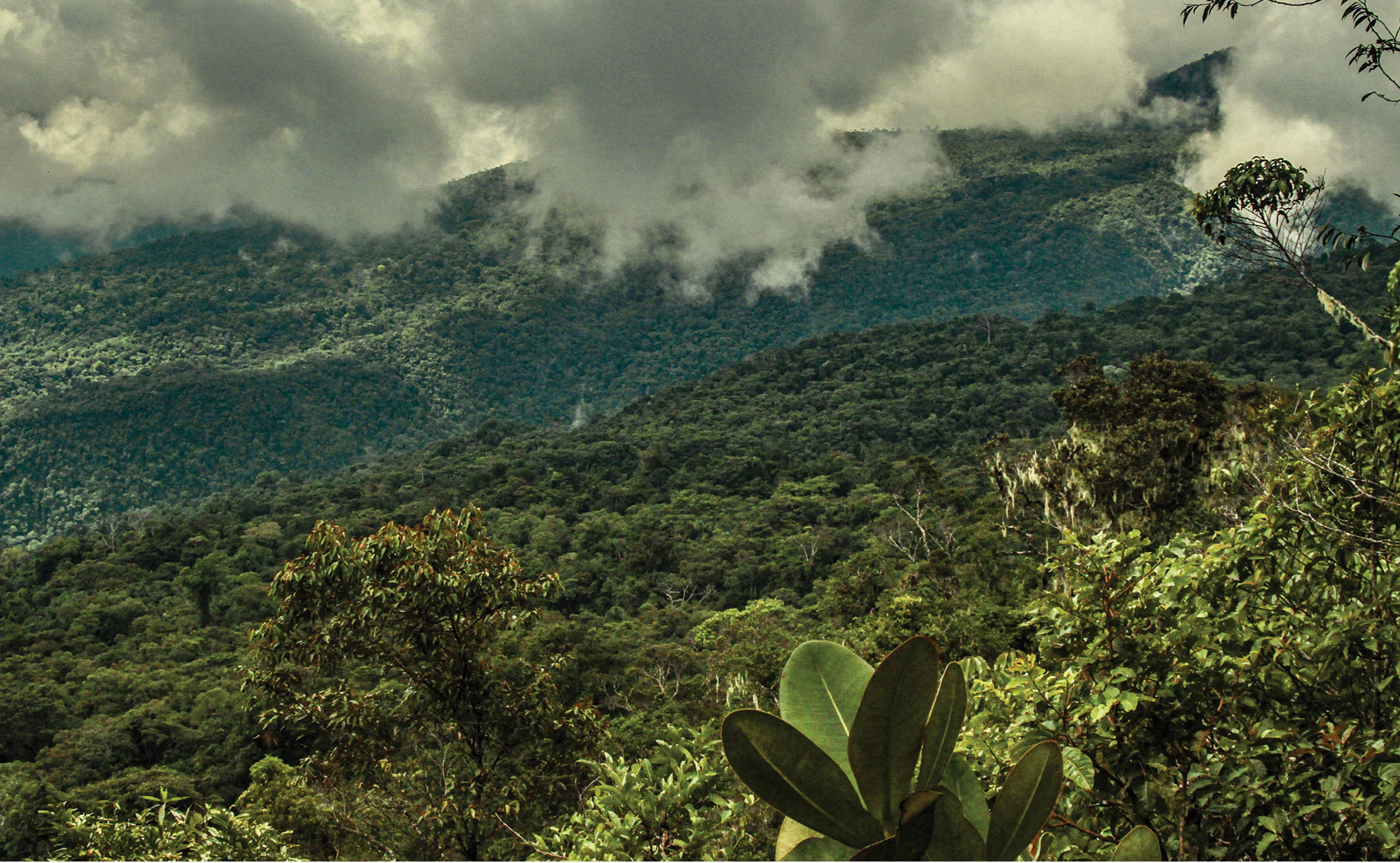
The landscape of El Sira Communal Reserve is defined by the Sira Mountain range, a sub-Andean cordillera forming part of the Eastern Andes of Peru. The terrain descends westward from the highlands toward the Amazon basin, producing a dramatic altitudinal gradient from approximately 130 meters up to about 2,250 meters above sea level. This range encompasses pre-montane forest, montane forest, and lowland tropical forest, all integrated into a single protected mosaic within the reserve's borders.
The reserve's western flank receives significant cloud condensation, while the eastern side drains more directly toward the Ucayali basin and experiences slightly different climatic conditions. In the southern reaches of the reserve lies the landscape known as Gran Pajonal, an area of somewhat cooler and less humid terrain that contrasts with the hotter lowland forests found elsewhere.
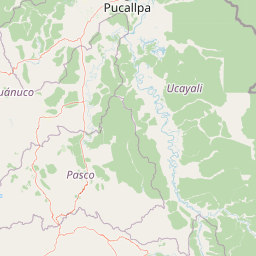
Rivers shape the character of the landscape as much as the mountains do. The Ucayali River hugs the eastern edge of the Sira range along a south-to-north course, forming meanders and abandoned oxbow lakes known locally as tipishcas. The Pachitea River traces the western side of the northern sector, while the Pichis River, joining with the Palcazu, defines the center-west portion of the reserve. Together, these watercourses give the protected area a deeply dissected geography of ridges, valleys, river terraces, and forested lowlands.
El Sira Communal Reserve ecosystems, habitats, and plant life
Ecologically, El Sira Communal Reserve occupies a transitional position between the Andes and the Amazon, and this position is reflected in the diversity of its vegetation. The dominant ecosystem types are tropical lowland forest and highland rainforest, distributed across a vertical gradient that spans roughly 2,000 meters of elevation. This layering of habitats supports more than 500 recorded tree species, including Sapium glandulosum, Bunchosia armeniaca, Iriartea deltoidea, Weinmannia species, Manilkara bidentata, Pourouma cecropiifolia, various Ilex species, Theobroma cacao, Nectandra species, Ceiba pentandra, Pouteria caimito, Brosimum alicastrum, and multiple Inga species.
The altitudinal variation creates distinct vegetation bands. Lower elevations below roughly 1,000 meters feature warm, wet rainforest consistent with the western Amazon. Higher zones above 1,000 meters shift toward semi-humid to very humid forest with cooler conditions, including the more temperate landscape of the southern Gran Pajonal region. This combination of lowland and montane forest types within a single protected area allows species from both biomes to overlap and supports a high degree of plant endemism.
The reserve's vegetation contributes directly to its hydrological function. Forested watersheds slow runoff, sustain base flow in rivers, and stabilize soils along steep Andean slopes, reinforcing the ecological link between forest cover and the downstream river systems of the Pachitea, Pichis, and Ucayali.
El Sira Communal Reserve wildlife and species highlights
The diverse habitats of El Sira Communal Reserve support an unusually rich fauna shaped by the convergence of Andean and Amazonian environments. Mammals documented in the reserve include large charismatic species such as the jaguar, puma, South American tapir, and spectacled bear, along with brown woolly monkey, brown-mantled tamarin, southern two-toed sloth, nine-banded armadillo, pacarana, lowland paca, Brazilian cottontail, Bolivian squirrel, collared peccary, red brocket, giant otter, and capybara.
Birdlife is particularly notable and includes species with restricted ranges in the Sira Mountains. Among the birds documented are the red-and-green macaw, Andean cock-of-the-rock, sickle-winged guan, southern mealy amazon, fiery-throated fruiteater, scarlet-breasted fruiteater, Peruvian tyrannulet, violet-fronted brilliant, black-streaked puffbird, Koepcke's hermit, and the endemic Sira tanager and Sira curassow, which are of particular scientific interest because of their limited distribution.
The reserve's herpetofauna and freshwater fauna are also significant. Roughly 105 reptile species have been recorded, spanning worm lizards, saurians, and especially snakes, while about 68 amphibian species, dominated by toads and frogs in the families Hylidae and Leptodactylidae, are documented. The aquatic systems of the reserve and its rivers sustain approximately 111 species of bony fish, with the order Characiformes being the most diverse component of this freshwater community.
El Sira Communal Reserve conservation status and protection priorities
Conservation significance at El Sira Communal Reserve operates at multiple levels. At a regional scale, the reserve protects a sizeable portion of the sub-Andean Amazon transition zone that would otherwise be vulnerable to logging, agricultural expansion, and resource extraction pressures. Its altitudinal and habitat diversity provides a refuge for species of both lowland and montane forest, including endemics tied specifically to the Sira range.
Watershed protection is a defining element of the reserve's conservation value. By encompassing the headwaters and middle tributaries of the Pachitea, Pichis, and Ucayali river systems, El Sira contributes directly to maintaining downstream water quality, sediment regulation, and seasonal flow regimes in rivers that supply communities across central Peruvian Amazonia. The forested watersheds within the reserve also buffer against erosion and help stabilize river courses, including the meandering Ucayali and Pachitea channels.
The reserve's international profile was strengthened in 2010 through its inclusion in the UNESCO-recognized Oxapampa-Asháninka-Yánesha Biosphere Reserve. This designation affirmed the site's dual value as a biodiversity stronghold and as a landscape where traditional indigenous land use continues to coexist with conservation objectives. As an IUCN Category VI protected area, El Sira combines biodiversity protection with the regulated sustainable use of natural resources, reinforcing its conservation role as a place where ecological and cultural sustainability are pursued together.
El Sira Communal Reserve cultural meaning and human context
El Sira Communal Reserve was created explicitly to recognize and protect the ancestral and sustainable use of natural resources by indigenous peoples living in and around the Sira Mountains. Its communal reserve designation reflects a conservation approach that treats indigenous presence as a foundational component of the landscape rather than as a competing pressure on it. The reserve sits alongside related indigenous-territory protected areas in the region, such as the Asháninka Communal Reserve and the Yanesha Communal Reservation, and together these areas form a network of indigenous-rooted conservation landscapes.
The reserve's inclusion in the Oxapampa-Asháninka-Yánesha Biosphere Reserve in 2010 further embedded this cultural dimension into an internationally recognized framework. The rivers that cross and border the reserve, including the Ucayali, Pachitea, and Pichis, historically function as the principal communication channels for communities throughout the region, linking settlements such as Puerto Bermúdez, Pucallpa, and Atalaya. The cultural identity of the area is therefore tightly connected to river access and to a forest landscape that sustains traditional livelihoods and resource practices.
Top sights and standout views in El Sira Communal Reserve
El Sira Communal Reserve's defining qualities include its position as one of Peru's largest communal reserves, stretching across more than 600,000 hectares of Andean-Amazon transitional forest. It protects the Sira Mountains, a range notable for hosting both Amazonian lowland species and Andean foothill species within a single contiguous landscape, and for harboring range-restricted birds such as the Sira tanager and Sira curassow.
Equally important are the reserve's hydrological role, encompassing the upper basins of the Pachitea, Pichis, and Ucayali rivers, and its recognition as part of the UNESCO Oxapampa-Asháninka-Yánesha Biosphere Reserve. The combination of high biodiversity, indigenous-led conservation governance, and large-scale watershed protection gives El Sira a distinctive profile within Peru's protected-area system.
Best time to visit El Sira Communal Reserve
The climate of El Sira Communal Reserve is warm and humid overall, with average annual temperatures near 25.5 degrees Celsius. Seasonal variation is modest in temperature but more pronounced in rainfall, with the first and last trimesters of the year bringing the highest precipitation and the second and third trimesters corresponding to the drier period, when monthly rainfall may drop to around 100 millimeters in some localities. Rainfall totals also differ across the reserve, with the western flank receiving notably more precipitation than parts of the eastern Ucayali basin.
For visitors and researchers, periods with reduced rainfall can offer more accessible river and trail conditions, while wetter months intensify the rainforest character of the landscape and the activity of its rivers. The highland areas, including the southern Gran Pajonal region, are noticeably cooler than the lowlands. Given the reserve's remote character and ecological focus, any visit should be understood in the context of seasonal river navigability, forest conditions, and the broader logistics of accessing such an expansive and rugged protected area.