Why Forrester Island Wilderness stands out
Forrester Island Wilderness is best known as a breeding and hauling ground for Steller sea lions, whose seasonal rookeries along the island's rocky shoreline are among the most biologically significant features of the wilderness. The island's steep forested slopes, exposed Pacific coastline, and isolation create the kind of undisturbed marine mammal habitat that has drawn sustained scientific and conservation interest. Equally important to the wilderness's identity is its place within the Alaska Maritime National Wildlife Refuge, one of the most extensive marine protected-area networks in North America. This positioning has shaped its management and reinforced its role as a refuge for seabirds, marine mammals, and coastal ecosystems in a region otherwise affected by industrial activity and changing ocean conditions.
Forrester Island Wilderness history and protected-area timeline
Forrester Island carries a layered history of exploration-era naming, long predating its modern protected status. In 1774, Spanish explorer Juan Pérez recorded the island as Santa Cristina, and in 1775 Francisco Antonio Maurelle labeled it San Carlos. The British sea captain William Douglas named it Douglas Island in 1778, before Royal Navy officer George Dixon gave it the name Forrester Island in 1787, a designation adopted by George Vancouver's 1793 expedition and the one that has endured.
The first formal step toward protection came in 1912, when U.S. President William Howard Taft signed a law establishing the Forrester Island Refuge. The original refuge included Forrester Island, Lowrie Island, and Wolf Rock, recognizing even at that early date the importance of the area's seabird colonies and marine mammal populations.
In 1970, the surrounding waters and terrestrial area were designated the Forrester Island Wilderness, adding the site to the National Wilderness Preservation System. This designation aligned with the broader American movement to secure exemplary wild landscapes under permanent legal protection and incorporated the island into the framework that would later be reinforced through the Alaska Maritime National Wildlife Refuge.
Forrester Island Wilderness landscape and geographic character
Forrester Island is a compact, elongated island dominated by steep terrain and dense coastal vegetation. It rises to roughly 814 feet at its highest point, producing a mountainous profile that falls sharply toward the Pacific on nearly every side. The shoreline consists largely of rugged, exposed rock, with cliffs and rocky benches that are central to the island's character and to its ecological role as marine mammal habitat.
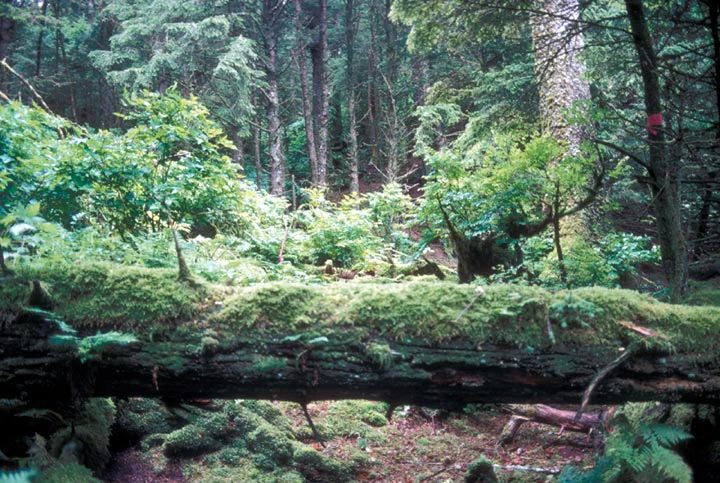
Vegetation across the island is dominated by temperate coastal forest typical of the Alaska Panhandle, with a continuous canopy broken only by cliffs, rocky outcrops, and active sea lion haul-outs. The combination of forested ridge tops, sheer coastal slopes, and wave-beaten shorelines creates a landscape where the boundary between land and sea is unusually sharp and visually prominent.
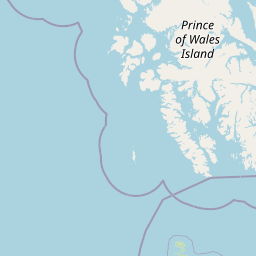
Surrounding the island is open North Pacific water, with no sheltering mainland nearby. This oceanic exposure shapes the wilderness's atmosphere, weather patterns, and overall sense of remoteness, contributing to the strong feeling of isolation that defines the site.
Forrester Island Wilderness ecosystems, habitats, and plant life
The ecological character of Forrester Island Wilderness is shaped by the meeting of temperate coastal forest and the open Gulf of Alaska. The island's vegetation reflects the wet, maritime climate of the southern Alaska Panhandle, with coniferous forest cover that extends down to the upper shoreline in many places.
The near-shore environment is equally important to the wilderness's natural profile, supporting kelp and intertidal communities typical of the Pacific Northwest. These habitats in turn support a broader food web that sustains seabirds and marine mammals, anchoring the island's identity as an ecological transition zone between terrestrial forest and North Pacific marine ecosystems.
Because the area has been protected for over a century, its ecological processes remain relatively undisturbed. The wilderness functions as a refuge not only for its most famous residents, the Steller sea lions, but also for seabird colonies and other species dependent on undisturbed coastal habitat.
Forrester Island Wilderness wildlife and species highlights
Forrester Island Wilderness is primarily known for its Steller sea lion rookeries, which occupy the island's rocky shoreline and represent one of the more significant concentrations of this species in the region. The presence of these rookeries has defined the island's conservation history and remains the single most important wildlife feature of the wilderness.
Scientific observations from the island include remarkable records of animal movement, including the longest recorded Steller sea lion migration, a roughly 1,600-mile journey from Forrester Island to Cape Newenham in Bristol Bay. Such records underscore both the productivity of the island's habitat and its role within a much larger regional marine mammal population.
Beyond sea lions, the surrounding waters and the island itself host seabirds and other marine wildlife typical of the Alaska Maritime National Wildlife Refuge. The wilderness's protected status and isolation contribute to its continuing importance for these species, particularly those sensitive to disturbance on breeding and haul-out sites.
Forrester Island Wilderness conservation status and protection priorities
Forrester Island Wilderness has been protected for well over a century, beginning with the establishment of the Forrester Island Refuge in 1912 under President William Howard Taft. That early refuge designation recognized the island's importance as habitat for marine mammals and seabirds long before the modern wilderness system existed.
The 1970 designation as a congressionally recognized wilderness added stronger legal protection and aligned the island with national wilderness standards emphasizing ecological integrity, natural conditions, and limits on development. As part of the Alaska Maritime National Wildlife Refuge, Forrester Island Wilderness now sits within one of the largest and most ecologically significant marine protected-area networks in North America.
From a conservation perspective, the wilderness's principal value lies in its ability to support undisturbed marine mammal habitat in a coastal region otherwise subject to varied human pressures. Steller sea lions, in particular, have faced population challenges elsewhere in their range, making protected breeding and haul-out sites like those on Forrester Island critical for long-term population resilience.
Forrester Island Wilderness cultural meaning and human context
Forrester Island has a documented Haida name, Gasḵúu, reflecting the broader cultural history of the Alaska Panhandle and the southern Panhandle region as part of longstanding indigenous homelands and travel corridors along the Pacific coast. While direct evidence of continuous habitation is limited compared to larger mainland areas, the persistence of indigenous names for places as remote as Forrester Island underscores the depth of regional knowledge and movement along this coast prior to European contact.
European exploration layers further enrich the island's cultural history. Spanish, British, and American voyages contributed a succession of names, including Santa Cristina and San Carlos in the Spanish era, Douglas Island under British maritime exploration, and finally Forrester Island, the name that survived and was eventually entrenched through George Vancouver's 1793 expedition. These overlapping naming histories make the island a small but layered example of competing imperial-era mapping traditions in the North Pacific.
Top sights and standout views in Forrester Island Wilderness
Forrester Island Wilderness stands out for the rare combination of small geographic footprint and outsized ecological importance. Its Steller sea lion rookeries are the centerpiece of its identity, supported by rocky shorelines that have been protected from disturbance for more than a century.
The island's mountainous, forested interior, its position within the Gulf of Alaska, and its integration into the Alaska Maritime National Wildlife Refuge all reinforce its value as a self-contained wilderness unit. Few wilderness areas of comparable size combine such immediate exposure to the open ocean, such dense coastal forest, and such sustained federal protection.
Best time to visit Forrester Island Wilderness
Conditions around Forrester Island are strongly shaped by the marine climate of the Gulf of Alaska, with calmest conditions typically occurring in the late spring and summer months when daylight is longest and seas are generally more workable. These seasons also correspond with peak activity at the sea lion rookeries, when seasonal wildlife presence is at its most visible.
Autumn and winter bring rougher seas, reduced daylight, and harsher weather, making the surrounding area far less conducive to visits. Any meaningful engagement with the island is generally best considered within the broader late spring through early fall window, when weather windows and biological activity coincide.