
Why Garden Mountain Wilderness stands out
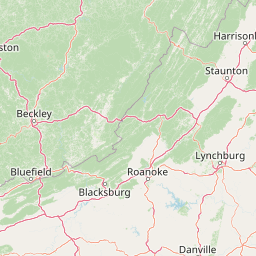
Garden Mountain Wilderness is best known for its position along a long Appalachian ridge that carries a section of the Appalachian Trail through one of the larger remaining stands of old-growth forest in Virginia. The crest overlooks Burkes Garden, an enclosed valley shaped by the erosion of an ancient geological dome, giving the area a distinct sense of isolated Appalachian landscape. It is also recognized for harboring a rare pure stand of table mountain pine, an unusual fire-dependent tree found on Appalachian ridgetops, as well as lower elevation habitat for the endangered Tennessee dace in the beaver ponds and swamps of Lick Creek.
Garden Mountain Wilderness history and protected-area timeline
Garden Mountain Wilderness is a comparatively new designation in the long history of Appalachian land use. Much of its existing forest originated after widespread logging and burning in the late nineteenth and early twentieth centuries, and many of today's trees are under 100 years old. Despite this disturbance history, the area retained roughly 840 acres of possible old-growth trees, representing one of the more significant old-growth remnants in the region.
The modern wilderness designation came in 2009, when Garden Mountain was designated as wilderness through the Omnibus Public Land Management Act of 2009. This act, supported by conservation organizations concerned with protecting remaining mature forest in the southern Appalachians, added Garden Mountain, Beartown, and Hunting Camp Creek to the National Wilderness Preservation System in a coordinated effort that included surrounding areas in what is now known as the Garden Mountain Cluster.
Following designation, the U.S. Forest Service took over stewardship of the area through the Eastern Divide Ranger District of the George Washington and Jefferson National Forests. Management focuses on limiting motorized access, regulating group size, and restricting camping in order to keep the wilderness as undisturbed as possible, even as older logging roads in the area continue to be degraded by illegal off-road vehicle traffic along the western end of the property.
Garden Mountain Wilderness landscape and geographic character
Garden Mountain Wilderness is defined by long Appalachian ridges and the deeply cut valley of Lick Creek. The area lies within the Ridge and Valley Section of the central Appalachians, where parallel ridges and narrow valleys trend in a northeast-southwest direction. Sandstone and shale dominate the underlying geology, and the topography forms two contrasting slope types: the upper slopes of Garden Mountain have broad, shallow drainage patterns, while the lower slopes are steeper, deeper, and more confined.
The crest of Garden Mountain is the wilderness's high point at roughly 4,080 feet, while the lowest elevations along Lick Creek near the eastern boundary drop to around 2,500 feet. From the ridgetop, occasional gaps in the trees open onto expansive views of Burke's Garden, a large, enclosed valley created when the eroded core of an ancient geological dome collapsed to leave behind a ring of mountains. Garden Mountain was part of that original dome, and its position encircling the valley gives the wilderness a sense of encircling, ridge-bound terrain typical of the southern Appalachian highlands.
Garden Mountain Wilderness ecosystems, habitats, and plant life
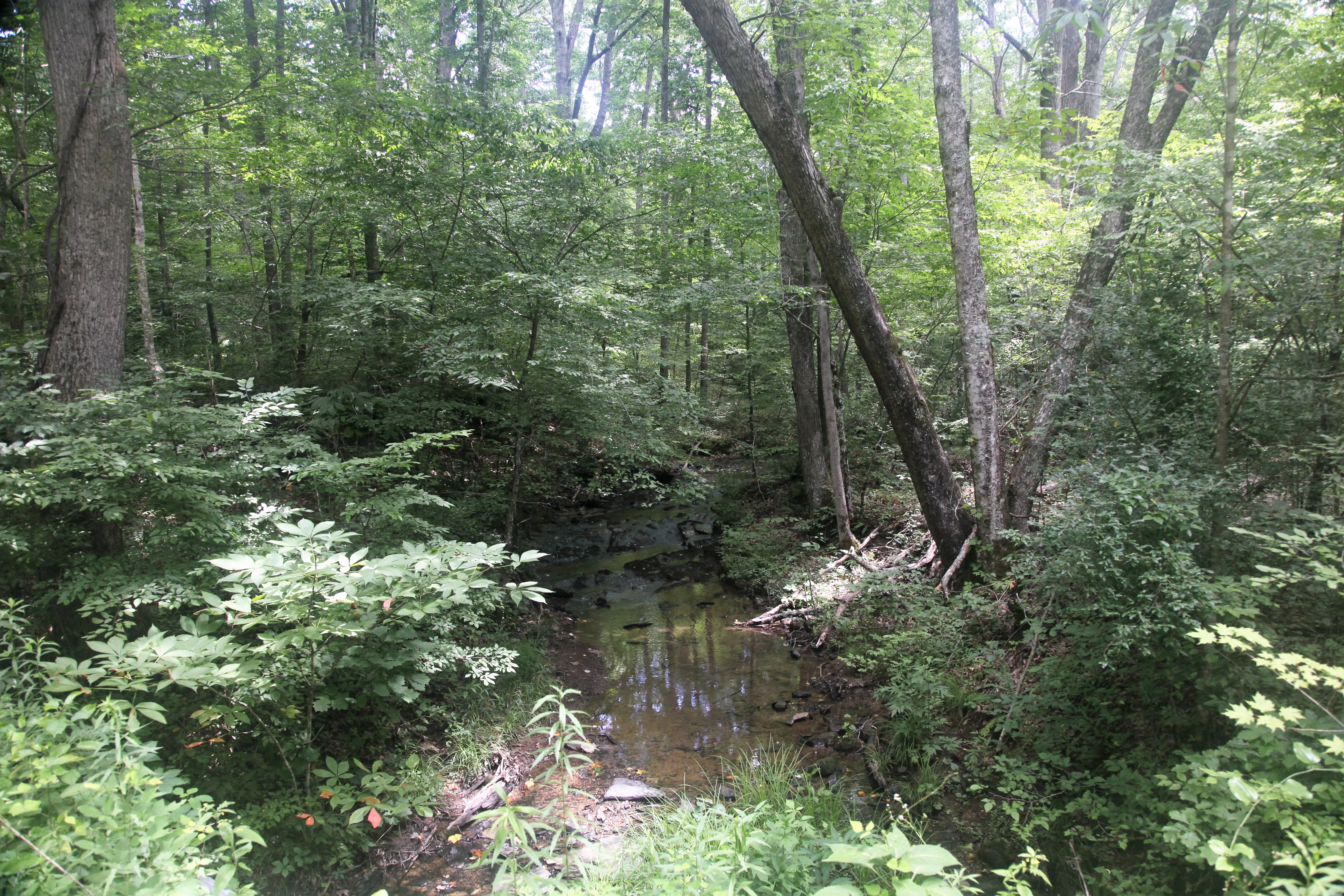
The ecological character of Garden Mountain Wilderness reflects its elevation range and aspect. Lower valley forests are dense and species-rich, supporting a mix of mesic hardwoods adapted to moister, sheltered conditions. Yellow poplar, northern red oak, white oak, basswood, cucumbertree, white ash, eastern hemlock, and red maple dominate these valley positions, creating a layered, deciduous forest that thrives in the cooler, wetter microclimate of ravines and stream bottoms.
On the ridgetops and exposed south- and east-facing slopes, the forest shifts to a drier, more fire-adapted character. Chestnut oak, scarlet oak, and yellow pine dominate these sites, while the wilderness's most unusual community is a pure stand of table mountain pine, a regionally rare conifer that depends on periodic fire to reproduce. The presence of this species suggests a long history of natural and possibly human-influenced fire in the area.
Between these extremes, additional plant species add botanical diversity. Southern mountain cranberry, intermediate shield fern, Indian cucumber root, fire pink, wild sarsaparilla, bloodroot, black cohosh, and white snake root grow along the high ridges, while beaver-influenced ponds and swamps along Lick Creek create wetland microhabitats that contrast with the otherwise dry upland forests.
Garden Mountain Wilderness wildlife and species highlights
Wildlife in Garden Mountain Wilderness is shaped by the area's extensive forest cover, ridgetop habitats, and small wetland systems along Lick Creek. The bird community is a notable part of the park's fauna, with species such as cerulean warblers, red crossbills, winter wrens, and black-throated green warblers documented within the area. These species depend on different parts of the landscape: warblers favor the mature deciduous canopy of slopes and valleys, while crossbills are typically associated with conifer seeds and ridgetop forests.
Aquatic and wetland-dependent wildlife is concentrated along Lick Creek, where beaver activity has created a series of ponds and swamps. These wet habitats support a range of amphibians, aquatic invertebrates, and fish, including the federally endangered Tennessee dace, a small stream-dwelling minnow whose presence in the wilderness adds significant conservation value to the area. Larger mammal species typical of Appalachian forests, including black bears, white-tailed deer, and wild turkey, are also part of the broader wildlife community, even where the source data does not list them explicitly.
Garden Mountain Wilderness conservation status and protection priorities
Garden Mountain Wilderness plays a meaningful conservation role as one of the few federally protected wilderness areas along this section of the Virginia Appalachian highlands. Its 3,331 acres preserve a portion of the southern Appalachian landscape that, despite a history of logging and fire in the nineteenth and early twentieth centuries, still harbors a substantial old-growth component estimated at around 840 acres. This makes it an important reference site for understanding forest recovery and old-growth dynamics in the central Appalachians.
The wilderness is also ecologically significant for protecting rare plant communities and aquatic habitat. Its pure stand of table mountain pine is unusual in the region and represents a fire-dependent ecosystem that benefits from the limited management restrictions in a wilderness area. Wet habitats created by beavers along Lick Creek support the endangered Tennessee dace, adding aquatic biodiversity to the area's conservation profile.
By being part of the Garden Mountain Cluster and bordering both the Beartown and Hunting Camp Creek Wilderness areas, Garden Mountain Wilderness contributes to a larger connected matrix of protected Appalachian forest. Restrictions on motorized equipment, motor vehicles, mountain bikes, group size, and camping intensity reflect a management approach focused on minimizing human impact and preserving the wilderness character of the landscape.
Garden Mountain Wilderness cultural meaning and human context
The cultural context of Garden Mountain Wilderness is rooted in the broader Appalachian and rural mountain heritage of Bland County and the surrounding region. The adjacent community of Burke's Garden is a historic high-elevation farming valley surrounded by the very mountain ridges protected within the wilderness, and the area has long been part of a rural landscape shaped by small-scale agriculture, hunting, and forestry.
A century and a half ago, the upland forests that now make up the wilderness were worked by timber crews and influenced by landscape-scale fire, leaving only a remnant of old-growth forest. The abandoned logging roads that still cross parts of the area, some of them now degraded by illegal all-terrain vehicle use, are physical reminders of that working landscape history. Today, the surrounding region is associated with quiet rural communities, ridge-and-valley scenery, and the long-distance hiking tradition represented by the Appalachian Trail, which passes along the crest of Garden Mountain itself.
Top sights and standout views in Garden Mountain Wilderness
Garden Mountain Wilderness concentrates a remarkable amount of ecological value into a small Appalachian footprint. Its most striking highlight is the large old-growth forest on the Garden Mountain ridge, traversed by a section of the Appalachian Trail, with occasional vistas onto the encircling Burke's Garden valley.
Equally compelling is the wilderness's botanical rarity, especially the pure stand of table mountain pine, a fire-dependent tree rarely seen in such concentration, and the diverse hardwood and oak forests that blanket its slopes and valleys. With its protected birdlife, beaver-influenced wetlands, and endangered Tennessee dace habitat along Lick Creek, the area delivers a strong sense of how a small wilderness landscape can carry outsized conservation importance.
Best time to visit Garden Mountain Wilderness
Garden Mountain Wilderness is best experienced during the cooler and more visually dynamic seasons of spring and fall. In spring, the lower elevation hardwood forests leaf out early, while ridgetop wildflowers such as fire pink, bloodroot, and wild sarsaparilla emerge, and temperatures along the ridge are comfortable for hiking. Warbler activity also increases during this period, making spring one of the strongest seasons for birdwatching.
Autumn is one of the most rewarding times to visit, with the mixed hardwoods of yellow poplar, oak, and maple putting on a broad display of fall color across the slopes and valleys. Cooler temperatures and reduced humidity make the longer ridge walks along the Appalachian Trail more comfortable. Summer visits can be warm and humid, especially at lower elevations along Lick Creek, while winter brings snow and ice to the higher elevations of Garden Mountain, offering quieter but more demanding hiking conditions.