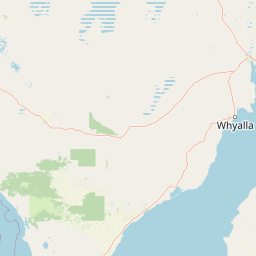
Why Gawler Ranges Conservation Park stands out
The conservation park is best known for its extensive stands of tree mallee woodland, particularly red mallee, gilja, and scattered yorrell, set against the rocky terrain at the southern fringe of the Gawler Ranges. It represents one of the more accessible examples of Eyre Peninsula mallee habitat preserved under formal conservation protection.
Gawler Ranges Conservation Park history and protected-area timeline
The protected area that is today known as Gawler Ranges Conservation Park went through a notably tangled administrative history before arriving at its current form. The Geographical Names Board originally approved the name Bockelberg Conservation Park for the site, reflecting its location within the Bockelberg locality. Due to legal processes, however, the area was not constituted under the National Parks and Wildlife Act 1972 as originally intended.
Instead, on 11 November 1993, it was declared under the state's Crown Lands Act 1929 as the Gawler Ranges Conservation Reserve, with its name chosen because of its proximity to the better-known Gawler Ranges. By 2006, it was the stated intention that this conservation reserve would be incorporated into the adjoining Gawler Ranges National Park, signalling that the reserve was always regarded as part of a larger conservation picture for the region.
The reserve was eventually redesignated as Gawler Ranges Conservation Park on 6 September 2012, bringing it formally under the national parks and wildlife framework as a conservation park. Today it is managed by the South Australian Department for Environment and Water and recognised as an IUCN Category VI protected area, sealing its place within the state's modern system of conservation reserves.
Gawler Ranges Conservation Park landscape and geographic character
The landscape of Gawler Ranges Conservation Park is shaped by the semi-arid character of the western Eyre Peninsula and by its position at the southern fringe of the Gawler Ranges volcanic province. The terrain tends to be gently undulating, with rocky rises, shallow valleys, and exposures of harder basement rock typical of the older Gawler Craton country that underlies much of this part of South Australia.
Soils are generally shallow and infertile by agricultural standards, and the climate is hot and dry, with low and unreliable rainfall that supports hardy, drought-adapted vegetation rather than dense forest. The visual impression is one of wide horizons, low tree cover, and a colour palette dominated by the muted greens, greys, and ochres of mallee leaves, weathered rock, and dusty ground.
Rather than presenting dramatic peaks or deeply carved gorges, the conservation park offers a quiet, textured landscape: rocky ridges broken by corridors of mallee, open swales between the rises, and a horizon line that always carries the sense of being on the edge of a much larger, sparsely settled country.
Gawler Ranges Conservation Park ecosystems, habitats, and plant life
Ecologically, Gawler Ranges Conservation Park sits firmly within the mallee zone of southern Australia. Although small in absolute size, it preserves a coherent example of mallee woodland on Eyre Peninsula soils and geology, and so it has outsize importance for representing this habitat type within the regional conservation network.
The vegetation is dominated by tree mallee eucalypts, low-growing trees that characteristically form multiple slender stems from a swollen lignotuber near the ground. The most extensively recorded species in this mix are red mallee, gilja, and yorrell, with scattered patches of yorrell providing variation across the otherwise broad stands of red mallee and gilja. The result is a vegetation mosaic that, while broadly uniform at a glance, contains subtle differences in species composition and density across the park.
Because the surrounding Eyre Peninsula has seen significant land-clearing for cropping and grazing, the conservation value of the park rests substantially on its preservation of relatively intact mallee habitat with its full complement of soil crusts, leaf litter, and associated understorey plants. The protected area thus contributes to the long-term conservation of mallee ecosystem processes on a peninsula where such unbroken examples are increasingly rare.
Gawler Ranges Conservation Park wildlife and species highlights
Detailed species-level information about Gawler Ranges Conservation Park is limited in the available sources, and the park's wildlife profile is best understood as a function of its mallee habitat rather than as a list of individually documented species. As with other semi-arid mallee reserves on the Eyre Peninsula, it provides cover and forage for typical inhabitants of this vegetation type, including a range of small ground-dwelling mammals, reptiles, and birds adapted to dry conditions and dense low woodland.
Its position adjacent to much larger tracts of natural habitat, including the Gawler Ranges National Park, also gives the conservation park a role as part of a broader landscape through which wildlife can move between protected areas. Because the source material does not provide reliable species accounts, any stronger statements about named species or population figures should be avoided.
Gawler Ranges Conservation Park conservation status and protection priorities
Conservation significance for Gawler Ranges Conservation Park lies less in spectacular or iconic species and more in the preservation of a representative block of Eyre Peninsula mallee habitat at a time when much of the surrounding countryside has been converted to farmland. By securing a sizeable tract of intact mallee vegetation under formal protection, the park helps maintain habitat continuity and ecological processes that would otherwise be reduced to fragments on this part of the peninsula.
Its IUCN Category VI status reflects a conservation designation that allows for sustainable use of natural resources alongside protection of ecosystems, aligning it with a model of conservation that retains the landscape's working pastoral character rather than locking it away entirely. The formal redesignation of the area from conservation reserve to conservation park in 2012 also represents an administrative strengthening of its protection, drawing it more fully into the South Australian national parks and wildlife framework.
Together, these factors make the conservation park a meaningful contributor to habitat protection on the Eyre Peninsula, even though it occupies a relatively small share of the regional land area.
Top sights and standout views in Gawler Ranges Conservation Park
The conservation park stands out for the unbroken character of its mallee woodland, the contrast between its rocky rises and softer swales, and its quiet, semi-arid atmosphere typical of the far west of the Eyre Peninsula. Its redesignation in 2012 marked a clearer place for it within the state's conservation system, complementing the nearby Gawler Ranges National Park and reinforcing the protection of habitat in a region long shaped by pastoral use.
Best time to visit Gawler Ranges Conservation Park
Seasonal conditions on the Eyre Peninsula are strongly shaped by a hot, dry climate with cool, sometimes wetter winters. Cooler months generally offer more comfortable conditions for exploring mallee country, when temperatures are lower and, in good seasons, the vegetation and soils respond to winter rainfall. By contrast, the warmer months are typically hot and dry, which can make outdoor exploration less pleasant but produces the classic bleached, sunlit appearance of mallee in late summer and autumn. Visitors should plan around personal tolerance for heat and remoteness rather than around any single dramatic seasonal event.