Why Grasslands National Park stands out
Grasslands National Park is best known for protecting one of Canada's last remaining tracts of untouched prairie grassland, a critically endangered ecosystem that has been largely converted to agricultural use across the continent. The park contains the country's only black-tailed prairie dog colonies, which serve as a keystone species supporting a complex web of dependent wildlife including the endangered black-footed ferret. The park is also renowned for its reintroduced plains bison herd, which has grown from 71 animals in 2006 to over 300 individuals, representing a successful restoration of a keystone grazer to its native landscape. Additionally, the park's dark-sky preserve status, designated in 2009, makes it a destination for astronomy enthusiasts seeking to experience pristine night skies.
Grasslands National Park history and protected-area timeline
The history of Grasslands National Park extends deep into the geological and human past of the Canadian plains. The landscape itself was shaped by glacial meltwater erosion, with the Frenchman River Valley, the Seventy Mile Butte, and the badlands of Rock Creek forming the park's most distinctive geological features. In 1874, Sir George Mercer Dawson discovered Western Canada's first dinosaur remains in the Killdeer Badlands during the International Boundary Survey, establishing the region as significant for paleontology.
The human history of the area is equally rich. In 1877, Sitting Bull took refuge in the region with approximately 5,000 Sioux followers following their defeat of General Custer at the Battle of Little Bighorn, a period that left lasting cultural associations with the landscape. The park is situated on Treaty 4 land of the Blackfoot (Niitsítapi) people of the Canadian and American plains. Grasslands National Park was formally established in 1981, becoming Saskatchewan's second national park after Prince Albert. In 2006, plains bison from Elk Island National Park in Alberta were reintroduced to the park, and by 2015 the herd had grown from 71 animals to over 300. A 2022 agreement between the Métis Nation-Saskatchewan and Parks Canada provides for the transfer of additional bison, further strengthening the ecological and cultural restoration of the park.
Grasslands National Park landscape and geographic character
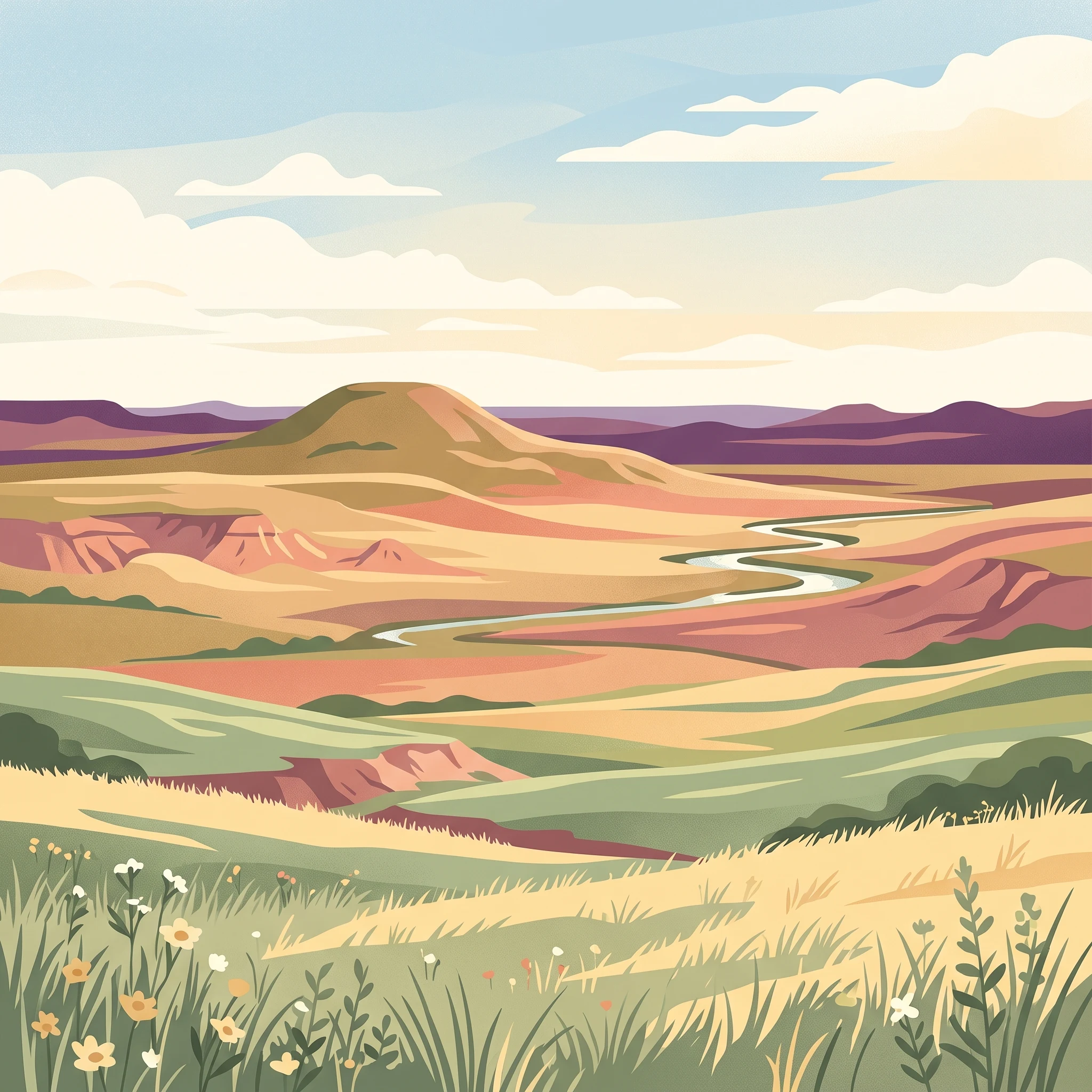
The landscape of Grasslands National Park is defined by the sweeping horizontal expanse of the prairie, broken by distinctive geological features that provide vertical relief and ecological diversity. The Frenchman River Valley in the West Block cuts through the grassland in a series of steep-sided coulees, harboring Cottonwood groves and providing habitat diversity amid the surrounding uplands. The Seventy Mile Butte rises from the plain as a prominent landmark offering panoramic views across the park. The East Block contains the striking badlands of Rock Creek, where erosion has exposed colorful bands of clay and sandstone that reveal the geological history of the region.
The overall character of the landscape is one of semi-arid openness, with the sky often the most dramatic element, particularly under the dark-sky preserve designation that protects the nighttime environment. The prairie itself appears deceptively uniform but actually contains subtle variations in vegetation across different terrain types, from the mixed-grass communities of the uplands to the more specialized plant associations of the valley floors and badlands areas.
Grasslands National Park ecosystems, habitats, and plant life
The nature of Grasslands National Park centers on the Prairie Grasslands ecosystem, one of the most endangered habitats in North America. The park lies within the Northern short grasslands ecoregion, characterized by a semi-arid climate that supports a distinctive assembly of drought-adapted plants. The native vegetation includes blue grama grass and needlegrass as dominant prairie species, with plains cottonwood occurring in riparian areas and valleys, and silver sagebrush adding shrub-layer diversity to the grassland matrix.
The ecological significance of the park extends beyond the grassland itself to the specialized habitats created by the Frenchman River Valley, the badlands formations, and the prairie dog towns that serve as ecological keystones. The park is designated as an Important Bird Area, with a 16-kilometre stretch along the Frenchman River in the West Block and the East Block both recognized as significant for grassland bird conservation. The combination of protected grassland, riparian corridors, and badlands habitats creates a complex of ecological niches that supports remarkable biodiversity in a region where much of the original prairie has been converted to agricultural use.
Grasslands National Park wildlife and species highlights
The wildlife of Grasslands National Park includes a remarkable assembly of species adapted to the open grassland environment, many of which are found nowhere else in Canada. The park is home to the country's only black-tailed prairie dog colonies, which serve as a foundational species supporting an entire ecological community. These prairie dog towns provide habitat for the endangered black-footed ferret, which was reintroduced to the park in 2009 after a 70-year absence from the Canadian prairie. Other predators supported by the prairie ecosystem include coyotes, swift foxes, and prairie rattlesnakes.
Large mammals include the plains bison, restored to the park through a reintroduction program that began in 2006, and pronghorns, the fastest land mammal in North America, which remain common across the prairie. Birdlife is particularly diverse, with greater sage-grouse performing their dramatic mating displays on the leks, burrowing owls nesting in abandoned prairie dog burrows, ferruginous hawks hunting across the open grassland, and loggerhead shrikes and horned larks common throughout. The park also supports populations of ring-necked pheasants, eastern yellow-bellied racers, and greater short-horned lizards, completing a fauna assemblage that represents the prairie ecosystem at its most intact.
Grasslands National Park conservation status and protection priorities
Grasslands National Park represents a critical conservation stronghold for one of North America's most endangered ecosystems. The Northern short grasslands ecoregion has been heavily impacted by agricultural conversion, with the park protecting some of the last remaining tracts of native prairie that have not been substantially altered by human activity. The designation of the park as an Important Bird Area recognizes its global significance for grassland bird conservation, while the dark-sky preserve status ensures protection of the nocturnal environment and all species that depend on natural light-dark cycles.
The reintroduction of plains bison represents a landmark conservation achievement, restoring a keystone grazer that shapes prairie ecology through its foraging behavior and creates heterogeneity in the grassland structure. The black-footed ferret recovery program, which successfully established a population in the prairie dog colonies after decades of absence, demonstrates the park's capacity to support endangered species recovery. The 2022 agreement with the Métis Nation-Saskatchewan for additional bison transfers further advances the ecological and cultural restoration of the park.
Grasslands National Park cultural meaning and human context
Grasslands National Park is situated on Treaty 4 land of the Blackfoot (Niitsítapi) people, whose traditional territory spans the Canadian and American plains. The park's landscape holds deep historical significance for Indigenous peoples, and the 2022 agreement between the Métis Nation-Saskatchewan and Parks Canada reflects ongoing relationships between the park and Indigenous communities. The area also gained historical prominence in 1877 when Sitting Bull and approximately 5,000 Sioux took refuge there following the Battle of Little Bighorn, a pivotal moment in the history of the North American plains that left lasting associations with the landscape.
Top sights and standout views in Grasslands National Park
Grasslands National Park offers visitors the opportunity to experience one of North America's most endangered ecosystems in a relatively intact state. The reintroduced plains bison herd, now over 300 animals strong, provides the iconic wildlife experience of the park, grazing across the prairie in a scene that evokes the pre-settlement Great Plains. The black-tailed prairie dog colonies represent a unique Canadian wildlife spectacle, while the badlands of Rock Creek in the East Block offer a dramatically different landscape of eroded formations and ancient geological strata. The dark-sky preserve designation makes the park a destination for stargazing, with the Milky Way visible on clear nights away from any light pollution. The Valley of 1000 Devils in the East Block and the views from the summit of 70 Mile Butte provide outstanding scenic vantage points across the grassland landscape.
Best time to visit Grasslands National Park
The best time to visit Grasslands National Park depends on the experience sought, with each season offering distinct advantages. Spring and early summer bring the green-up of the prairie and are excellent for wildlife viewing as bison calves are born and pronghorns are active across the landscape. The greater sage-grouse mating displays occur in early spring, drawing birdwatchers to the lek sites. Fall offers another excellent wildlife-viewing window and the opportunity to see the prairie in its autumn colors, with the added benefit of cooler temperatures for hiking. Summer brings the warmest conditions and the main visitor season, though daytime temperatures can be high. Winter transforms the landscape with snow and offers a stark beauty, though many facilities operate on reduced schedules. The dark-sky preserve is particularly compelling in fall and winter when the night sky is clearest and the Milky Way is most prominent.