Mori Atlas logo
National parkJoshua Tree National Park

Discover the unique park boundaries and natural terrain of this Southern California national park.

Joshua Tree National Park: California's Mapped Protected Landscape and Regional Geography

Joshua Tree National Park stands as a significant protected area within California's diverse geography, offering a distinct natural landscape to explore. This page serves as a detailed entry point for understanding the park's mapped boundaries, its unique terrain, and its geographic context within the broader regional atlas. Dive into the specifics of this important national park's protected status and its place in the natural landscape.

Desert LandscapeRock ClimbingDark Sky ParkJoshua TreesWilderness AreaGranite Formations

Joshua Tree National Park

National park

Park overview

Structured park overview, official facts, and landscape profile for Joshua Tree National Park

Joshua Tree National Park park facts, protected area profile, and essential visitor context
Review the core facts for Joshua Tree National Park, including designation, size, terrain, visitor scale, habitats, and operating context in one park-focused overview.

About Joshua Tree National Park

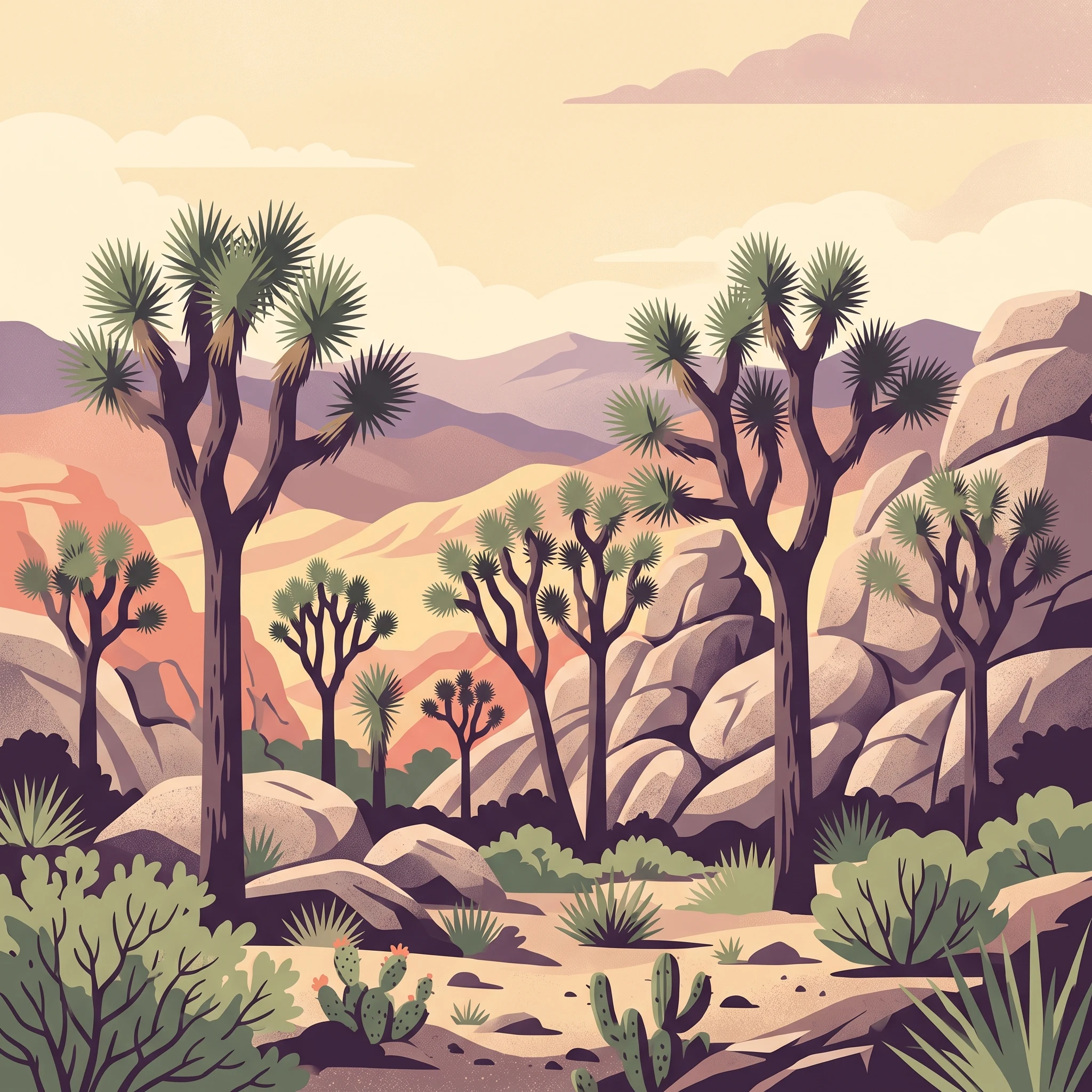
Joshua Tree National Park represents one of the most distinctive desert landscapes in the United States, where the iconic Joshua tree creates forests across the rocky terrain of the western Mojave Desert. The park's terrain is characterized by exposed monzogranite formations that have been sculpted by groundwater erosion and flash floods into dramatic boulder piles and rounded rock outcrops known as inselbergs. The Wonderland of Rocks, a particularly spectacular monzogranite area north of Barker Dam, exemplifies this geological character with its maze of towering boulders and vertical faces. The park sits at the convergence of the Transverse Ranges and the Basin and Range Province, with the Little San Bernardino Mountains marking the southwestern edge. Six mountain ranges traverse the park, five of which belong to the east-west trending Transverse Ranges. The geology is remarkably ancient, with Pinto Gneiss and other crystalline rocks dating back 1.7 billion years, making some of the park's exposed surfaces among the oldest in North America. The park's ecological significance stems from its position at the boundary of two desert systems, creating a mosaic of habitats that supports remarkable biodiversity despite the harsh desert conditions.

Quick facts and research context for Joshua Tree National Park

Joshua Tree National Park covers roughly 795,000 acres, making it slightly larger than Rhode Island. About 429,690 acres are designated wilderness managed under the Wilderness Act. The park straddles the transition between the Mojave and Colorado deserts, with elevations ranging from roughly 900 feet to over 5,800 feet. The park features the iconic Joshua tree, a yucca species unique to the Mojave Desert. It receives approximately 3 million visitors annually and was designated an International Dark Sky Park in 2017.

Park context

Deeper park guide and search-rich context for Joshua Tree National Park

Joshua Tree National Park history, landscape, wildlife, and travel context
Explore Joshua Tree National Park through its history, landscape character, ecosystems, wildlife, conservation priorities, cultural context, and seasonal travel timing in a structured park guide built for atlas discovery and search intent.

Why Joshua Tree National Park stands out

Joshua Tree is best known for its otherworldly landscape of Joshua tree forests interspersed with massive granite boulder formations. The park is a world-renowned rock climbing destination with thousands of climbing routes on rough quartz monzonite granite. It is also celebrated for its exceptionally dark night skies, earning Dark Sky Park designation from the International Dark Sky Association. The park protects five natural palm oases featuring California's only native palm, the California fan palm (Washingtonia filifera), a rare sight in the state's desert regions.

Joshua Tree National Park history and protected-area timeline

The land within Joshua Tree National Park has been inhabited for millennia. The earliest known residents were the Pinto Culture peoples, who lived and hunted in the area between 8000 and 4000 BCE, leaving behind stone tools and spear points discovered in the Pinto Basin in the 1930s. Later inhabitants included the Serrano, Cahuilla, Chemehuevi, and Mojave peoples, all of whom lived in small villages near water sources, particularly the Oasis of Mara in what became Twentynine Palms. European exploration began in 1772 when Spanish explorer Pedro Fages became the first European to sight Joshua trees while pursuing runaway mission converts. By the mid-1800s, American explorers and fur trappers had traversed the region. After the Mexican-American War brought California under U.S. control, white settlers began grazing cattle in the 1870s, and mining operations expanded throughout the region between the 1860s and 1940s, with approximately 300 pit mines operating in what became the park. The Lost Horse Mine was among the most successful, producing gold and silver worth roughly $5 million in today's currency. On August 10, 1936, President Franklin D. Roosevelt used the Antiquities Act to establish Joshua Tree National Monument, protecting about 825,000 acres. The monument was redesignated as a national park on October 31, 1994, when Congress passed the California Desert Protection Act, which added 234,000 acres to the park.

Joshua Tree National Park landscape and geographic character

The physical landscape of Joshua Tree National Park presents one of the most visually striking desert environments in North America. The western portion of the park features the iconic Joshua tree growing in patterns ranging from dense forests to widely spaced specimens across boulder-strewn terrain. The dominant geological features are hills of bare rock broken into loose boulders and massive monzogranite formations that create a surreal, almost alien terrain. These rock formations, particularly in areas like the Wonderland of Rocks, are the result of groundwater filtering through rectangular joints in the monzonite and eroding the edges and corners of stone blocks, combined with flash floods that exposed the harder rocks while softer material was washed away. The park contains six mountain blocks: the Little San Bernardino, Hexie, Pinto, Cottonwood, Eagle, and Coxcomb Mountains. The eastern portion of the park drops into the Colorado Desert below 3,000 feet, where the landscape transitions to creosote bush scrub, cholla cactus gardens, and the sandy grasslands of the lower Coachella Valley. Five natural oases with California fan palms mark rare year-round water sources in this otherwise arid landscape.

Joshua Tree National Park ecosystems, habitats, and plant life

The ecological character of Joshua Tree National Park is defined by its position at the boundary of the Mojave and Colorado deserts, creating a diversity of habitats within a single protected area. The higher Mojave Desert harbors the Joshua tree, which grows in communities that also include piñon pine, California juniper, desert scrub oak, and various cholla and prickly pear cacti. The lower Colorado Desert features creosote bush scrub, ocotillo, desert saltbush, and dense stands of cholla cactus that appear like natural gardens. According to the Kuchler potential natural vegetation classification, the park's lower elevations support creosote bush desert shrubland while higher elevations feature juniper and pinyon pine in a Great Basin montane forest transition. The five palm oases represent critically important ecological refugia, supporting species that require year-round water in an otherwise arid environment. However, these communities face significant stress from climate change, with studies indicating fewer Joshua tree seedlings surviving and projected habitat loss of up to 80% by 2099 under high-emission scenarios.

Joshua Tree National Park wildlife and species highlights

Joshua Tree National Park supports remarkable wildlife diversity given its desert setting, with approximately 2,145 documented plant, fungi, and animal species. Over 250 bird species inhabit or visit the park, including resident desert species like the greater roadrunner, cactus wren, northern mockingbird, LeConte's thrasher, verdin, and Gambel's quail, with about 78 species nesting within the park boundaries. The park lies along an inland stretch of the Pacific Flyway, making it a critical rest stop for migratory birds in winter. Mammalian species number around 50, including the desert bighorn sheep, coyote, bobcat, mountain lion, mule deer, black-tailed jackrabbit, and the desert tortoise, a threatened species well-adapted to arid conditions. Reptiles are particularly abundant, with multiple rattlesnake species, kingsnakes, coastal rosy boas, and the desert tortoise being notable inhabitants. The park supports nearly 1,000 invertebrate species, including the yucca moth that pollinates the Joshua trees after which the park is named. Many larger mammals are crepuscular, being most active at sunrise and sunset to avoid the extreme daytime heat.

Joshua Tree National Park conservation status and protection priorities

Joshua Tree National Park holds significant conservation value as a protected area spanning two desert ecosystems and supporting substantial biodiversity in an otherwise arid region. The park's 429,690 acres of designated wilderness are managed under the Wilderness Act, providing strong protection for the most remote and undeveloped portions of the park. However, the park faces serious conservation challenges. Climate change is making the region hotter and drier, with annual precipitation decreasing by 39% since 1895 and temperatures increasing by 3°F, leading to more frequent and severe wildfires. Invasive plants like cheatgrass and red brome contribute to worsening wildfire conditions by creating dense fuel layers that burn hotter than natural vegetation. The desert tortoise population has declined due to habitat loss and climate change, and bird populations have dropped by 43% between studies conducted in 1908-1968 and 2013-2016. The Mojave Desert Land Trust has played a critical role, conserving over 10,290 acres within the park and selling an additional 25,801 acres to the National Park Service, more than any similar organization.

Joshua Tree National Park cultural meaning and human context

The cultural history of Joshua Tree National Park spans thousands of years of indigenous habitation. The Pinto Culture represents the earliest known inhabitants, living in the area between 8000 and 4000 BCE. The Serrano, Cahuilla, Chemehuevi, and Mojave peoples subsequently inhabited the region, living in small villages near water sources and subsisting on plant foods supplemented by small game. The Oasis of Mara in what became Twentynine Palms was a particularly important settlement area. These peoples used local plants for medicines, bows, arrows, baskets, and other daily items. Today, the Twentynine Palms Band of Mission Indians, descendants of the Chemehuevi, own a reservation in Twentynine Palms near the park. The park also contains significant mining heritage from the late 1800s through the mid-1900s, with structures like Barker Dam (added to the National Register of Historic Places in 1975), the Lost Horse Mine, and the Wall Street Mill reflecting this historical period of human activity in the desert landscape.

Top sights and standout views in Joshua Tree National Park

Joshua Tree National Park offers an exceptional combination of geological wonder, ecological diversity, and recreational opportunities. The park's most distinctive landscape features are the massive monzogranite boulder formations scattered across Joshua tree forests, creating an otherworldly terrain unlike anywhere else in the American West. Rock climbing enthusiasts will find thousands of routes on these formations, from beginner-friendly boulders to challenging multi-pitch routes. The park's dark night skies, recognized with International Dark Sky Park designation in 2017, provide extraordinary stargazing opportunities far from urban light pollution. The five palm oases, particularly Lost Palms Oasis, offer a striking contrast to the surrounding desert, with California fan palms creating verdant pockets in the rocky landscape. Keys View provides a spectacular panorama overlooking the Coachella Valley, Salton Sea, San Andreas Fault, and mountain ranges including San Gorgonio, the highest peak in Southern California.

Best time to visit Joshua Tree National Park

The best times to visit Joshua Tree National Park are during the spring and fall when temperatures are most comfortable, typically ranging from the low 50s to mid-80s Fahrenheit. These seasons offer ideal conditions for hiking, rock climbing, and exploring the park's diverse landscapes without the extreme heat of summer or the occasional winter snow at higher elevations. Spring visitors may catch the wildflower bloom, which has become increasingly popular and contributed to rising visitation. Winter brings cooler daytime temperatures around 60°F but can include freezing nights, with occasional snow at higher elevations. Summer temperatures regularly exceed 100°F during the day with nights remaining warm, making early morning or evening activities essential. The park is busiest on weekends and during holidays, so weekdays offer a more solitary experience. Night sky viewing is exceptional year-round, though summer nights allow for more comfortable stargazing after dark.
Park location guide

Geography guide, regional context, and park location map for Joshua Tree National Park

Joshua Tree National Park park geography, regions, and map view in United States of America
Understand where Joshua Tree National Park sits in United States of America through a broader geographic reading of the surrounding landscape, nearby location context, and its mapped position within the national park landscape.

How Joshua Tree National Park fits into United States of America

The United States of America is a federal presidential republic and one of the world's largest countries by area and population. It consists of 50 states across a vast territory spanning multiple time zones, with its capital in Washington, D.C. and largest city in New York City. The nation has a diverse economy, influential political system, and significant cultural and military presence globally.

Wider geography shaping Joshua Tree National Park in United States of America

The United States occupies a vast territory in North America, bordered by Canada to the north and Mexico to the south. The 48 contiguous states stretch from the Atlantic to the Pacific Ocean, while Alaska occupies the northwestern region and Hawaii is an archipelago in the Pacific. The country encompasses diverse terrain including the Rocky Mountains, Appalachian Mountains, Great Plains, and extensive river systems.

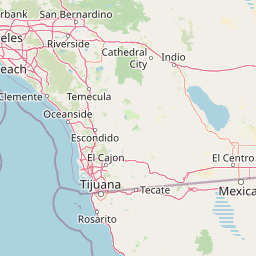
Map view of Joshua Tree National Park

Use this park location map to pinpoint Joshua Tree National Park in United States of America, understand its exact geographic position, and read its mapped placement within the surrounding landscape more clearly.

Pigeon | © OpenStreetMap contributors

Location context for Joshua Tree National Park

California
Park atlas

Compare the unique desert protected areas and surrounding regional landscapes.

Parks Near Joshua Tree National Park: Discover Other Protected Areas and Landscapes
After exploring Joshua Tree National Park, expand your geographic understanding by browsing other protected areas in the surrounding California deserts and nearby regions. Compare diverse landscapes, conservation priorities, and geological features to build a richer atlas of this unique corner of North America.
National parkEnsenada Municipality

Constitution 1857 National Park National Park: Mapped Protected Landscape Discovery

Geographic context and park boundaries for Ensenada Municipality.

Delve into the protected landscape of Constitution 1857 National Park, a key national park entity located in the Ensenada Municipality. This resource highlights the park's distinct geographic features and mapped protected area, crucial for atlas exploration and understanding the regional natural terrain. Gain structured insight into the park's identity and its role within the wider geographic context.

Area
50.09 km²
Established
1962
IUCN
II
Relief
Mountain
National parkCalifornia

Death Valley National Park: Exploring California's Mapped Protected Landscape

View the geographic boundaries and desert terrain.

Access a detailed atlas perspective of Death Valley National Park, a protected national park situated in California. Understand the park's distinct mapped boundaries and its role within the regional geography. This resource highlights the unique desert landscape, offering focused insights into its protected-area identity and natural terrain for geographic discovery.

Area
13,848.4 km²
Established
1994
IUCN
II
Visitors
1.1M annual
National parkCalifornia

Channel Islands National Park: A Protected Landscape within California's Geography

Explore its unique mapped terrain and protected area context.

Channel Islands National Park stands as a key protected area, providing critical insight into California's unique geographic features and natural landscapes. This entry focuses on the park's identity as a protected entity, detailing its mapped boundaries and the surrounding regional geography. It offers an atlas-level view, essential for understanding the park's contribution to the broader landscape context of the United States and its conservation importance.

Area
1,009.94 km²
Established
1980
IUCN
II
Visitors
323.2K annual
National parkCalifornia

Sequoia National Park National Park: Geographic Identity and Protected Landscape Atlas

Explore mapped boundaries and the terrain of this California protected area.

Gain a structured understanding of Sequoia National Park as a protected landscape, focusing on its mapped geographic boundaries and its context within California. This entry provides foundational data for exploring the park's natural terrain and its role in a broader atlas of conservation lands, ideal for users seeking detailed geographic information.

Area
1,635.19 km²
Established
1890
IUCN
II
Visitors
1.2M annual
Watercolor painting of a mountainous landscape with pine trees, rolling hills, and a pastel sky
National parkBaja California

Sierra de San Pedro Mártir National Park: Protected Landscape and Geographic Exploration

National park boundaries and natural terrain in Baja California.

Sierra de San Pedro Mártir National Park is a vital protected landscape situated in Baja California. This destination offers users a focused atlas exploration of its national park status, detailing its geographic setting and mapped protected area. Understand the park's specific place within the region, examining its natural terrain and boundaries for a clear geographic context, essential for any structured discovery of Mexico's conserved lands.

Area
729.09 km²
Established
1947
IUCN
II
Relief
Mountain
National parkCalifornia

Kings Canyon National Park National Park: California Protected Landscape & Geography Atlas

Mapped park boundaries and regional natural context.

Kings Canyon National Park stands as a key protected national park within California, offering a specific focus for geographic understanding and atlas-based exploration. This page details the park's mapped boundaries and its integration into the broader regional geography of California. For users interested in the distribution of protected lands and the mapping of natural landscapes, Kings Canyon National Park provides a crucial point of study within the comprehensive park atlas.

Area
1,869.25 km²
Established
1890
IUCN
II
Visitors
641K annual
National parkArizona

Grand Canyon National Park: Arizona National Park Protected Landscape & Geography

Explore mapped boundaries and regional atlas context.

Grand Canyon National Park stands as a premier national park, showcasing a unique protected landscape within Arizona's diverse geography. This detailed entry focuses on the park's specific geographic identity, its mapped boundaries, and its significance within the regional atlas. Discover the contours of this protected area and its place in the natural terrain of the American Southwest.

Area
4,926.08 km²
Established
1919
IUCN
II
Visitors
4.9M annual
National parkUtah

Zion National Park National Park: Detailed Mapped Geography and Protected Landscape Identity

Explore the mapped terrain and regional context of this Utah national park.

Zion National Park represents a key protected area within Utah, ideal for detailed geographic exploration. This canonical page offers insights into the park's specific mapped boundaries, its inherent landscape character, and its regional geographic setting. It is designed for users seeking to understand the atlas-level significance of Zion National Park as a national park entity, focusing on its protected terrain and natural geography.

Area
593.26 km²
Established
1919
IUCN
II
Visitors
4.9M annual

Common questions about visiting, size, designation, and location context for Joshua Tree National Park

Joshua Tree National Park FAQs for park facts, access, geography, and protected area context
Find quick answers about Joshua Tree National Park, including protected-area facts, park geography, trail and visitor context, and how the park fits into its surrounding country and regional landscape.
MoriAtlas Explorer

Continue Your Protected Areas Search Across the Global Atlas

Deepen your exploration by continuing the structured search for national parks and protected areas worldwide. Utilize the comprehensive filtering capabilities to compare different conservation landscapes and refine your understanding of global park geography. Discover more about the distribution and characteristics of protected natural areas.

Global natural geography