Mori Atlas logo
Nature reserveKortenbach bei Froschhausen

Mapping the ecological boundaries and relict broadleaf woodland of the Main river valley

Kortenbach bei Froschhausen Nature Reserve and Protected Hardwood Floodplain Forest Geography

(Naturschutzgebiet Kortenbach bei Froschhausen)

Kortenbach bei Froschhausen serves as an ecologically significant nature reserve in the district of Offenbach, Germany, preserving rare hardwood floodplain forest remnants known as Hartholzaue. This site protects a mature moist broadleaf woodland corridor shaped by the Werniggraben stream. By mapping these dense forest patches within the suburban Rhine-Main matrix, we provide a clear view of the protected landscape boundaries and the unique hydrologic features defining this woodland refuge.

nature reservebroadleaf foresthardwood floodplain forestHartholzaueriparian habitatWerniggraben

Kortenbach bei Froschhausen

Nature reserve

Park overview

Structured park overview, official facts, and landscape profile for Kortenbach bei Froschhausen

Kortenbach bei Froschhausen park facts, protected area profile, and essential visitor context

Review the core facts for Kortenbach bei Froschhausen, including designation, size, terrain, visitor scale, habitats, and operating context in one park-focused overview.

About Kortenbach bei Froschhausen

Kortenbach bei Froschhausen is one of the many small nature reserves that collectively preserve the remaining natural woodland pockets of the densely populated Rhine-Main region. It occupies a compact area of forest on the western edge of Seligenstadt, between the older town center and the smaller district of Froschhausen. Despite its proximity to major transport routes, the A3 motorway and the L 2310 state road frame the reserve to the south, the woodland retains a quiet, enclosed character shaped by its soils and hydrology.

Ecologically, the reserve belongs to the historically widespread but now fragmented floodplain forest landscape of the Main valley. Its vegetation is dominated by moist broadleaf woodland on fresh, base-rich soils interspersed with relic stands of Hartholzaue, a forest type defined by oaks, hornbeams, elms, and other light-demanding hardwoods that once covered the rarely flooded upper levels of large river floodplains. The Werniggraben, a modest stream linked to the broader Hellenbach system, threads through the reserve and sustains the damp conditions that support these communities.

The protection of Kortenbach bei Froschhausen reflects a broader German effort to secure small but ecologically valuable forest fragments whose continuity with the wider floodplain ecosystem has been severed by land use change. Within the Offenbach district, the reserve is one component of a network of protected sites that includes other woodland, wetland, and former gravel pit areas, collectively maintaining habitat diversity in a heavily urbanized setting. Kortenbach bei Froschhausen thus serves both as a local nature reserve and as a small but representative sample of a regional forest type that has almost disappeared elsewhere.

Quick facts and research context for Kortenbach bei Froschhausen

Kortenbach bei Froschhausen is a designated nature reserve in the Offenbach district of Hesse, Germany, classified under IUCN Category IV as a Habitat/Species Management Area. It was established in 1998 and covers approximately 40.5 hectares of forest within Seligenstadt's administrative area.

The reserve lies between Seligenstadt and Froschhausen, bounded to the south by the A3 motorway, the L 2310 state road, and a golf course. It is drained by the Werniggraben, a tributary associated with the Hellenbach system flowing toward the Main river, and is administered by the lower nature conservation authority of the Offenbach district.

Protection and recognition

Examine the verified conservation records and global database entries for this protected landscape.

Kortenbach bei Froschhausen Protection Status and Protected Area Documentation

Kortenbach bei Froschhausen maintains a documented protection profile within the global protected area registry. Official conservation records provide verifiable baseline parameters for geographic analysis.

Protection details

WDPA ID
318680
Park context

Deeper park guide and search-rich context for Kortenbach bei Froschhausen

Kortenbach bei Froschhausen history, landscape, wildlife, and travel context

Explore Kortenbach bei Froschhausen through its history, landscape character, ecosystems, wildlife, conservation priorities, cultural context, and seasonal travel timing in a structured park guide built for atlas discovery and search intent.

Why Kortenbach bei Froschhausen stands out

Kortenbach bei Froschhausen is known for its relict stands of Hartholzaue, the hardwood floodplain forests that once formed the natural woodland of the Main valley's higher floodplain terraces. These are stands of oak-hornbeam-elm woodland shaped by periodic river influence but rarely by prolonged inundation, and they survive here only as small fragments within a heavily altered landscape. The reserve is also recognized for the presence of mature European white elms (Ulmus laevis), a regionally rare species whose populations have been reduced by groundwater decline and disease pressure. Together, the moist broadleaf forest, the relic hardwood floodplain elements, and the Werniggraben stream corridor make the site a notable reference point for floodplain forest conservation in the Rhine-Main area.
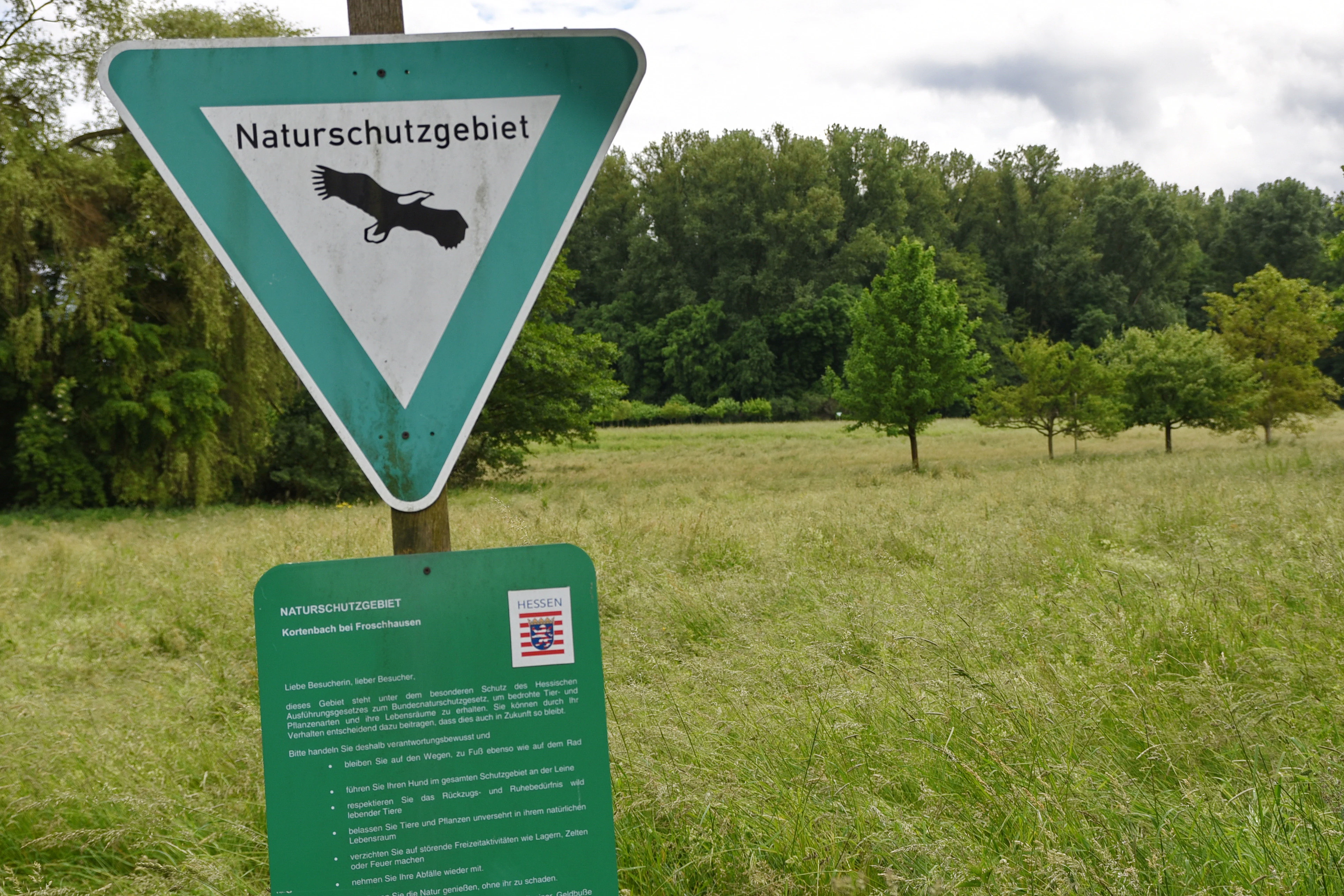
A triangular nature reserve sign with a bird silhouette and a green informational board below it, set against a grassy field and trees.
Entrance sign for the Kortenbach bei Froschhausen nature reserve.

Kortenbach bei Froschhausen history and protected-area timeline

The forest that now forms the reserve has likely existed for centuries as part of the traditional woodland mosaic around Seligenstadt and Froschhausen, but its ecological value came under increasing pressure during the twentieth century as groundwater levels fell, infrastructure expanded, and surrounding land was converted. The decisive moment for modern protection came in 1998, when the area was formally designated as a Naturschutzgebiet under Hessian nature conservation law.

The designation was driven by the recognition that the combination of moist broadleaf forest and relict Hartholzaue woodland made the site a particularly important habitat fragment in the district. Since designation, the reserve has been managed by the lower nature conservation authority (Untere Naturschutzbehörde) of the Offenbach district, with management focused on preserving the old-growth character of the forest and safeguarding the hydrological conditions along the Werniggraben.

In recent decades, concerns have grown over the impact of groundwater extraction and other land use changes on the site's water regime. Lowered water tables have been identified as a particular threat to the mature white elms and other moisture-dependent species, framing ongoing conservation attention around the need to maintain or restore favorable hydrological conditions within and around the reserve.

Kortenbach bei Froschhausen landscape and geographic character

The landscape of Kortenbach bei Froschhausen is a gently undulating stretch of broadleaf forest typical of the loess and alluvial deposits found near the Main river. The terrain is low and relatively flat, with no dramatic relief; instead, the character of the site is defined by subtle changes in soil moisture and elevation that determine where moist forests, drier Hartholzaue relicts, and stream-side vegetation occur.

The Werniggraben, a small stream belonging to the Hellenbach system that ultimately reaches the Main, carves a soft corridor through the middle of the reserve. Its shallow valley creates the moist, base-rich microhabitats that distinguish parts of the woodland from the surrounding countryside. Outside the forest, the reserve's edge is strongly defined by human features: the A3 motorway to the south, the L 2310 state road, intensively used farmland, and a golf course all sit immediately adjacent to the protected woodland.

This juxtaposition gives the reserve a distinctive profile: a quiet, geomorphologically modest forest island set within a busy transport and agricultural matrix. Despite the small size and compressed boundaries, the interior of the reserve maintains an unusually intact sense of forest continuity, with mature tree cover dominating the view in every direction.

Kortenbach bei Froschhausen ecosystems, habitats, and plant life

The ecological identity of Kortenbach bei Froschhausen rests on two closely related forest communities. The first is moist broadleaf woodland on fresh, nutrient-rich soils, characterized by species such as oak, hornbeam, ash, and other hardwoods that thrive where groundwater remains relatively close to the surface. The second is the Hartholzaue, a relict floodplain forest type of the upper floodplain zone that experiences only occasional flooding and is dominated by light-demanding hardwoods rather than willows and poplars.

The Hartholzaue stands within the reserve are considered relicts of the once much more extensive floodplain forests that lined the Main. Today they survive in fragmentary form, preserved because the combination of stream influence, soil conditions, and historical land use has prevented the area from being cleared or converted. Their old-growth character, including mature trees and complex vertical structure, is one of the site's most important ecological features.

Along the Werniggraben, vegetation transitions into a wetter, more dynamic stream-side community. The interface between the dry-phase Hartholzaue relicts on higher ground and the moister gallery elements along the stream gives the reserve a layered ecological structure within a very small area. This layering supports a range of habitat conditions for invertebrates, birds, fungi, and other woodland species, while also making the site sensitive to changes in water availability.

Kortenbach bei Froschhausen wildlife and species highlights

The wildlife value of Kortenbach bei Froschhausen is closely tied to its undisturbed, structurally diverse broadleaf forest and its stream corridor. Mature mixed deciduous woodland of this kind typically supports a rich community of breeding birds, including woodland specialists that depend on old trees, cavities, and a layered understory. The combination of closed canopy, dead wood, and adjacent open farmland creates edge habitats that are also used by various insect and small mammal species.

Particular ecological attention has focused on the ancient European white elms (Ulmus laevis) in the reserve. These trees host their own specialized fauna, including elm-feeding insects, and provide nesting and roosting opportunities for cavity-using birds and bats. Their conservation status within the site is considered a key indicator of overall habitat quality.

The Werniggraben and its bordering vegetation add an aquatic and semi-aquatic dimension, supporting amphibian breeding habitat, dragonflies, and other invertebrates, as well as small fish where the stream is deep enough. Although the reserve is too small to host populations of larger mammals, its position within a network of nearby protected areas means that species such as foxes, small mustelids, and deer use it as part of a wider forested landscape in the Rhine-Main region.

Kortenbach bei Froschhausen conservation status and protection priorities

Kortenbach bei Froschhausen was designated as a nature reserve primarily to secure a small but ecologically valuable fragment of forest from further degradation and to maintain the hydrological and habitat conditions on which its characteristic species depend. The official protection purpose is to preserve and develop the moist broadleaf forest and Hartholzaue relicts with their old-growth stands, together with the Werniggraben and adjacent agricultural land, as a living habitat for numerous endangered plant and animal species.

The site's conservation significance is amplified by its regional context. The historic floodplain forests of the Main valley have been reduced to scattered remnants by centuries of clearance, drainage, and conversion. Each surviving fragment, including Kortenbach bei Froschhausen, has therefore acquired disproportionate importance for the long-term persistence of forest species and for the genetic and ecological continuity of the Hartholzaue community type.

Management of the reserve is carried out by the lower nature conservation authority of the Offenbach district and focuses on maintaining the natural forest dynamics, protecting old trees, and, where possible, mitigating the hydrological stresses caused by groundwater drawdown in the surrounding area. The reserve is also linked to broader nature conservation planning in Hesse, which identifies relic floodplain forests as priority habitats for protection, monitoring, and where needed, restoration.

Kortenbach bei Froschhausen cultural meaning and human context

The forest at Kortenbach bei Froschhausen has long been part of the traditional woodland surrounding Seligenstadt, a historic town on the Main with roots reaching back to the medieval period. While the reserve itself is valued primarily for its natural qualities, its location between the old town of Seligenstadt and the village of Froschhausen situates it within a landscape shaped by long-running human use, including agriculture, viticulture, and forestry along the Main valley.

The presence of centuries-old trees and the survival of a recognizable Hartholzaue relict reflect a history of selective rather than intensive forest management in earlier centuries, which allowed certain stands to mature with less disruption than in many other parts of Germany. Today, the reserve is appreciated locally as a green landmark and a quiet natural contrast to the dense settlement pattern of the Rhine-Main metropolitan region.

Top sights and standout views in Kortenbach bei Froschhausen

Kortenbach bei Froschhausen stands out for the survival of authentic Hartholzaue relicts within an otherwise heavily altered Rhine-Main landscape, supported by the Werniggraben stream corridor and a matrix of mature broadleaf forest.

Its most distinctive single feature is the presence of ancient European white elms, a regionally rare species whose fortunes reflect the broader health of floodplain forest hydrology. The reserve also exemplifies how small, carefully designated woodland fragments can play an outsized conservation role in densely populated regions.

Best time to visit Kortenbach bei Froschhausen

Kortenbach bei Froschhausen can be visited throughout the year, as it offers different qualities in each season. In spring, the forest floor fills with wildflowers, ferns, and the fresh green of newly leafing trees, while the Werniggraben is at its most lively with higher water levels. Summer brings dense canopy shade and active birdlife, making it a good period for observing woodland species and enjoying the cool contrast to nearby urban areas.

Autumn is perhaps the most visually rewarding time, with mature broadleaf trees displaying rich color and a notable abundance of fungi in the damp, base-rich soils. Winter reveals the structure of the forest itself, exposing the old-growth character of the Hartholzaue relicts and the architectural form of ancient trees, while also offering the best chance to observe tracks and other signs of wildlife activity in undisturbed leaf litter. As a small, quiet reserve, the site rewards slow, low-impact visits at any time of year.
Monthly climate preview

Long-term representative point measurements tracking monthly temperature and precipitation rhythm

Kortenbach bei Froschhausen Climate Normals and Annual Weather Patterns

Representative coordinates record measured monthly temperature ranges and precipitation averages across the protected terrain. Analyzing the complete twelve-month profile provides deeper statistical context for long-term regional climate normals.
Annual mean10 °C
0 °C21 °C
Jan
Feb
Mar
Apr10°
May14°
Jun18°
Jul21°
Aug20°
Sep15°
Oct10°
Nov
Dec
Warmest month
July

20.6 °C

Coolest month
January

0.2 °C

Wettest month
July

2.2 mm/day

Driest month
April

1.4 mm/day

Park location guide

Geography guide, regional context, and park location map for Kortenbach bei Froschhausen

Kortenbach bei Froschhausen park geography, regions, and map view in Germany

Understand where Kortenbach bei Froschhausen sits in Germany through a broader geographic reading of the surrounding landscape, nearby location context, and its mapped position within the national park landscape.

How Kortenbach bei Froschhausen fits into Germany

Germany is a federal republic in Western and Central Europe with a population of over 83 million across sixteen constituent states. It is Europe's largest economy by nominal GDP and a major global exporter and importer. The capital is Berlin, and the country borders Denmark, Poland, Czech Republic, Austria, Switzerland, France, Luxembourg, Belgium, and the Netherlands.

Wider geography shaping Kortenbach bei Froschhausen in Germany

Germany is located in Western and Central Europe, spanning 357,022 km². It borders Denmark to the north, Poland and the Czech Republic to the east, Austria and Switzerland to the south, and France, Luxembourg, Belgium, and the Netherlands to the west. The country has coastlines on the Baltic Sea and North Sea to the north, with the Alps located in the southern region.

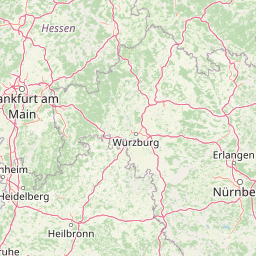
Map view of Kortenbach bei Froschhausen

Use this park location map to pinpoint Kortenbach bei Froschhausen in Germany, understand its exact geographic position, and read its mapped placement within the surrounding landscape more clearly.

Pigeon | © OpenStreetMap contributors

Location context for Kortenbach bei Froschhausen

HessenLandkreis Offenbach

Explore protected floodplain habitats, ancient trees, and stream environments through detailed field photography.

Kortenbach bei Froschhausen Photos and Landscape Scenery Visuals

Visual documentation captures the moist broadleaf forest, relict hardwood stands, and stream corridors defining Kortenbach bei Froschhausen. Examining these protected habitats provides clear insight into the conservation character and woodland terrain of the region.

A triangular nature reserve sign with a bird silhouette and a green informational board below it, set against a grassy field and trees.

Park atlas

Compare adjacent forest reserves and regional floodplain habitats across Hesse

Parks Near Kortenbach bei Froschhausen and Surrounding Protected Areas

Browsing parks near Kortenbach bei Froschhausen reveals a network of protected forest reserves and regional wetland sites across the surrounding landscape. Comparing these neighboring conservation areas provides valuable geographic context for understanding floodplain woodland remnants throughout the Rhine Main region.
A pale, horizontal watercolor painting showing a grassy floodplain, scattered deciduous trees, a gentle path or stream winding through the center, and a soft, pastel-toned sky.
Nature reserveHessen
About 1.7 km away#1 closest

Northeast

Pechgraben bei Klein-Krotzenburg Nature Reserve in the Hessen Protected Landscape Network

A preserved mosaic of ancient floodplain terrain and wetland habitats.

Located in the Offenbach district, this nature reserve protects a rare post-glacial flood channel of the Main river. The site exhibits a diverse landform mosaic, ranging from near-natural broadleaf forests to expansive sedge marshes. It functions as a critical protected geography for regional species, maintaining its ecological character against the surrounding agricultural and residential development of the Lower Main valley.

Area
0.341 km²
Established
1998
IUCN
IV
Relief
Lowland
Nature reserveLandkreis Offenbach
About 3.8 km away#2 closest

Southeast

Langhorst von Hainburg und Seligenstadt: Geography of a Main Valley Nature Reserve

Protected floodplain forest and wet meadows in Landkreis Offenbach

Langhorst von Hainburg und Seligenstadt is a key nature reserve in Landkreis Offenbach, Germany. This protected area showcases a preserved floodplain mosaic, featuring structurally diverse broadleaf forest, open wet meadows, and historical stream relics of the Main river system, serving as an essential ecological refuge within a densely populated region.

Area
0.823 km²
Established
1996
IUCN
IV
Relief
Lowland
A soft watercolor illustration of a wetland scene with a calm pool of water, grassy banks, a line of trees, and distant rolling hills against a white background.
Nature reserveHesse
About 4.2 km away#3 closest

East

Affelderchen und Rettichbruch von Klein-Welzheim: Protected Wetland Nature Reserve in Hesse

Examining the ecological landscape and hydrology of this German protected area

Affelderchen und Rettichbruch von Klein-Welzheim is a notable nature reserve in Hesse characterized by its wet meadows and marshy woodland. This geographic study covers the protected site's transition from an agricultural lowland depression to a dynamic, beaver-influenced wetland system that supports endangered plant species and diverse breeding avian populations.

Area
0.512 km²
Established
1983
Relief
Lowland
Scope
Terrestrial
Nature reserveLandkreis Offenbach
About 4.7 km away#4 closest

South

Rotsohl und Thomassee von Dudenhofen Nature Reserve in Landkreis Offenbach, Germany

Protected pine forest, wetland habitat, and pond mosaic

Spanning 52 hectares in the Rhine-Main lowlands, this nature reserve is defined by its compact interplay of dry pine forest and diverse wet open habitats. Known for the Postteiche and Weißensee ponds, it serves as a significant site for both breeding and migratory bird populations in a densely settled metropolitan region.

Area
0.519 km²
Established
1999
IUCN
IV
A wide watercolor illustration depicting a green wetland landscape with reed beds, grasses, and distant hills under a pale sky.
Nature reserveHessen
About 5.2 km away#5 closest

Northwest

Gräbenwäldchesfeld von Hausen: Nature Reserve and Protected Wetland Landscape Geography

Mapping rare meadow ecosystems in the Hessen region

Gräbenwäldchesfeld von Hausen functions as a critical protected nature reserve, safeguarding species-rich wet meadows and moisture-dependent flora in the town of Obertshausen. This atlas entry details the site's role within the Landkreis Offenbach, focusing on the preservation of reed beds and marsh landscapes amidst a predominantly urbanized terrain.

Area
0.054 km²
Established
1990
IUCN
IV
Relief
Lowland
Nature reserveHessen
About 5.8 km away#6 closest

South

Mooskiefernwald von Dudenhofen: Mapped Nature Reserve and Protected Pine Woodland in Hessen

Regional landscape context and protected area boundaries

Study the geographic composition of Mooskiefernwald von Dudenhofen, a specialized nature reserve in Hessen. This 36-hectare site features a rare moss-pine woodland environment and sandy soil habitats, offering a distinct contrast to the industrial and suburban landscape of the Rodgau area.

Area
0.361 km²
Established
1999
IUCN
IV
Nature reserveHesse
About 6.1 km away#7 closest

West

Im Woog von Hainstadt Nature Reserve: Regional Geography and Protected Landscape Atlas

Mapping floodplain habitats in the Lower Main plain of Hesse

Im Woog von Hainstadt is a structurally diverse nature reserve located in Hainstadt, Germany. The site protects a compact floodplain mosaic consisting of deciduous woodland, wet meadows, and dry grasslands on a former river meander. Adjacent to the Wildpark Alte Fasanerie, the reserve functions as a biodiversity hotspot, offering essential habitat within the developed eastern Lower Main plain landscape.

Area
0.142 km²
Established
1992
Relief
Lowland
Climate
Temperate
A horizontal watercolor painting showing a stylized, layered forest scene in muted green, pink, and yellow tones on a white background.
Nature reserveHesse
About 6.2 km away#8 closest

Northwest

Lauternsee bei Klein-Auheim Nature Reserve: Geography and Protected Bog Landscape

A historic high terrace habitat within the Hesse woodland region.

Lauternsee bei Klein-Auheim represents a specialized Flachmoor habitat that emerged from a former river channel of the Main. This nature reserve serves as an important ecological anchor in the lower Main valley, protecting essential wetlands, amphibian populations, and unique marsh plant communities within an expansive forest setting.

Established
1987

Common questions about visiting, size, designation, and location context for Kortenbach bei Froschhausen

Kortenbach bei Froschhausen FAQs for park facts, access, geography, and protected area context

Find quick answers about Kortenbach bei Froschhausen, including protected-area facts, park geography, trail and visitor context, and how the park fits into its surrounding country and regional landscape.
MoriAtlas Explorer

Continue Your Protected Areas Search Across the Global Atlas

Deepen your exploration by continuing the structured search for national parks and protected areas worldwide. Utilize the comprehensive filtering capabilities to compare different conservation landscapes and refine your understanding of global park geography. Discover more about the distribution and characteristics of protected natural areas.

Global natural geography