
Why Martinské stěny stands out
Martinské stěny is best known for its dramatic quartz sandstone cliff face, a roughly 300-metre-long steep defilé formed in the Middle Turonian strata of the Bohemian Cretaceous Basin. The cliffs are distinguished by well-developed karren features in the uppermost parts of the rock wall, and by specialised heathland and rock-dwelling invertebrates such as the heathland wolf spider (Alopecosa fabrilis) and the brown trapdoor spider, which thrive on the site's mossy rock surfaces and heath microhabitats.
Martinské stěny history and protected-area timeline
Martinské stěny was formally designated as a Czech natural monument on 19 November 2002 by the administration of the Kokořínsko Protected Landscape Area. The designation recognised both the site's geomorphological significance and the presence of specialised invertebrate fauna on its sandstone cliffs and associated heath and lichen microhabitats.
The natural monument was created as part of a broader conservation effort in the northern part of the Kokořínsko region, where a series of small protected areas including Vlhošť, Husa, Kostelecké bory, Stříbrný vrch, and Martinské stěny were established or strengthened to safeguard the characteristic sandstone-rock landscape of the Ralská pahorkatina. The site was also integrated into the Roverské skály European significant locality, anchoring the protection of its cliffs within the larger Natura 2000 framework.
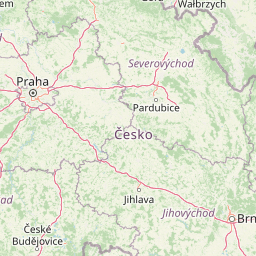
Martinské stěny landscape and geographic character
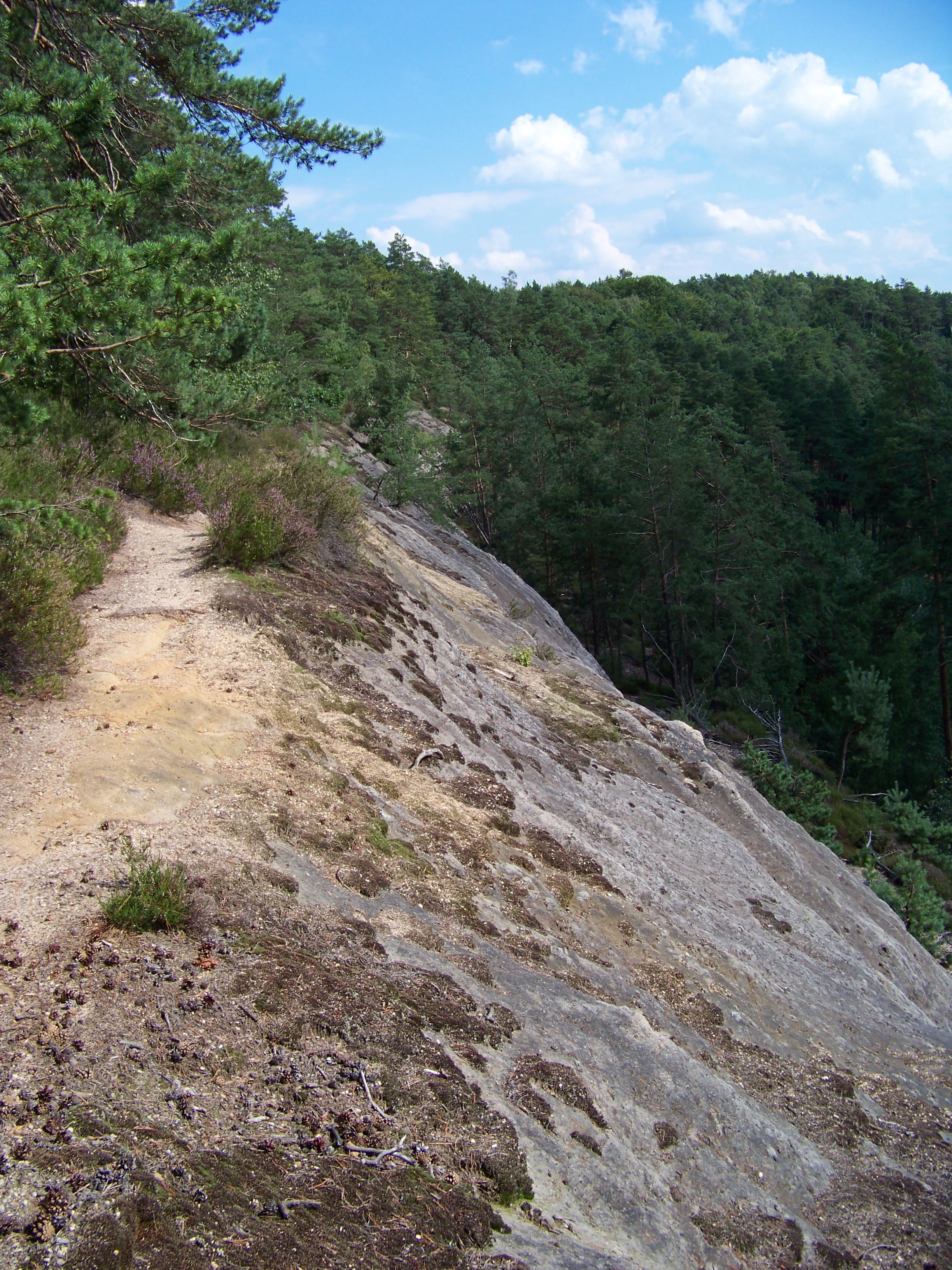
The landscape of Martinské stěny is dominated by a single defining feature: a steep sandstone cliff roughly 300 metres long. The cliff rises to elevations between 390 and 420 metres above sea level, forming an abrupt wall within an otherwise gently rolling forested terrain. The surrounding land is part of the Ralská pahorkatina, a gently undulating upland dotted with sandstone outcrops, small valleys, and mixed forest stands.
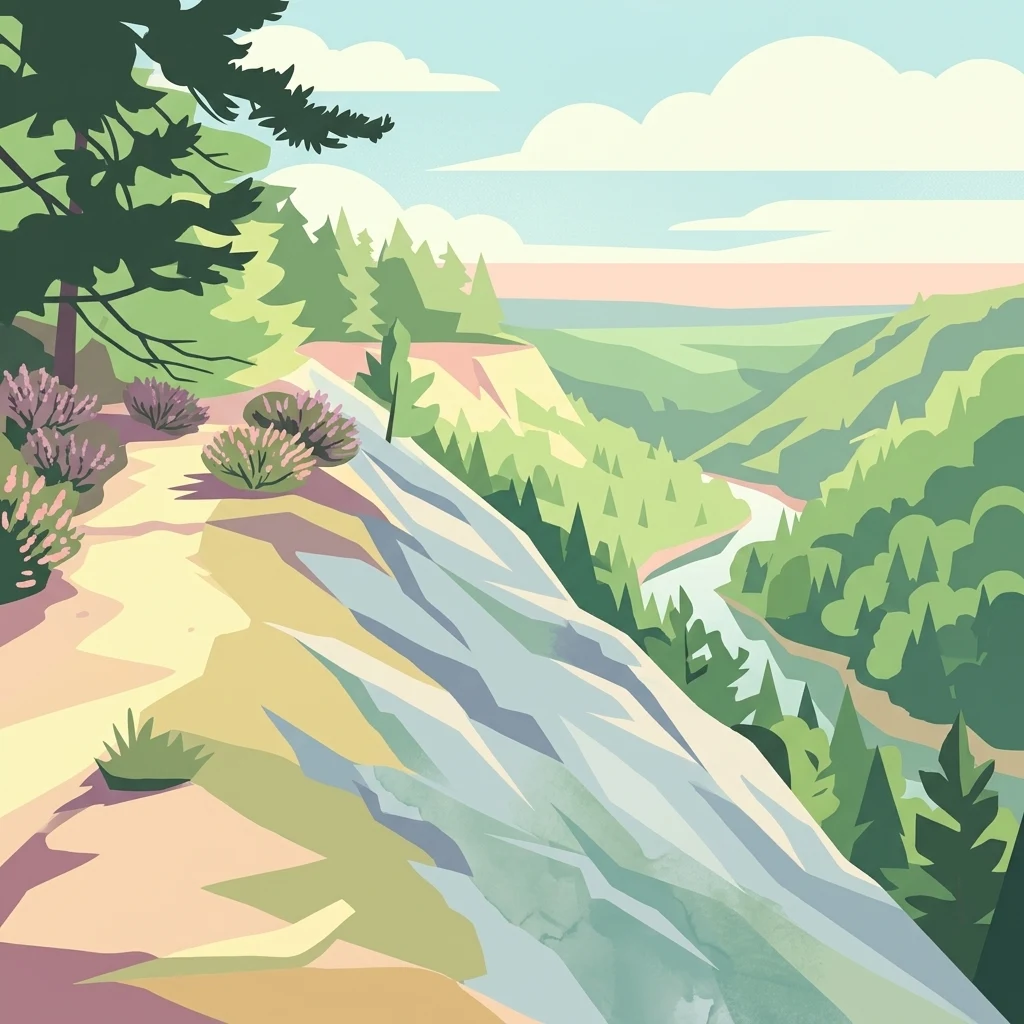
At the cliff itself, the rock face is composed of quartz sandstones of the Middle Turonian Jizerské souvrství, a stratigraphic unit within the Bohemian Cretaceous Basin. Erosion has carved the wall into a near-vertical defilé, with the highest, most intact sections preserving well-developed karren features (solution grooves and pits) that give the rock a distinctive sculpted appearance. The cliff's upper edge, where resistant sandstone caps softer layers, is followed by a marked hiking trail that traces the entire northern section of Kokořínsko.
Below and around the cliff, the terrain is densely forested, characteristic of the protected landscape area's sandstone soils. Heath and lichen communities colonise sun-warmed rock surfaces, crevices, and shallow ledges, providing the open microhabitats that distinguish this site from the closed woodland that surrounds it.
Martinské stěny ecosystems, habitats, and plant life
The ecosystems of Martinské stěny combine forested sandstone terrain, exposed rock faces, and specialised heath and lichen communities. The woodlands surrounding the cliff are part of the broader mosaic of the Kokořínsko Protected Landscape Area, where sandstone soils support mixed forest stands typical of northern Bohemian uplands.
The most ecologically distinctive component is the cliff itself, together with thin soils and rock ledges where heath and lichen vegetation develops. These warm, dry microhabitats support a restricted community of invertebrates adapted to exposed rock environments, and are the primary reason for the site's formal protection. The combination of open rock, scattered heath patches, mossy crevices, and forested surround creates a layered ecological gradient within a very small area.
Martinské stěny wildlife and species highlights
The site's protected fauna consists of several invertebrates closely tied to heath and lichen habitats on warm sandstone rock. The heathland wolf spider (Alopecosa fabrilis) is among the documented species, occupying open ground and rock-edge habitats where heather and moss provide cover. The brown trapdoor spider is also recorded, occupying burrows and crevices in stable rocky substrates.
These invertebrate communities are characteristic of dry, sun-exposed sandstone environments in northern Bohemia and represent the conservation focus of the monument. The broader forest landscape around the cliffs supports typical woodland fauna of the Kokořínsko region, though the formal protection targets remain the specialised rock-dwelling invertebrates, rather than larger vertebrates.
Martinské stěny conservation status and protection priorities
Martinské stěny carries IUCN management category III designation as a natural monument, recognising its significance at both geological and ecological levels. Conservation here is narrowly targeted: the site is protected primarily for its sandstone cliff geomorphology and for the small, specialised invertebrate community associated with heath and lichen microhabitats on the rock. Any disturbance to the rock face, exposed soils, or surrounding heath vegetation could directly affect the protected invertebrate species.
At the landscape scale, Martinské stěny sits within the Roverské skály European significant locality, which spans around 1,688 hectares across multiple cadastres in the northern Kokořínsko area. This inclusion connects the small monument to European-level conservation frameworks and places it in a wider network of protected sites that collectively safeguard the sandstone-rock landscape between Česká Lípa and Dubá.
Martinské stěny cultural meaning and human context
There is limited specific cultural or historical material associated with Martinské stěny beyond its long-standing identity as a regionally familiar sandstone cliff. The surrounding landscape of the Kokořínsko area has a strong tradition of small-scale, intimate exploration by hikers and naturalists, reflected in the network of marked trails that thread through the protected landscape area. The cliff itself is referenced by the red-blazed hiking trail that runs along its upper edge, linking it into the broader pedestrian culture of northern Bohemia.
Top sights and standout views in Martinské stěny
Martinské stěny is best appreciated for the contrast between its modest size and the visual drama of its sandstone cliff, and for its role as a refuge for specialised heathland invertebrates. The site's key qualities include the 300-metre-long quartz sandstone defilé, the small-scale karren features along the cliff's upper intact sections, the heath and lichen communities clinging to exposed rock, and its position within the wider network of small protected sites in northern Kokořínsko.
Best time to visit Martinské stěny
Martinské stěny can be appreciated throughout much of the year, but the warm late-spring and summer months are generally the most rewarding. Warmer, drier conditions highlight the heath and lichen communities along the cliff, and the invertebrate fauna that the monument is designed to protect is most active in this season. Spring and autumn also offer pleasant walking conditions along the cliff-top trail, with softer light on the sandstone surfaces and the surrounding forest in seasonal colour.