
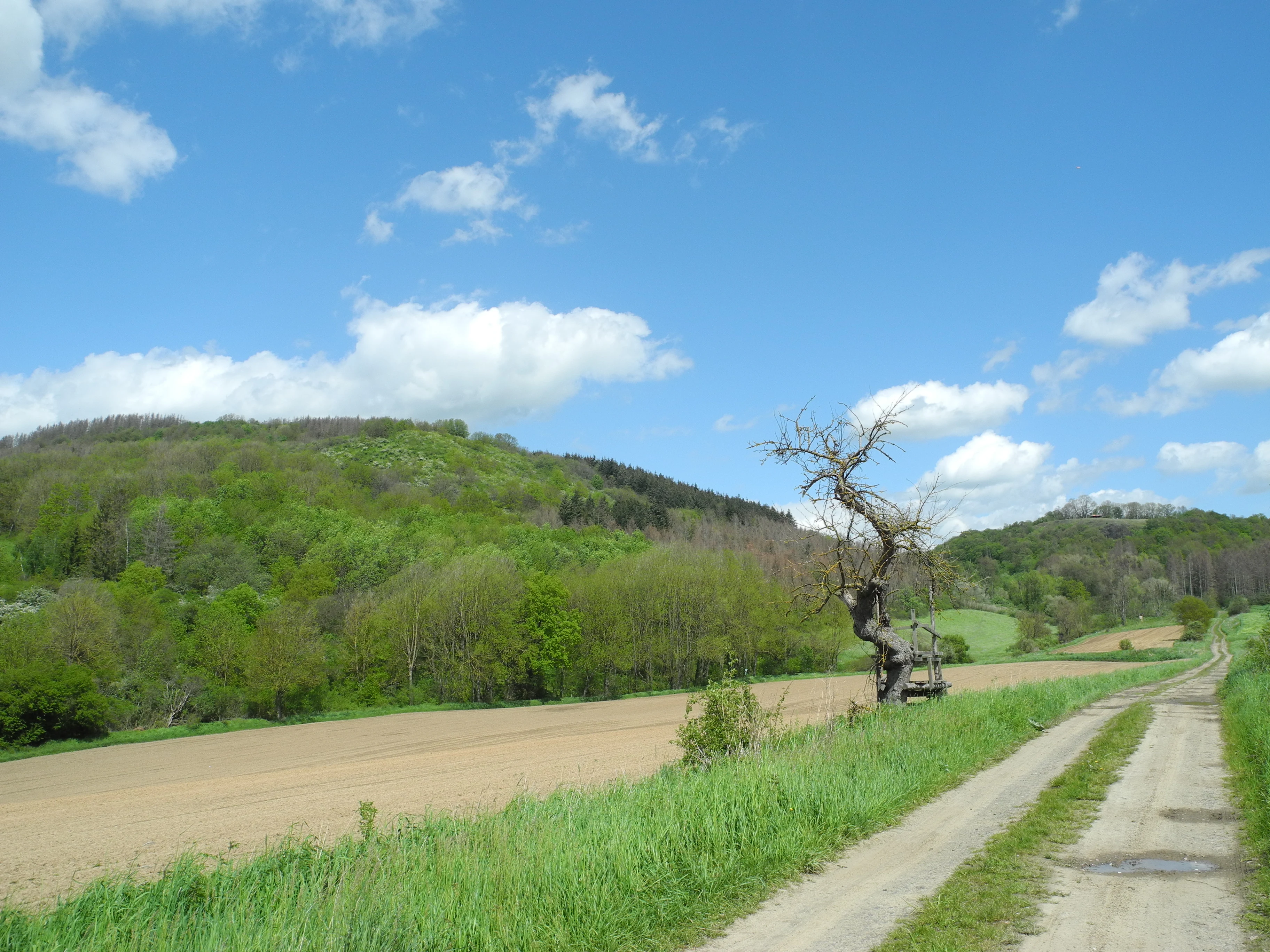
Why Mosenberg bei Homberg stands out
The reserve is best known for its species-rich, light oak-hornbeam forest with abundant deadwood on basalt scree, and for its mosaic of nutrient-poor grasslands shaped by historic sheep grazing and wood-pasture use. It is also recognized as a breeding and foraging habitat for characteristic birds of warm-dry slope environments, notably red-backed shrike, black woodpecker, and peregrine falcon.
Mosenberg bei Homberg history and protected-area timeline
The area around the Mosenberg has a long history shaped by settlement, hilltop fortification, and traditional land use. The slopes bear the Sauerburg, a ruined castle site that anchors both the name and the cultural identity of the hill. For centuries, the surrounding woodland slopes were managed as coppice (Niederwald) and wood-pasture (Waldweide or Hutewald), while the drier, sun-exposed grasslands were grazed by sheep or mown in rotation. These systems gradually produced the species-rich vegetation patterns still visible today.
Formal nature conservation arrived in 1986, when the area was placed under legal protection as a Naturschutzgebiet under the designation number 1634015 by the responsible Hessian authorities. The protected area was later recognized at the European level as part of the Natura 2000 network, becoming FFH site 4922-301 "Mosenberg bei Homberg," and the two designations were made spatially identical.
A formal management plan was prepared by the Regierungspräsidium Kassel in May 2011, addressing the protection and development of the site's grassland and woodland habitats. This plan formalized ongoing measures such as sheep grazing, mowing regimes, hay-transfer seeding, and the maintenance of the characteristic oak-hornbeam forest structure, marking a shift from passive protection to active, targeted conservation management.
Mosenberg bei Homberg landscape and geographic character
The reserve occupies the lower and middle slopes of the Mosenberg and the basalt scree leading down from the Sauerburg. The relief is moderately sloping to locally steep, with thin, stony soils derived from basalt weathered material. These edaphic conditions, combined with the south-west to west exposure, create drier and warmer microclimates than the surrounding plateau and valley.
At its eastern edge, the hill rises to the summit of the Mosenberg at about 437 meters above sea level. Below the summit, the basalt rubble slopes descend into a mixture of open grassland, scrub patches, and gradually denser woodland. The distinctive feature of the slope is the transition, over relatively short distances, from open lean grassland to closed oak-hornbeam forest, producing sharp habitat edges that are themselves valuable for many species.
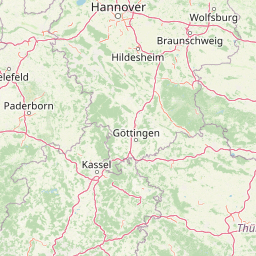
A small stream, the Klingelbach, runs along the southern margin of the reserve as a right-hand tributary of the Efze. Combined with the nearby Landesstraße L 3224 along the southeastern edge, the site is bordered by both hydrological and infrastructure features that frame its landscape setting between natural valley and settled countryside.
Mosenberg bei Homberg ecosystems, habitats, and plant life
Ecologically, Mosenberg bei Homberg is defined by warm-dry, semi-open habitats that have become rare in much of central Germany. The vegetation mosaic includes nutrient-poor grasslands (Magerrasen) in various stages of succession, from open, grazed turf to thicket with colonizing shrubs. Embedded within this grassland matrix are small patches of extensive meadows and field copses, while along the basalt slopes the vegetation shifts into light oak-hornbeam woodland rich in noble hardwoods.
The woodland itself is structurally distinctive. Because it evolved under coppice and wood-pasture systems rather than modern high-forestry practice, it is comparatively open, multi-layered, and rich in old, gnarled trees. Standing and fallen deadwood is abundant, supporting communities of fungi and invertebrates specialized on decaying wood. The combination of open soils, exposed rock, and varied microhabitats gives the slope a particularly high habitat diversity over a small area.
The site's classification as an FFH area reflects the presence of habitat types of European interest, particularly the open dry grasslands and the orchis- and hornbeam-rich deciduous forest communities of the basalt slopes. These habitats not only host notable flora, they also underpin the site's value for breeding birds and invertebrates that depend on structurally rich, extensively used landscapes.
Mosenberg bei Homberg wildlife and species highlights
The wildlife profile of Mosenberg bei Homberg is closely tied to the structure of its habitats. The reserve is explicitly recognized for its breeding and foraging bird communities, which include the red-backed shrike as a breeding species, and black woodpecker and peregrine falcon as regular visitors searching for food. Red-backed shrike, in particular, is associated with the warm, partly open slopes with scattered shrubs and trees that the reserve provides in abundance.
Black woodpecker benefits from the high volume of deadwood and old trees in the oak-hornbeam forest, using them both for foraging and for cavity creation that other species later reuse. Peregrine falcon presence, even as a foraging guest rather than a confirmed breeder, indicates that the open slopes and adjacent cliff-like or rocky terrain around the Sauerburg provide hunting opportunities and possibly nesting ledges.
Beyond birds, the mosaic of dry grassland, scrub, and deadwood-rich woodland supports a rich invertebrate fauna characteristic of traditional cultural landscapes, including pollinators, grasshoppers, and saproxylic beetles associated with decaying wood. Small mammals typical of woodland edges and dry grasslands, as well as common reptiles that use warm, stony slopes, also find suitable habitat here, although the available documentation emphasizes the site's bird conservation value above all.
Mosenberg bei Homberg conservation status and protection priorities
Conservation significance at Mosenberg bei Homberg rests on the spatial coincidence of two formal protection regimes: the German Naturschutzgebiet designation under code 1634015 since 1986, and the European Natura 2000 designation as FFH site 4922-301. This double designation means the site is managed to maintain both nationally valued habitats and habitat types and species of Community interest under the EU Habitats Directive.
The conservation strategy combines preservation with active management. The lean grasslands on the southern and western slopes are maintained and developed through targeted sheep grazing and mowing-pasture regimes, supplemented by measures such as hay-transfer seeding to reinforce characteristic species. The oak-hornbeam forests on the basalt scree of the Sauerburg slopes are maintained in their historical, structurally rich form, retaining features such as open canopy, deadwood, and a high proportion of noble hardwoods.
The management plan published in 2011 by the Regierungspräsidium Kassel systematized these measures and tied them explicitly to the conservation goals of the FFH designation. In this framework, Mosenberg bei Homberg is not viewed as a static relic but as a working cultural landscape whose biodiversity depends on the continuation of adapted, low-intensity land use.
Mosenberg bei Homberg cultural meaning and human context
The cultural context of Mosenberg bei Homberg is inseparable from its ecological value. The mosaic of grassland, coppice relicts, and wood-pasture woodland is a direct product of centuries of rural land use in the Efze valley, where steep basalt slopes were never intensively farmed. The presence of the Sauerburg, a ruined castle perched above the reserve, ties the landscape to broader patterns of medieval settlement, fortification, and territorial control in northern Hesse.
Traditional practices such as sheep herding, rotational mowing, and selective woodland cutting for fuel wood and grazing are not merely historical curiosities; they remain embedded in the reserve's current conservation strategy. The site thus serves as a tangible reminder that many of the most biodiverse habitats in central Europe are cultural landscapes, maintained by the interaction of people, livestock, and terrain over long periods.
Recognition of this dual natural-cultural value is reflected in the management approach, which frames grazing, mowing, and selective forestry as cultural practices that simultaneously sustain local identity, rural livelihoods, and habitat quality.
Top sights and standout views in Mosenberg bei Homberg
A standout feature of Mosenberg bei Homberg is the sharp ecological transition across a short distance, from open lean grassland on the lower slopes to a light, deadwood-rich oak-hornbeam forest on the basalt scree. This structural complexity, compressed into a relatively small area, gives the site an unusually high habitat density for its size.
The reserve's formal significance is reinforced by the overlap of national and European protection frameworks, while its practical significance lies in the way historic grazing and coppice practices continue to shape biodiversity outcomes today. Few sites of comparable size combine such a clear demonstration of warm-dry slope habitats, traditional land use, and conservation planning in a single, coherent landscape.
Best time to visit Mosenberg bei Homberg
As a small, low-elevation reserve without major seasonal infrastructure, Mosenberg bei Homberg is principally a site for quiet, off-season nature observation. Late spring and early summer are typically the most rewarding time to experience the lean grasslands, when grasses and wildflowers are in full growth, shrub-nesting birds such as the red-backed shrike are establishing territories, and insect activity on the warm slopes is at its peak.
Autumn can also be attractive for visitors interested in woodland character, as the oak-hornbeam forest on the basalt slopes takes on warm leaf colors and fruiting structures become more visible, while the deadwood component of the forest remains evident year-round. Winter visits offer clearer views across the open slopes and the silhouette of the Mosenberg hill and Sauerburg ruins against the surrounding agricultural landscape, though weather-dependent accessibility along minor rural roads may be a constraint outside the main seasons.