
Why Naturwald Waldhaus stands out
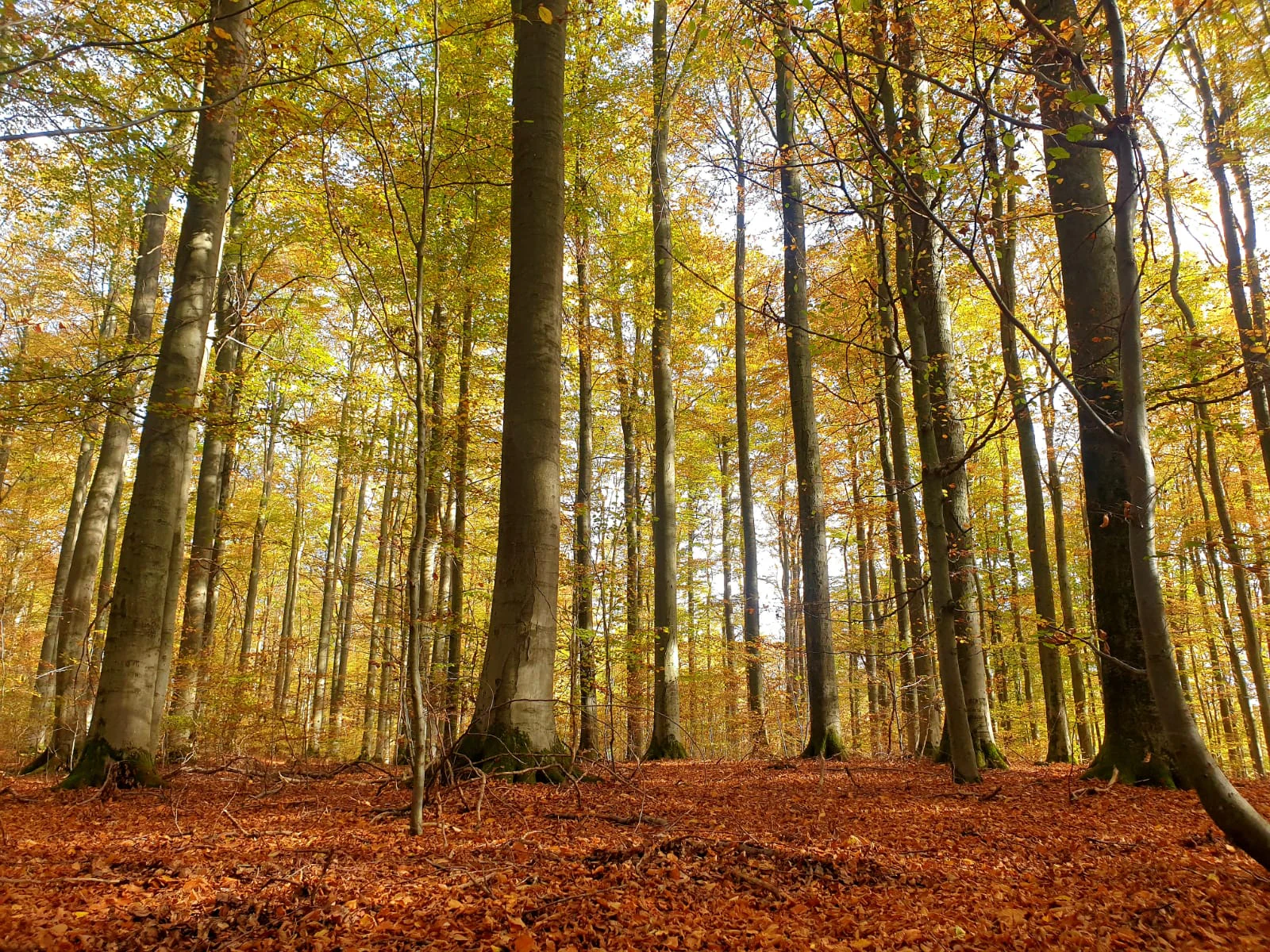
Naturwald Waldhaus is renowned for its exceptionally old beech stands, including roughly two dozen so-called Schaufelbuchen trees that are around 300 years old. Around 40 percent of the standing timber volume per hectare in parts of the reserve originates from these ancient trees, together with around 190-year-old cohorts that have been left to grow undisturbed. This continuity of very old trees has produced a near-primeval forest structure that is extremely rare in Germany. The reserve is also widely known as the best-studied beech stand in southern Germany and ranks among Bavaria's hotspot sites for saproxylic beetles, including the rare hermit beetle (Osmoderma eremita) and a total of more than 300 documented xylobiont beetle species across the whole reserve.
Naturwald Waldhaus history and protected-area timeline
The story of Naturwald Waldhaus is essentially a story of long, passive protection and active scholarly attention. Unlike many of the surrounding state forests, the Waldhaus area was historically managed only extensively rather than intensively, which allowed trees with woodpecker cavities, fungal infections such as the birch polypore (Zunderschwamm), and other biologically valuable features to remain standing. Over time this lighter management approach produced structurally rich forest stands that contrasted sharply with the more productive, evenly aged timber forests around them.
Formal conservation began in 1978, when 10 hectares of the woodland were designated as a Naturwaldreservat. In 1998 the reserve was expanded to roughly 92 hectares, and in 2020, in the wake of the 2019 Bavarian citizens' initiative 'Artenvielfalt & Naturschönheit in Bayern' (Biodiversity and Natural Beauty in Bavaria), the Bavarian state government committed to taking 10 percent of the state forest out of active use. Waldhaus was expanded to 106.24 hectares and reclassified as a Naturwald under Bavarian forest law.
Because the area is owned by the Free State of Bavaria, the reserve was integrated into the Bavarian natural forest network alongside the state's other Naturwaldreservate, providing it with an additional Naturwald protection layer. Scientific research on the site began in the early 1980s, and the area is now regarded as one of the most thoroughly investigated beech reserves in Germany, attracting studies on fungi, bats, beetles, molluscs, and forest dynamics across multiple decades.
Naturwald Waldhaus landscape and geographic character
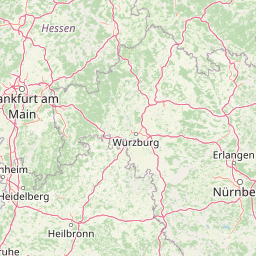
Naturwald Waldhaus sits on the western flank of the Steigerwald, a low mountain range whose slopes and ridges define much of the surrounding landscape of northern Bavaria. The reserve itself occupies a compact but varied section of terrain, sloping from roughly 350 metres above sea level in the south to about 448 metres on an unnamed northeastern hilltop. This gradient creates a sequence of microclimates within a relatively small footprint, ranging from cool, shaded ravine sections to drier, more exposed ridges.
The forest is drained by two small unnamed streams that feed into the Handthaler Graben, a tributary valley system that connects the reserve to the wider Steigerwald landscape. Springs such as Klaupertsbrunnen and Waldhausbrunnen on the eastern side of the area provide additional moisture, creating locally humid conditions that support moss-rich, fern-rich microhabitats.
The broader landscape around the reserve is shaped by the alternating woodland, agriculture, and small villages typical of Upper and Lower Franconia. Just south of the protected area lies the Baumwipfelpfad Steigerwald canopy walkway in the Radsteinwald, linking visitors visually and thematically to the wider forest landscape. The neighbouring Naturwald Brunnstube, about two kilometres to the east, forms part of a small cluster of protected forest stands that together represent some of the most natural forest scenery left in the region.
Naturwald Waldhaus ecosystems, habitats, and plant life
Ecologically, Naturwald Waldhaus is defined above all by its unusually old and structurally diverse beech forest stands. European beech (Fagus sylvatica) is the dominant species, but the reserve also contains oak, hornbeam, ash, and black alder, particularly in wetter and transitional zones. The mix of mature and ancient cohorts gives the forest both vertical layering and a strong deadwood component, with old, dying, and standing dead trees all present in significant numbers.
The reserve falls entirely within the Natura 2000 site 'Buchenwälder und Wiesentäler des Nordsteigerwalds' and within the bird protection area 'Oberer Steigerwald'. These designations connect it to a wider network of protected broadleaf forest and meadow-valley habitats that characterise the northern Steigerwald.
In the core zone of the reserve, researchers have documented 407 species of fungi, 96 vascular plant species, five moss species, and a wide range of invertebrate and vertebrate groups. The forest is therefore notable not only for what is visible from a trail, but also for the cryptic biodiversity that lives in its bark, deadwood, leaf litter, and small streams. The presence of the rare Bechstein's bat, the barbastelle bat, and the hazel dormouse indicates that the forest functions as a connected, structurally intact habitat for species that depend on old-growth conditions.
Naturwald Waldhaus wildlife and species highlights
The wildlife profile of Naturwald Waldhaus reflects the age and continuity of its forest. Researchers have recorded 35 bird species, 15 bat species, 23 mollusc species, 16 ground beetle species, 42 bug species, 42 earthworm species, smaller populations of ants and harvestmen, and 289 saproxylic beetle species in the 10-hectare core zone alone, with 314 saproxylic beetles documented across the entire reserve.
Among the birds, the reserve supports several species characteristic of mature deciduous forest, including the middle spotted woodpecker, grey-headed woodpecker, collared flycatcher, red-breasted flycatcher, stock dove, Eurasian pygmy owl, boreal owl, honey buzzard, and Eurasian woodcock.
Mammal records include the hazel dormouse, Bechstein's bat, and the Western barbastelle, all of which depend on the cavity-rich, structurally complex trees that have been allowed to age in place. Invertebrate highlights include the hermit beetle (Osmoderma eremita), a saproxylic beetle that depends on very old hollow broadleaf trees and was first confirmed here in a southern German beech forest in 2006. The reserve's rich wood-fungi community, with 407 documented species, underpins much of this saproxylic food web. Aquatic life in the small streams includes the stone crayfish and the European brook lamprey.
Naturwald Waldhaus conservation status and protection priorities
Naturwald Waldhaus is one of the core reference sites for natural forest development in Bavaria. It is protected under Article 12a of the Bavarian Forest Act and managed by the Bayerische Staatsforsten, with all timber harvesting excluded except where necessary for forest protection or public safety. This places the reserve in the strict end of the German forest protection spectrum, alongside other Naturwaldreservate.
The expansion of the reserve from 10 hectares in 1978 to 92 hectares in 1998 and finally to over 106 hectares in 2020 mirrors the gradual shift in Bavarian forest policy toward longer-term unmanaged conservation. The 2020 enlargement in particular reflected the outcome of the 2019 Bavarian citizens' initiative on biodiversity, which committed the state to retaking 10 percent of state forest from active use for ecological reasons. At the national level, Waldhaus contributes to Germany's target of leaving 5 percent of forest area free for natural development.
Internationally, the reserve's IUCN status has not been formally reported and the site is below the typical IUCN size thresholds for strict nature reserves, but its importance is clearly recognised through its inclusion in Natura 2000, both as a Fauna-Flora-Habitat site and as part of a bird protection area. Its exceptionally well-developed beech stands place it among the most structurally valuable central European beech forests still present outside the Carpathians.
Top sights and standout views in Naturwald Waldhaus
Naturwald Waldhaus stands out for combining unusually old beech trees, strict long-term protection, and a long record of scientific study. The age profile of its beech stands, with about two dozen Schaufelbuchen roughly 300 years old and 190-year-old cohorts left to age in place, gives the forest a primeval structure rarely seen in German beech reserves outside the Carpathian context.
The reserve is also exceptional for the depth of its biodiversity documentation, with 407 recorded fungal species, more than 300 saproxylic beetle species, and well-studied assemblages of bats, birds, and molluscs. Its 2020 expansion under Bavarian biodiversity policy gives it both a contemporary conservation role and a place in the longer story of natural forest protection in central Europe.
Best time to visit Naturwald Waldhaus
The forest can be visited at any time of year, but the experience changes with the seasons. Spring brings fresh green foliage and increasing bird activity, including the return of woodpeckers, flycatchers, and other forest-breeding species. Summer offers a deeply shaded, cool forest atmosphere, while autumn is the most visually distinctive period, with beech and oak colour, abundant fungi, and the visible increase in deadwood and decaying wood features that are central to the reserve's character. Winter exposes the structural complexity of the stand, making it easier to see the ancient Schaufelbuchen and the cavity trees that define the old-growth character of the site.