Why Naturwald Wotansborn stands out
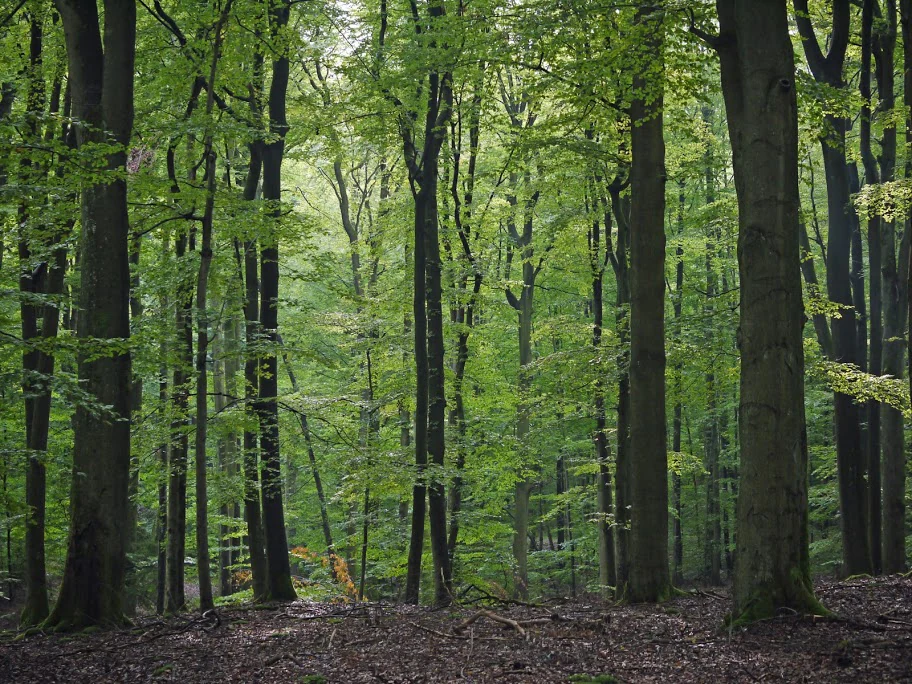
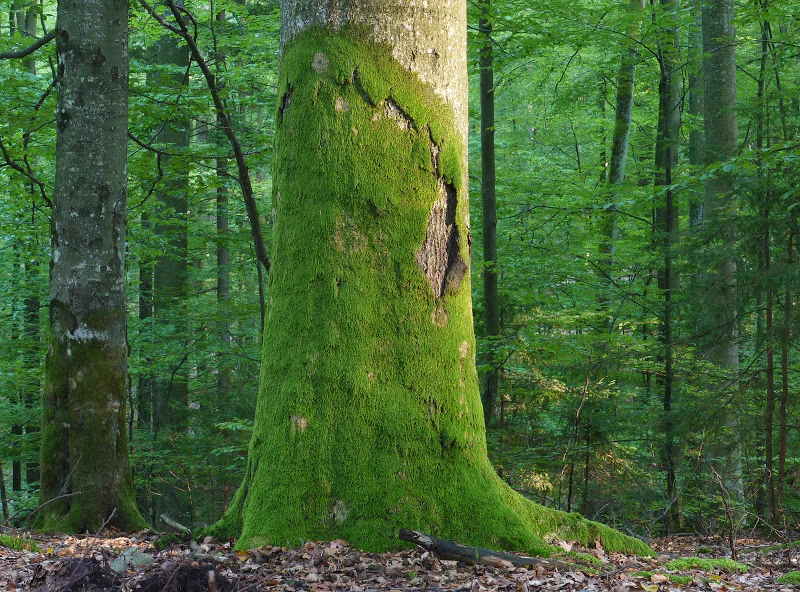
Naturwald Wotansborn is best known for being a compact, old-growth beech forest island with roughly 170- to 200-year-old trees, abundant biotope trees, and an unusually rich deadwood structure for such a small area. It also includes the 1912-captured Wotansborn spring, from which the reserve takes its name, and the Erlesbach stream, a fish-free, cool, oxygen-rich brook that supports fire salamander larvae. The reserve is a textbook example of a Bavarian Naturwald: small in size but intensively structured as habitat, with characteristic features such as hollow beeches, mossy trunks, specialised bracket fungi, and a herpetologically significant amphibian community.
Naturwald Wotansborn history and protected-area timeline
The forest of the northern Steigerwald, including the beech stand at Wotansborn, belonged from 1023 onward to the Würzburg Hochstift, the ecclesiastical principality of the Prince-Bishopric of Würzburg. For centuries thereafter the woodlands were managed without systematic planning, and by the early modern period the Hochstift had grown concerned about the long-term condition of its forests.
In 1721, the Hochstift issued a forestry ordinance that required main trees to be retained within felling areas. This shifted the local practice toward the formation of multi-layered coppice-with-standards woodlands (Mittelwälder), which supplied wood for local glass and iron smelting operations. After 1814, when this part of the Steigerwald passed into the hands of the Kingdom of Bavaria following the territorial reorganizations of the Napoleonic era, the management regime gradually transitioned from Mittelwald to Hochwald, or high forest.
This long-term shift had a lasting effect on species composition: oak, prized as construction timber, declined sharply, while the less commercially attractive beech was able to survive and eventually dominate. The mature beech stand visible today at Wotansborn is a direct legacy of this historical preference. Because the stand ceased to be commercially logged, it developed into a roughly 170- to 200-year-old beech island rich in biotope trees and deadwood. On 6 March 2020, the area was formally designated a Naturwald under Article 12a of the Bavarian Forest Law, securing it as a permanently unmanaged forest reserve within the Natura 2000 site "Buchenwälder und Wiesentäler des Nordsteigerwalds."
Naturwald Wotansborn landscape and geographic character
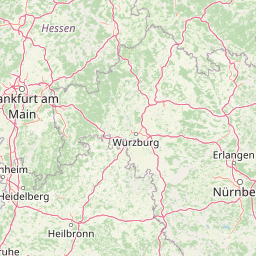
Naturwald Wotansborn lies in the wooded hills of the northern Steigerwald, a low mountain range of sandstone and keuper geology in Lower Franconia. Its terrain is gently undulating, shaped by centuries of selective forestry, but within the reserve itself the ground profile is largely the product of long ecological processes: standing and fallen old beeches, mossy slopes along the Erlesbach, and the small captured Wotansborn spring at the heart of the site.
The dominant landform is the small valley of the Erlesbach, fed by the spring and flowing on toward the Rauhe Ebrach. The brook crosses the reserve through a narrow, shaded corridor where beech leaves blanket the forest floor, and where cool, well-oxygenated water creates still pools and damp pockets in an otherwise freely flowing stream. Uphill from the brook, the reserve climbs through dense beech canopy, with understory gaps and hummocky terrain around large old root plates.
A narrow strip of forest humorously nicknamed "Transwotanien" lies just across the Erlesbach from the main reserve, illustrating how the protected area is embedded within a wider forested landscape rather than sitting as an isolated patch. Overall, the landscape is a beech-dominated, mid-elevation woodland marked more by age, decay, and process than by dramatic relief, offering an intimate rather than panoramic kind of scenery.
Naturwald Wotansborn ecosystems, habitats, and plant life
Ecologically, Naturwald Wotansborn is a beech-dominated mixed woodland (Buchenmischwald) that has been deliberately released from forestry pressure to allow natural forest dynamics to unfold. Because the stand is no longer harvested, it has entered a phase of structural diversification that commercial forests rarely achieve at this scale: multiple layers of canopy, abundant old-growth features, and an unusually high proportion of deadwood in different stages of decay.
The arboreal character of the reserve is shaped largely by European beech (Fagus sylvatica), with individual trees estimated at 170 to 200 years old. Around them, the typical near-natural beech forest community develops, including mosses on the humid, shaded sides of trunks, characteristic spring geophytes, and moisture-loving understory plants such as Impatiens noli-tangere, the large touch-me-not, which is known for its explosive seed pods. Other woodland plants characteristic of moist, shaded, base-rich beech soils also appear, contributing to the typical herb-layer profile of Steigerwald forests.
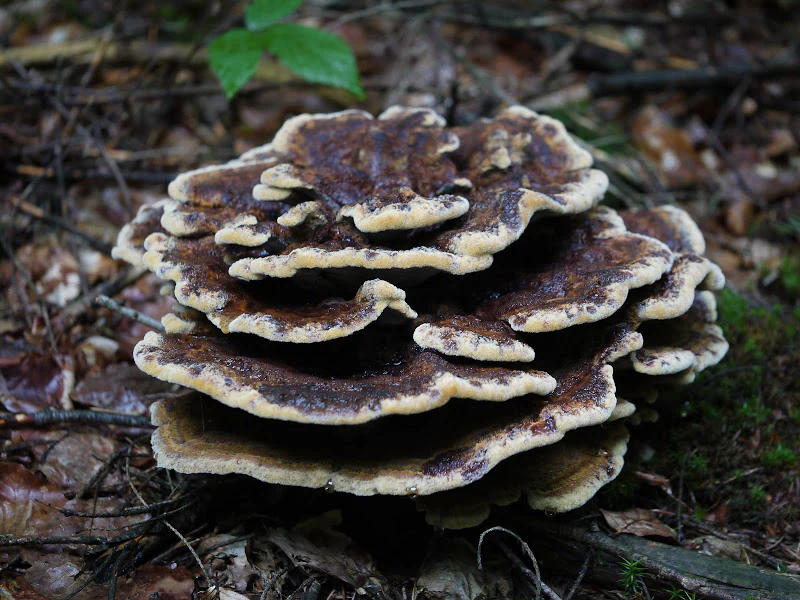
Fungi are unusually well represented thanks to the abundance of dead and dying wood. Notable species observed in the reserve include Ramaria coral fungi, the red-belted conk (Fomitopsis pinicola), the multilayered turkey tail (Trametes versicolor), the giant polypore (Meripilus giganteus), and Bulgaria inquinans, the black jelly fungus whose spores historically were used as a dye. The combination of old beeches, deadwood, moss, and seepage lines from the Wotansborn spring creates a set of microhabitats that mirror the structural complexity of much larger old-growth forests.
Naturwald Wotansborn wildlife and species highlights
Wildlife at Naturwald Wotansborn is modest in species number but distinctive in character, mirroring the amphibian-rich, structurally complex forests typical of the Steigerwald. The most prominent group is the amphibians, which depend on the cool, well-oxygenated, fish-free headwaters of the Erlesbach for their reproduction.
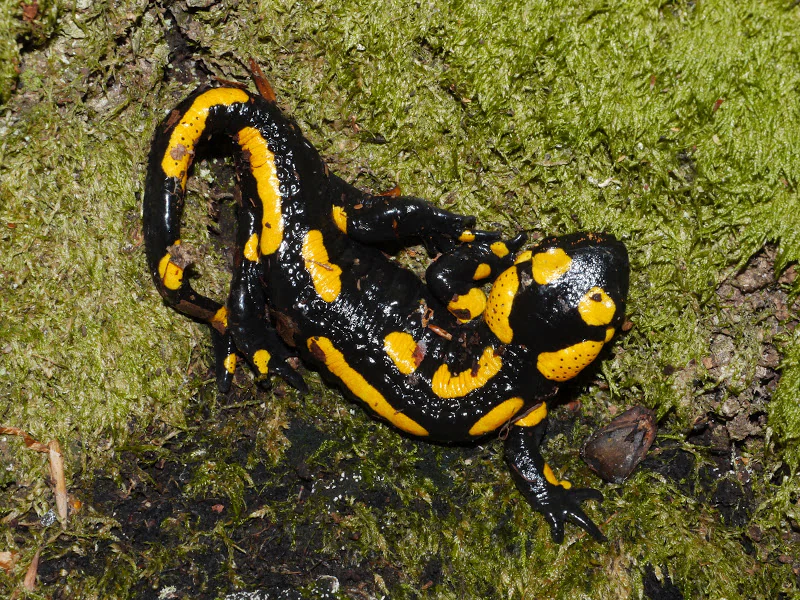
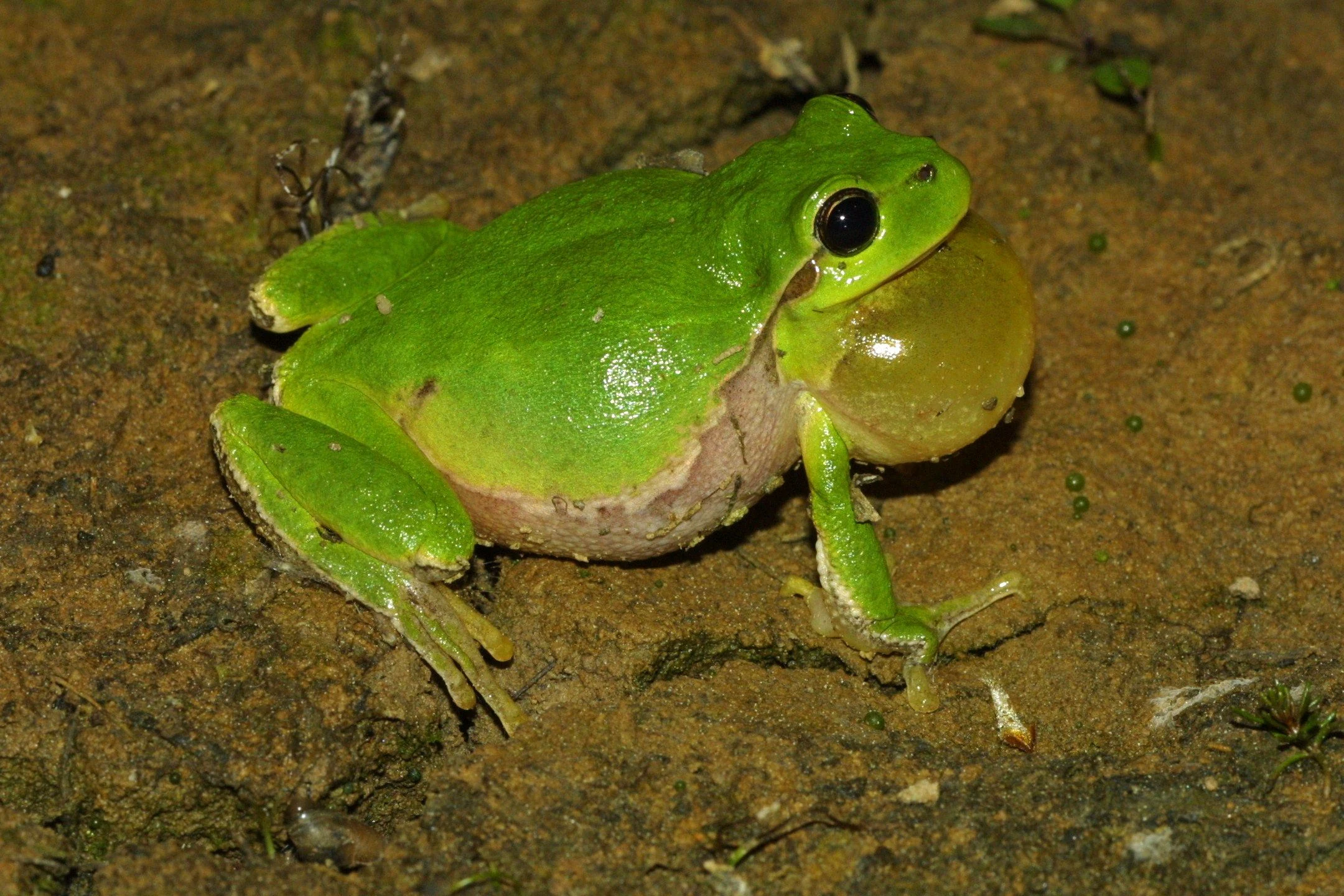
Fire salamanders (Salamandra salamandra) are the signature species of the reserve. Their larvae develop in the small still-water pockets along the brook, which meet the precise habitat requirements of the species: cold, clean, oxygen-rich, nutrient-poor, and free of fish that would prey on the larvae. Other amphibians documented at the site include the smooth newt (Lissotriton vulgaris), the Alpine newt (Ichthyosaura alpestris), the European tree frog (Hyla arborea), the common frog (Rana temporaria), the agile frog (Rana dalmatina), and the common toad (Bufo bufo). The European tree frog is described as rare in Unterfranken generally but has a notable concentration of occurrences in the Steigerwald and Hassberge hills.
Beyond amphibians, the reserve's abundance of biotope trees supports a wider forest fauna. Hollow beeches create nesting and roosting opportunities for cavity-nesting birds such as owls, for small mammals, for bats, and for wild bees that use abandoned wood-boring insect galleries as nest sites. Fallen trunks and bark crevices provide shelter for invertebrates and small forest vertebrates, while the undisturbed leaf litter and moss layers sustain a rich soil fauna typical of long-undisturbed beech forests.
Naturwald Wotansborn conservation status and protection priorities
Naturwald Wotansborn is a small but representative component of Bavaria's network of Naturwald reserves. Designated under Article 12a of the Bavarian Forest Law in 2020, it falls under the management of the Bayerische Staatsforsten, and the standing of the area is IUCN Category IV, meaning it is primarily managed for habitat and species conservation rather than for extractive use. No timber harvesting takes place inside the reserve, except for measures required for forest protection and public safety.
The site's conservation significance is closely tied to the wider Steigerwald forest complex. The reserve lies entirely within the Natura 2000 FFH area "Buchenwälder und Wiesentäler des Nordsteigerwalds" (site 6029-371), which protects beech forests and meadow valleys across the region. By preserving a roughly 170- to 200-year-old beech stand together with a permanent spring system, Wotansborn contributes to maintaining the habitat structures, deadwood resources, and microclimatic conditions on which many specialist species depend.
Its importance is also comparative. Although Wotansborn is tiny next to nearby reserves such as Naturwald Knetzberge-Böhlgrund and Naturwald Kleinengelein, it captures a specific phase of beech forest development that has largely been lost from commercially active forests. The accumulation of biotope trees, hollow trunks, and deadwood in such a compact area makes Wotansborn a useful reference site for understanding the ecological value of unmanaged even small forest patches and for connecting the Steigerwald's larger protected forests into a functional ecological network.
Naturwald Wotansborn cultural meaning and human context
The forest history of Naturwald Wotansborn is intertwined with the broader cultural history of the Steigerwald. For nearly eight centuries after 1023, the woodland belonged to the Würzburg Hochstift, an ecclesiastical principality whose fortunes shaped the management and ownership patterns of the forest. The 1721 forestry ordinance of the Hochstift left a visible legacy on stand structure by shifting management toward coppice-with-standards woodlands that fed local iron and glass smelting operations.
After the Napoleonic reorganization of German territories, ownership of the forest passed in 1814 to the Kingdom of Bavaria. The subsequent shift away from coppice management toward high-forest management reshaped the species balance of the stand, with beech gaining dominance as oak was preferentially harvested. The Kulturkampf-era "Mooshaut" beech, the "Kragenbuche" deformed by beech canker, and the regional folk name "Transwotanien" for a narrow strip of forest across the Erlesbach all reflect how local communities have long observed and named the oldest trees and forest features of this landscape.
Top sights and standout views in Naturwald Wotansborn
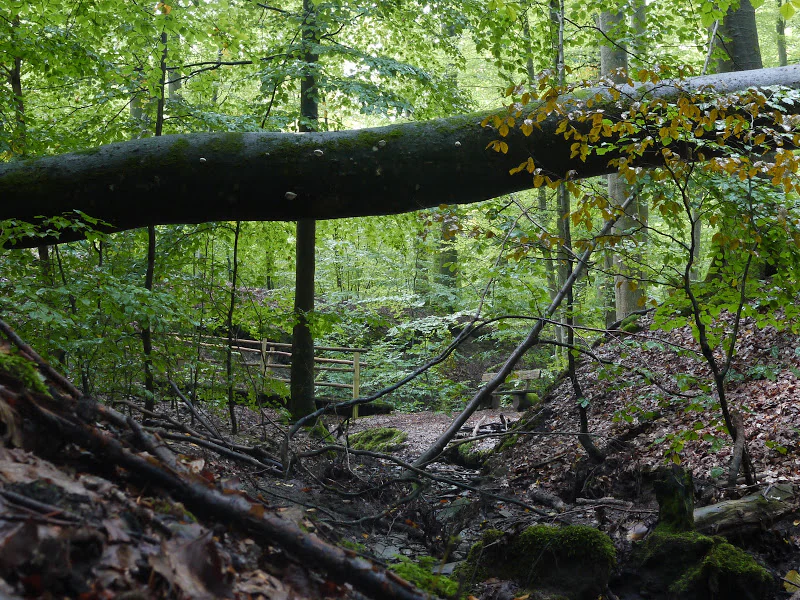
Despite its tiny size, Naturwald Wotansborn concentrates several of the most distinctive features of Steigerwald old-growth beech forests: a roughly 170- to 200-year-old mature beech island left free of forestry, a dense network of biotope trees at every stage of decay, and a recurring pattern of standing and fallen trunks across the Erlesbach. The 1912 Wotansborn spring remains structurally intact and continues to feed the brook through the reserve.
Ecologically, the reserve stands out for its amphibian fauna, especially its fire salamander population, and for a fungi community reflecting the abundance of deadwood: Ramaria corals, turkey tails, red-belted conks, giant polypores, and the black-spore Bulgaria inquinans. Its position within the Natura 2000 FFH site "Buchenwälder und Wiesentäler des Nordsteigerwalds" and alongside larger forest reserves such as Naturwald Knetzberge-Böhlgrund and Naturwald Kleinengelein also makes it a useful waypoint in the wider protected forest network of northern Bavaria.
Best time to visit Naturwald Wotansborn
Wotansborn can be appreciated throughout the year, but the most rewarding times are spring and early autumn. In spring, the beech canopy is just leafing out, allowing more light to reach the forest floor and making amphibians such as fire salamanders, tree frogs, and common frogs easier to observe near the Erlesbach. The forest floor is also at its most visually varied in this season, with spring geophytes and the first flushes of moss and fungi preparing to grow on damp trunks.
Early autumn brings the classic Steigerwald beech atmosphere: warm-colored leaf litter on the forest floor, intense fungal activity on deadwood and trunks, and cool, damp conditions along the spring and brook that heighten the impression of an undisturbed, near-natural forest. Winter visits offer a clearer view of individual trees, biotope features, and the structure of the stand, though the trail can be wet, muddy, and cold. Visitors should generally expect a quiet, contemplative small-reserve experience rather than a destination with extensive visitor infrastructure.