Mori Atlas logo
Nature reserveRéserve naturelle régionale de l'Ilon

Tracing the protected marshland boundaries and floodable meadow geography of the Alpilles foothills.

Réserve naturelle régionale de l'Ilon: A Mediterranean Wetland in Provence-Alpes-Côte d'Azur

(Réserve naturelle régionale de l'Ilon (RNR247))

The Réserve naturelle régionale de l'Ilon serves as a vital protected wetland within the Provence-Alpes-Côte d'Azur region. Located at the southern base of the Alpilles, this reserve preserves a complex mosaic of marshlands, seasonally flooded pastures, and unique touradon tussock formations. This landscape provides a distinct contrast to the surrounding limestone hills and acts as a significant habitat for regional bird and amphibian populations.

wetlandmarshlandregional nature reserveProvenceAlpillesMediterranean wetland
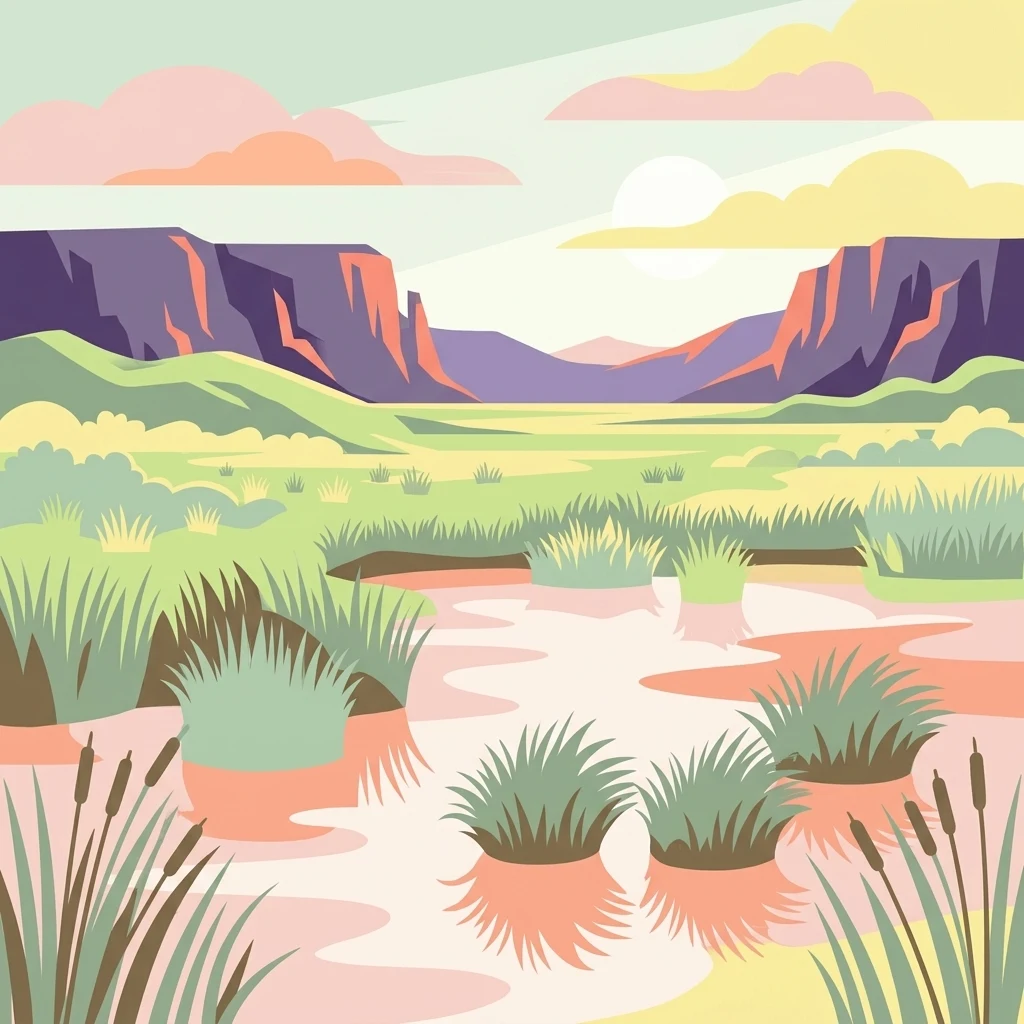
A flat-style digital illustration showing a marshy wetland with patches of tall grass in the foreground and dark, rocky cliffs in the background under a pale, soft-colored sky.

Réserve naturelle régionale de l'Ilon

Nature reserve

Park overview

Structured park overview, official facts, and landscape profile for Réserve naturelle régionale de l'Ilon

Réserve naturelle régionale de l'Ilon park facts, protected area profile, and essential visitor context

Review the core facts for Réserve naturelle régionale de l'Ilon, including designation, size, terrain, visitor scale, habitats, and operating context in one park-focused overview.

About Réserve naturelle régionale de l'Ilon

The Réserve naturelle régionale de l'Ilon is a compact but ecologically rich protected area in the Provence-Alpes-Côte d'Azur region of southern France. Designated as a regional nature reserve in 2012, it represents one of the most important lowland wetland conservation efforts in the Bouches-du-Rhône department. Despite covering a relatively modest surface of around 176 hectares, the reserve concentrates an unusual density of habitat types and species, a feature that has made it a benchmark site for wetland biodiversity in the western Alpilles foothills.

Geographically, the reserve sits where the wooded and rocky slopes of the Alpilles descend toward a vast lowland plain historically shaped by water. It lies within the broader Marais des Baux, a wetland complex that has been progressively reduced by agricultural drainage and urbanization. By protecting a working fragment of this landscape, the Ilon reserve safeguards a living example of the hydrological and ecological processes that shaped the lower Alpilles for centuries.

The reserve's ecological interest is rooted in its combination of permanent and seasonal water bodies, wet meadows that flood in winter and spring, and characteristic marsh formations dominated by tussock-building plants. This mosaic attracts a particularly diverse bird community, with over 200 species recorded, and supports amphibians including the Western spadefoot toad, reptiles such as the ocellated lizard and the European pond turtle, and mammals such as the European beaver. The richness of dragonflies further enhances its scientific value, contributing to the reserve's reputation among naturalists.

Managed by the Parc naturel régional des Alpilles, the reserve is part of a broader territorial strategy that connects the Alpilles' dry Mediterranean habitats with its wetter fringes, reinforcing ecological continuity across the protected area network. A walking trail allows visitors to experience the marshland setting directly, making the reserve not only a conservation site but also a place of quiet discovery at the meeting point of mountain and marsh in Provence.

Quick facts and research context for Réserve naturelle régionale de l'Ilon

The Réserve naturelle régionale de l'Ilon is a French regional nature reserve (réserve naturelle régionale) classified on 17 February 2012 by decision of the regional council. It lies in the Bouches-du-Rhône department, on the communes of Arles and Paradou, at the southeastern foot of the Alpilles and within the Marais des Baux.

The reserve covers about 176 hectares of wetland and floodable meadow, including marshes characterized by touradons. Administered by the Parc naturel régional des Alpilles, it is categorized as IUCN Category IV (habitat/species management area) and recorded in international databases of protected areas. Its avifauna includes more than 200 recorded bird species, and its odonatological fauna includes over 50 dragonfly species.

Protection and recognition

Documented conservation records and official protected area designations for the territory

Protection Status and International Recognition for Réserve naturelle régionale de l'Ilon

Examine the verified protection status and administrative designation records established for Réserve naturelle régionale de l'Ilon. Review the compiled environmental framework, management scope, and conservation background maintained in the global protected area registry.

Protection details

WDPA ID
555559580
Park context

Deeper park guide and search-rich context for Réserve naturelle régionale de l'Ilon

Réserve naturelle régionale de l'Ilon history, landscape, wildlife, and travel context

Explore Réserve naturelle régionale de l'Ilon through its history, landscape character, ecosystems, wildlife, conservation priorities, cultural context, and seasonal travel timing in a structured park guide built for atlas discovery and search intent.

Why Réserve naturelle régionale de l'Ilon stands out

The reserve is best known for its protected Mediterranean wetland complex, a mosaic of marshes, seasonally flooded pastures, and touradon-filled peat-like areas that contrast with the dry, rocky Alpilles rising just above it. It is recognized in particular for its exceptional bird diversity, including rare or localized species such as the Eurasian bittern, European roller, purple heron, and black-winged stilt, and for hosting more than 50 dragonfly species, making it a notable site for odonatological observation in Provence. Beyond its biodiversity value, the reserve is appreciated as a representative fragment of the Marais des Baux wetlands, an increasingly threatened lowland landscape in southeastern France. Its proximity to the Alpilles, Arles, and Paradou also gives it cultural and scenic significance, linking the wetland ecosystem to one of the most emblematic small mountain ranges of Provence.
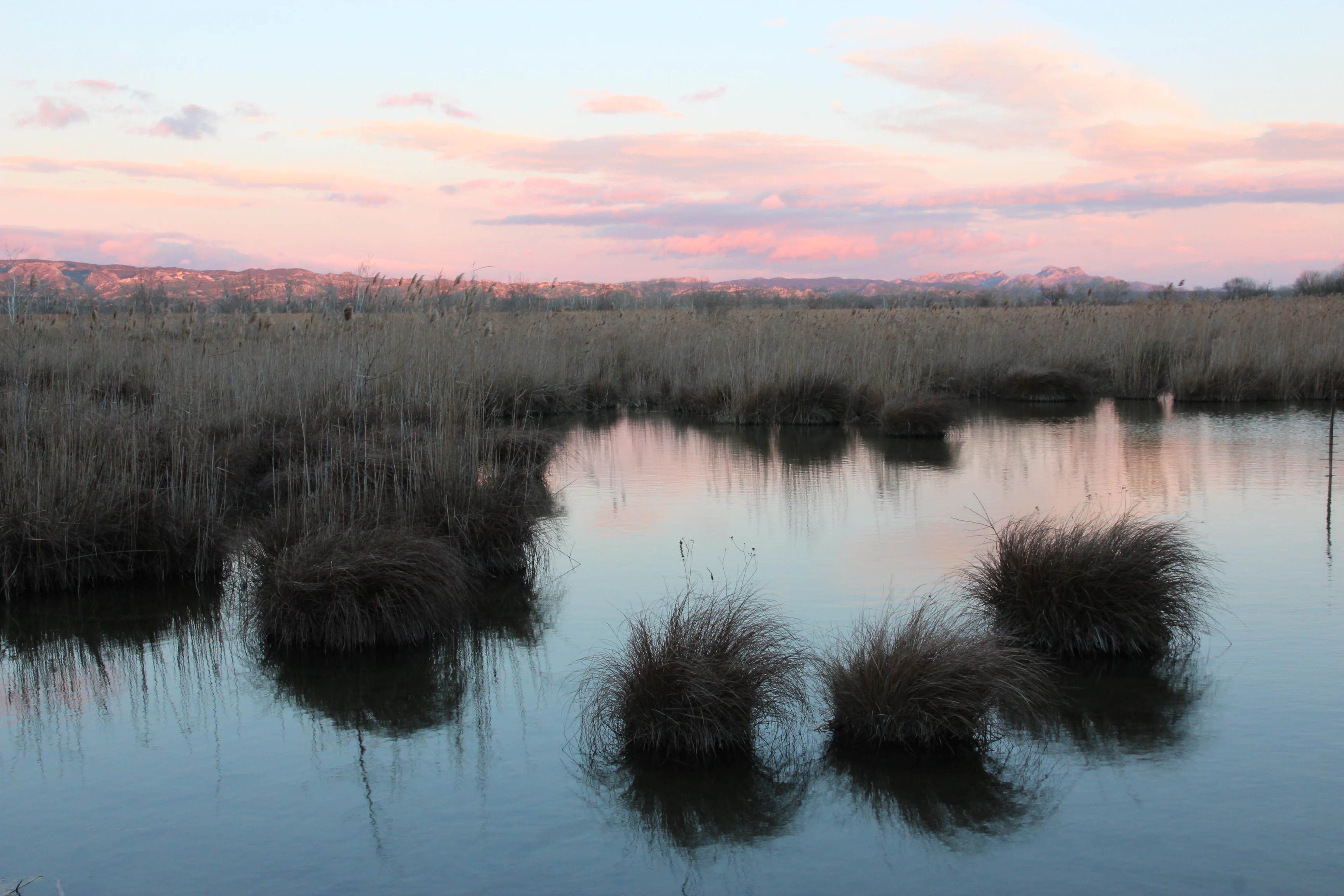
A peaceful marsh landscape at sunset with tall grasses, calm reflecting water, and low mountains in the distance under a pink and blue sky.
Sunset over the wetlands of Réserve naturelle régionale de l'Ilon.

Réserve naturelle régionale de l'Ilon history and protected-area timeline

The Réserve naturelle régionale de l'Ilon was formally created by a deliberation of the regional council of Provence-Alpes-Côte d'Azur on 17 February 2012, establishing the protection of approximately 176 hectares of wetland straddling the communes of Arles and Paradou. Its creation was driven by the need to preserve a representative fragment of the Marais des Baux, a lowland wetland complex that has long been subject to drainage, agricultural conversion, and infrastructure development in the plain south of the Alpilles.

From its inception, the reserve was entrusted to the Parc naturel régional des Alpilles, embedding the site's management within the broader conservation framework of the Alpilles territory. The choice of an existing regional park as administrator reflects an effort to coordinate wetland protection with the management of the surrounding dry Mediterranean landscapes, linking the marshlands at the foot of the range to the cultural and ecological identity of the Alpilles.

While the formal protection of the site dates to 2012, the landscape itself carries a longer history of human use, shaped by traditional pastoral practices that depend on seasonal flooding. The reserve's creation can therefore be seen as a recognition of the ecological value of these older land-use patterns, alongside more recent imperatives to safeguard Mediterranean wetland biodiversity.

Réserve naturelle régionale de l'Ilon landscape and geographic character

The landscape of the Réserve naturelle régionale de l'Ilon is defined by its flat, low-lying terrain, which sits at an altitude close to sea level at the southern foot of the Alpilles. The contrast is central to its scenic character: the bright limestone slopes, garrigue, and pine woodlands of the Alpilles rise sharply above a broad, open plain of meadows, ditches, and shallow marshes. This juxtaposition of mountain and wetland is one of the reserve's defining visual qualities.

Within the protected area, the terrain is shaped by water movement. Seasonal flooding transforms pastures into temporary wetlands, while more permanent marsh zones hold water through much of the year. The most visually striking features are the touradons, dense tussocks formed by certain marsh plants, which give the boggy areas a hummocky, textured appearance that is relatively unusual in the Provençal landscape.

Beyond the marshes, the broader setting includes elements of the surrounding Marais des Baux: flat agricultural land, networks of channels and ditches, and reed-fringed pools. The reserve reads as a transitional space where the cultivated Camargue-like plain meets the foothills of the Alpilles, offering a softer, greener counterpoint to the rocky, fragrant hillsides for which the Alpilles are best known.

Réserve naturelle régionale de l'Ilon ecosystems, habitats, and plant life

The natural environment of the Réserve naturelle régionale de l'Ilon is dominated by wetland and marshland habitats. Key vegetation includes blue moor-grass, sedges, saw-sedge, and Schoenus, which together shape the structure of the marsh through their tussock-forming growth. These plants dominate both the open marshes and the seasonally flooded meadows, creating a layered habitat of tall clumps, shallow water, and moist ground.

Ecologically, the reserve functions as a refuge of lowland Mediterranean wetland conditions that have largely disappeared elsewhere in the region. The presence of touradons gives the marshes their distinctive micro-topography, supporting a wide range of insects, amphibians, and aquatic invertebrates. The floodable pastures that surround the core marshes provide feeding and resting habitat for many bird species and link the wetter zones to drier peripheral habitats.

The site's ecological significance extends beyond its immediate plant communities. The combination of open water, marsh, wet meadow, and surrounding dry-margin habitats supports an unusually rich fauna for such a small area, reinforcing the reserve's role as a biodiversity hotspot within the Bouches-du-Rhône lowlands.

Réserve naturelle régionale de l'Ilon wildlife and species highlights

The wildlife of the Réserve naturelle régionale de l'Ilon is one of its most distinctive features. The reserve is recognized above all for its rich avifauna, with more than 200 bird species recorded. Notable species include the Eurasian bittern, the European roller, the Eurasian eagle-owl, the purple heron, and the black-winged stilt, indicating that the wetlands support both secretive reedbed species and more visible open-country and edge-of-habitat birds.

The reserve is also important for amphibians, hosting seven recorded species including the Western spadefoot toad, a Mediterranean specialist associated with seasonally flooded habitats. Reptiles are likewise well represented, with the ocellated lizard, the European pond turtle, and other wetland-associated species regularly encountered. Dragonflies and damselflies are particularly notable: more than 50 odonate species have been recorded, making the reserve a significant site for odonatological study in the region.

Larger mammals also find refuge here, most notably the European beaver, whose presence underscores the integrity of the aquatic habitats. The cumulative diversity of birds, amphibians, reptiles, dragonflies, and mammals illustrates how a relatively small wetland reserve can sustain a disproportionately rich community of species, making the site a focal point for conservation interest in the Alpilles foothills.

Réserve naturelle régionale de l'Ilon conservation status and protection priorities

From a conservation standpoint, the Réserve naturelle régionale de l'Ilon plays an important role in preserving a remnant of the Marais des Baux wetlands, one of the historically significant wetland complexes in the Bouches-du-Rhône department. The reserve's combination of marshes, floodable meadows, and touradon-rich peat-like formations represents a habitat type that has been heavily reduced by drainage, agricultural intensification, and urban expansion across the Provençal lowlands.

The reserve is classified as a regional nature reserve under French law and is listed in international protected-area databases, with a UICN management category of IV, recognizing its role in habitat and species management. Its designation reflects the understanding that lowland Mediterranean wetlands require active protection not only for their biodiversity but also for their hydrological functions, including water retention and flood regulation in a region increasingly affected by climate stress.

By placing the site under the management of the Parc naturel régional des Alpilles, conservation strategy also connects the wetland to the larger protected mosaic of the Alpilles territory. This integration strengthens ecological connectivity between dry Mediterranean uplands and lowland wetlands, a key consideration for species such as amphibians and dragonflies that depend on transitions between habitat types throughout their life cycles.

Réserve naturelle régionale de l'Ilon cultural meaning and human context

The Réserve naturelle régionale de l'Ilon is closely tied to the cultural landscape of the Alpilles and the Camargue borderlands. The surrounding plain has long supported pastoral and agricultural practices built around seasonal flooding, and the marshlands are part of the heritage of communities in Arles and Paradou that have lived with these rhythms of water and pasture for generations.

The reserve's proximity to Arles places it within a region deeply associated with Provençal and Mediterranean identity, an area marked by traditions of livestock raising, aromatic herbs, and historic villages nestled at the foot of the Alpilles. By protecting the wetland, the reserve also preserves a layer of this cultural landscape that complements the better-known dry hillsides and olive-growing traditions of the Alpilles.

At the same time, the reserve contributes to contemporary regional identity around nature-based tourism and environmental education. Its integration within the Parc naturel régional des Alpilles reflects a broader movement in Provence to link heritage, agriculture, and biodiversity conservation, positioning the wet margins of the Alpilles as a cultural as well as ecological asset.

Top sights and standout views in Réserve naturelle régionale de l'Ilon

The reserve's principal highlight is its remarkable concentration of biodiversity within a small wetland footprint: more than 200 bird species, more than 50 dragonfly species, seven amphibian species, and notable populations of beaver, ocellated lizard, and European pond turtle. Equally distinctive is its landscape, where the marshes and floodable meadows of the Marais des Baux contrast directly with the rocky Alpilles above, creating one of the most striking mountain-and-marsh settings in Provence.

Equally worth noting is the reserve's role as a model of integrated conservation, managed by the Parc naturel régional des Alpilles to link wetland preservation with broader territorial planning. The presence of a marked walking trail reinforces its value as a place of public discovery, where visitors can experience an ecologically significant Mediterranean wetland within a landscape traditionally celebrated for its dry hills and hilltop villages.

Best time to visit Réserve naturelle régionale de l'Ilon

The reserve's character varies notably with the seasons in this Mediterranean climate. Late winter and spring are typically the most striking hydrological periods, when seasonal flooding expands the wetland extent and the floodable meadows become true shallow marshes. This is also when waterbird activity and amphibian breeding are at their peak, making it a rewarding time for birdwatchers and naturalists.

Summer brings drier conditions, with the marshes contracting and vegetation becoming more dominant, but the site still retains its ecological interest, particularly for dragonflies, reptiles, and certain nesting birds. Autumn can offer a quieter, more atmospheric experience, with softer light across the marshes and the Alpilles above. Because the landscape and wildlife offerings shift considerably across the year, any visit should be chosen with attention to the specific seasonal character the visitor wants to encounter.
Monthly climate preview

Long-term representative point measurements tracking monthly climate rhythms across the protected landscape

Annual Temperature and Precipitation Normals for Réserve naturelle régionale de l'Ilon

Representative coordinates record measured temperature variation and precipitation amounts across twelve distinct monthly intervals. Examining these long-term climate normals provides essential baseline data for understanding environmental conditions within Réserve naturelle régionale de l'Ilon.
Annual mean15 °C
8 °C25 °C
Jan
Feb
Mar11°
Apr14°
May18°
Jun22°
Jul25°
Aug24°
Sep20°
Oct16°
Nov12°
Dec
Warmest month
July

24.6 °C

Coolest month
January

7.6 °C

Wettest month
November

2.6 mm/day

Driest month
July

0.5 mm/day

Park location guide

Geography guide, regional context, and park location map for Réserve naturelle régionale de l'Ilon

Réserve naturelle régionale de l'Ilon park geography, regions, and map view in France

Understand where Réserve naturelle régionale de l'Ilon sits in France through a broader geographic reading of the surrounding landscape, nearby location context, and its mapped position within the national park landscape.

How Réserve naturelle régionale de l'Ilon fits into France

France is a unitary semi-presidential republic and one of the world's largest economies. It borders Belgium, Luxembourg, Germany, Switzerland, Italy, Monaco, Andorra, and Spain, with a maritime border to the United Kingdom. The country is known for its cultural influence, art, cuisine, and political history spanning centuries.

Wider geography shaping Réserve naturelle régionale de l'Ilon in France

France is located in Western Europe. Metropolitan France extends from the Rhine to the Atlantic Ocean and from the Mediterranean Sea to the English Channel and North Sea. The country borders Belgium, Luxembourg, Germany, Switzerland, Italy, Monaco, Andorra, Spain, and has a maritime border with the United Kingdom.

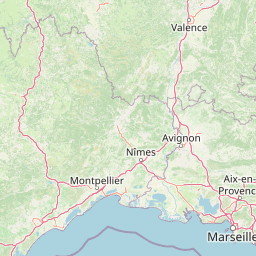
Map view of Réserve naturelle régionale de l'Ilon

Use this park location map to pinpoint Réserve naturelle régionale de l'Ilon in France, understand its exact geographic position, and read its mapped placement within the surrounding landscape more clearly.

Pigeon | © OpenStreetMap contributors

Location context for Réserve naturelle régionale de l'Ilon

Provence-Alpes-Côte d'Azur

Visualizing the Mediterranean wetland habitats and rocky mountain contrast of Provence

Réserve naturelle régionale de l'Ilon Photos and Mapped Landscape Views

Photographic documentation reveals the distinct lowland marshes, seasonally flooded pastures, and touradon formations defining Réserve naturelle régionale de l'Ilon. Visual exploration highlights the stark terrain contrast between the humid wetland plain and the limestone ridges of the adjacent Alpilles range.

A peaceful marsh landscape at sunset with tall grasses, calm reflecting water, and low mountains in the distance under a pink and blue sky.

Park atlas

Compare nearby wetland habitats, regional nature reserves, and Mediterranean protected areas.

Parks Near Réserve Naturelle Régionale de l'Ilon and Surrounding Protected Landscapes

Browse other parks near Réserve naturelle régionale de l'Ilon to examine related wetland habitats, regional reserves, and Mediterranean protected landscapes across the surrounding region. Extending the geographic comparison reveals how lowland marshes and mountain foothills connect within the broader Provençal conservation network.
A horizontal watercolor illustration showing a marshy, grassy landscape with soft green and muted pink tones against a white background.
Regional parkProvence-Alpes-Côte d'Azur
About 7.4 km away#1 closest

Southwest

Parc naturel régional de Camargue: Mapping the Rhône Delta Protected Wetland Landscape

Regional park geography and wetland conservation zones

Parc naturel régional de Camargue is a sprawling protected landscape at the confluence of the Rhône and the Mediterranean. This regional park contains significant saline lagoons, coastal dunes, and fertile marshes that serve as a crucial site for waterbird migration. Understand the interplay between traditional salt-making, pastoral ranching, and the strictly protected nature reserves that shape this delta territory.

Area
856.9 km²
Established
1970
IUCN
V
Relief
Lowland
Nature reserveProvence-Alpes-Côte d'Azur
About 21 km away#2 closest

East

Réserve naturelle régionale de la Poitevine-Regarde-Venir: Steppe Conservation and Geography

Protected dry steppe landscapes in the French Crau region

Delve into the geography of the Réserve naturelle régionale de la Poitevine-Regarde-Venir, a specialized nature reserve that safeguards the distinctive pebbly coussoul of the Crau plain. The area represents a fundamental piece of Mediterranean pastoral history, balancing fragile steppe ecosystems with traditional agricultural meadows.

Area
2.207 km²
Established
2009
IUCN
IV
A watercolor illustration of a tranquil marshland scene with soft green and muted pink tones, depicting reeds, sparse trees, and calm water.
Nature reserveFrance
About 22 km away#3 closest

South

Réserve naturelle régionale de la Tour du Valat: Mediterranean Wetland and Research Landscape Map

A critical protected area and ecological research estate in the Rhône delta of France.

Located in the Bouches-du-Rhône department, the Réserve naturelle régionale de la Tour du Valat serves as a reference point for Mediterranean wetland science. The reserve features an intricate landscape of marshes, salt meadows, and woodland patches that support diverse birdlife and habitats. This protected area demonstrates the integration of active pastoral land use with habitat management on a significant deltaic estate near Arles.

Area
18.44 km²
Established
2008
Relief
Lowland
Climate
Mediterranean
A soft watercolor illustration depicting layered rolling hills, distant mountain silhouettes, and clusters of trees in a pale color palette.
Regional parkProvence-Alpes-Côte d'Azur
About 25 km away#4 closest

East

Parc naturel régional du Luberon: Regional Park Boundaries and Protected Landscape Atlas

Geology, mountain ridges, and Mediterranean ecosystems of Provence

Parc naturel régional du Luberon serves as a vital protected corridor in southeastern France. The park features three parallel limestone massifs, dramatic ochre formations, and fossil-rich plateaus. Its geography offers a case study in integrating sustainable land use with rich biodiversity across the Vaucluse and Alpes-de-Haute-Provence departments.

Area
1,747.26 km²
Established
1977
IUCN
V
Visitors
350K annual
Nature reserveProvence-Alpes-Côte d'Azur
About 32 km away#5 closest

Southeast

Réserve naturelle régionale du Pourra - Domaine du Ranquet: Coastal Lagoon Protected Landscape

Regional Nature Reserve in Provence-Alpes-Côte d'Azur

Spanning over 300 hectares near Port-de-Bouc, this protected area preserves interconnected Mediterranean lagoons and surrounding marshlands. It offers a distinct geographic perspective on transitional coastal habitats situated within the heavily developed Bouches-du-Rhône department.

Area
3.153 km²
Established
2020
IUCN
IV
Watercolor painting of a marshy wetland scene with grassy foreground, scattered trees, and distant hills.
Nature reserveGard
About 35 km away#6 closest

West

Réserve naturelle régionale du Scamandre: Mapped Boundaries and Wetland Geography in Gard

Protected marshlands and salt steppe in southern France.

Deep dive into the ecological layout of Réserve naturelle régionale du Scamandre. Situated in the Gard department, this protected site preserves a mosaic of prairie, sansouïre, and marshland, creating a high-density wetland corridor essential for regional biodiversity and landscape analysis.

Area
1.467 km²
Established
2006
IUCN
IV
Relief
Lowland
A soft watercolor painting of a winding river flowing through a gentle, rolling green valley with hills in the background.
Nature reserveOccitanie
About 40 km away#7 closest

Northwest

Réserve naturelle régionale des gorges du Gardon: Geography and Protected Area Overview

Mediterranean river valley and raptor conservation corridor

Examine the distinct topography of the Réserve naturelle régionale des gorges du Gardon. The protected area features steep limestone cliffs and a river corridor that sustains dense Mediterranean oak forests. This site remains a critical node for raptor conservation, specifically supporting nesting Egyptian vultures and Bonelli eagles within its structured valley geography.

Area
4.913 km²
Established
2007
IUCN
IV
A horizontal watercolor painting depicting a soft, washed-out landscape of wetlands with green vegetation, calm water, and gentle hills in the distance.
Nature reserveOccitanie
About 44 km away#8 closest

West

Réserve naturelle régionale de Mahistre et Musette: Regional Nature Reserve and Wetland Atlas

Petite Camargue geography and protected marshland mosaic in Occitanie

Located in the Gard department of southern France, the Réserve naturelle régionale de Mahistre et Musette represents a successful case of wetland restoration. This protected area features a distinct landscape of reedbeds, saline flats, and ponds, providing critical habitat for numerous wetland species. Access detailed geographic context on how these restored marshes link to the broader Petit Camargue environmental network.

Area
2.616 km²
Established
1999
IUCN
IV

Common questions about visiting, size, designation, and location context for Réserve naturelle régionale de l'Ilon

Réserve naturelle régionale de l'Ilon FAQs for park facts, access, geography, and protected area context

Find quick answers about Réserve naturelle régionale de l'Ilon, including protected-area facts, park geography, trail and visitor context, and how the park fits into its surrounding country and regional landscape.
MoriAtlas Explorer

Continue Your Protected Areas Search Across the Global Atlas

Deepen your exploration by continuing the structured search for national parks and protected areas worldwide. Utilize the comprehensive filtering capabilities to compare different conservation landscapes and refine your understanding of global park geography. Discover more about the distribution and characteristics of protected natural areas.

Global natural geography