Mori Atlas logo
Wildlife reserveSessa Orchid Sanctuary

Mapping the altitudinal diversity and rugged mountain terrain of the Bhalukpong Forest Division

Sessa Orchid Sanctuary: Protected Himalayan Forest Landscapes and Regional Wildlife Reserve Geography

Sessa Orchid Sanctuary encompasses a rugged, steep mountainous tract within the Himalayan foothills of Arunachal Pradesh, India. Stretching from 900 to 3,250 metres in elevation, this wildlife reserve protects a dense closed-canopy forest that serves as a critical habitat for over 200 orchid species. The sanctuary forms a fundamental component of the Kameng Protected Area Complex, bridging steep gorges and high ridges that are essential for regional biodiversity and monsoon-driven forest ecosystems.

orchid sanctuarysubtropical forestmonsoon forestHimalayan foothillsclosed-canopy forestelephant reserve

Sessa Orchid Sanctuary

Wildlife reserve

Park overview

Structured park overview, official facts, and landscape profile for Sessa Orchid Sanctuary

Sessa Orchid Sanctuary park facts, protected area profile, and essential visitor context

Review the core facts for Sessa Orchid Sanctuary, including designation, size, terrain, visitor scale, habitats, and operating context in one park-focused overview.

About Sessa Orchid Sanctuary

Sessa Orchid Sanctuary occupies a strategically located segment of the Himalayan foothills in West Kameng District, Arunachal Pradesh. Together with the adjacent Eaglenest Wildlife Sanctuary, it forms a roughly east-west oriented protected landscape, with Sessa taking the northeastern quadrant and bounded on its eastern edge by the Bhalukpong-Bomdila highway and on its northern side by the Tenga River valley. Together, the two sanctuaries cover an east-west rectangle and share a continuous forest matrix that has ecological value far greater than either site in isolation.

The environment is shaped sharply by elevation and rainfall. Sessa's altitude ranges from around 900 metres to 3,250 metres, producing layered vegetation and strong ecological transitions across relatively short horizontal distances. The sanctuary's ridges are the first major geographic barrier to the monsoon as it moves north from the plains of Assam, a setting that produces extremely high precipitation on southern slopes, over 3,000 millimetres, with about 1,500 millimetres on the northern side. This orographic moisture pattern supports dense subtropical and temperate forests and underpins the area's exceptional plant diversity.

Hydrologically, the sanctuary is drained primarily by the Tippi Naala, which flows down through the forest and joins the Kameng River at Tippi village along the Bhalukpong-Bomdila highway. The combination of steep gradients, deep gorges and narrow valleys, high peaks, and rugged terrain creates a dramatic landscape that is central both to the sanctuary's scenic value and to the difficulty of its interior. The Environment and Forests Department has responded by developing trekking routes that allow visitors to experience the natural habitats of orchids and the broader forest environment.

Administratively and ecologically, Sessa is part of the Kameng Protected Area Complex (KPAC), one of Arunachal Pradesh's most important conservation landscapes. KPAC links Sessa, Eaglenest, Pakke, Nameri, and Sonai Rupai sanctuaries with surrounding reserved forest blocks to form the state's largest contiguous closed-canopy forest tract, spanning roughly 3,500 square kilometers and ranging from around 100 metres up to about 3,300 metres in elevation. This complex is also recognized as an elephant reserve under India's Project Elephant framework, giving the sanctuary added importance for large mammal conservation in addition to its botanical and ornithological values.

Cultural context also shapes the sanctuary. Most of the Sessa area has traditionally been claimed by the Bugun community as part of their territory, reflecting the long-standing relationship between local indigenous communities and the forest landscape now protected under formal conservation frameworks.

Quick facts and research context for Sessa Orchid Sanctuary

Sessa Orchid Sanctuary lies in West Kameng District of Arunachal Pradesh, in northeastern India, within the Himalayan foothills just south of the Tenga River valley. It covers about 100 square kilometers and ranges in elevation from roughly 900 metres to 3,250 metres, forming one of the first major barriers to the South Asian monsoon as it pushes north from the Assam plains. The sanctuary is administratively part of the Bhalukpong Forest Division and falls within the larger Kameng Protected Area Complex, which links Sessa, Eaglenest, Pakke, Nameri, and Sonai Rupai into the largest contiguous closed-canopy forest tract of Arunachal Pradesh. Ornithologically, Sessa and Eaglenest together are recognized as an Important Bird Area by BirdLife International, while ecologically the broader zone has been highlighted by the Critical Ecosystem Partnership Fund as a globally significant biodiversity region within the Eastern Himalaya.

Protection and recognition

Terrestrial conservation framework and official recognition records

Sessa Orchid Sanctuary Protection Status and Designated Area Records

Sessa Orchid Sanctuary maintains documented terrestrial protection status within its regional conservation framework. Official records compile administrative designation details and international recognition data to support accurate protected area research.

Protection details

Protection scope
Terrestrial
Transboundary protection
No
Park context

Deeper park guide and search-rich context for Sessa Orchid Sanctuary

Sessa Orchid Sanctuary history, landscape, wildlife, and travel context

Explore Sessa Orchid Sanctuary through its history, landscape character, ecosystems, wildlife, conservation priorities, cultural context, and seasonal travel timing in a structured park guide built for atlas discovery and search intent.

Why Sessa Orchid Sanctuary stands out

Sessa Orchid Sanctuary is best known as one of India's richest orchid habitats. It hosts more than 200 orchid species, including a remarkable set of seven endemic saprotrophic orchids and a number of rare taxa, with notable diversity across the genera Dendrobium, Bulbophyllum, Coelogyne, Eria, Phaius, and Liparis. Sub-tropical epiphytic orchids thrive in the warm, wet, monsoon-fed forests of the lower slopes, while rarer higher-elevation forms are found in the cooler, more exposed reaches of the sanctuary. Beyond orchids, the sanctuary is recognized for its contiguous closed-canopy Himalayan foothill forest, its position within a landscape designated as an Important Bird Area, and its role as part of the Kameng elephant reserve complex. The sanctuary is also notable for its closeness to the Orchid Research and Development Centre at Tipi, which has been central to scientific discovery and conservation of rare orchid species in the region.
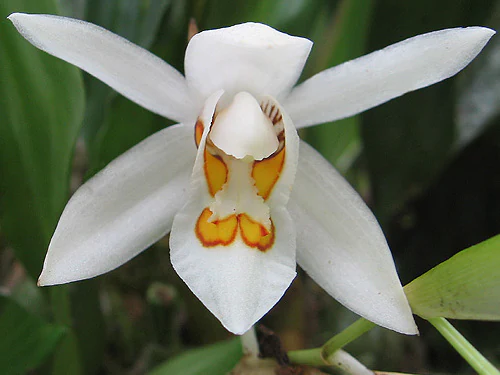
A close-up shot of a single white Coelogyne nitida orchid flower, featuring long, elegant white petals and a central structure marked with vibrant yellow and orange tones, set against a blurred green leafy background.
A detailed view of a Coelogyne nitida orchid, highlighting the delicate white petals and the distinct yellow and orange markings on the labellum.

Sessa Orchid Sanctuary history and protected-area timeline

The modern history of Sessa Orchid Sanctuary is closely tied to the development of orchid science in Arunachal Pradesh. In the late 1970s, the Government of Arunachal Pradesh created a dedicated post of orchidologist within the state Forest Department, marking the beginning of formal scientific attention to the region's extraordinary orchid flora. Two related institutions followed: in 1989, the Orchid Research and Development Centre (ORDC) was established at Tipi, and the Sessa Orchid Sanctuary itself was created about 20 kilometres away as a protected field site for that work.

Since its establishment, the sanctuary has been linked operationally to the ORDC, which has been responsible for exploration, collection, cultivation in orchidaria and gardens, taxonomic study, conservation of rare and endangered species, the creation of germplasm collections, and the use of tissue culture techniques to multiply rare orchids. Through this work, ORDC is credited with the discovery of several orchid taxa new to science, including species named after the region or the type localities of Sessa and elsewhere in Arunachal Pradesh.

The sanctuary has since become embedded in wider conservation frameworks. It is a core component of the Kameng Protected Area Complex, recognized as an elephant reserve, and has been highlighted by global bodies such as the Critical Ecosystem Partnership Fund and BirdLife International as ecologically significant for biodiversity and bird conservation. A demonstration farm of Cymbidium hybrids for cut-flower production and a nursery holding representative specimens of the sanctuary's orchid species have also been developed to extend the practical use of the sanctuary's botanical resources.

Sessa Orchid Sanctuary landscape and geographic character

Sessa Orchid Sanctuary lies within a rugged section of the Himalayan foothills where elevation, relief, and rainfall combine to produce a physically dramatic protected landscape. Altitude in the sanctuary ranges from about 900 metres at lower reaches to roughly 3,250 metres at the highest ridges, an altitudinal gradient of more than 2,300 metres within a relatively small geographic footprint. The result is a steep, broken terrain of deep gorges, narrow valleys, fast-flowing streams, and exposed high peaks.

The sanctuary's ridges form the first major orographic barrier to the South Asian monsoon as it pushes north from the Assam plains, meaning that the southern slopes of these ranges receive very heavy rainfall, more than 3,000 millimetres annually, while the northern flanks receive substantially less, around 1,500 millimetres. This sharp climatic contrast across short distances shapes vegetation patterns, stream flow, and erosional processes within the sanctuary. Sessa's principal drainage is the Tippi Naala, a tributary stream that joins the Kameng River system at Tippi village, linking the sanctuary's hydrology with the broader Bhalukpong-Bomdila corridor.

Geographically, Sessa occupies the northeastern quadrant of a broader east-west oriented protected landscape that includes Eaglenest Wildlife Sanctuary to the southwest. Together, the two sanctuaries present one of the most intact and continuous mid-elevation forest landscapes in the region, marked by forested ridgelines, deep ravines, and cliff systems. The Bhalukpong-Bomdila highway marks the eastern boundary, while the Tenga River valley defines the northern edge, giving the sanctuary clearly defined physical limits.

Sessa Orchid Sanctuary ecosystems, habitats, and plant life

The vegetation of Sessa Orchid Sanctuary reflects its position along a steep elevational gradient in the Himalayan foothills, where warm, wet forests transition upward into cooler, more exposed montane communities. The southern, monsoon-exposed slopes sustain particularly dense, moist subtropical forests with the high humidity, abundant epiphytes, and stable closed canopy that support rich orchid assemblages. The northern slopes, which receive markedly less rainfall, support somewhat drier vegetation patterns and form a clear ecological contrast within the same sanctuary.

Closed-canopy forest is the defining ecological character of Sessa and the wider Kameng Protected Area Complex. As the largest contiguous closed-canopy forest tract in Arunachal Pradesh, this landscape provides extensive core habitat for species that depend on intact forest interiors, from canopy trees and epiphytic orchids to mammals, birds, and soil-dwelling organisms. The combination of intact forest, gradient-driven microhabitats, and strong moisture inputs makes the sanctuary ecologically complex over short geographic distances.

A particularly distinctive element of the sanctuary's nature is its orchid richness, with more than 200 orchid species recorded, including new and endemic taxa. Beyond orchids, the broader Kameng Protected Area Complex supports a wide range of Himalayan flora across altitudinal zones stretching from around 100 metres up to about 3,300 metres, giving the wider landscape exceptional botanical value that complements the sanctuary's specific role as a stronghold for orchids.

Sessa Orchid Sanctuary wildlife and species highlights

Sessa Orchid Sanctuary's wildlife significance is embedded in its position within one of the most important forest blocks of Arunachal Pradesh. As part of the Kameng Protected Area Complex, the sanctuary contributes to habitat for large mammals, including elephants, whose conservation is a key reason the complex is designated as an elephant reserve under India's Project Elephant framework. The large, continuous closed-canopy forest tract that surrounds and includes Sessa is central to this role, providing the kind of connected habitat that wide-ranging species require.

The sanctuary is also notable for its birdlife. BirdLife International has jointly designated Sessa and Eaglenest Wildlife Sanctuaries as an Important Bird Area (IBA IN344), reflecting the combined significance of the two sites for bird conservation. Among the notable species associated with the area is Blyth's tragopan, identified as vulnerable and emblematic of the sanctuary's montane forest bird communities. The altitudinal range of the sanctuary, from low subtropical forests up to high ridges, supports a layered avifauna typical of the Eastern Himalaya.

Beyond these headline species, Sessa's intact forest environment is habitat for a wide range of smaller mammals, reptiles, amphibians, and invertebrates associated with Himalayan foothill forests. While specific species lists are not the focus of this profile, the combination of high rainfall, steep terrain, and closed-canopy forest creates the structural complexity that supports rich, vertically layered wildlife communities across the sanctuary.

Sessa Orchid Sanctuary conservation status and protection priorities

Sessa Orchid Sanctuary is an important node within several overlapping conservation frameworks. At the regional level, it forms part of the Kameng Protected Area Complex, which protects the largest contiguous closed-canopy forest tract in Arunachal Pradesh and is recognized as an elephant reserve. At the global level, the sanctuary falls within the Eastern Himalaya region identified by the Critical Ecosystem Partnership Fund as a critical global biodiversity-rich area, and within the Himalaya Biodiversity Hotspot recognized by Conservation International. The North-Bank Landscape, which includes the Eaglenest and Sessa slopes north of the Brahmaputra, has been highlighted as deserving particular conservation focus.

Botanically, the sanctuary's conservation significance is unusually strong. With more than 200 orchid species, including seven endemic saprotrophic orchids and several rare taxa across multiple families, Sessa is an important reservoir of orchid genetic diversity in northeastern India. The adjoining Orchid Research and Development Centre at Tipi supports this conservation role through exploration, taxonomic study, conservation of rare and endangered species, germplasm collection, and the use of tissue culture techniques to multiply rare species, including species new to science that have been formally described through this work.

Avian conservation is another pillar. The joint designation of Sessa and Eaglenest as an Important Bird Area, with Blyth's tragopan identified as a vulnerable species of the area, gives the sanctuary international recognition for bird conservation. Together, these layers of designation underline the sanctuary's role not only as a local reserve for orchids but as a key component of broader strategies to protect the rich, montane biodiversity of the Eastern Himalaya.

Sessa Orchid Sanctuary cultural meaning and human context

The cultural landscape of Sessa Orchid Sanctuary is shaped by the indigenous Bugun community, who have traditionally claimed most of the Sessa area as part of their territory. This long-standing relationship between the Bugun people and the forest environment of the foothills gives the sanctuary a strong local human context, even as formal conservation frameworks have been layered onto the same landscape. The presence of trekking routes developed by the Environment and Forests Department and the involvement of forest administrators from surrounding districts reflect ongoing state-level engagement with the area's natural and cultural value.

The sanctuary is also inseparably linked to the Orchid Research and Development Centre at Tipi, which represents a more recent institutional cultural thread. The work of the ORDC, including its discoveries of new orchid species and the development of Cymbidium hybrid demonstration plots for cut-flower production, has helped position the Sessa region as a centre of botanical science within Arunachal Pradesh, supplementing indigenous and traditional values attached to the forest.

Top sights and standout views in Sessa Orchid Sanctuary

Sessa Orchid Sanctuary stands out for the combination of extreme orchid richness, dramatic Himalayan foothill topography, and integration into one of the most important forest complexes in northeastern India. With more than 200 recorded orchid species and seven endemic saprotrophic orchids, it is one of the most important orchid habitats in the country. Its elevation span from around 900 metres to 3,250 metres, its deep gorges and high ridges, and its role as a frontline barrier to the monsoon give it a striking physical character.

Equally significant is its role within the Kameng Protected Area Complex, which links Sessa with Eaglenest, Pakke, Nameri, and Sonai Rupai into the largest contiguous closed-canopy forest tract of Arunachal Pradesh. Recognition as an Important Bird Area, integration into the Himalaya Biodiversity Hotspot, and identification as a critical conservation priority by international funding bodies underline the sanctuary's value beyond its borders. The Bugun community's traditional presence adds a further dimension, grounding the sanctuary in the long indigenous history of the West Kameng landscape.

Best time to visit Sessa Orchid Sanctuary

Sessa's climate is strongly shaped by the South Asian monsoon, with heavy rainfall concentrated in the summer months on the southern slopes of the sanctuary's ridges and substantially less rainfall on the northern flanks. The most comfortable conditions for experiencing the forest, trekking the routes developed by the Environment and Forests Department, and observing orchids and birds generally fall in the drier months outside the peak monsoon, when visibility improves, streams are less threatening, and forest interiors are more accessible to visitors.

At higher elevations, especially above 2,500 metres, winter can bring cooler temperatures and frost-prone conditions, so seasonal timing can also affect how much of the sanctuary's altitudinal range is comfortably accessible. Because the sanctuary spans warm subtropical zones and cooler montane ridges, the ideal visit depends on whether the focus is on low-elevation orchid habitats, higher-elevation forests, or broader bird observation.


Monthly climate preview

Long-term monthly temperature and precipitation patterns across representative terrain

Sessa Orchid Sanctuary Climate Normals, Average Temperature and Precipitation

Representative coordinate records show average monthly temperatures ranging from 11.49 to 24.4 degrees Celsius alongside measured precipitation variations from 0.23 to 10.13 millimeters per day. Examining the complete twelve-month climatology profile reveals comprehensive data for baseline temperature ranges and monthly precipitation patterns.
Annual mean19 °C
11 °C24 °C
Jan11°
Feb14°
Mar17°
Apr21°
May23°
Jun24°
Jul24°
Aug24°
Sep23°
Oct20°
Nov17°
Dec13°
Warmest month
August

24.4 °C

Coolest month
January

11.5 °C

Wettest month
July

10.1 mm/day

Driest month
December

0.2 mm/day

Park location guide

Geography guide, regional context, and park location map for Sessa Orchid Sanctuary

Sessa Orchid Sanctuary park geography, regions, and map view in India

Understand where Sessa Orchid Sanctuary sits in India through a broader geographic reading of the surrounding landscape, nearby location context, and its mapped position within the national park landscape.

How Sessa Orchid Sanctuary fits into India

India is a South Asian country bordered by the Indian Ocean, Arabian Sea, and Bay of Bengal. It shares land borders with Pakistan, China, Nepal, Bhutan, Bangladesh, and Myanmar. The country has a population of over 1.4 billion people and operates as a federal parliamentary republic with its capital in New Delhi.

Wider geography shaping Sessa Orchid Sanctuary in India

India occupies the Indian subcontinent in South Asia, bordered by the Arabian Sea to the southwest, the Bay of Bengal to the southeast, and the Indian Ocean to the south. It shares land borders with Pakistan to the west, China, Nepal, and Bhutan to the north, and Bangladesh and Myanmar to the east. The territory also includes the Andaman and Nicobar Islands in the Indian Ocean.

Map view of Sessa Orchid Sanctuary

Use this park location map to pinpoint Sessa Orchid Sanctuary in India, understand its exact geographic position, and read its mapped placement within the surrounding landscape more clearly.

Pigeon | © OpenStreetMap contributors

Location context for Sessa Orchid Sanctuary

Arunachal Pradesh

Visual exploration of protected forest terrain, steep river gorges, and diverse orchid habitats.

Sessa Orchid Sanctuary Photos and Himalayan Foothill Landscape Scenery

Visual documentation of Sessa Orchid Sanctuary reveals the rugged topography, steep forest ridges, and deep Himalayan river gorges that shape the protected landscape. Detailed photography illustrates the dense subtropical canopy and specialized epiphytic habitats found across the rugged elevation gradient.

A close-up shot of a single white Coelogyne nitida orchid flower, featuring long, elegant white petals and a central structure marked with vibrant yellow and orange tones, set against a blurred green leafy background.

Park atlas

Discover connected Himalayan foothill reserves and regional conservation landscapes

Explore Protected Areas and Parks Near Sessa Orchid Sanctuary

Compare Sessa Orchid Sanctuary with adjacent Himalayan protected areas and contiguous forest complexes across the regional terrain. Broaden your geographic exploration by examining nearby wildlife sanctuaries and interconnected mountain habitats within the wider ecosystem.
Wildlife reserveWest Kameng
About 15 km away#1 closest

Southwest

Eaglenest Wildlife Sanctuary: Geography and Protected Forest Atlas

Mapping the Eastern Himalayan foothills in West Kameng

Eaglenest Wildlife Sanctuary stands as a landmark of Indo-Burmese biodiversity conservation, spanning a dramatic altitudinal range that anchors the West Kameng forest complex. This wildlife reserve features dense bamboo stands, temperate ridges, and foothill forest corridors that provide a crucial environment for diverse mammal and bird species. The sanctuary remains a primary site for understanding the interaction between mountain topography and ecological connectivity in the Eastern Himalayas.

Area
218 km²
Established
1989
IUCN
IV
Visitors
75 annual
National parkSonitpur
About 36 km away#2 closest

Southeast

Nameri National Park: A Protected Landscape within Sonitpur's Geography

Explore the mapped terrain and national park boundaries.

Nameri National Park represents a significant protected natural area, contributing to the regional geography of Sonitpur, India. This page offers an atlas-oriented perspective, detailing the park's mapped landscape and its designation as a national park. Understand the geographic context and the protected land's specific identity within this mapped region.

Area
200 km²
Established
1978
IUCN
II
Relief
Mountain
Wildlife reserveTrashigang District
About 55 km away#3 closest

West

Sakteng Wildlife Sanctuary: Protected Area and Wildlife Reserve in Bhutan's Trashigang District

Mapping the mountainous terrain and unique temperate ecosystems.

Sakteng Wildlife Sanctuary is a vital protected area in eastern Bhutan, recognized as a wildlife reserve. Spanning approximately 742 square kilometers within Trashigang District, it features a dramatic mountainous terrain characterized by steep valleys and alpine meadows. The sanctuary's landscape transitions from forested slopes to subalpine conifer forests, representing Bhutan's easternmost temperate ecosystems and offering rich geographic context for atlas exploration.

Area
742.46 km²
Established
2003
IUCN
IV
Relief
Mountain
National parkAssam
About 73 km away#4 closest

South

Orang National Park: Assam's Key Floodplain Protected Landscape

Explore mapped boundaries and terrain context of this national park.

Orang National Park, located in Assam, India, is a significant protected area celebrated for its unique alluvial floodplain terrain and critical role in conservation. This national park provides a focused atlas-style view of grassland and wetland ecosystems, essential habitats for iconic species like the great Indian one-horned rhinoceros and Bengal tiger. Its geographical setting along the Brahmaputra River contributes to a dynamic landscape, offering rich context for understanding protected area distribution and regional natural features. Discover the mapped boundaries and ecological significance of this important protected land.

Area
78.81 km²
Established
1985
IUCN
II
Relief
Lowland
Wildlife reserveAssam
About 78 km away#5 closest

South

Bura Chapori Wildlife Sanctuary: Protected Grassland Geography in the Brahmaputra Valley

A vital wildlife reserve and buffer area within Assam's floodplain ecosystem.

Located in the Sonitpur district of Assam, Bura Chapori Wildlife Sanctuary offers a focused look at the Brahmaputra valley's dynamic floodplain environment. This protected area supports an essential mosaic of open grasslands and riverine woodlands, serving as a critical corridor for large mammals and endangered grassland birds. Its geography is deeply influenced by the seasonal rhythms of the Brahmaputra River, shaping the sanctuary as both a wetland habitat and a key conservation link.

Area
44.06 km²
Established
1974
IUCN
IV
Relief
Lowland
Watercolor painting of green hills, fields, and a body of water
National parkAssam
About 86 km away#6 closest

Southeast

Kaziranga National Park National Park: Protected Landscape and Geographic Atlas

Mapped boundaries and regional landscape context for this Assam natural area.

Delve into the detailed geographic profile of Kaziranga National Park, a prominent National Park located in Assam, India. This section focuses on its mapped protected area extent, its unique landscape characteristics within the Brahmaputra valley, and its role as a key natural landmark in northeastern India's atlas. Understand the structured geographic data and protected land identity that makes Kaziranga National Park a distinct entity for exploration.

Area
1,090 km²
Established
1905
IUCN
II
Relief
Lowland
Wildlife reserveAssam
About 87 km away#7 closest

Southwest

Bornadi Wildlife Sanctuary: Geographic Atlas and Protected Area Context in Assam

Mapping Himalayan foothill terrain and Indo-Bhutan border ecosystems.

Spanning the rolling foothills of Assam, Bornadi Wildlife Sanctuary represents a significant protected area focused on Himalayan fringe habitats. This geographic overview highlights the reserve's unique riverine corridors, mixed forest cover, and transitional grasslands that function as essential nodes in the broader conservation geography of northeastern India.

Area
26.22 km²
Established
1980
IUCN
IV
Relief
Upland
Wildlife reserveArunachal Pradesh
About 108 km away#8 closest

East

Itanagar Wildlife Sanctuary: Hill Forest Reserve and Protected Landscape in Arunachal Pradesh

Exploring the dense evergreen geography of a key Indian wildlife reserve

Spanning 140 square kilometres, Itanagar Wildlife Sanctuary preserves a vital mosaic of tropical semi-evergreen and wet evergreen forest within the foothills of Arunachal Pradesh. Bounded by the Pachin, Pam, Neorochi, and Chingke streams, this protected area offers a unique juxtaposition of dense hill forest and urban edges, functioning as a significant biodiversity habitat in northeastern India.

Area
140.3 km²
Established
1978
IUCN
IV
Relief
Upland

Common questions about visiting, size, designation, and location context for Sessa Orchid Sanctuary

Sessa Orchid Sanctuary FAQs for park facts, access, geography, and protected area context

Find quick answers about Sessa Orchid Sanctuary, including protected-area facts, park geography, trail and visitor context, and how the park fits into its surrounding country and regional landscape.
MoriAtlas Explorer

Continue Your Protected Areas Search Across the Global Atlas

Deepen your exploration by continuing the structured search for national parks and protected areas worldwide. Utilize the comprehensive filtering capabilities to compare different conservation landscapes and refine your understanding of global park geography. Discover more about the distribution and characteristics of protected natural areas.

Global natural geography