Mori Atlas logo
Wildlife reserveShekha Bird Sanctuary

Mapping the freshwater lake habitat and migratory waterbird refuges of this distinct regional wildlife reserve.

Shekha Bird Sanctuary: A Protected Wetland Wildlife Reserve within the Uttar Pradesh Ganges Plain

Shekha Bird Sanctuary stands as a vital protected wildlife reserve situated within the flat agricultural expanse of the upper Ganges plain in Uttar Pradesh. This compact freshwater lake provides a necessary seasonal refuge for a diverse range of migratory waterbirds, serving as a significant node in the regional hydrological network near the historic Grand Trunk Road. The surrounding terrain, defined by canal-fed wetlands and open agricultural fields, creates a unique mosaic of habitats that supports consistent bird activity throughout the year.

bird sanctuarywetlandfreshwater lakewaterbirdsmigratory birdsbirdwatching

Shekha Bird Sanctuary

Wildlife reserve

Park overview

Structured park overview, official facts, and landscape profile for Shekha Bird Sanctuary

Shekha Bird Sanctuary park facts, protected area profile, and essential visitor context

Review the core facts for Shekha Bird Sanctuary, including designation, size, terrain, visitor scale, habitats, and operating context in one park-focused overview.

About Shekha Bird Sanctuary

Shekha Bird Sanctuary represents a relatively recent but meaningful addition to India's network of wetland conservation sites. Located in the open countryside east of Aligarh, the sanctuary revolves around a single freshwater lake that has existed since the mid-nineteenth century, when the construction of the Upper Ganges Canal altered local hydrology and created the perennial waterbody that defines the site today.

The lake, often referred to locally as Shekha Jheel, sits amid a landscape dominated by agriculture and small rural settlements. Its year-round water presence makes it a vital refuge for birds in an otherwise heavily cultivated region where natural wetlands have become increasingly scarce. The proximity of the Grand Trunk Road gives the sanctuary easy access from major transportation corridors, which contributes to its popularity among birdwatchers traveling between Delhi, Agra, and other points in northern India.

Although the protected area is small in absolute terms, its ecological value is amplified by its function as a wintering habitat. Each year, the lake hosts migratory waterfowl alongside resident species, and the surrounding scrub and fields support additional birds of prey, francolins, and peafowl. The sanctuary's IUCN Category IV designation reflects a management approach focused specifically on maintaining the wetland habitat and its associated species, rather than preserving a large unbroken natural landscape.

In the broader context of Uttar Pradesh's protected-area network, Shekha fills a niche as a wetland-oriented bird sanctuary in a region that otherwise features dry forests, grasslands, and river systems. Its combination of historical origin, modest formal establishment in 2009, and rich avian biodiversity makes it a useful example of how small, human-influenced wetlands can be conserved for significant ecological returns.

Quick facts and research context for Shekha Bird Sanctuary

Shekha Bird Sanctuary is situated in Aligarh district, Uttar Pradesh, in northern India, approximately 17 kilometers east of the city of Aligarh and about 5 kilometers from the Grand Trunk Road. The protected area centers on a roughly 25-hectare perennial freshwater lake that originated in the mid-nineteenth century as a byproduct of the Upper Ganges Canal system constructed in 1852.

The sanctuary was formally created in 2009 and is administered by the Uttar Pradesh Government through the state Forest Department. It is classified as an IUCN Category IV habitat and species management area, a designation that emphasizes targeted conservation of particular wetland habitats and the birdlife they support rather than broad landscape protection.

Protection and recognition

Documented terrestrial protection scope and international recognition records

Shekha Bird Sanctuary Protection Status and Conservation Recognition Data

Shekha Bird Sanctuary maintains a documented terrestrial protection scope within the global protected area network. Recorded management facts and international recognition sources provide transparent administrative baseline data for conservation analysis.

Protection details

Protection scope
Terrestrial
Transboundary protection
No
Park context

Deeper park guide and search-rich context for Shekha Bird Sanctuary

Shekha Bird Sanctuary history, landscape, wildlife, and travel context

Explore Shekha Bird Sanctuary through its history, landscape character, ecosystems, wildlife, conservation priorities, cultural context, and seasonal travel timing in a structured park guide built for atlas discovery and search intent.

Why Shekha Bird Sanctuary stands out

The sanctuary is best known as a wintering ground for migratory and resident waterbirds in the densely populated upper Ganges plain. The lake attracts species such as black-necked storks, sarus cranes, bar-headed geese, greylag geese, spoonbills, several species of ducks including ferruginous duck and Baer's pochard, and a variety of herons, ibises, and raptors. Birdwatchers value Shekha as an accessible birding site where a wide spectrum of waterfowl and wading birds can be observed in a single small wetland. The contrast between the compact lake habitat and the surrounding agricultural landscape gives the sanctuary a distinctive character among India's bird protection sites.
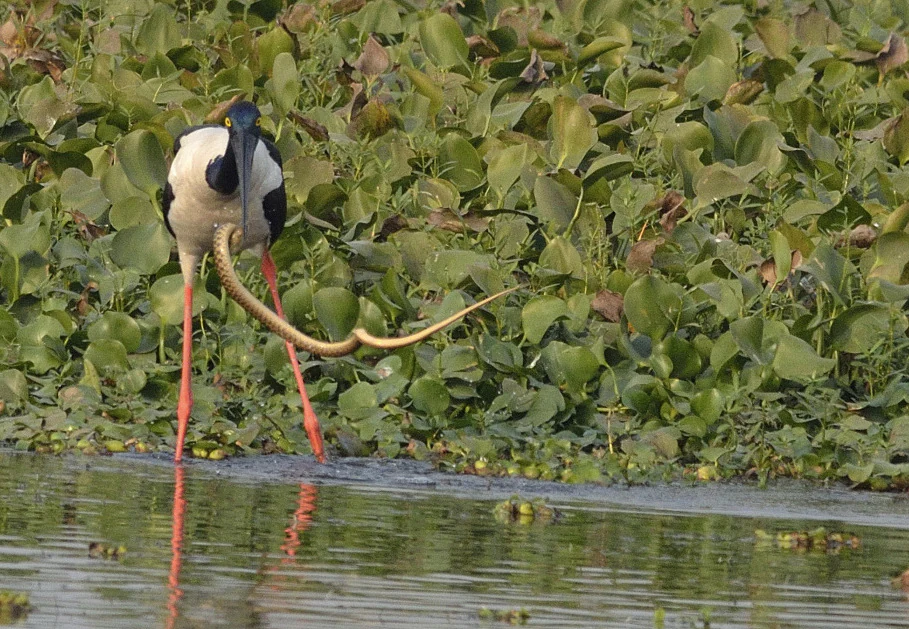
A black necked stork stands at the water's edge in a wetland area, holding a snake in its beak.
A black necked stork feeding in the marshy habitat of Shekha Bird Sanctuary.

Shekha Bird Sanctuary history and protected-area timeline

The lake at the heart of Shekha Bird Sanctuary was created indirectly by human engineering rather than appearing as a natural feature. Its existence traces to 1852, when the Upper Ganges Canal was constructed across the region, altering local drainage and giving rise to a perennial freshwater body adjacent to the canal corridor.

For many decades the lake functioned as part of the local rural landscape, supporting fishing, irrigation-related water use, and seasonal bird populations without formal protection. As awareness of wetland conservation grew across India, the site's importance for overwintering waterbirds drew the attention of naturalists and state authorities.

In 2009, the area around the lake was formally designated as a bird sanctuary by the Uttar Pradesh Government, establishing institutional recognition and management responsibility. Since then, the Forest Department has taken on the maintenance of the site, and the sanctuary has gradually developed a reputation among birdwatchers as a reliable location for observing a wide range of waterfowl and wading birds in northern Uttar Pradesh.

Shekha Bird Sanctuary landscape and geographic character

The landscape of Shekha Bird Sanctuary is defined by a single relatively small freshwater lake set within the flat agricultural terrain of the upper Ganges plain. The surrounding region is overwhelmingly rural, dominated by crop fields, scattered trees, small villages, and irrigation-related features associated with the Upper Ganges Canal system.

The lake itself forms the visual and ecological center of the sanctuary. Its open water surface is bordered by vegetated margins that provide cover for wading birds, while the adjacent canal corridor adds a linear water feature that connects the sanctuary to the wider hydrological network of the region. The terrain lacks significant elevation change, giving the site a level, lowland character typical of the Indo-Gangetic plain.

Beyond the waterbody, the surrounding landscape includes scrubby edges, fallow fields, and patches of grassland that support ground-dwelling birds such as francolins and quails, as well as raptors hunting over open country. The combination of open water, marshy edges, and dry cultivated surroundings produces a compact mosaic of habitats that contributes to the site's bird diversity despite its limited size.
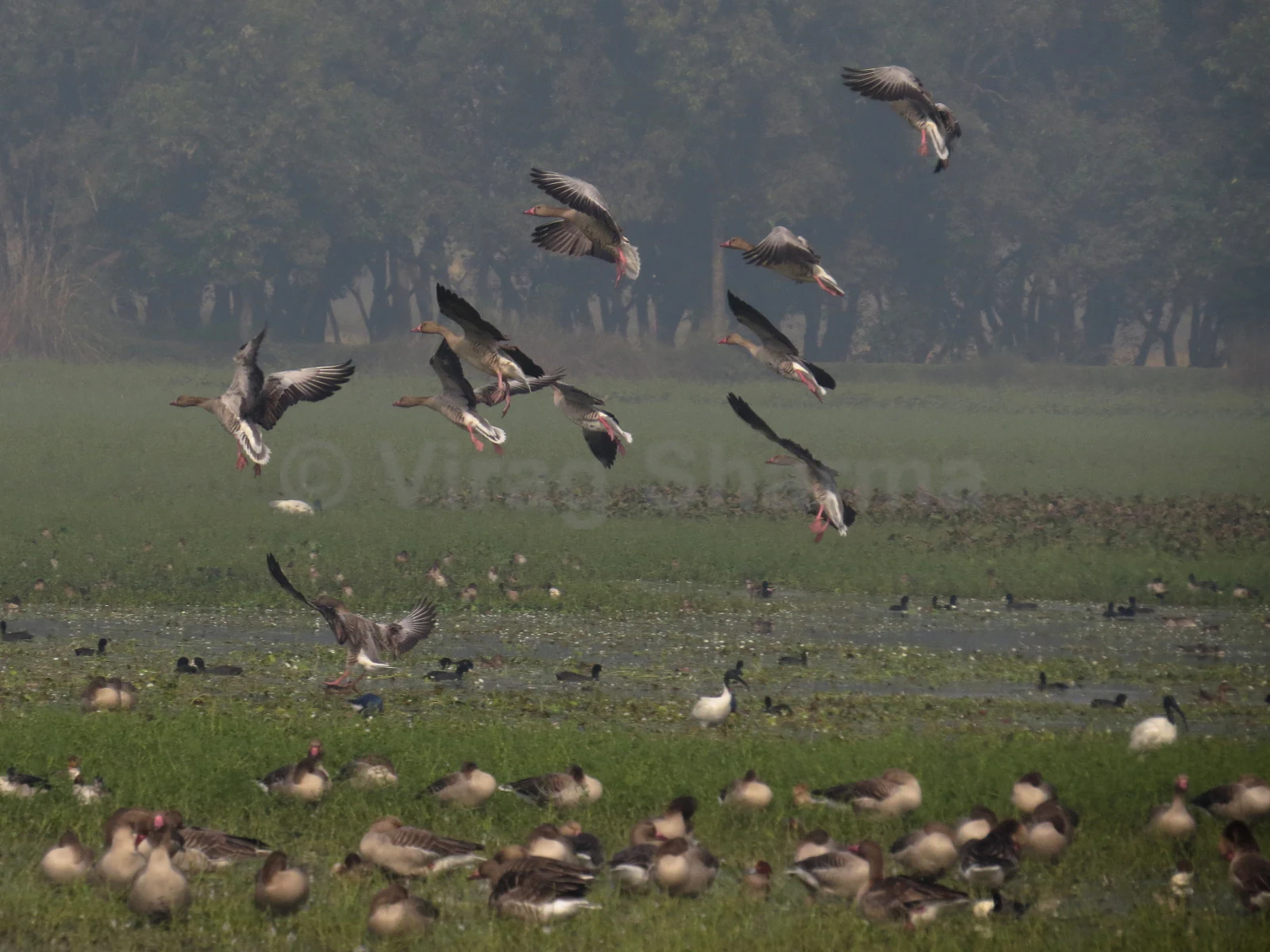
A large flock of geese, some in flight and some standing on the marshy green banks of Shekha Bird Sanctuary, under hazy conditions.
A flock of Greylag Geese in flight and resting at Shekha Bird Sanctuary.

Shekha Bird Sanctuary ecosystems, habitats, and plant life

Shekha Bird Sanctuary centers on a freshwater wetland ecosystem that functions as a year-round aquatic habitat in an otherwise dry, agricultural landscape. The perennial lake, maintained by canal-fed water flow, supports emergent vegetation along its margins and open water conditions across most of its surface, creating conditions attractive to a wide range of waterbirds.

The wetland ecosystem blends into a broader seminatural matrix of scrub, seasonal grasses, and cultivated fields. This surrounding habitat provides nesting and foraging opportunities for ground birds, while the open water supports dabbling and diving ducks, geese, and storks. The proximity of the Upper Ganges Canal adds an additional linear wetland habitat that birds can use for movement and feeding.

As an IUCN Category IV protected area, the sanctuary's ecological role is focused on habitat and species management rather than preservation of an intact wilderness. Its biodiversity value comes primarily from its consistent water supply, mixed wetland and dryland edge habitats, and position within a major migratory flyway for waterfowl in northern India.
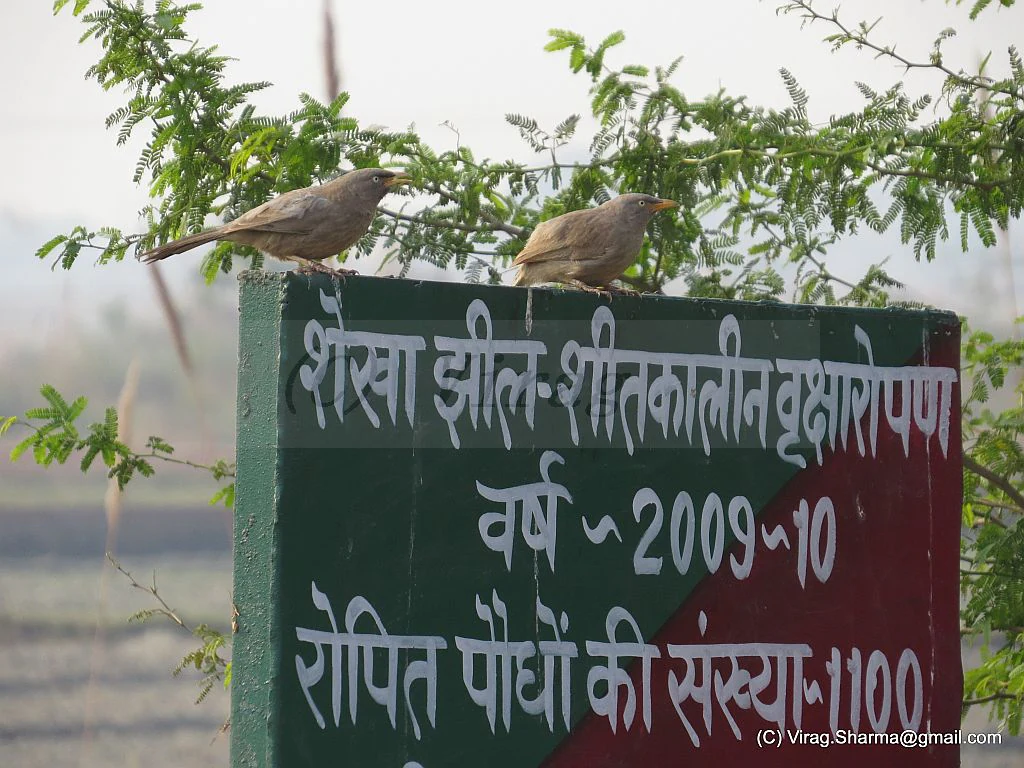
Two small birds perched on top of a green and maroon metal sign in the Shekha Bird Sanctuary, with Hindi text visible on the board.
A bird perched atop a sign detailing tree plantation efforts at Shekha Jheel.

Shekha Bird Sanctuary wildlife and species highlights

The wildlife profile of Shekha Bird Sanctuary is dominated by birds, reflecting the site's role as a dedicated bird sanctuary. The lake and its margins attract both resident species and seasonal migrants, producing a particularly rich bird list for a small protected area.

Among the most notable species recorded are black-necked storks, woolly-necked storks, Asian openbills, and sarus cranes, which give the wetland a distinctive identity among Indian bird sites. Ducks are well represented, with greylag goose, bar-headed goose, ruddy shelduck, northern pintail, common teal, Indian spot-billed duck, common pochard, ferruginous duck, Baer's pochard, and tufted duck all observed in the area. Wading birds include white ibis, black-headed ibis, red-naped ibis, Eurasian spoonbill, purple heron, cattle egret, and Indian pond-heron.

The sanctuary also supports a range of raptors such as black-shouldered kite, booted eagle, Bonelli's eagle, shikra, black kite, and Egyptian vulture. Ground-dwelling species like Indian peafowl, common quail, black francolin, and gray francolin occur in the surrounding scrub and fields, while smaller birds such as red-breasted flycatcher and little grebe add to the site's diversity. Mammal sightings in the area have included nilgai in the countryside around the lake, illustrating the broader faunal interest of the surrounding rural landscape.
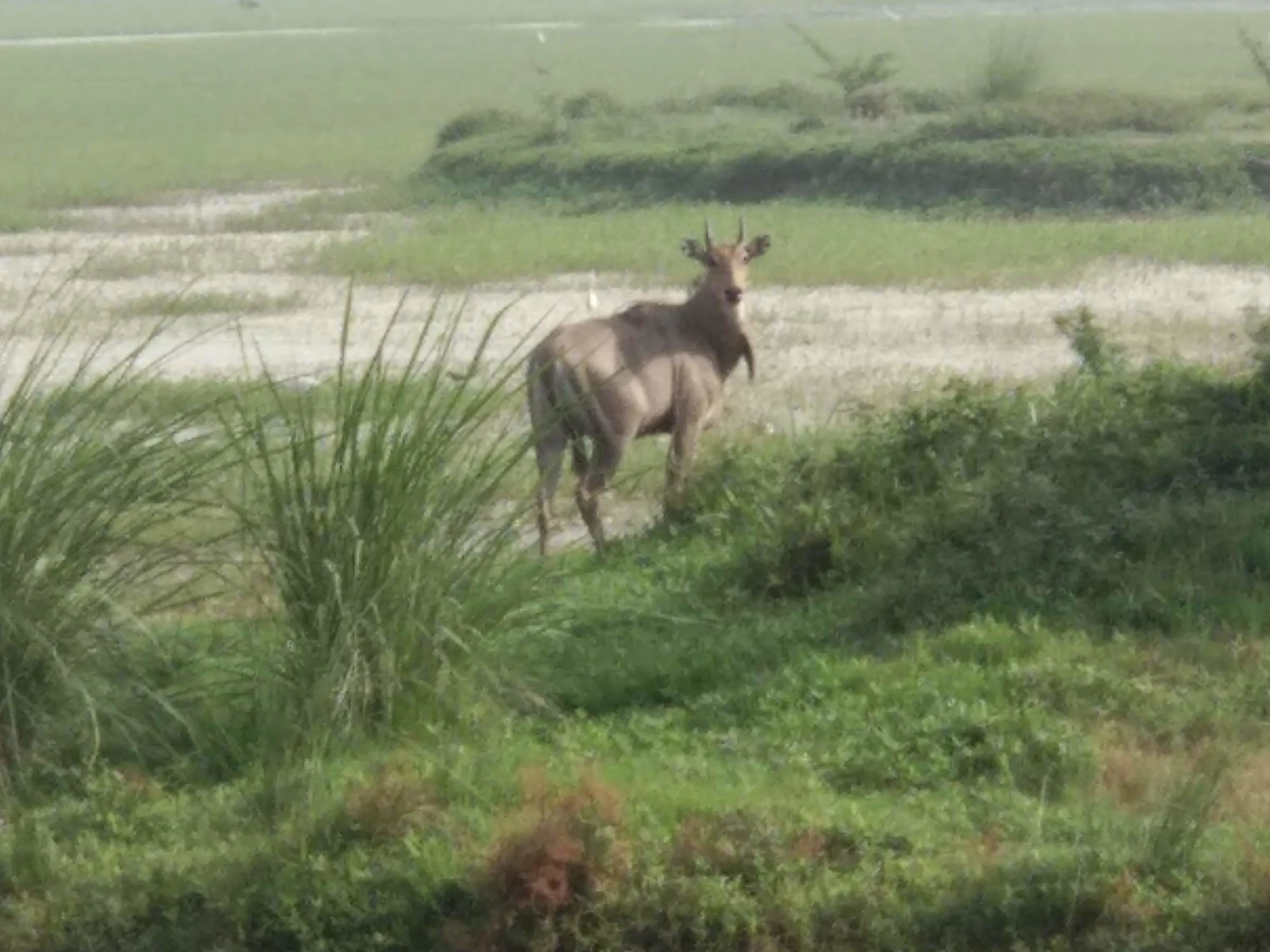
A medium shot of a nilgai antelope looking towards the camera in a grassy wetland field.
A nilgai antelope standing in the wetland landscape at Shekha Bird Sanctuary.

Shekha Bird Sanctuary conservation status and protection priorities

The conservation significance of Shekha Bird Sanctuary lies in its function as a protected wetland within a densely populated and intensively cultivated region. By formally recognizing the lake as a bird sanctuary in 2009, the Uttar Pradesh Government created a legal framework for managing a waterbody that otherwise risked degradation from agricultural expansion, water use changes, and surrounding development pressure.

As an IUCN Category IV habitat and species management area, the sanctuary is oriented toward the maintenance of wetland conditions and the species that depend on them. The presence of the Forest Department as the governing body indicates an emphasis on active management, habitat protection, and regulated visitor access to minimize disturbance to waterbirds during sensitive seasons.

The site's conservation value is amplified by its location along major migratory pathways for waterfowl in northern India. Protecting a wintering refuge of this kind, even at a relatively small scale, contributes to broader efforts to sustain migratory bird populations and maintain functional wetland networks in the Indo-Gangetic plain.

Top sights and standout views in Shekha Bird Sanctuary

Shekha Bird Sanctuary stands out as a compact yet ecologically rich wetland reserve in the upper Ganges plain, offering a strong birding experience within a short distance of the historic Grand Trunk Road. Its most distinctive highlights include the presence of large wading birds such as black-necked storks and sarus cranes, the diversity of duck species that overwinter on the lake, and the unusual historical origin of the waterbody as a byproduct of nineteenth-century canal construction.

The site also provides a useful model of small-scale wetland conservation in a heavily farmed region, where formal protection of even a modest freshwater lake can deliver significant outcomes for migratory and resident birdlife. Its combination of accessibility, habitat diversity, and a substantial bird checklist makes it noteworthy among Uttar Pradesh's protected natural areas.

Best time to visit Shekha Bird Sanctuary

The most rewarding season to visit Shekha Bird Sanctuary is the cool, dry winter period between November and February. During these months, migratory waterfowl arrive in large numbers and the lake becomes a hub for storks, cranes, geese, and ducks, while pleasant temperatures make observation around the wetland easier. Summer and monsoon conditions can make sightings less predictable, reduce visibility of certain species, and bring heavier vegetation growth around the lake margins.
Monthly climate preview

Long-term representative point measurements tracking temperature and precipitation rhythm

Shekha Bird Sanctuary Climate Normals and Annual Weather by Month

Historical NASA Power records document average monthly temperatures ranging from 14.19 degrees Celsius to 36.17 degrees Celsius alongside distinct precipitation patterns across the representative coordinate. Examining the complete twelve-month dataset reveals broader thermal shifts and moisture averages for deeper geographic analysis.
Annual mean26 °C
14 °C36 °C
Jan14°
Feb18°
Mar24°
Apr31°
May35°
Jun36°
Jul32°
Aug30°
Sep28°
Oct25°
Nov20°
Dec16°
Warmest month
June

36.2 °C

Coolest month
January

14.2 °C

Wettest month
July

6.6 mm/day

Driest month
November

0.1 mm/day

Park location guide

Geography guide, regional context, and park location map for Shekha Bird Sanctuary

Shekha Bird Sanctuary park geography, regions, and map view in India

Understand where Shekha Bird Sanctuary sits in India through a broader geographic reading of the surrounding landscape, nearby location context, and its mapped position within the national park landscape.

How Shekha Bird Sanctuary fits into India

India is a South Asian country bordered by the Indian Ocean, Arabian Sea, and Bay of Bengal. It shares land borders with Pakistan, China, Nepal, Bhutan, Bangladesh, and Myanmar. The country has a population of over 1.4 billion people and operates as a federal parliamentary republic with its capital in New Delhi.

Wider geography shaping Shekha Bird Sanctuary in India

India occupies the Indian subcontinent in South Asia, bordered by the Arabian Sea to the southwest, the Bay of Bengal to the southeast, and the Indian Ocean to the south. It shares land borders with Pakistan to the west, China, Nepal, and Bhutan to the north, and Bangladesh and Myanmar to the east. The territory also includes the Andaman and Nicobar Islands in the Indian Ocean.

Map view of Shekha Bird Sanctuary

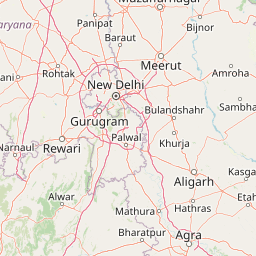
Use this park location map to pinpoint Shekha Bird Sanctuary in India, understand its exact geographic position, and read its mapped placement within the surrounding landscape more clearly.

Pigeon | © OpenStreetMap contributors

Location context for Shekha Bird Sanctuary

Uttar Pradesh

Visualizing wetland habitats, open water margins, and protected area terrain

Shekha Bird Sanctuary Photos and Landscape Scenery Exploration

Browse detailed field photography showcasing the freshwater lake, marshy margins, and flat agricultural terrain of Shekha Bird Sanctuary. Visual reference material reveals the ecological character, waterbird habitats, and surrounding protected landscape features.

A black necked stork stands at the water's edge in a wetland area, holding a snake in its beak.

A large flock of birds flying above and swimming in a wetland area with grassy banks and a tree line in the background.

A large flock of geese, some in flight and some standing on the marshy green banks of Shekha Bird Sanctuary, under hazy conditions.

Two small birds perched on top of a green and maroon metal sign in the Shekha Bird Sanctuary, with Hindi text visible on the board.

A medium shot of a nilgai antelope looking towards the camera in a grassy wetland field.

Park atlas

Compare adjacent wetland reserves and regional protected landscapes across the upper Ganges plain.

Explore Other Parks Near Shekha Bird Sanctuary and Surrounding Protected Areas

Continue geographic comparison by examining nearby national parks and related protected areas situated across the surrounding plains. Expanding beyond Shekha Bird Sanctuary reveals broader regional biodiversity patterns and connected wetland habitats.
Wildlife reserveUttar Pradesh
About 75 km away#1 closest

Southwest

Sur Sarovar Wildlife Reserve: A Protected Wetland Sanctuary in Uttar Pradesh

Mapped freshwater landscapes and migratory bird habitats.

Sur Sarovar serves as a significant wildlife reserve in Uttar Pradesh, characterized by the distinct geometric shape of Keetham Lake. This protected wetland provides essential breeding habitat for diverse waterbird species across its shallow margins and islands. The area also hosts a vital sloth bear rescue center, anchoring its status as a key site for wildlife rehabilitation and conservation efforts within the broader Gangetic plains region.

Area
7.13 km²
Established
1991
Water
Water-dominated
Watercolor illustration of a wetland landscape with grasses, trees, and a sunset
National parkIndia
About 101 km away#2 closest

Southwest

Keoladeo National Park: India's Renowned Wetland Bird Sanctuary and Protected Landscape

Explore its mapped terrain and critical avian habitat near Bharatpur.

Keoladeo National Park, a designated national park in India, represents a critical hub for wetland conservation and avian biodiversity. The park's meticulously managed wetland system, a mosaic of shallow waters and grasslands, provides essential habitat for thousands of resident and migratory birds from across Eurasia. Situated near Bharatpur, this protected landscape offers a unique opportunity to study the intersection of arid and fertile plains geography and serves as a vital stopover point on major bird flyways, underscoring its importance in regional conservation efforts.

Area
28.7 km²
Established
1982
IUCN
II
Visitors
147K annual
Wildlife reserveUttar Pradesh
About 131 km away#3 closest

Southeast

Saman Bird Sanctuary: Protected Wildlife Reserve Geography and Wetland Atlas

Inland wetland habitat within the western Uttar Pradesh agricultural plain

Saman Bird Sanctuary represents a key protected Ramsar wetland located in the Mainpuri district of Uttar Pradesh. The site is defined by a seasonal, rain-fed oxbow lake that integrates with surrounding agricultural fields. It maintains a distinct ecological identity through its nesting colonies of resident birds and large winter congregations of migratory species on the flat alluvial landscape.

Area
5.25 km²
IUCN
IV
Relief
Lowland
Climate
Subtropical
National parkHaryana
About 146 km away#4 closest

Northwest

Sultanpur National Park: Haryana's Designated Protected Landscape and Atlas Context

Mapped boundaries and regional geographic significance.

Delve into Sultanpur National Park, an important protected area within Haryana, India, viewed through an atlas and map-driven lens. This entry details the park's designation as a national park, offering insights into its specific geographic footprint and its relation to the surrounding regional terrain. Understand how Sultanpur National Park contributes to the protected landscape mosaic of North India, providing critical data for those exploring India's geography and conservation areas.

Area
1.43 km²
Established
1991
IUCN
II
Relief
Lowland
Wildlife reserveUttar Pradesh
About 169 km away#5 closest

North

Haiderpur Wetland Wildlife Reserve: Exploring the Ganges Floodplain and Migratory Flyways

A critical Ramsar-designated freshwater marshland within Uttar Pradesh

Spanning over 6,900 hectares, Haiderpur Wetland represents a significant protected area where open water and floodplain terrain create a haven for migratory birds along the Central Asian Flyway. The reserve, positioned within the broader Hastinapur Wildlife Sanctuary, offers a detailed look at how artificial water control impacts local riverine biodiversity and landscape development in North India.

Area
69 km²
Established
1984
Water
Water-dominated
Wildlife reserveHaryana
About 178 km away#6 closest

Northwest

Bhindawas Wildlife Sanctuary: Protected Wetland Mapping and Regional Landscape Context

A key Ramsar site within the Sahibi River ecological corridor of Haryana

Examine the geographic footprint of Bhindawas Wildlife Sanctuary, a significant 412-hectare wetland in Haryana. This protected area supports dense migratory waterbird populations by maintaining a stable aquatic environment through an engineered network of canals and natural rainfall. The sanctuary stands as an essential component of the regional forest and wetland chain linking the Aravalli hills to the Yamuna floodplain.

Area
4.12 km²
Established
1986
IUCN
IV
Relief
Lowland
A watercolor illustration of a calm, marshy wetland landscape with soft green and earthy tones, featuring distant vegetation, a small island, and foreground trees.
Wildlife reserveUttar Pradesh
About 182 km away#7 closest

East

Sandi Bird Sanctuary: Wetland Reserve and Geographic Landscape in Uttar Pradesh, India

A Ramsar-designated protected area in the Indo-Gangetic plains

Sandi Bird Sanctuary represents a critical protected wetland ecosystem in Uttar Pradesh, featuring the 309-hectare Dahar Jheel. This reserve acts as a focal point for birdlife in northern India, providing essential marshland habitat alongside the River Garra. The geography reflects the flat, alluvial nature of the Gangetic plain, offering deep insights into regional wetland conservation and migratory ecology.

Area
3.09 km²
Established
1990
IUCN
IV
Relief
Lowland
National parkUttarakhand
About 188 km away#8 closest

North

Jim Corbett National Park: Uttarakhand National Park and Protected Landscape Atlas

Mapped Boundaries and Regional Geographic Context

Jim Corbett National Park offers a specific entry point for understanding protected landscapes and their geographic significance. As a designated national park within Uttarakhand, India, it provides a distinct case study for exploring mapped boundaries and regional natural terrain. This detailed view allows for a deep dive into the park's identity as a protected area, highlighting its placement within the larger atlas of India's natural heritage and its contribution to the Himalayan geographic narrative.

Area
1,288.31 km²
Established
1936
IUCN
II
Visitors
365K annual

Common questions about visiting, size, designation, and location context for Shekha Bird Sanctuary

Shekha Bird Sanctuary FAQs for park facts, access, geography, and protected area context

Find quick answers about Shekha Bird Sanctuary, including protected-area facts, park geography, trail and visitor context, and how the park fits into its surrounding country and regional landscape.
MoriAtlas Explorer

Continue Your Protected Areas Search Across the Global Atlas

Deepen your exploration by continuing the structured search for national parks and protected areas worldwide. Utilize the comprehensive filtering capabilities to compare different conservation landscapes and refine your understanding of global park geography. Discover more about the distribution and characteristics of protected natural areas.

Global natural geography