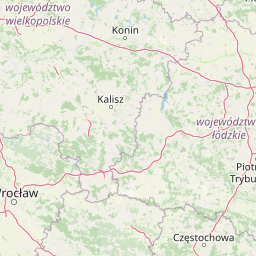

Why Stobrawski Landscape Park stands out
Stobrawski Landscape Park is best known for its extensive pine-dominated forest complexes, collectively referred to as the Bory Stobrawskie, which cover nearly four-fifths of the park's territory. These lowland pinewoods give way to river valleys, oxbow lakes, ponds, and wet meadows along the Stobrawa and its tributaries, producing a landscape that combines dense forest with freshwater habitats. The park is also valued for its rich biodiversity within a lowland setting: more than 40 strictly protected plant species, around 130 rare plant species, and roughly 250 protected animal species have been recorded here, including 165 bird species, 18 of which are considered globally threatened. Habitats such as wet valleys, small ponds, and floodplain forests support orchids, water lilies, sundews, otters, beavers, white-tailed eagles, kingfishers, and rare dragonflies.
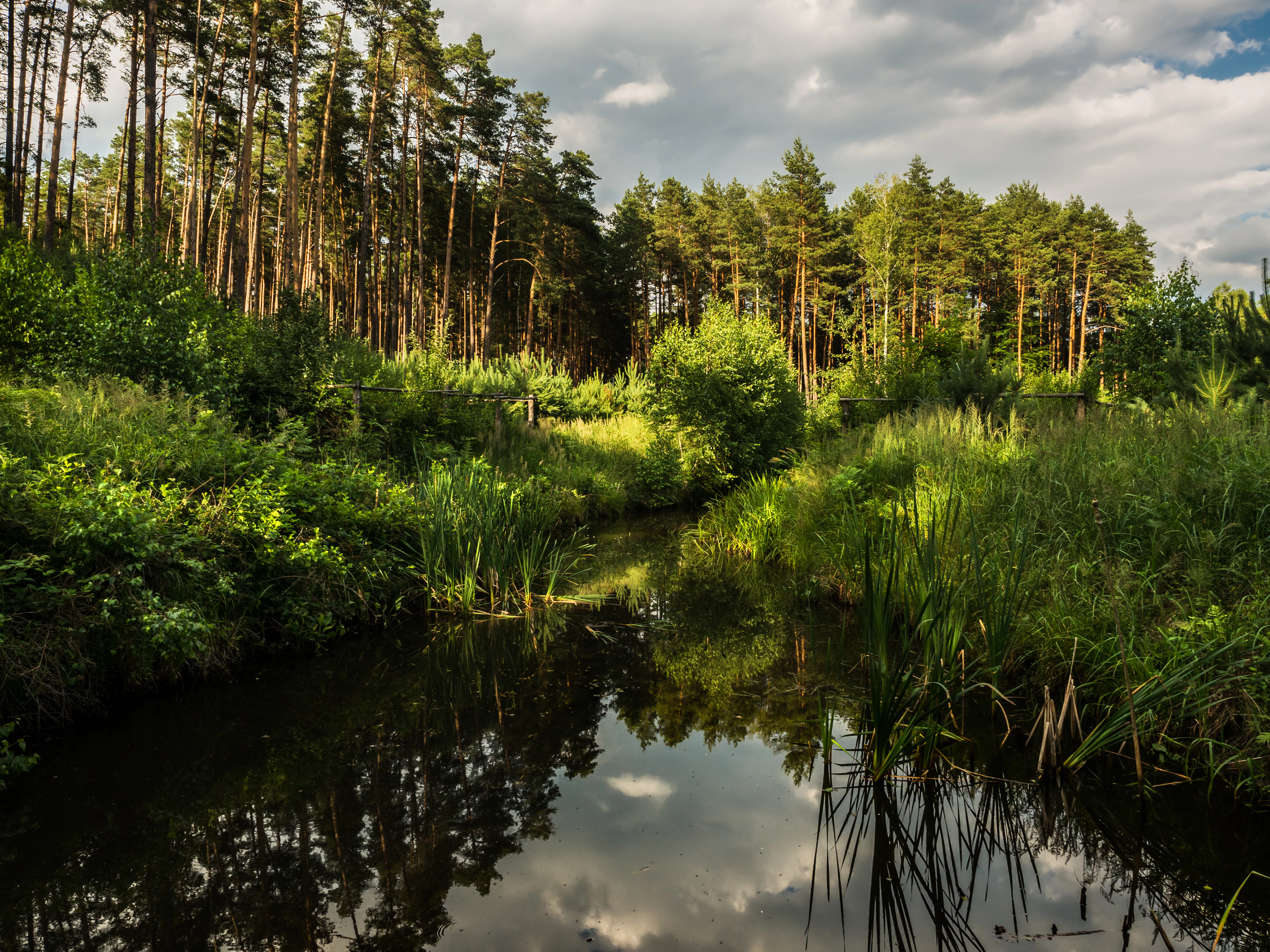
Stobrawski Landscape Park history and protected-area timeline
Stobrawski Landscape Park was created by Regulation No. P/11/99 of the Voivode of Opole, issued on 28 September 1999, as the twelfth and youngest landscape park within the Opole Voivodeship. Its establishment reflected a growing recognition during the late 1990s of the ecological importance of the Bory Stobrawskie forest complex and the river valleys of northern Opole, areas that had previously lacked a unified form of landscape-level protection.
Although the park itself is young, several of its most valuable natural sites already had a longer tradition of conservation. Four nature reserves (Barucice, Leśna Woda, Lubsza, and Rogalice) sit within its boundaries, while a fifth reserve, Śmiechowice, once located inside the park's territory, has since been liquidated. Over time the park has also become integrated with the wider European conservation framework, as portions of its area overlap with the Natura 2000 network, including the Special Protection Area Grądy Odrzańskie and the Special Areas of Conservation Lasy Barucickie and Łąki w okolicach Karłowic nad Stobrawą, strengthening its role as a key lowland biodiversity area in southwestern Poland.
Stobrawski Landscape Park landscape and geographic character
The landscape of Stobrawski Landscape Park is shaped by the contrast between extensive flat forests and a network of river valleys. Most of the park is occupied by the Bory Stobrawskie, a continuous complex of pine-dominated lowland forests that gives the territory a strongly wooded character. Pine stands prevailing in these woods alternate locally with mixed and deciduous forest patches, particularly along streams and in areas where soils shift from sandy uplands to wetter riverine substrates.
The park's hydrological structure is just as important as its forests. The territory lies within the catchment basins of the Stobrawa and several of its tributaries, including the Budkowiczanka, Bogacica, Brynica, and Smortawa. In the south, the boundary runs along the broad valleys of the Odra and the Nysa Kłodzka, two large lowland rivers whose floodplains and terraces introduce a different, more open element into the scenery. Small ponds, oxbows, wet meadows, and field depressions add further variation to the otherwise uniform plain.
Three physical-geographical regions meet within the park: the agricultural and forested plains of the Równina Opolska, the lower-lying Równina Oleśnicka to the east, and the Pradolina Wrocławska, an ancient glacial spillway that crosses the western part of the park. The transition between these regions produces changes in relief, soils, and vegetation, so the park is experienced as a stitched-together mosaic of sandy pinewood plateaus, river corridors, marshy fragments, and patches of farmland rather than as a single uniform landscape.
Stobrawski Landscape Park ecosystems, habitats, and plant life
Ecologically, Stobrawski Landscape Park is a lowland landscape area dominated by coniferous forest, but biologically it is far richer than its wooded surface might suggest. The Bory Stobrawskie pine forests form the principal habitat type, yet river valleys, ponds, and wet depressions harbor a diverse flora and fauna that depend on the mosaic between dry sandy ground and aquatic or semi-aquatic environments.
The park's botanical interests are concentrated in its wet and open habitats. More than 40 strictly protected plant species and around 130 rare plant species have been recorded here. Aquatic and wetland species include royal fern, water caltrop, and floating watermoss, while forest and meadow habitats support yellow water lily, mezereon, round-leaved sundew, common centaury, and pink broomrape. Orchids are particularly well represented, with orchid species such as spotted orchid, broad-leaved orchid, early marsh orchid, two helleborine species, white helleborine, and twayblade all documented in the park.
Faunal richness is similarly tied to habitat diversity. Around 250 protected animal species have been recorded, drawn from a wide range of habitats. Forest and water habitats support otter and Eurasian beaver; river and pond ecosystems host cormorant; and forests, riverbanks, and meadows together support 165 bird species, of which 18 are considered globally threatened. The park's combination of large forest blocks and a network of small water bodies also makes it a habitat for the imperial dragonfly, the largest European dragonfly.
Stobrawski Landscape Park wildlife and species highlights
Stobrawski Landscape Park supports a rich and varied fauna dominated by species tied to its forests, rivers, and ponds. Around 250 protected animal species have been recorded in the park, of which 165 are bird species, indicating a particularly strong ornithological significance. The size of these figures reflects the way different habitats interlock within the protected area: dry pine forest, mixed deciduous stands, river floodplains, fishponds, and wet meadows each support distinct animal communities.
Mammal species of conservation interest include otter, which uses the park's many watercourses and ponds, and Eurasian beaver, whose dams and lodges have become a notable feature along parts of the Stobrawa and its tributaries. The aquatic fauna and flora attract large numbers of waterbirds as well as cormorant, which feeds on the park's rivers and ponds. Bird diversity more broadly is high, with globally threatened species among the 165 recorded, including raptors and other birds associated with large forest and river complexes.
Among the most charismatic species recorded are white-tailed eagle, the large fish-eating raptor that nests in lakeside and riverside forests, and common kingfisher, a small, brightly colored bird tied to clear rivers and streams. Invertebrate diversity is also notable; the park hosts the imperial dragonfly, Europe's largest dragonfly, which depends on the same wet habitats that support many of the protected plant species. Together, these features make the park an important lowland refuge for wildlife between the larger river valleys of the Odra region.
Stobrawski Landscape Park conservation status and protection priorities
Stobrawski Landscape Park is a key lowland conservation area in southwestern Poland, with a protection framework that combines landscape-level designation, strict nature reserves, and European ecological networks. As a park krajobrazowy, the area is managed to preserve both natural and cultural landscape values across a territory of more than 52,600 hectares, with forests making up roughly four-fifths of the surface.
Inside the park's boundaries lie four nature reserves that protect particularly valuable habitats: Barucice, Leśna Woda, Lubsza, and Rogalice. Each of these reserves focuses on sites of high botanical or ecological interest and reinforces the wider protection offered by the landscape park.
The park also intersects with the European Natura 2000 ecological network. The Special Protection Area Grądy Odrzańskie covers part of the park, providing formal recognition of the area's importance for birds, while the Special Areas of Conservation Lasy Barucickie and Łąki w okolicach Karłowic nad Stobrawą protect important forest and meadow habitats. Together, these overlapping designations underline the park's role in maintaining lowland pine forests, river corridors, and orchid-rich meadows within the broader Odra river basin.
Stobrawski Landscape Park cultural meaning and human context
Stobrawski Landscape Park lies in a region shaped by long-standing human interaction with lowland forest and river environments. The area of the Bory Stobrawskie has historically been a landscape of managed pinewoods, small-scale agriculture, and fishpond management, with many of the park's villages and rural settlements dating back centuries. The intersection of forest exploitation, river use, and farming has produced the park's current mosaic of woodlands, meadows, fields, and ponds.
The park's geography also reflects patterns of settlement in the northern Opole region, with twelve communes intersected by its territory. Traditional land uses, including forestry, agriculture, and fish farming along the Stobrawa and its tributaries, continue to coexist with the protected landscapes. Elements such as village churches, manor houses, and historical routes are part of the broader cultural fabric of the area, though the park itself is primarily recognized for its natural rather than cultural heritage.
Top sights and standout views in Stobrawski Landscape Park
Among the most distinctive features of Stobrawski Landscape Park is the sheer scale of its lowland pine forests, which collectively form one of the larger forest complexes of the Opole region. These pinewoods are the visual and ecological backbone of the protected area and provide continuous habitat for large mammals, breeding birds, and rare plants.
Equally noteworthy is the density of water-related habitats: the Stobrawa and several tributaries, together with the broad valleys of the Odra and Nysa Kłodzka, create a rich system of streams, oxbows, fishponds, and wet meadows. These habitats support orchids, sundews, otters, beavers, white-tailed eagles, kingfishers, and Europe's largest dragonfly, and they overlap with Natura 2000 sites including the Grądy Odrzańskie bird protection area. The combination of huge forest tracts and intricate aquatic habitats makes the park a particularly valuable lowland refuge in southwestern Poland.
Best time to visit Stobrawski Landscape Park
Stobrawski Landscape Park can be appreciated through most of the year, but the seasons shape the experience in characteristic ways. Spring brings renewed vegetation, flowering orchids and other woodland plants in the lower forests and meadows, and active birdlife, making it a rewarding period for those interested in flora and birdwatching.
Summer offers the fullest green character of the Bory Stobrawskie and the river valleys, with the park at its most vegetatively lush; warm-weather visits favor exploring forest paths, ponds, and the riverbank landscapes. Autumn is marked by the russet tones of the pinewoods and deciduous patches, while winter exposes the open character of the flat lowland terrain and the river floodplains, when the scale of the forest complexes is most visible.