Why Tengku Hassanal Wildlife Reserve stands out
Tengku Hassanal Wildlife Reserve is best known for protecting one of the largest and most ecologically significant tracts of lowland dipterocarp forest remaining in Peninsular Malaysia. The reserve's combination of extensive lowland forest, hill forest, and montane vegetation on Gunung Benom gives it exceptional habitat diversity within a single contiguous protected block. The reserve is also renowned as a stronghold for the gaur, the largest wild bovine of Southeast Asia, which is the species it was originally gazetted to protect. Its primate populations, particularly gibbons and leaf monkeys, alongside its exceptional bat and bird diversity, have made it a long-standing destination for zoological research since Lord Medway's 1960s expedition to Gunung Benom. The Kuala Krau research station, located in the western part of the reserve, has drawn scientists to study the area's mammal and bird communities for decades.
Tengku Hassanal Wildlife Reserve history and protected-area timeline
The origins of Tengku Hassanal Wildlife Reserve lie in the early colonial period, when rapid expansion of the rubber industry in Malaya brought extensive forest clearing and rising human-wildlife conflict. Responding to public concern over the decline of wildlife, the British colonial administration established Krau Game Reserve in June 1923 under the Wild Animals and Bird Protection Enactment. From the start, the reserve was conceived as a refuge for the gaur, whose wild populations were already considered vulnerable.
In 1965 the reserve's name was changed from Krau Game Reserve to Krau Wildlife Reserve, reflecting an evolution in thinking from hunting control to broader wildlife protection. Administrative responsibility shifted in stages: the Pahang State Game Department initially ran the reserve, before management passed to the Federal Game Department in 1973. The agency was later restructured into the Department of Wildlife and National Parks (PERHILITAN) in 1976, which continues to oversee the area today. The 1960s also marked the beginning of sustained scientific interest in the reserve, following Lord Medway's zoological expedition to Gunung Benom, which drew a generation of biologists, primatologists, and ornithologists to the western part of the reserve and led to the establishment of the Kuala Krau research station.
In November 2022, the reserve was officially renamed Tengku Hassanal Wildlife Reserve in honor of the crown prince of Pahang, Tengku Hassanal Ibrahim Alam Shah, who serves as the protected area's royal patron. The reserve's boundaries and total area have been adjusted several times across its history, with the current extent standing at approximately 60,551 hectares. Today it sits at the center of Malaysia's conservation efforts in central Pahang, combining its colonial-era legacy with a modern role in protecting some of the country's most threatened forest wildlife.
Tengku Hassanal Wildlife Reserve landscape and geographic character
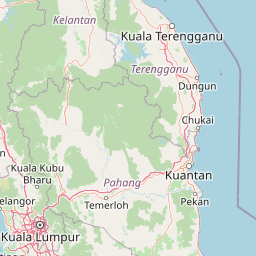
Tengku Hassanal Wildlife Reserve occupies a substantial portion of the central Titiwangsa Mountains, one of the most important mountain systems in Peninsular Malaysia. The reserve's landscape stretches across an unusually broad elevation range, beginning at about 43 meters above sea level in the Kuala Lompat lowlands and rising steeply through hill and montane terrain to the summit of Gunung Benom at 2,107 meters. This altitudinal span creates clearly defined ecological zones, from humid lowland valleys to cooler, mist-shrouded upper slopes, all within a single protected block.
The reserve's drainage network is centered on three major rivers: the Krau, the Lompat, and the Teris, which carve the forest floor into a series of valleys and ridges. These rivers shape both the vegetation and the patterns of animal movement across the landscape, with riverine corridors cutting through dense forest cover. Along the way, waterfalls such as Lata Bujang and Lata Sebarau interrupt the river systems, adding prominent scenic features to the interior terrain.
Underlying the reserve is a mix of sedimentary formations from the Semantan series, including post-Semantan redbeds, together with intrusive igneous rocks of the Benom Complex. The Benom Complex dominates the central part of the reserve, while sedimentary rocks dominate the northeast-to-southern arc, and igneous outcrops are more exposed in the northern and western sectors. Peaks such as Gunung Benom, Gunung Tungku, and Bukit Bongkok provide additional topographic relief and serve as landmarks within the protected landscape.
Tengku Hassanal Wildlife Reserve ecosystems, habitats, and plant life
Tengku Hassanal Wildlife Reserve is dominated ecologically by an exceptional expanse of lowland dipterocarp forest, which accounts for roughly 61 percent of the wooded area within its boundaries. This lowland matrix is complemented by substantial tracts of hill dipterocarp forest and montane forest on the higher slopes around Gunung Benom. Each forest type has its own internal subtypes, creating a layered mosaic of vegetation that supports an unusually rich array of niches for insects, birds, and mammals.
In the lowlands and along the river valleys, tall dipterocarp trees form a closed canopy that sustains shade-tolerant understory plants, ferns, and palms. As elevation increases on the approach to Gunung Benom, the vegetation shifts into hill dipterocarp communities, and eventually into montane forest with smaller, hardier trees and a higher proportion of mosses, lichens, and epiphytes. Although much of the upper montane area remains pristine and little explored, it is regarded as particularly valuable for conservation.
Disturbed secondary vegetation and cultivated plots occupy smaller portions of the landscape, but the bulk of the reserve remains ecologically intact. Among the rare plant species documented in the area are Kibatalia laurifolia and Phlegmariurus phyllanthus, both of which are considered endangered. The reserve's ecological continuum, from lowland rivers to montane ridges, gives it an unusually complete representation of Peninsular Malaysia's forest biodiversity within a single protected territory.
Tengku Hassanal Wildlife Reserve wildlife and species highlights
Wildlife diversity is one of the defining characteristics of Tengku Hassanal Wildlife Reserve. Surveys have recorded roughly 655 wildlife species within the reserve and its immediate surroundings, distributed across birds, amphibians, reptiles, mammals, and freshwater fish. Of these, 322 species are fully protected, with additional protection extended to 70 species under Malaysia's Wildlife Conservation Act 2010 and Fisheries Act 1985. Five species are classified as critically endangered and 16 as endangered.
Large mammals remain a center of conservation attention. The reserve still supports populations of the Malayan tiger, the Malayan tapir, the Sunda pangolin, and the elusive flat-headed cat, while packs of dhole continue to range through the forested interior. The gaur, the original focus of the reserve's protection, still occurs in parts of the territory, supported in part by the work of the southern gaur conservation center near Jenderak. Primates are equally prominent, with the dusky leaf monkey and the Sunda slow loris among the species of conservation concern present in the canopy and sub-canopy.
Birdlife is exceptionally rich, reflecting the diversity of habitats from lowland forest to montane ridges. Among the most notable species are the white-crowned hornbill, distinguished by its pale casque, and Storm's stork, both indicators of intact lowland forest. The rare Malayan peacock-pheasant still survives within the reserve in small but meaningful numbers. Bats are also remarkably diverse, with 71 recorded species contributing to the reserve's status as an important site for chiropteran research. Reptiles, amphibians, and freshwater fish collectively add further layers of faunal richness to the protected area.
Tengku Hassanal Wildlife Reserve conservation status and protection priorities
Tengku Hassanal Wildlife Reserve holds an exceptional position in Malaysia's conservation framework as one of the country's largest and most ecologically complete protected wildlife areas. Its scale, its intact lowland dipterocarp forest, and its connection from lowland rivers to high montane ridges make it indispensable for the long-term survival of several species that have lost much of their range elsewhere in Peninsular Malaysia.
The reserve's conservation value is reinforced by a network of conservation centers operating in and around its boundaries. PERHILITAN manages facilities including the Malayan Tiger Conservation Center and the southern gaur conservation center, while the nearby Kuala Gandah Elephant Conservation Centre focuses on Asian elephant welfare and public engagement. Together, these centers conduct breeding, rehabilitation, translocation, and outreach work that supports the reserve's wild populations and raises public awareness of wildlife protection.
Indigenous and rural communities are integral to modern conservation in the reserve. Under PERHILITAN's Biodiversity Protection and Patrolling Program, members of local communities, including Jah Hut and Cheq Wong villagers, are recruited as forest guardians. This approach recognizes the traditional relationship between these communities and the surrounding forest while strengthening patrolling capacity within the protected area. The reserve's importance is further underlined by the protection status of a majority of its fauna species, with more than half of the recorded wildlife species fully protected under Malaysian law.
Tengku Hassanal Wildlife Reserve cultural meaning and human context
The cultural landscape around Tengku Hassanal Wildlife Reserve is shaped by the presence of indigenous communities whose lives are closely intertwined with the surrounding forest. Around 36 villages lie within or near the reserve's boundaries, with the Jah Hut and Cheq Wong peoples forming the dominant indigenous groups in the eastern sector, particularly around Mukim Jenderak. Ten of these villages are indigenous settlements, including Kg. Seboi, Kg. Pian, Kg. Penderas, Kg. Paya Mendoi, and Kg. Kuala Terboi, while non-indigenous settlements such as Kg. Bolok Hulu, Kg. Ulu Cheka, and Felda Lembah Klau ring the reserve's edges.
These communities have long relied on the forest for livelihoods, traditional practices, and cultural identity, and their knowledge of the landscape complements formal conservation efforts. The recognition of local communities as forest guardians under PERHILITAN's Biodiversity Protection and Patrolling Program reflects a broader shift toward integrating indigenous stewardship into protected-area management in Malaysia. This partnership strengthens the reserve's social legitimacy and helps bridge traditional land use with modern wildlife protection.
Top sights and standout views in Tengku Hassanal Wildlife Reserve
Tengku Hassanal Wildlife Reserve stands out for the sheer size and continuity of its lowland dipterocarp forest, which remains one of the most extensive such blocks in Peninsular Malaysia. Rising from river valleys to the summit of Gunung Benom, the reserve compresses an entire elevational gradient of forest types into a single protected territory.
Equally distinctive is the reserve's concentration of rare and threatened species, from the gaur and Malayan tiger to the Sunda pangolin and flat-headed cat, alongside a remarkably intact primate community. The presence of multiple wildlife conservation centers, including facilities for elephants, tigers, and gaur, gives the protected area an active role in species recovery that goes beyond passive protection, while partnerships with indigenous communities ensure that local people remain central to the reserve's future.
Best time to visit Tengku Hassanal Wildlife Reserve
The climate of central Pahang is governed by the monsoon system that affects most of Peninsular Malaysia. The drier months, generally associated with the southwest monsoon period, typically offer more stable conditions for forest travel, clearer mountain views, and easier trekking on trails such as those leading to Lata Bujang or the peaks of Gunung Benom and Gunung Tungku. Wetter periods bring heavier rainfall, rising river levels, and denser insect activity, which can make trail conditions more challenging.
Wildlife observation can be productive throughout the year, although the cooler early mornings typical of the drier season often provide better chances of encountering primates and birds in the canopy. Visitors interested in combining forest exploration with visits to nearby conservation centers, such as the Kuala Gandah Elephant Conservation Centre, generally find the dry months more comfortable, while those drawn to lush green forest conditions and active waterfalls may prefer the early wet season. Because the reserve is not fully open for general tourism, visits typically focus on designated entry points and surrounding attractions rather than free movement through the interior.