
Mori Atlas logo
Nature reserveTorbiera delle Viote

A rare high-altitude peat bog ecosystem situated on the high plateau of Monte Bondone

Torbiera delle Viote Nature Reserve: Mapping the Alpine Wetland Landscape and Plateau Terrain

Torbiera delle Viote represents a distinct protected basin on the Monte Bondone plateau within the Trentino-Alto Adige region of northern Italy. This 13-hectare nature reserve provides a specialized habitat where lowland wetland flora, including yellow water-lily and flowering rush, coexist with surrounding spruce and larch forests at an elevation exceeding 1,500 meters. The area serves as a critical alpine enclave, offering researchers and geography enthusiasts a window into the complex interplay between glacial plateau terrain and rare, water-defined ecological communities.

peat bogalpine wetlandbiotopeNatura 2000Monte BondoneTrentino
A flat style digital illustration of a mountain valley with a waterfall cascading from a cliff, a meadow in the foreground, pine trees, and a sunlit sky.

Torbiera delle Viote

Nature reserve

Park overview

Structured park overview, official facts, and landscape profile for Torbiera delle Viote

Torbiera delle Viote park facts, protected area profile, and essential visitor context

Review the core facts for Torbiera delle Viote, including designation, size, terrain, visitor scale, habitats, and operating context in one park-focused overview.

About Torbiera delle Viote

Torbiera delle Viote is a compact but ecologically rich protected biotope located on the Piana delle Viote, the high plateau that forms part of the Monte Bondone massif overlooking the city of Trento in northern Italy. Although small in extent, the site captures an unusual combination of alpine and wetland environments: a flat, waterlogged basin dominated by peat-forming vegetation, fringed by montane conifer forest and partially shaded by scattered birch and hazel.

The Bog sits at the foot of the Bondone astronomical observatory and near the well-known Alpine Botanical Garden of Viote, two landmarks that place the reserve within a broader mountain landscape that blends natural, scientific, and recreational uses. Provincial authorities formally established the protected area in 2003, recognizing the peatland's importance as one of the limited high-altitude wetland remnants in the region and integrating it into the European Natura 2000 ecological network.

Ecologically, the site functions as a refugium for biodiversity. Its wet, acidic conditions produce a plant community more typical of lowland marshes than of alpine slopes, creating a striking ecological contrast with the surrounding spruce and larch forests. This unusual setting supports unusual combinations of amphibians, reptiles, breeding birds, migratory birds, and mammals, and the broader Piana delle Viote is also used as ranging habitat by large carnivores such as wolf and brown bear, whose occasional presence adds to the reserve's conservation significance.

For visitors, Torbiera delle Viote represents an accessible point of contact with a less commonly encountered alpine ecosystem. Despite its modest size, the area is appreciated for the clarity with which it illustrates how localized geology and hydrology can shape a distinctive ecological island within a large mountain landscape.

Quick facts and research context for Torbiera delle Viote

Torbiera delle Viote is a protected biotope of about 13 hectares on the Monte Bondone plateau, within the municipality of Trento in Trentino-Alto Adige, Italy. It was established as a provincial protected area by the Autonomous Province of Trento in 2003 and is part of the Natura 2000 ecological network under site code IT3120050.

The site is a high-altitude peat bog bordered by spruce and larch woodland, with scattered birch and other broadleaf trees growing on the bog itself. It supports a notably diverse wetland flora and serves as a refuge for amphibians, alpine and migratory bird species, and a wide range of forest mammals, including occasional visits from wolf and brown bear moving through the broader Bondone area.

Protection and recognition

Official protected area recognition and administrative status records for Torbiera delle Viote

Torbiera delle Viote Protection Status and Natura 2000 Designation Data

Examine the verified protection status and administrative designation history associated with Torbiera delle Viote through structured international records. Review recorded Natura 2000 network data to understand the established environmental framework governing this protected wetland landscape.
Park context

Deeper park guide and search-rich context for Torbiera delle Viote

Torbiera delle Viote history, landscape, wildlife, and travel context

Explore Torbiera delle Viote through its history, landscape character, ecosystems, wildlife, conservation priorities, cultural context, and seasonal travel timing in a structured park guide built for atlas discovery and search intent.

Why Torbiera delle Viote stands out

Torbiera delle Viote is best known for being one of the few true peat bog ecosystems preserved at altitude in the Trentino, an unusual feature in a region otherwise dominated by conifer forests, alpine meadows, and rocky Dolomitic terrain. The bog, set in a shallow basin on the Bondone plateau, hosts plant species typical of lowland wetlands, including yellow water-lily, flowering rush, yellow flag iris, and arrowhead, which coexist here at over 1,500 meters of elevation with surrounding spruce and larch stands. The reserve is also recognized for its rich and somewhat unexpected wildlife composition. Alpine ungulates such as red deer and chamois share the surrounding forest with smaller mammals, while the bog and its ponds support a strong amphibian community, including alpine newt, fire salamander, and yellow-bellied toad. Birdlife includes a mix of resident alpine species and seasonal migrants, giving the site particular interest for ornithological observation across different parts of the year.
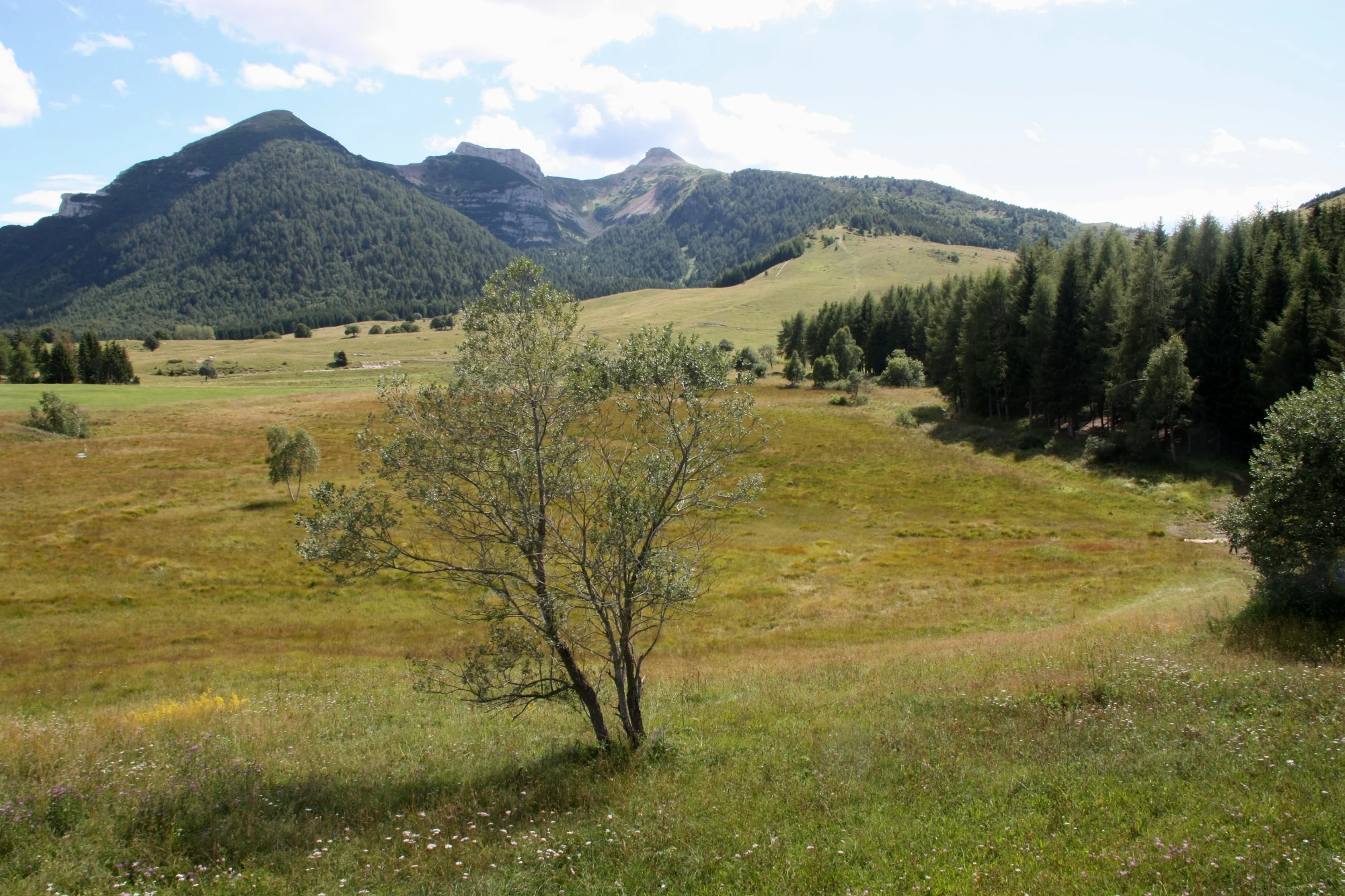
A panoramic view of the rolling meadows and peat bog area of Torbiera delle Viote in front of the Monte Bondone mountain range.
A wide view of the Monte Bondone massif overlooking the peat bog landscape of Torbiera delle Viote.

Torbiera delle Viote history and protected-area timeline

Torbiera delle Viote acquired its current protected status relatively recently. The area was designated as a provincial biotope by the Autonomous Province of Trento through a deliberation dated October 17, 2003, formalizing conservation recognition for a peatland that had developed naturally on the high plateau of Monte Bondone.

Its inclusion in the Natura 2000 network under site code IT3120050 reflects broader European interest in the site's wetland values, while local management by the province has aimed to maintain the peatland's hydrology and biological character within an alpine setting that is otherwise shaped by forestry, pastoral use, and tourism infrastructure connected to the nearby observatory and botanical garden.

Torbiera delle Viote landscape and geographic character

The Torbiera delle Viote occupies a relatively flat basin on the Piana delle Viote, a broad plateau set high above the Adige valley and dominated visually by the ridge of Monte Bondone and its peak, Cima Palon. Within this typically steep and forested alpine setting, the bog forms a striking level expanse, where water collects among mosses, sedges, and shallow pools rather than draining rapidly downslope.

Around the bog, the terrain transitions into dense conifer forest dominated by Norway spruce and larch, with scattered broadleaf trees on the bog itself adding structural variety to the wetland. The plateau is also shaped by human elements: an astronomical observatory crowns the skyline above the site, and a restaurant and service facilities nearby mark the area's long-standing role as a destination on the Bondone. Despite these features, the small protected area remains a quiet, water-defined landscape with its own distinct atmospheric and visual character within the larger mountain mass.

Torbiera delle Viote ecosystems, habitats, and plant life

Ecologically, Torbiera delle Viote is defined by its peat-forming wetland, an uncommon and ecologically distinctive habitat in the context of the surrounding Dolomitic and pre-Dolomitic mountains. The peat substrate and persistently waterlogged conditions have produced a flora strongly reminiscent of lowland marshes, with species such as yellow water-lily, flowering rush, yellow flag iris, arrowhead, and lily of the valley coexisting here with typical upland plants like pulsatilla.

The bog is encircled by a coniferous border dominated by spruce and larch, while the wettest areas hold scattered, hardy broadleaf trees such as silver birch, hazel, and hornbeam, trees that are otherwise rare at such elevations in the region. This juxtaposition of wetland, bog woodland, and montane conifer forest within a small area gives the site a layered ecological structure of considerable interest for understanding altitudinal gradients in the Trentino.

The hydrology of the basin is central to the site's ecological identity. Stagnant pools, saturated peat, and seasonal flooding maintain the conditions required by the bog flora and by the amphibian communities for which the reserve is particularly noted. The proximity of the Alpine Botanical Garden further enhances the botanical significance of the site, allowing comparisons between naturally established wetland flora and the cultivated collections of high-altitude plants nearby.

Torbiera delle Viote wildlife and species highlights

The wildlife of Torbiera delle Viote reflects the site's position at the interface between alpine woodland, wetland, and open plateau. Mammals are well represented, including red deer, roe deer, and Alpine chamois which use the surrounding forests and pastures, alongside smaller species such as red fox, stone marten, pine marten, least weasel, Eurasian badger, red squirrel, European hare, Western hedgehog, edible dormouse, hazel dormouse, alpine shrew, and European snow vole.

The site's broader landscape context, set within the Monte Bondone range, also provides habitat for the two large carnivores that have made something of a natural comeback in the Italian Alps. Wolf has been observed several times in and around the bog, and brown bear has made incursions into the surrounding woods, lending the area occasional, but ecologically significant, large-predator presence.

Birdlife is one of the reserve's most distinctive features. Breeding and resident species include birds typical of alpine pastures and montane forests, such as red-backed shrike, yellowhammer, yellow wagtail, tree pipit, Eurasian jay, common cuckoo, common kestrel, red kite, Eurasian sparrowhawk, northern goshawk, black woodpecker, goldcrest, coal tit, Eurasian treecreeper, fieldfare, mistle thrush, little owl, Eurasian scops owl, barn owl, tawny owl, common redstart, whinchat, and common linnet. Migratory species occur seasonally, including meadow pipit, short-toed snake eagle, willow warbler, European honey buzzard, and Eurasian hobby, while in recent years alpine accentor and snowfinch have also been recorded around the bog.

Amphibians are especially diverse due to the wetland conditions, with populations of alpine newt, fire salamander, yellow-bellied toad, and common frog tied closely to the pools and stagnant water of the bog. Recent observations have also included alpine salamander near some of the small pools. Reptiles recorded in the area include Aesculapian snake, green whip snake, and asp viper, species that together illustrate the varied microclimates present within this small mountain reserve.

Torbiera delle Viote conservation status and protection priorities

The principal conservation value of Torbiera delle Viote lies in its preservation of a peatland ecosystem at an altitude where such habitats are naturally scarce. By maintaining the waterlogged conditions of the basin, the reserve protects a specialized flora and the amphibian, bird, and invertebrate communities that depend on it, while also buffering a distinctive ecological contrast within the broader conifer-dominated alpine landscape of Monte Bondone.

Its designation as a provincial biotope in 2003 and its integration into the Natura 2000 network under site code IT3120050 place the site within a coordinated framework of European habitat protection. Active management by the Autonomous Province of Trento aims to maintain the bog's hydrology and ecological structure in the face of pressures associated with nearby tourism, forestry, and infrastructure, ensuring that the site's role as a refugium for alpine wetland biodiversity continues over time.

Torbiera delle Viote cultural meaning and human context

The Piana delle Viote has long served as a place of crossing between the city of Trento and the higher slopes of Monte Bondone, and the development of the astronomical observatory, the Alpine Botanical Garden, and supporting hospitality facilities reflects a long-standing tradition of using this plateau for both scientific and recreational purposes. The bog itself, however, remains a more contemplative feature of the landscape, valued for its quiet ecological character rather than for built heritage.

Top sights and standout views in Torbiera delle Viote

The Torbiera delle Viote stands out for the unusual coexistence of lowland-style wetland vegetation with subalpine conifer forest within a small, well-defined area on the Bondone plateau. Its peat substrate and shallow pools sustain a flora and amphibian community rarely encountered at this altitude, while the surrounding woods support a rich mammal community and a varied birdlife that combines resident, migrant, and high-mountain species.

The site's accessibility from Trento, combined with its proximity to the Bondone observatory and the Alpine Botanical Garden, gives it unusual value as a place where alpine geology, wetland ecology, biodiversity conservation, and scientific research come together in a single compact setting.

Best time to visit Torbiera delle Viote

Late spring and early summer typically offer the richest conditions for visiting the bog, when wetland flora is in active growth and breeding birds are most vocal across the surrounding plateau. Summer visits showcase the full extent of the bog's plant diversity and the activity of amphibians around its pools, while autumn brings quieter conditions and shifting color in the larch stands that frame the wetland. Winter landscapes can be striking but generally limit access to and within the peatland itself.
Monthly climate preview

Long-term representative temperature and precipitation patterns for Torbiera delle Viote

Torbiera delle Viote Climate Normals and Measured Weather by Month

Torbiera delle Viote displays a recorded range of monthly mean temperatures from negative values through warm summer peaks alongside varying daily precipitation rates. Examining the complete twelve-month record reveals detailed shifts in average temperature and monthly precipitation across the representative coordinate.
Annual mean7 °C
-3 °C18 °C
Jan-3°
Feb-1°
Mar
Apr
May11°
Jun15°
Jul18°
Aug18°
Sep13°
Oct
Nov
Dec-2°
Warmest month
July

17.7 °C

Coolest month
January

-3 °C

Wettest month
October

3.5 mm/day

Driest month
January

1.2 mm/day

Park location guide

Geography guide, regional context, and park location map for Torbiera delle Viote

Torbiera delle Viote park geography, regions, and map view in Italy

Understand where Torbiera delle Viote sits in Italy through a broader geographic reading of the surrounding landscape, nearby location context, and its mapped position within the national park landscape.

How Torbiera delle Viote fits into Italy

Italy is a unitary parliamentary republic in Southern and Western Europe, located on the Italian Peninsula with the Alps to the north. It borders France, Switzerland, Austria, Slovenia, Vatican City, and San Marino, and shares maritime boundaries with several Mediterranean countries. The country has approximately 59 million residents and uses the Euro as its currency.

Wider geography shaping Torbiera delle Viote in Italy

Italy occupies a boot-shaped peninsula in southern Europe, bordered by the Alps to the north. It shares land borders with France, Switzerland, Austria, Slovenia, Vatican City, and San Marino. The country includes the Mediterranean islands of Sicily and Sardinia, along with approximately 800 smaller islands.

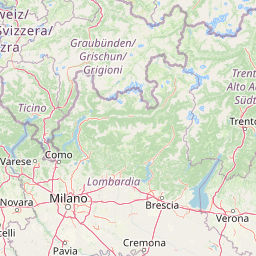
Map view of Torbiera delle Viote

Use this park location map to pinpoint Torbiera delle Viote in Italy, understand its exact geographic position, and read its mapped placement within the surrounding landscape more clearly.

Pigeon | © OpenStreetMap contributors

Location context for Torbiera delle Viote

Trentino-Alto Adige
Recorded earthquake history

Examine the Historical Earthquake Records Associated with Torbiera delle Viote

Review the documented history of seismic activity recorded in the surrounding area of Torbiera delle Viote. Through the MoriAtlas collection, users can access individual event data, including timing and magnitude, to understand the historical seismic landscape near this protected alpine peatland.

Torbiera delle Viote Earthquake History

Catalogued events

67 events

Strongest magnitude

Magnitude 5.1

Most recent event

Jan 9, 2026

This history includes earthquakes recorded inside the park or within 50 km of its borders

Examine the high altitude peatland basin, conifer forests, and protected alpine wetland environment.

Torbiera delle Viote Photos and Landscape Scenery Visual Exploration

Visual documentation reveals the distinct terrain and fragile habitats defining the protected alpine peat bog. Photographic records illustrate the stark contrast between shallow water pools and surrounding spruce forests on the high mountain plateau.

A panoramic view of the rolling meadows and peat bog area of Torbiera delle Viote in front of the Monte Bondone mountain range.

Park atlas

Continue comparing alpine wetlands and mountain reserves across the regional terrain

Exploring Parks Near Torbiera delle Viote and Surrounding Protected Landscapes

Compare Torbiera delle Viote with other protected areas across the surrounding alpine region to understand connected mountain habitats. Examining adjacent reserves reveals how high-elevation wetlands and conifer forests fit into broader regional geography.
A horizontal watercolor illustration depicting a lake framed by green rolling hills and distant purple mountain ridges.
Nature reserveTrentino-Alto Adige
About 6.6 km away#1 closest

Northwest

Biotopo Lago di Toblino Protected Area and Regional Landscape Geography

Nature reserve featuring Alpine and sub-Mediterranean plant habitats

Biotopo Lago di Toblino acts as a sheltered basin where lake, marsh, and woodland habitats create an essential corridor for wildlife. This protected landscape is shaped by the interplay between the surrounding steep mountains and the influence of nearby Lake Garda, fostering an unusual climatic overlap that supports a wide range of native flora and waterbird populations within an important European conservation site.

Area
1.705 km²
Established
1992
IUCN
IV
Soft watercolor painting of layered green hills and distant mountain ranges with a hazy, light-filled sky.
Nature reserveTrentino-Alto Adige
About 8.4 km away#2 closest

Southwest

Biotopo Marocche di Dro: Geologic Protected Landscape in Trentino-Alto Adige

Discover the massive postglacial rockfall deposits of northern Italy.

Biotopo Marocche di Dro is a protected nature reserve defined by its expansive, boulder-strewn arid surface and exceptional postglacial rockslide deposits. Unlike typical wetland biotopes, this site provides a rare, sun-exposed habitat for reptile-rich fauna and unique plant communities within the broader Trentino landscape, offering a window into the dramatic geological transformations that have shaped the valley floor.

Area
2.508 km²
Established
1989
IUCN
IV
Nature reserveTrentino-Alto Adige
About 14 km away#3 closest

West

Biotopo Lomasona Nature Reserve: Protected Landscapes and Alpine Geography in Trentino

A small-scale conservation area in the heart of Val Lomasona

Biotopo Lomasona stands as a specialized nature reserve in the Italian Province of Trento. This compact protected area focuses on habitat conservation within the alpine terrain, serving as an important ecological anchor in the valley landscape of Comano Terme and the wider Trentino-Alto Adige region.

Area
0.26 km²
Established
1987
IUCN
IV
A watercolor painting showing a panoramic view of a green wetland landscape with soft purple mountains in the background.
Nature reserveTrentino-Alto Adige
About 16 km away#4 closest

West

Biotopo Fiavé: A Protected Wetland and Archaeological Landscape in Trentino-Alto Adige

Mapping glacial lake basins and ancient prehistoric heritage sites

Located at the foot of Monte Cogorna, Biotopo Fiavé functions as a vital wetland reserve characterized by extensive peat bogs and mixed willow-alder thickets. This area offers a unique intersection of natural hydrological evolution and UNESCO-protected archaeological history, serving as a rare, compact cross-section of alpine valley ecosystems and prehistoric human settlement patterns.

Area
1.373 km²
Established
1988
IUCN
IV
A soft watercolor painting of a wetland landscape with distant rolling hills, green grassy banks, and a calm water surface, rendered in a muted palette.
Nature reserveTrentino
18 km away#5 closest

Southwest

Lago di Loppio Nature Reserve: A Protected Wetland and Archaeological Landscape in Trentino

Mapping the ecological intersection of wetlands and historical island sites.

Lago di Loppio functions as a critical provincial biotope, blending rare marshland ecology with a deep historical footprint on the Island of Sant'Andrea. Situated within a depression in the Adige valley, this protected area features a unique transitional microclimate that supports diverse flora and fauna, alongside ruins spanning Roman to medieval eras.

Area
1.126 km²
Established
1987
Relief
Upland
Climate
Temperate
Nature reserveTrentino-Alto Adige
About 19 km away#6 closest

Southwest

Biotopo Monte Brione: Protected Nature Reserve and Mediterranean Landscape Map

Exploring the limestone ecology of northern Italy

Biotopo Monte Brione stands as a remarkable protected area where southern European vegetation, including holm oaks and Phoenician juniper, flourishes against a backdrop of sun-exposed limestone cliffs. Situated as a natural buffer near Lake Garda, this reserve offers a deep look into the intersection of Mediterranean floral diversity and Alpine geographic settings, providing a essential refuge for protected raptors and rare invertebrate species.

Area
0.663 km²
Established
1992
IUCN
IV
Nature reserveTrentino-Alto Adige
About 27 km away#7 closest

Northeast

Biotopo Prati di Monte: Nature Reserve and Protected Alpine Landscape Discovery

Geographic overview of the Dossone di Cembra alpine ridge

Biotopo Prati di Monte represents a protected nature reserve in Trentino-Alto Adige, known for its unique concentration of peatland habitats. The area encompasses the remnant Lago di Valda basin, acidic spruce forests, and diverse wetland meadows. This atlas-focused perspective highlights the reserve as a significant refugium for sub-arctic flora situated along the porphyritic mountain terrain between the Val di Cembra and the Bassa Atesina.

Area
0.06 km²
Established
1994
IUCN
IV
A soft watercolor painting of a tranquil lake surrounded by gentle, rolling green hills and wetland vegetation.
Nature reserveTrentino-Alto Adige
33 km away#8 closest

Southwest

Lago d'Ampola: Mapping the Ecology of a Glacial Nature Reserve in Trentino

A critical protected wetland and montane biotope

Lago d'Ampola preserves a remarkably layered habitat of glacial origin, where water lilies, marsh vegetation, and spruce-beech forests converge. This protected site in Trentino-Alto Adige offers a focused look at the intersection of glacial geography and successful ecosystem recovery in an Alpine valley setting.

Area
0.5 km²
Established
1990
Relief
Mountain
Climate
Alpine

Common questions about visiting, size, designation, and location context for Torbiera delle Viote

Torbiera delle Viote FAQs for park facts, access, geography, and protected area context

Find quick answers about Torbiera delle Viote, including protected-area facts, park geography, trail and visitor context, and how the park fits into its surrounding country and regional landscape.
MoriAtlas Explorer

Continue Your Protected Areas Search Across the Global Atlas

Deepen your exploration by continuing the structured search for national parks and protected areas worldwide. Utilize the comprehensive filtering capabilities to compare different conservation landscapes and refine your understanding of global park geography. Discover more about the distribution and characteristics of protected natural areas.

Global natural geography