
Why Velká Volavka Natural Monument stands out
Velká Volavka is best known for hosting the only known population of critically endangered sea plantain (Plantago maritima) in the Most district, together with a small assemblage of halophilous plant species typical of inland saline habitats. The site represents one of those rare Bohemian refugia where salt-steppe vegetation persists in a landscape otherwise dominated by agriculture and industrial use, and it is precisely the unusual combination of a saline plant community inside an inland upland setting that gives Velká Volavka its scientific and conservation importance.
Velká Volavka Natural Monument history and protected-area timeline
Velká Volavka was established by decree of the Okresní úřad v Mostě (the former District Office in Most) under regulation No. 1/2000, with effect from 30 March 2000. The declaration was issued specifically to safeguard a delicate community of halophilous plants in a locality that, at that time, was recognized as the only site in the Most district supporting the critically endangered Plantago maritima.
The site sits within a landscape whose ecological and human history is closely tied to the heavy industrial development of the North Bohemian basin. Despite that history, the small sloping patch around the northwestern foot of Velká Volavka hill was identified by local naturalists as botanically exceptional, and their surveys; including earlier work such as Jaromír Sládek's 1988 study of contemporary halophyte vegetation in the Most region published in the Sborník Okresního muzea Most, provided the scientific basis for formal protection. Since its designation, the area has continued to be catalogued within Czech nature conservation records under its dedicated code (2174 in the national database) and is repeatedly referenced in inventories of protected sites and memorial trees of the Most district.
Velká Volavka Natural Monument landscape and geographic character
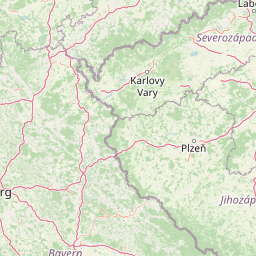
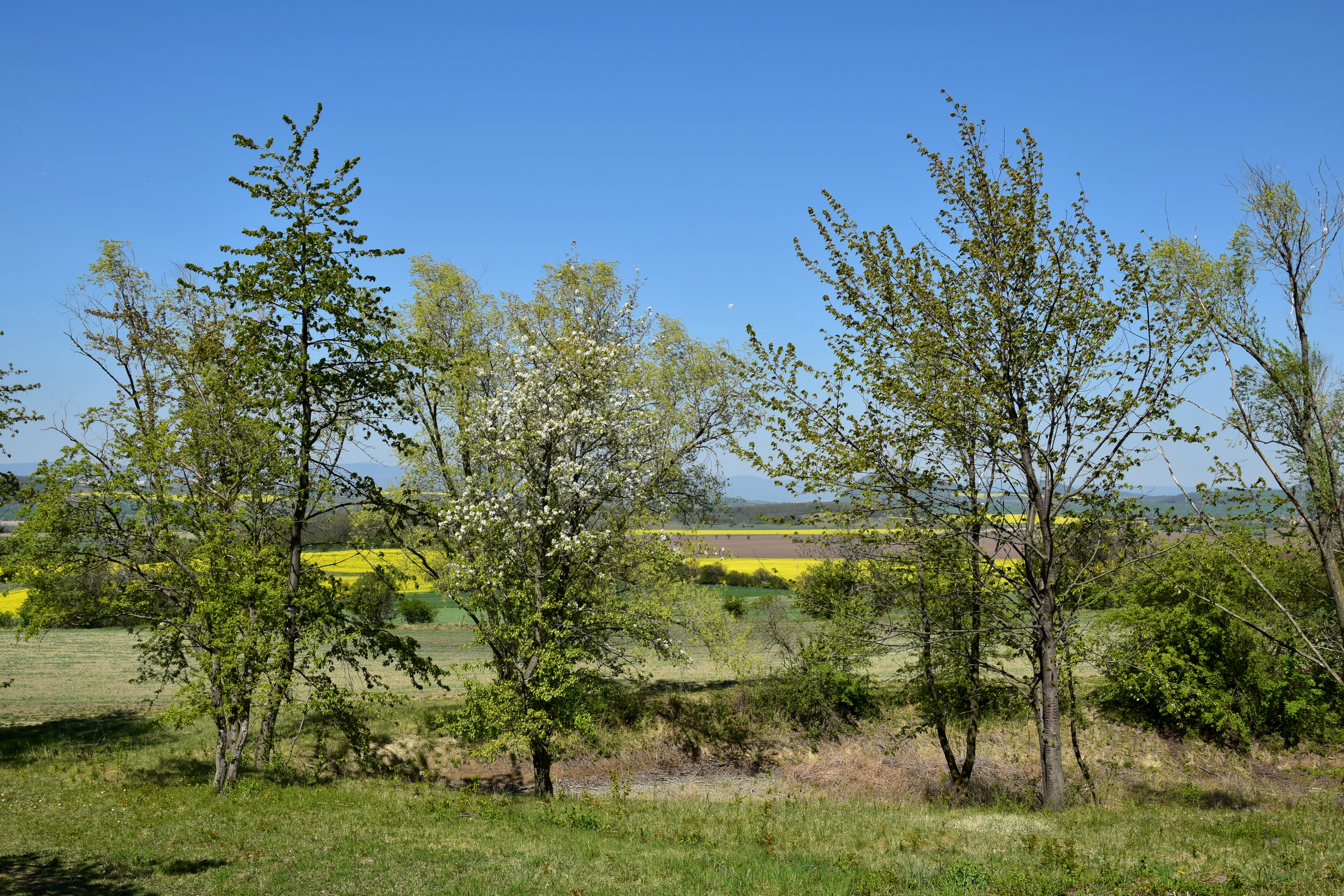
The Velká Volavka protected area sits on the northwestern, lower slopes of a hill also called Velká Volavka, whose summit reaches about 344 meters and which belongs to the Ranské středohoří, a southwestern spur of the larger České středohoří system. The protected plot itself occupies a relatively flat or gently sloping zone between roughly 262 and 274 meters in elevation, an unusually sheltered position compared to the steeper hill above it. The terrain is marked by a small, often drained or seasonally fluctuating water reservoir in the central part, visible in photographs of the site as a dry basin framed by open ground and low vegetation.
Although the immediate landscape is subdued, the surrounding context is shaped by the broader České středohoří orography, with volcanic hills and basalt ridges framing the horizon. Local soils in such foothill positions typically reflect a mixture of weathered volcanic substrate and accumulated fine sediments, and in low-lying pockets like Velká Volavka, mineral-rich seepage has historically contributed to the mildly saline conditions that now support the site's distinctive flora. The overall impression is of a tiny, almost hidden enclave tucked into the lower flanks of a hill, surrounded by countryside that nevertheless carries the deeper geological imprint of the North Bohemian volcanic highlands.
Velká Volavka Natural Monument ecosystems, habitats, and plant life
The defining ecological character of Velká Volavka is its community of halophilous, or salt-tolerant, plants, an exceptionally rare vegetation type in inland Central Europe. Halophytes require specific conditions, often linked to saline soils or mineral-rich seepage, and in the Czech Republic today they survive mainly in small isolated refugia rather than as continuous habitats. The little plot protected here is one such refugium, and from an ecological standpoint its most important function is to maintain the abiotic conditions; open ground, fluctuating moisture, and the subtle chemistry of the substrate; that allow this fragile community to persist.
The protected vegetation is open and low-growing, dominated by a mosaic of short grasses, sedges, rushes, and small forbs adapted to nutrient-poor and intermittently moist saline substrates. Around the central reservoir, the moisture gradient creates the variety of microhabitats that halophyte species typically exploit, with drier, more exposed patches supporting the most stress-tolerant plants and the wetter fringes favoring species tolerant of seasonal inundation. This fine-scale ecological mosaic is precisely what makes small sites like Velká Volavka disproportionately important: a few meters of disturbance or ecological change can shift the balance for entire specialized communities.
Velká Volavka Natural Monument wildlife and species highlights
The source material for Velká Volavka focuses overwhelmingly on its botanical rather than its zoological significance, and accordingly the protected site's identity is plant-centered. In ecological terms, however, the open halophyte patches and the small seasonal reservoir it contains can be expected, like similar salt-steppe refugia in the region, to support modest but distinctive invertebrate communities, including halophile-associated insects whose life cycles are tied to the same saline microhabitats. Beyond that, the surrounding Ranské středohoří foothills are typical dry-grassland and light-woodland habitats of the České středohoří foothills, supporting common species of small mammals, common reptile species of warm dry slopes, and the usual passerine birds of open countryside and low scrub.
Because the source pages do not document specific fauna records, the most honest reading is that the site's recognized conservation value is essentially botanical, while any wildlife interest comes from the broader landscape setting rather than from particular rare species documented at the protected plot itself.
Velká Volavka Natural Monument conservation status and protection priorities
The conservation value of Velká Volavka lies in its role as a refuge for halophyte vegetation, an inland vegetation type that has been heavily reduced across Central Europe through drainage, agricultural intensification, and changes in land use. The site's IUCN category IV designation, used in the Czech system to denote the přírodní památka category, explicitly frames it as a habitat and species management area. In practical terms, this means the small patch is protected primarily because of the species and habitats it harbors, rather than for landscape or scenic reasons.
The site's unique contribution to conservation in the region is that it supports the only known population of Plantago maritima in the Most district, alongside several other protected halophilous species such as Carex secalina, Juncus gerardii, Centaurium pulchellum, Eleocharis uniglumis, Melilotus dentatus, Scirpus tabernaemontani, Lotus tenuis, and Lotus maritimus. Many of these are rare or declining in the Czech Republic, and their joint occurrence in such a small area is what gives Velká Volavka its regional conservation weight. As a small protected node embedded in a much larger industrial and agricultural landscape, the site also exemplifies how invaluable even tiny nature reserves can be for keeping rare ecological communities alive over the long term.
Velká Volavka Natural Monument cultural meaning and human context
The Velká Volavka area lies within the cultural landscape of North Bohemia, characterized by a long history of mining, heavy industry, agriculture, and settlement that contrasts sharply with the small preserved patch of saline flora at its core. The nearby village of Volevčice in the Most district anchors the site within the traditional rural-mosaic of the České středohoří foothills, where small communities have historically lived among vineyards, orchards, and dry grassland.
The natural monument is also a part of the long Czech tradition of small-scale, scientifically driven nature protection, in which local naturalists, district authorities, and national conservation databases collaborate to identify and shield small but ecologically irreplaceable sites. The 1988 study by Jaromír Sládek on the current state of halophyte vegetation in the Most region is an example of that tradition: a regional museum scientist whose field survey ultimately contributed to the formal 2000 declaration of Velká Volavka as a protected natural monument.
Top sights and standout views in Velká Volavka Natural Monument
Velká Volavka is notable above all as the only documented locality in the Most district where the critically endangered sea plantain (Plantago maritima) survives, making the tiny reserve a single-population stronghold for one of the Czech Republic's rarest halophytes. Equally important is the broader halophyte assemblage it protects, including Carex secalina, Juncus gerardii, Lotus maritimus, and several other saline-affiliated species whose joint occurrence here is regionally unusual.
Beyond its botanical highlights, the site is a textbook example of the small, habitat-focused nature monument (přírodní památka) model in Czech conservation, formal IUCN category IV, declared in 2000 on a patch of less than one hectare to preserve conditions that cannot survive in the surrounding intensively used landscape. Its position on the slopes of Ranské středohoří adds a subtle geological backdrop, showing how even minute pockets of specialized habitat can carry disproportionate conservation significance.
Best time to visit Velká Volavka Natural Monument
Velká Volavka is a small botanical reserve rather than a scenic visitor destination, so timing a visit is more about observing its flora than about dramatic seasonal scenery. The vegetation emerges and becomes identifiable in late spring and early summer, when the halophyte species flower and the characteristic low mosaic of the saline community is most visible. Late spring visits are particularly well suited to seeing Plantago maritima in flower, while drier parts of summer allow easier walking across the open ground around the central reservoir.
Because the site is small and exposed, very wet or frost-bound conditions in winter and early spring make the terrain less comfortable to traverse and obscure the low-growing flora. Late spring through early autumn is generally the most rewarding window for any botanical or photographic interest, though visitors should expect a quiet, working conservation landscape rather than a tourist attraction.