
Why Velké bahno stands out
Velké bahno is best known for its unusual concentration of wetland and mire habitats packed into a small area, including extensive spruce-alder swamp forests and several smaller peatlands in various stages of development. The reserve stands out for harboring rare Bohemian flora such as marsh calla, several orchid species, bog star, and the only known Bohemian locality of the rare mountain bolete mushroom Butyriboletus subappendiculatus. It is also notable for the strong presence of critically threatened wildlife, including a large population of the pool frog and rare ground beetles adapted to boggy forest habitats. Together, these wetland, woodland, and species features give the reserve a distinctive character within the broader Šumava conservation landscape.
Velké bahno history and protected-area timeline
Velké bahno was formally declared a natural monument (přírodní památka) on 27 May 1992 by the District Office in Český Krumlov. Its designation recognized the ecological value of an already-recognizable wetland complex embedded within the Blíženský forest, near the headwaters of a stream flowing toward the Lipno reservoir.
In the decades leading up to protection, the wider landscape had undergone significant change. From the mid-20th century onward, the traditional mosaic of forests, extensive meadows, and marshes that once characterized the area was progressively converted into a more uniform forest landscape dominated by spruce, with pine as a secondary component. Some of the moors and marshes were also affected by forestry drainage works, leaving a patchwork of degraded hydrology that the declared reserve was meant to help stabilize.
Since its declaration, Velké bahno has been administered as part of the Šumava Protected Landscape Area, and its management has focused on maintaining and gradually restoring the wetland character of the site. The reserve continues to be viewed as an important local reference site for understanding how spruce-dominated mire forests and small peatlands recover and develop in this part of the Bohemian Forest foreland.
Velké bahno landscape and geographic character
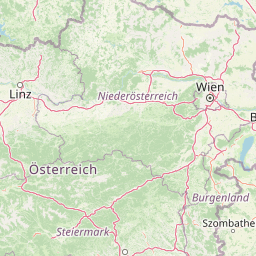
The landscape of Velké bahno is shaped by a shallow depression on the rolling terrain of the Šumava foothills, lying between roughly 730 and 750 meters above sea level. The underlying bedrock consists of biotite and sillimanite-biotite paragneiss, which in combination with the local hydrology has favored the persistence of wet, peaty conditions rather than freely draining soils.
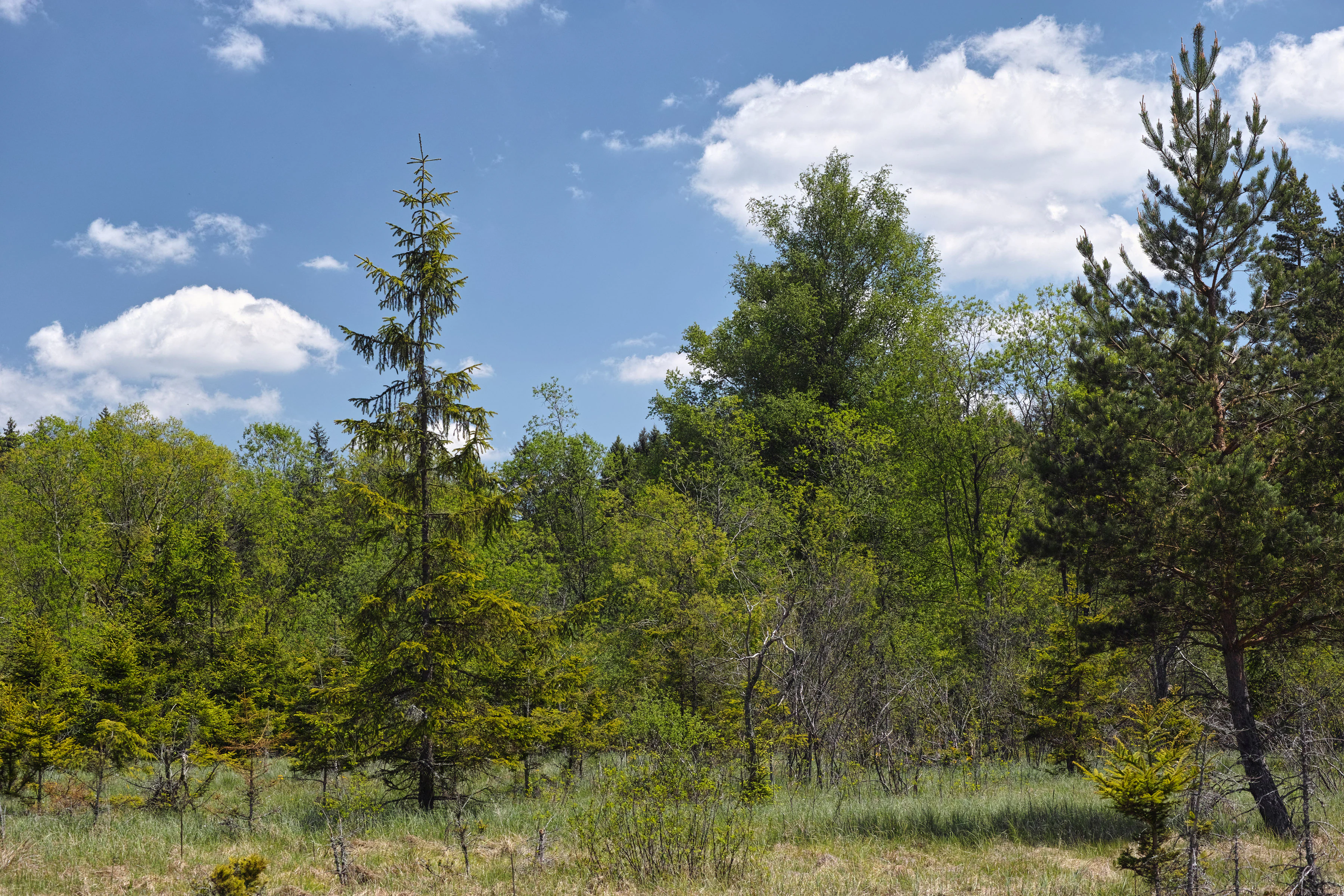
Streams and seepage flow through the depression, eventually feeding toward the Lipno reservoir to the south. This wetness has produced a mosaic of spruce-dominated forests with occasional pine, patches of alder swamp forest (smrkové olšiny), small boggy peatlands, and boggy willow stands. Some former non-forest areas still appear as open, marshy clearings within the woodland matrix, while historically drained sections show ongoing hydrological recovery.
Overall, the terrain feels gently undulating rather than dramatic, but the interplay between forest blocks, mires, and wet openings gives the area a distinctive texture. The combination of dark conifer stands, lighter boggy openings, and the soft contours of the Šumava foothills defines the visual and ecological character of the reserve.
Velké bahno ecosystems, habitats, and plant life
Velké bahno is defined ecologically by the interplay between conifer-dominated forest, alder swamps, and open or semi-open wetland habitats. The broader Šumava foothills region once carried a mosaic of forests, extensive meadows, and marshes, and Velké bahno preserves a recognizable fragment of that older landscape structure even after a century of forest conversion and partial drainage.
The dominant woodland signal is spruce with pine admixed, while wetland edges are characterized by alder (olše) and willow (vrba) formations typical of Central European mire forests. Succession is actively shifting parts of the reserve toward waterlogged spruce-alder swamp and boggy willow stands, reinforcing the wet-forest character that the protection designation emphasizes.
Non-forest soils and young thickets add to the ecological diversity, supporting a surprisingly rich flora for so small a site. The combination of wooded mires, open peat patches, and seasonally marshy clearings makes the reserve a compact but unusually complete representation of upland wetland habitats in this part of southern Bohemia.
Velké bahno wildlife and species highlights
The fauna of Velké bahno reflects the strong wetland orientation of the reserve. The most striking element is a large population of the critically endangered pool frog (Pelophylax lessonae), which uses the boggy habitats and associated waters as core breeding and living territory.
The stream running through the reserve supports additional notable aquatic and semi-aquatic species. The European brook lamprey (Lampetra planeri) inhabits the stream itself, while the alpine newt (Ichthyosaura alpestris) and the smooth newt (Lissotriton vulgaris) occur in and around the wetter sections. These amphibians are characteristic of cool, well-vegetated upland waters and indicate that the hydrological conditions of the reserve remain largely intact.
Invertebrate diversity is also unusually strong for the size of the site. Ground beetles are particularly notable, with the critically endangered Carabus menetriesi pacholei documented here, along with the rare heather ground beetle and Epaphius rivularis. The bog-specialist butterfly Colias palaeno, classified as strongly threatened, adds to the picture of a mire-dependent invertebrate community that depends on the persistence of boggy, lightly wooded conditions.
Velké bahno conservation status and protection priorities
Velké bahno is protected as a přírodní památka (natural monument) under the Czech system of small-scale protected areas, with IUCN management category IV (habitat/species management area). It is administered within the broader Šumava Protected Landscape Area, which provides the regional conservation framework and management authority.
From a conservation standpoint, the reserve's importance lies in the concentration of threatened wetland and mire habitats within a small but ecologically coherent area. The site preserves spruce-alder swamp forests in various developmental stages, several peatlands, and additional wetlands on a geologically distinctive substrate, an unusual combination for the Šumava foothills. These habitats are the main reason for protection and the foundation for the site's species significance.
The reserve is also important as a refugium for several critically and strongly threatened species whose long-term survival in Bohemia depends on the continuity of boggy conditions. Maintaining hydrological integrity, curbing further drainage effects, and allowing natural succession toward wet forest conditions are central to its conservation value, ensuring that the site continues to function as a key local node within the wider Šumava conservation network.
Top sights and standout views in Velké bahno
Velké bahno stands out for packing a remarkable range of upland wetland features into a small Bohemian reserve: spruce-alder swamps, several wooded peatlands, boggy willow stands, and wet clearings developed on paragneiss bedrock. It hosts the only known Bohemian locality of the rare mountain bolete Butyriboletus subappendiculatus, alongside a suite of protected mire plants such as marsh calla, Dactylorhiza orchids, bog star, and buckbean.
The reserve is equally notable for its fauna, supporting a strong population of the critically endangered pool frog, brook lampreys in the local stream, alpine and smooth newts, and a set of rare mire-associated ground beetles including Carabus menetriesi pacholei. Set within the Šumava Protected Landscape Area and reachable from Černá v Pošumaví, Velké bahno offers a compact but characteristic example of the wetland heritage of the Šumava foothills.
Best time to visit Velké bahno
Velké bahno can be appreciated across much of the year, but late spring and early summer tend to be especially rewarding for botanical and wetland interest, when mire plants and orchids are in bloom and boggy clearings are at their most visually active. Late spring in particular brings flowering displays from species such as Calla palustris and Dactylorhiza orchids, while amphibian activity around pools and the stream is also high.
Early autumn can be a quieter and atmospherically rich time to visit, with cooler weather, soft light over the spruce forests, and a strong sense of the area's near-boreal character. Winter visits are possible in calmer conditions but are less suitable for observing the reserve's distinctive flora and fauna. As always at small wetland reserves, visitors should stick to existing paths to avoid disturbing sensitive mires and ground-nesting species.