Why Yellowstone National Park stands out
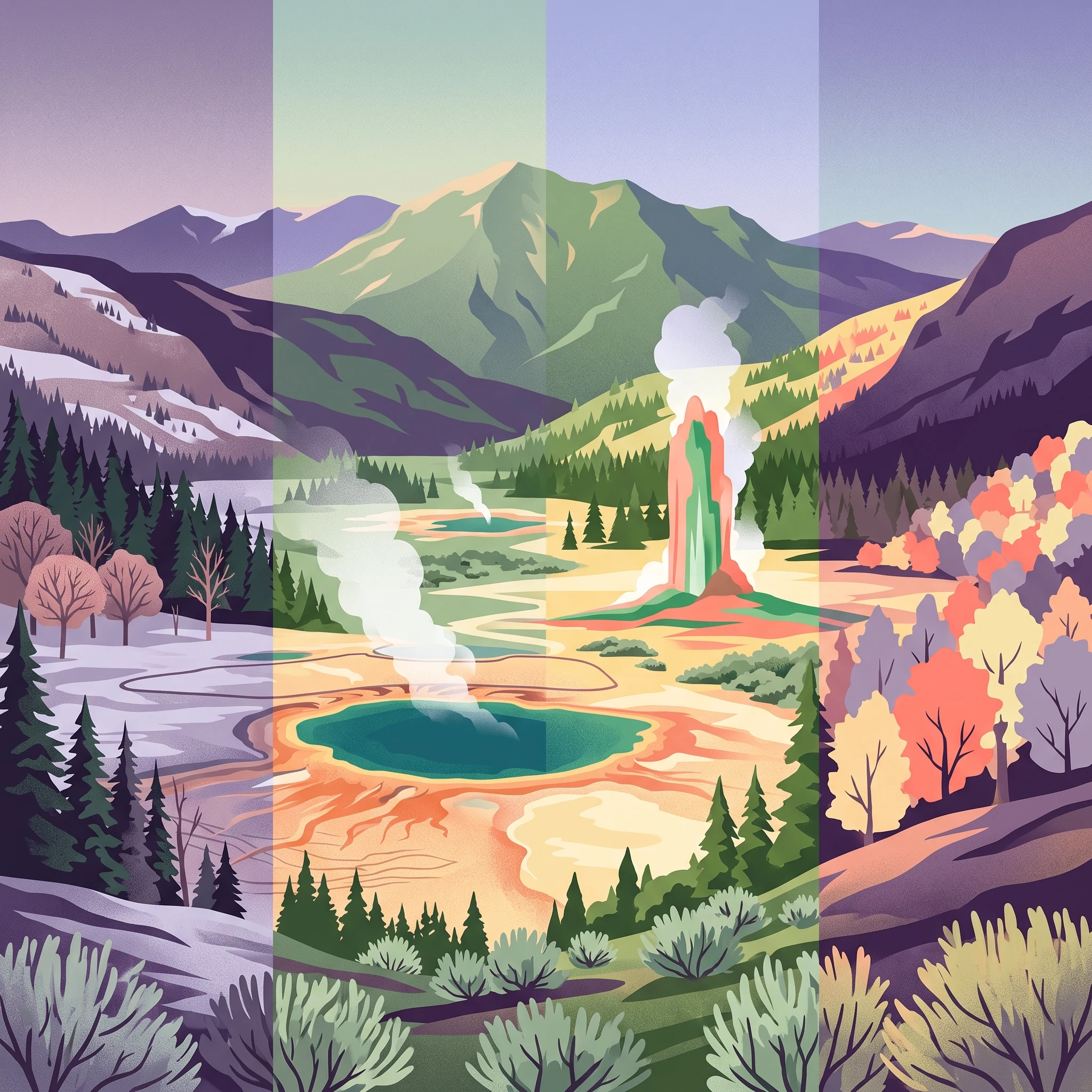
Yellowstone is best known for its unparalleled geothermal wonders. The park contains the world's largest concentration of active geysers, with Old Faithful being the most famous, erupting approximately every 90 minutes. The Yellowstone Caldera, a massive supervolcano, dominates the park's geology and fuels the hydrothermal system that creates geysers, hot springs, mudpots, and fumaroles. The park is also famous for its remarkable wildlife viewing opportunities, featuring the largest public bison herd in the United States, healthy populations of grizzly bears and gray wolves following successful reintroduction, and abundant elk herds. The Grand Canyon of the Yellowstone, with its colorful walls carved by the Yellowstone River, provides another iconic landscape. The combination of volcanic forces, thermal features, and abundant wildlife makes Yellowstone one of the most distinctive and biologically significant protected areas in the world.
Yellowstone National Park history and protected-area timeline
The human history of Yellowstone spans at least 11,000 years, with Native Americans including the Bannock, Shoshone, Nez Perce, Blackfeet, Crow, Salish, and Kootenai tribes using the region for hunting and fishing. Paleolithic Clovis culture peoples left evidence of their presence through obsidian tools found in the region, with obsidian from Yellowstone traded across great distances. European-American exploration began in the early 19th century when John Colter, a member of the Lewis and Clark Expedition, passed through the area in 1807-1808 and described geothermal features that were dismissed as myth. Over the following decades, reports from mountain men like Jim Bridger told of boiling mud and steaming rivers, but these were largely ignored. The first detailed scientific expeditions in the late 1860s and early 1870s, including the Cook-Folsom-Peterson Expedition and the Hayden Geological Survey of 1871, provided comprehensive documentation that convinced Congress to establish the park. The Act of Dedication signed in 1872 reserved the land as a public park for the benefit and enjoyment of the people. Early management proved challenging, with Nathaniel Langford serving as the first superintendent without salary or staff, leaving the park vulnerable to poaching and exploitation. The U.S. Army assumed management in 1886, constructing Fort Yellowstone and implementing protections that allowed wildlife populations to recover. In 1917, administration transferred to the newly created National Park Service, which adopted many of the Army's management principles. The park's history includes significant events like the 1988 fires that burned one-third of the park, the reintroduction of wolves in the 1990s, and ongoing conservation efforts balancing visitor access with ecological preservation.
Yellowstone National Park landscape and geographic character
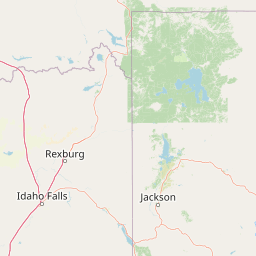
Yellowstone National Park occupies a roughly square parcel of volcanic complex that sits primarily in northwestern Wyoming, with approximately 96% within Wyoming, 3% in Montana, and 1% in Idaho. The park spans 63 miles north to south and 54 miles west to east, covering 2.2 million acres, an area larger than Rhode Island or Delaware. The park sits on the Yellowstone Plateau at an average elevation of 8,000 feet, bounded by mountain ranges of the Middle Rockies including the Gallatin Range to the northwest, the Beartooth Mountains in the north, the Absaroka Range to the east, the Teton Range to the south, and the Madison Range to the west. Eagle Peak rises to 11,358 feet as the park's highest point, while Reese Creek at 5,282 feet marks the lowest elevation. The landscape features three deep canyons carved through volcanic tuff by rivers over the last 640,000 years, most notably the Grand Canyon of the Yellowstone with its colorful walls. Yellowstone Lake covers 87,040 acres at 7,733 feet elevation, making it the largest high-elevation lake in North America, with depths reaching 400 feet and 110 miles of shoreline. The park contains 290 waterfalls of at least 15 feet, with the Lower Falls of the Yellowstone River at 308 feet being the tallest. Forests of lodgepole pine cover approximately 80% of the land area, with the remaining areas consisting primarily of grassland.
Yellowstone National Park ecosystems, habitats, and plant life
Yellowstone National Park is part of the South Central Rockies forests ecoregion, with subalpine forest being the most abundant biome. The park supports over 69,000 species of native vascular plants, with lodgepole pine forests dominating 80% of forested areas. Other conifers including subalpine fir, Engelmann spruce, Rocky Mountain Douglas-fir, and whitebark pine occur in scattered groves throughout the park. Deciduous species like quaking aspen and willows are common in riparian areas and meadows. The park contains one of the world's largest petrified forests, with ancient trees buried by volcanic ash and gradually replaced by minerals. The geothermal areas support unique microbial life, including extremophile bacteria like Thermus aquaticus, discovered in Yellowstone hot springs and crucial for developing DNA replication technology through Taq polymerase. The park's position on the Snake River Plain and at the confluence of three major mountain ranges creates diverse habitats from subalpine forests to grasslands to aquatic environments. The Greater Yellowstone Ecosystem, which the park anchors, represents the largest remaining nearly intact ecosystem in the Earth's northern temperate zone.
Yellowstone National Park wildlife and species highlights
Yellowstone is widely considered the finest megafauna habitat in the lower 48 states, with approximately 60 species of mammals documented. The park contains all three of North America's large canids: gray wolves, coyotes, and foxes, with the reintroduced wolf population now stable at approximately 108 individuals in 9 packs. Both black bears and grizzly bears thrive in the park, with an estimated 700 grizzly bears in the Greater Yellowstone Ecosystem. The Yellowstone bison herd, the largest public herd in the United States, numbers approximately 6,000 individuals, representing one of the last remaining wild bison populations. Elk populations exceed 30,000, representing the largest population of any large mammal species in the park and undertaking the largest mammalian migration in the continental United States. Other species include moose, mule deer, white-tailed deer, mountain goats, pronghorn, and bighorn sheep. The park supports 311 species of birds, including 26 nesting pairs of bald eagles documented in 1999, as well as rare species like whooping cranes, trumpeter swans, and peregrine falcons. Eighteen species of fish inhabit Yellowstone waters, with the Yellowstone cutthroat trout being highly significant. Reptiles include seven species and amphibians four species.
Yellowstone National Park conservation status and protection priorities
Yellowstone was designated as a UNESCO World Heritage Site in 1978 and an International Biosphere Reserve in 1976, reflecting its global significance. The park was placed on the List of World Heritage in Danger from 1995 to 2003 due to impacts from tourism, wildlife disease, and invasive species. The park faces ongoing conservation challenges, including the threat of invasive lake trout in Yellowstone Lake that prey on native cutthroat trout, and the spread of non-native plant species in high-visitation areas. The successful wolf reintroduction program, completed in the 1990s, represents one of the most significant conservation victories, with the wolf population stabil at approximately 108 individuals across 9 packs. The reintroduction has had profound ecological effects, influencing elk behavior and allowing aspen forest recovery. The 1988 fires, which burned over one-third of the park, prompted major changes in fire management policy, leading to the current approach of evaluating natural fires for ecological benefit. The park continues to manage the challenge of maintaining viable wildlife populations while accommodating millions of annual visitors and addressing issues like brucellosis in bison and elk. The Greater Yellowstone Ecosystem management approach emphasizes landscape-level conservation beyond park boundaries.
Yellowstone National Park cultural meaning and human context
The Yellowstone region has been home to Native American peoples for at least 11,000 years, with tribes including the Bannock, Shoshone, Nez Perce, Blackfeet, Crow, Salish, and Kootenai utilizing the area for hunting, fishing, and gathering. The Sheepeaters, a band of Eastern Shoshone, were the only year-round residents before the park's establishment, though they were effectively excluded during the 1870s and 1880s following treaty negotiations. The Nez Perce band's flight through the park in 1877 during their retreat from the U.S. Army, including a brief encounter with tourists and the naming of Nez Perce Creek, represents a significant historical episode. The park contains over 1,000 documented archaeological sites and 1,106 historic structures, including National Historic Landmarks like Obsidian Cliff and several buildings. The Heritage and Research Center in Gardiner, Montana houses the park's museum collection, archives, research library, and archaeology laboratory. Yellowstone's establishment reflected broader 19th-century ideas about preserving natural wonders for public benefit, influenced by romantic notions of nature and emerging conservation philosophy. The park contains structures representing various eras of American park management, from early rustic architecture to Mission 66 modernism.
Top sights and standout views in Yellowstone National Park
Yellowstone National Park offers an unparalleled combination of geological wonders, ecological diversity, and historical significance that makes it one of the world's most remarkable protected areas. The hydrothermal features, including Old Faithful and the Grand Prismatic Spring, demonstrate Earth's powerful internal forces in visually spectacular displays. The wildlife viewing opportunities, particularly the large mammals like bison, elk, bears, and wolves, provide encounters with North America's iconic fauna. The landscape diversity, from the colorful depths of the Grand Canyon of the Yellowstone to the vast expanse of Yellowstone Lake beneath caldera rims, creates endless photographic opportunities. The park's status as the world's first national park adds historical resonance to every visit. The successful recovery of wolves and the ecological changes they have induced represent a living demonstration of conservation principles in action. The petrified forests and volcanic formations tell a story of geological processes spanning millions of years. Whether exploring the backcountry, observing wildlife from the Lamar Valley, watching geysers erupt, or simply experiencing the vast silence of this remarkable landscape, Yellowstone offers experiences that define the American national park ideal.
Best time to visit Yellowstone National Park
Yellowstone can be visited year-round, though each season offers distinctly different experiences. Summer, from June through September, brings the highest visitation and the warmest temperatures, with daytime highs in the 70s Fahrenheit and excellent access to all areas of the park. This is the prime season for wildlife viewing, with animals active in the mornings and evenings, and for exploring the backcountry. However, summer also brings crowds, with July being the busiest month, and traffic jams both from visitors and road construction are common. Fall brings fewer visitors and the possibility of seeing elk rutting season, but some facilities begin closing and winter approach brings uncertainty. Winter transforms the park into a quiet wonderland, with snow-covered landscapes and geysers steaming in the cold air, though access is limited to the road from Gardiner to Cooke City and most areas require guided snowmobile or snow coach tours. Spring, particularly May and June, offers a transitional experience with wildlife giving birth, lower crowds, and wildflowers blooming, though some roads remain closed until mid-May. The shoulder seasons of May and September often provide the best balance of accessibility, wildlife viewing opportunities, and fewer crowds.