Why Land of the Leopard National Park stands out
Land of the Leopard is best known as the principal refuge of the Amur leopard, a critically endangered wild cat with only about 129 individuals remaining in Russia. The park protects more than half of the country's population and serves as the core area for international recovery efforts, including a unique transboundary reserve created jointly with China in 2024. The park's identity is also defined by its overlap with the southern range of the Amur tiger, making it one of the very few places where both rare big cats coexist. Its location in the relict Manchurian forests of the Amur ecoregion gives it additional distinction as a biodiversity hotspot shaped by millions of years of uninterrupted forest evolution.
Land of the Leopard National Park history and protected-area timeline
Land of the Leopard National Park was inaugurated on April 5, 2012, through the consolidation of the Leopardoviy wildlife refuge and surrounding lands in Khasan, Nadezhdinsky, and Ussuriysky districts, plus territory belonging to the Vladivostok urban area. The establishment was driven by the urgent need to secure habitat for the Amur leopard, whose population in Russia at the time had fallen to dangerously low numbers.
The park's early years focused on intensive scientific research and protection of the remaining leopard population, building on the longer tradition of conservation work carried out in the neighboring Kedrovaya Pad Reserve, with which it is now jointly managed. A growing camera trap network was deployed to identify individual leopards by their unique spot patterns, allowing researchers to track each animal and build a detailed picture of the population. Anti-poaching patrols and wildfire management became central operations, since poaching and forest fires were the main threats facing both leopards and tigers.
In 2016, the park recorded a record number of leopard cubs, an encouraging signal that recovery efforts were beginning to take hold. The institution that manages the park was renamed in 2018 in honor of Professor Nikolai Vorontsov (1934 to 2000), a prominent Russian zoologist and organizer of science. In December 2019, the territory was expanded to include a section of the Gamov Peninsula adjacent to the Far Eastern Marine Reserve, adding nearly 7,000 hectares of coastal habitat. By 2024, Russia's national count of Amur leopards had risen to about 129 individuals, with more than half living within the park, and a new conservation strategy set a target of 150 leopards in Russia by 2030.
Land of the Leopard National Park landscape and geographic character
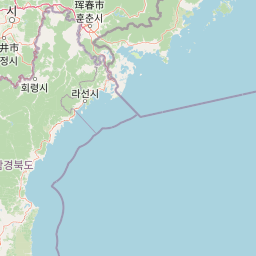
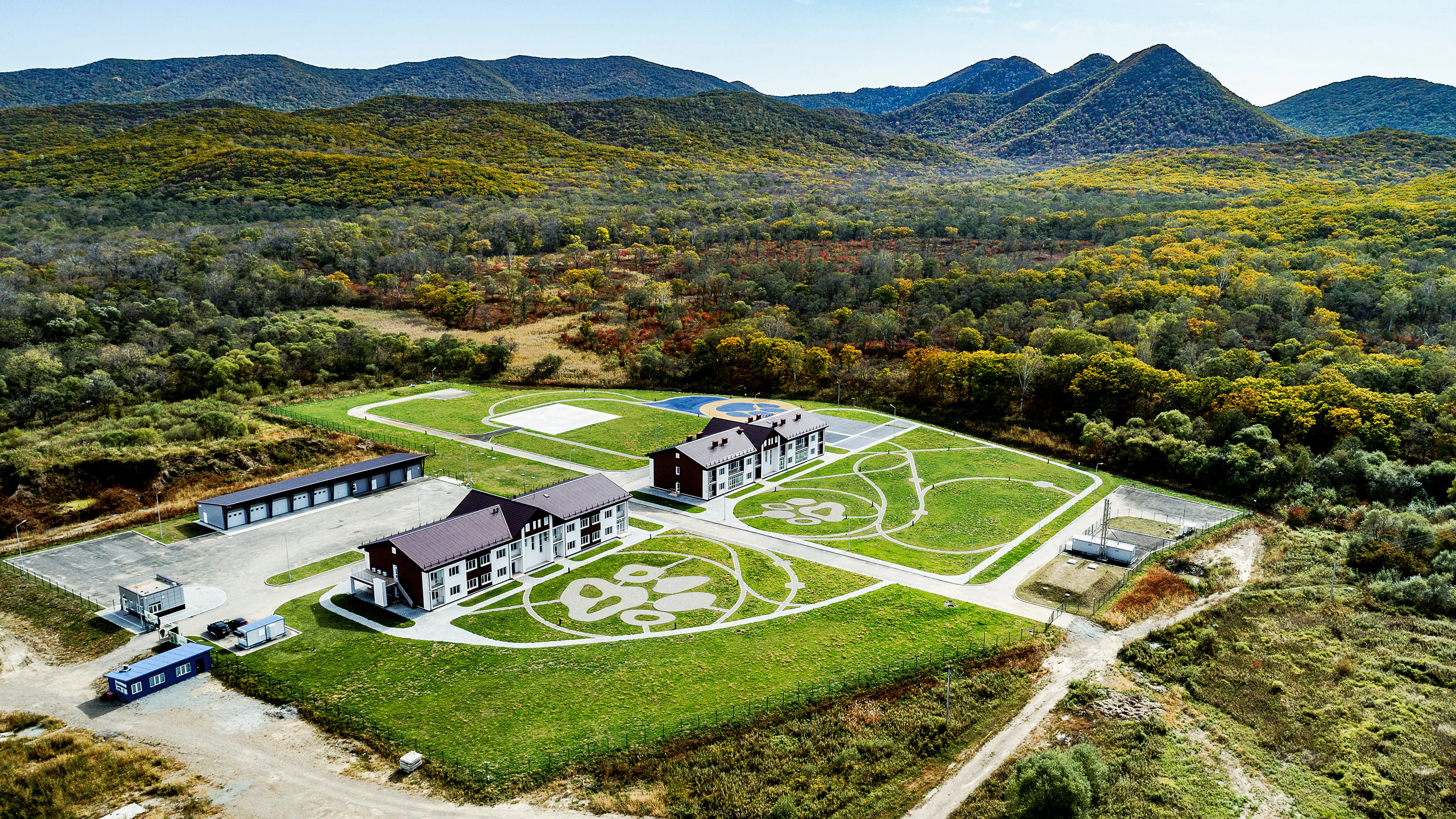
Land of the Leopard sits at the meeting point of Manchurian mixed forest and Pacific coastline, producing a dramatically varied landscape within a single protected territory. Its western edge runs along the Russian-Chinese border, while its eastern boundary reaches the shores of the Amur Bay in the Sea of Japan, extending from sheltered bays near Melkovodnaya Bay to the coastal reaches near Primorskaya station.
Internally, the park extends roughly 150 kilometers from north to south, covering gently rolling forested terrain, river valleys, low mountain ridges, and granite outcrops typical of the southwestern Primorye landscape. Forest cover is dominated by Manchurian broadleaf and mixed woodlands, with oak, larch, birch, and Korean pine stands maintaining the structural diversity that supports both leopards and tigers. The addition of the Gamov Peninsula in 2019 brought rocky coastline, coastal cliffs, and shoreline habitat into the park's mosaic, linking the terrestrial reserve more closely with the marine environment of the adjacent Far Eastern Marine Reserve.
Land of the Leopard National Park ecosystems, habitats, and plant life
The park preserves a substantial portion of the Amur ecoregion, centered on Manchurian mixed forests that escaped the last glaciation. This unique history has allowed relict plant species to survive here, alongside species typically associated with warmer climates, creating one of the most botanically diverse forest regions in Russia.
Documented biodiversity within the park includes 54 mammal species, 184 bird species, 7 amphibian species, 8 reptile species, 12 fish species, 940 vascular plant species, 283 freshwater algae species, 251 lichen species, 179 moss species, and a remarkable 1,914 fungal species. Many of these species are listed in regional, Russian, and international conservation frameworks, with around 40 rare and endangered species requiring urgent protective action, including 10 assigned the highest protection category used in China and 23 covered by Russian conservation law. Forests, river valleys, and coastal habitats together create the layered ecological structure that supports this unusually rich community of life.
Land of the Leopard National Park wildlife and species highlights
Land of the Leopard is, first and foremost, a sanctuary for the Amur leopard, the park's flagship species and the reason for its creation. Russia holds approximately 129 wild Amur leopards, the majority of which live within the park's borders, making this protected area the global center of survival for the subspecies.
The same forests also support the southwestern population of the Amur tiger, another charismatic and critically rare species whose range overlaps with that of the leopard. Other large mammals include the Ussuri Asiatic black bear, the Japanese brown bear, the Amur forest cat, the Eurasian lynx, the wolverine, the Asian badger, and the Amur hedgehog. Ungulates form a vital prey base, with the Manchurian sika deer, Siberian roe deer, elk, Siberian musk deer, goral, and wild boar roaming the forests.
Smaller carnivores and mammals recorded in the park include the red fox, raccoon dog, Asian chipmunk, Manchurian hare, sable, Ussuri marten, American mink, stoat, least weasel, Siberian weasel, Eurasian otter, and various shrews and bats. The return of the wolf, observed again in 2022 after an absence stretching back to the 1970s, was a notable milestone, since the species competes directly with leopards and tigers for prey. Seven amphibian species and twelve reptile species complete the terrestrial fauna, while 184 bird species reflect the park's importance for ornithological diversity.
Land of the Leopard National Park conservation status and protection priorities
The conservation significance of Land of the Leopard is exceptional, both nationally and globally. As the principal stronghold of the Amur leopard, the park underpins the survival of a subspecies that once stood on the brink of extinction and now forms the basis of an international recovery program.
Active management in the park focuses on four interlocking pillars: anti-poaching patrols, wildfire prevention, scientific monitoring through a network of more than 420 camera traps, and supplemental feeding of ungulates during harsh winters, when deep snow limits prey mobility. Each Amur leopard captured on camera is identified by its unique spot pattern, much like a fingerprint, and given an identification number and often an individual name, allowing long-term population tracking. In 2016, the program documented a record 16 leopard cubs from 9 females, a strong signal of population recovery.
The 2019 territorial expansion onto the Gamov Peninsula further strengthened ecological coherence with the Far Eastern Marine Reserve. The creation in 2024 of the transboundary reserve Land of the Big Cats, linking Land of the Leopard and Kedrovaya Pad with China's Northeast Tiger and Leopard National Park, marked the first such reserve of its kind in the world. A national leopard conservation strategy adopted in 2022 aims to raise Russia's wild Amur leopard population to 150 individuals by 2030, a target that shapes the park's ongoing scientific and protective work.
Land of the Leopard National Park cultural meaning and human context
Land of the Leopard lies in a region of southwestern Primorye with deep human and ecological history, where Russian, Chinese, and indigenous Far Eastern cultural influences converge. The park's territory draws on areas historically linked to local communities in the Khasan, Nadezhdinsky, and Ussuriysky districts, as well as the outskirts of Vladivostok, situating the reserve within a lived cultural landscape rather than a remote wilderness.
The park itself contributes to regional identity through public engagement, environmental education, and the development of ecological trails that connect visitors with the broader story of Amur cat conservation. Naming conventions for individual leopards, such as the leopard known as Dunya, named by a senior Russian official in collaboration with the park, reflect how conservation achievements have become part of contemporary cultural memory in the Russian Far East.
Top sights and standout views in Land of the Leopard National Park
Major strengths of the park include its role as the global stronghold for the Amur leopard, with more than half of Russia's remaining population living within its territory, and its importance for the southwestern population of the Amur tiger. It is also notable for its extraordinary botanical and faunal diversity, sustained by the relict character of the Manchurian forests that escaped the last glaciation.
The park combines intensive scientific infrastructure, including one of the largest camera trap networks of its kind in Russia, with hands-on habitat management through anti-poaching patrols, wildfire prevention, and winter feeding stations. Its transboundary integration with Chinese conservation areas through the Land of the Big Cats reserve, and the public-facing ecological trail opened in 2016, adds both international and outreach significance to the protected landscape.
Best time to visit Land of the Leopard National Park
Land of the Leopard spans an area where conditions shift strongly with the seasons. Winters here are snowy and cold, often tough for wildlife, and it is the season when supplemental feeding stations become most important for ungulates and, indirectly, for leopards and tigers. Summers bring warm, lush conditions in the Manchurian mixed forests, with rich bird activity and easier exploration along the park's ecological trail.
Spring and autumn offer particularly favorable periods for nature-focused visits. Spring brings renewal to the forests and increased wildlife movement, while autumn adds vivid coloration across the broadleaf and mixed woodlands. These transitional seasons tend to showcase the botanical character of the Amur ecoregion at its most expressive, while keeping conditions comfortable for outdoor exploration.