Why Zov Tigra National Park stands out
Zov Tigra is most widely recognized as a key protected habitat for the Amur tiger and as part of the broader Sikhote-Alin conservation landscape in the southern Russian Far East. The park's forests and mountain terrain support populations of both Amur tigers and occasional visiting Amur leopards, along with rare ungulates such as the Amur goral and Siberian musk deer. Beyond its megafauna, the park is notable for the exceptional botanical richness of the southern Primorye region, which escaped full Pleistocene glaciation and therefore retains both modern and relict plant lineages. Birdwatchers also prize the area for its long list of nesting and migratory species, including several species listed in the Red Data Book of Russia.
Zov Tigra National Park history and protected-area timeline
Zov Tigra National Park was established on 2 June 2007, becoming the first national park in the Russian Far East. Its creation was driven by the need to conserve and restore natural complexes and historical-cultural sites, support ecological education, advance scientific methods of nature protection, carry out environmental monitoring, and create conditions for regulated tourism and recreation.
The park was originally designated under the name Verkhne-Ussuriysky before being renamed Zov Tigra. Its establishment was tied to the federal program for the conservation of the Amur tiger adopted in 1997, reflecting the area's importance as tiger habitat. Early planning envisioned a larger coastal area at the mouth of the Chernaya River, but the final boundaries excluded the marine coast, reducing the park from roughly 194,000 hectares to about 97,100 hectares and, after further adjustments, to its present area near 83,490 hectares.
In 2008, a federal state institution was created to manage the park, and the conservationist Yu. I. Bersenev played a significant role in its establishment. In 2014, a unified directorate was formed to jointly administer Zov Tigra and the neighboring Lazovsky Nature Reserve, strengthening coordinated management of these adjacent protected landscapes. The park's founding also coincided with broader national-level efforts to safeguard the Amur tiger, for which the southern Sikhote-Alin represents one of the last strongholds.
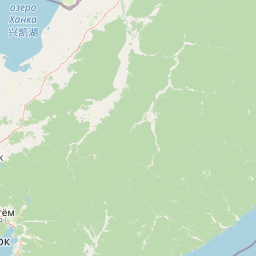
Zov Tigra National Park landscape and geographic character
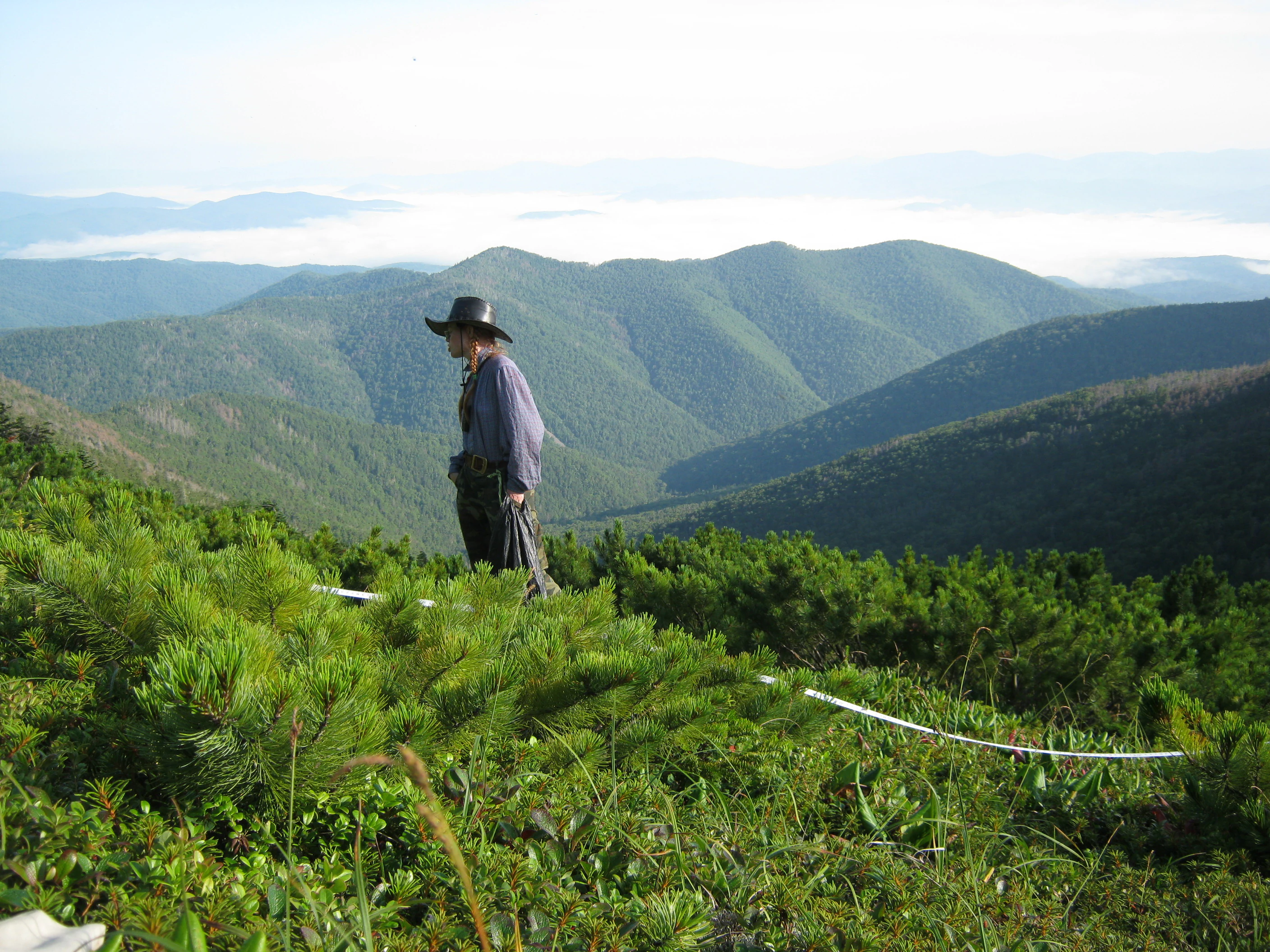
The landscape of Zov Tigra National Park is dominated by the Sikhote-Alin mountain range and its branching spurs, creating a deeply dissected terrain of ridges, valleys, and river gorges. Elevations vary dramatically, from about 155 meters in lower valleys to 1854 meters at the summit of Mount Oblachnaya, the highest point in Primorsky Krai. This vertical range gives the park an unusually compressed set of altitude-defined environments within a single protected area.
The park contains 56 mountains higher than one kilometer, supporting extensive highland terrain. The Sikhote-Alin ridge itself runs through the park for approximately 58 kilometers, from the western border to Mount Snezhnaya in the northeast. Between these high ridges lie the upper basins of the Ussuri, Milogradovka, and Kiyevka rivers, with the Ussuri alone extending about 41 kilometers through the park from its headwaters. This combination of mountain crests, slopes, and river valleys creates a consistent alternation of forested ridges and open water corridors.
Water features are closely tied to the topography. The park's rivers and streams carve through forested slopes, producing a network of cool, shaded valleys. Mineral springs occur within the territory, and archaeological monuments are found across the landscape, indicating long-standing human presence in the area. Although the original boundary discussions included a stretch of marine coast near the Chernaya River mouth, the coast itself lies outside the present park boundaries, and the protected area today focuses on the inland mountain and river environment.
Zov Tigra National Park ecosystems, habitats, and plant life
Forests cover about 96 percent of Zov Tigra National Park, making it one of the most heavily wooded protected areas in the southern Russian Far East. The vegetation follows a clear altitudinal pattern, with mountain tundra on the highest peaks, dark coniferous forests of spruce, fir, and Korean cedar on middle slopes, stone birch woodlands in the subalpine zone, and rich cedar-broadleaf and oak forests on warmer lower slopes. Much of this forested area has never been commercially logged, leaving large stands of mature, structurally complex forest.
A defining feature of the park's botanical character is the mixture of modern and relict plant lineages. Southern Primorye escaped full Pleistocene glaciation, which allowed plant communities shaped in earlier geological eras to survive alongside more recently evolved flora. Botanists working in the park have described several species new to science, including Kitagawia eryngiifolia, a high-mountain Ligularia, two Saussurea species, a Sikhote-Alin chrysanthemum, a Potentilla of the Gorovoy group, and a local monkshood. Sixteen plant species found here are not recorded in the reserves of Primorsky Krai, further underlining the area's distinct botanical identity.
Lichens have received less comprehensive study, but early collections from Mount Oblachnaya and Mount Snezhnaya were later expanded to a preliminary list of around 89 species. Comparable surveys in the neighboring Lazovsky Reserve (around 381 species) and the Verkhne-Ussuriysky research station (around 120 species) suggest the park's lichen flora may include on the order of 400 species once full surveys are completed. Botanical and lichenological richness together give Zov Tigra a particularly layered vegetation profile unusual for a single protected area.
Zov Tigra National Park wildlife and species highlights
Zov Tigra National Park supports an exceptionally diverse fauna for the southern Russian Far East, with virtually all rare, endemic, and ecologically valuable mammal species of the region represented within its borders. The most iconic resident is the Amur tiger, whose conservation was a central motivation for the park's establishment. The park's forests and mountain terrain also host occasional visits by the Far Eastern leopard, which historically lived here until the mid-1970s, along with the Far Eastern leopard cat, Eurasian lynx, gray wolf, red fox, raccoon dog, yellow-throated marten, Asian badger, sable, kolonok, American mink, Eurasian otter, and weasel. Brown bears and Himalayan black bears both occur in the park's forests.
Ungulates are well represented, including wild boar, Siberian red deer (izyubr), sika deer, Siberian roe deer, Amur goral, and Siberian musk deer. The Amur goral, an endangered cliff-dwelling ungulate, is among the park's most unusual large mammals. Smaller mammals include the Daurian hedgehog, Ussuri mole, multiple shrew species, the Manchurian hare, mountain hare, northern pika, flying squirrel, Manchurian squirrel, Siberian chipmunk, and several vole and mouse species, illustrating a broad small-mammal community typical of southern Sikhote-Alin.
Reptiles and amphibians add further ecological depth. Six amphibian species occur, including Red Data Book entries such as the Far Eastern fire-bellied toad and the Ussuri clawed salamander. Seven reptile species are present, among them the Korean grass lizard and the red-backed rat snake. The park's rivers and streams sustain around 13 fish species, including the Sakhalin taimen, a critically important conservation target. Rare and relic invertebrates also occur, including the relict cockroach and longhorn beetle, Schrenk's ground beetle, Uvarov's katydid, and a vicariant earwig, reflecting the park's position as a refuge for relict and endemic insect faunas.
The avifauna is rich and varied. About 239 bird species have been recorded, with more than 100 breeding species overall. Cedar-broadleaf and cedar-spruce ecotone forests support up to 43 breeding species, while typical spruce forests on Mount Oblachnaya host around 28. About 12 breeding species are ecologically tied to the high-mountain landscape, and a specialized community of about 10 breeding species is associated with a larch stand in the Muta area. Red Data Book species include Steller's sea eagle, the greater spotted eagle, the Far Eastern stork, the Siberian crane, the scaly-sided merganser, Blakiston's fish owl, the lesser white-fronted goose, the falcated duck, and the Siberian nuthatch, with additional notable species such as the black stork, osprey, white-tailed eagle, crested honey buzzard, and Mandarin duck completing the picture.
Zov Tigra National Park conservation status and protection priorities
Zov Tigra plays a central role in conservation of the Amur tiger and other rare species of southern Sikhote-Alin. The park was created explicitly to conserve and restore natural complexes and to support scientific methods of nature protection, and its establishment was directly linked to the federal program for the conservation of the Amur tiger adopted in 1997. Its large forested territory, much of which has never been logged, provides a stable core for tiger populations and the prey base on which they depend.
The park is also significant for the conservation of relict and endemic species. The southern Primorye region escaped full Pleistocene glaciation, and as a result the park hosts a mix of modern and pre-Quaternary flora, including species described as new to science within its territory. Sixteen plant species found here are not recorded in other reserves of the region, underscoring the park's role as a unique botanical refuge. Several lichen-rich habitats on Mount Oblachnaya and Mount Snezhnaya add a further dimension to this botanical importance.
The park's protected status reflects an IUCN Category II designation, in line with national park standards. The territory is divided into functional zones with different levels of protection and use, balancing strict conservation with limited recreation, regulated хозяйственного назначения use, and special protection. The 2014 creation of a unified directorate with the neighboring Lazovsky Nature Reserve strengthens coordinated management, allowing the two areas to function as a larger connected conservation landscape for tigers, leopards, goral, musk deer, and a wide array of forest birds and fish, including the Sakhalin taimen.
Zov Tigra National Park cultural meaning and human context
Although the park's primary identity is ecological, its territory contains a number of archaeological monuments, indicating that humans have interacted with these forests and mountain valleys over long periods. The presence of a mineral spring within the park adds another thread to this human history, traditionally drawing visitors and local populations to specific sites in the landscape.
The park's establishment itself is a significant chapter in Russian nature protection history. It was the first national park in the Russian Far East, and its creation was supported by the conservationist Yu. I. Bersenev, whose work helped place southern Sikhote-Alin on the national conservation map.
Top sights and standout views in Zov Tigra National Park
Zov Tigra's defining highlights are the combination of intact Sikhote-Alin forests, the towering presence of Mount Oblachnaya as the highest peak in Primorsky Krai, and the park's central role in the conservation of the Amur tiger and the broader southern Sikhote-Alin ecosystem. The altitudinal gradient from roughly 150 meters to above 1850 meters compresses a remarkable range of vegetation types into one protected area, including relict plant communities rarely found elsewhere in Russia.
Equally important are the park's wildlife assets: from Amur tiger and Amur goral to Steller's sea eagle and Blakiston's fish owl, the species list reflects both the northern and southern influences that meet in southern Primorye. Managed jointly with the Lazovsky Nature Reserve, Zov Tigra is one of the anchor points of conservation in the Russian Far East.
Best time to visit Zov Tigra National Park
The southern Russian Far East has a monsoon climate with warm, humid summers and cold, snowy winters, shaping how the park presents itself across the year. Late spring through early autumn is generally the most favorable window for experiencing the forests and rivers in full activity, when vegetation is at its lushest and wildlife is most visible around water sources and on mountain slopes. The forest colors of September, when the mixed broadleaf stands turn, are particularly striking in the upper Ussuri basin.
Winter brings heavy snow to the higher elevations, including the Sikhote-Alin ridges and Mount Oblachnaya, transforming the landscape into a quiet, snow-covered wilderness where tracks of large mammals are easier to observe on the snow surface. Seasonal conditions strongly affect accessibility of high-mountain areas, and visitors should expect that the high country is most easily appreciated in the warmer months, while valley and forest experiences remain rewarding throughout much of the year.