Why Agioi Theodoroi stands out
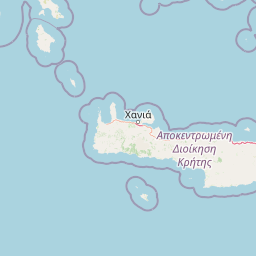
Agioi Theodoroi is best known as the long-established home of a self-sustaining population of the kri-kri, the wild Cretan goat, as well as for its breeding colony of Eleonora's falcons. The islets have been used repeatedly since the 1930s as a source population from which surplus kri-kri have been sent to zoos around the world, cementing their international conservation reputation. The combination of a strict nature reserve status, a tiny but well-documented breeding falcon colony, and a visible Venetian military history makes the islands a compact but unusually rich site within the Cretan archipelago.
Agioi Theodoroi history and protected-area timeline
The islets have a documented history that reaches back into antiquity. The Stadiasmus Maris Magni, a Greek navigational text from the second half of the third century BCE, mentions the islands and notes that they possessed potable water, indicating that they were already known as usable anchor points along the Cretan coast. In classical references they are mentioned under the names Coete, Koite, and Akytos, with the latter name traditionally interpreted as referring to something not inhabited.
During the Venetian period of Cretan rule, the islands took on a military role. In 1583, the Venetians constructed two small fortresses on Agios Theodoros, designed both to deny the islands to maritime raiders and to defend the nearby coastline. One fortress was sited on lower ground and became known as the fortress of San Francesco; the other, on higher ground, was called the fortress of San Thodoro, or Tourlourou.
These fortifications met a dramatic end in 1645, when the island was attacked during the Ottoman conquest of western Crete. Rather than surrender, the small Venetian garrison of about seventy defenders set fire to the powder magazine, destroying the fortress along with themselves and the Ottoman troops who had landed. The fortifications were never rebuilt and have survived only as ruins.
A new chapter began in 1930, when the municipality of Agia Marina, working with the hunting association of Chania, designated the islets as a nature reserve. This made Agioi Theodoroi one of the earliest formally protected small-island sites in modern Greece and set the stage for the introduction of the kri-kri herd five years later.
Agioi Theodoroi landscape and geographic character
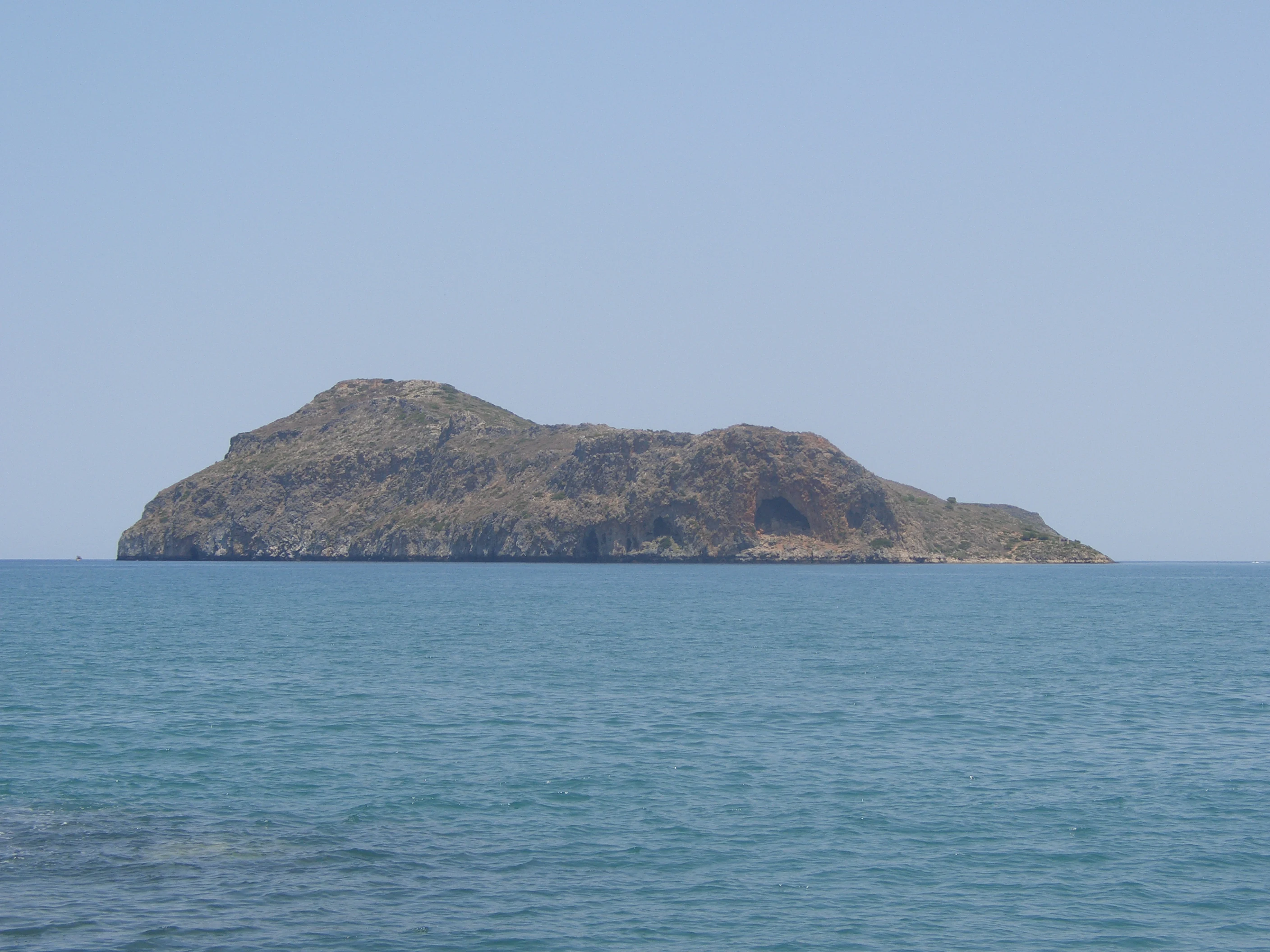
The landscape of Agioi Theodoroi is defined by small-scale, exposed Mediterranean island terrain rather than by dramatic relief. The larger islet, Agios Theodoros or Thodorou, rises to about 165 metres above the sea, creating a rocky, sloping landform that falls directly into the surrounding waters of the Aegean. Its surface is a mix of bare rock, low Mediterranean scrub, and patches of vegetation shaped by wind, salt spray, and the grazing pressure of the resident kri-kri herd.
A notable physical feature is a large, arched cave on the southern side of the main island, which is visible from nearby coastal viewpoints and adds a distinctive element to the otherwise simple coastline. The smaller companion islet, Mikros Agios Theodoros or Thodoropoula, lies only a short distance to the north and shares the same compact, rocky character on a far smaller scale.
From the islands themselves, the view extends across the northwestern Cretan coast toward the resort strip around Platanias and Agia Marina, and, on clear days, inland to the White Mountains, whose higher peaks frame the wider horizon. This juxtaposition of a tiny offshore landmass against the backdrop of the Lefka Ori range gives the islands a clear sense of place within the geography of western Crete.
On the higher ground of Agios Theodoros, the ruined Venetian fortifications are the most visible reminders of human shaping of the landscape, while the partly ruined church of the Saints Theodore gives the islands the name that has stuck for centuries.
Agioi Theodoroi ecosystems, habitats, and plant life
Ecologically, Agioi Theodoroi functions as a tightly bounded offshore extension of the Cretan natural environment. Its flora reflects typical Aegean island vegetation, with low, hardy phrygana-type scrub, scattered shrubs, and herb communities adapted to thin soils, strong sun, and limited freshwater. The presence of the kri-kri herd acts as a continuous ecological force, shaping which plants establish and persist.
The islands sit at the interface between the marine environment of the northwestern Cretan coast and the terrestrial habitats of the island itself, and this transition zone is of particular conservation interest. The cliffs and rocky outcrops provide nesting habitat for raptors, while the surrounding waters support the marine food web on which those birds depend. Because the islands are uninhabited and access is restricted for most of the year, the terrestrial habitats remain largely undisturbed by human activity, allowing natural processes to dominate.
The site's integration into the Natura 2000 network reflects this combined ecological value, protecting both the island ecosystems themselves and the birdlife they support.
Agioi Theodoroi wildlife and species highlights
Agioi Theodoroi's wildlife profile is unusually concentrated for such a small area. The dominant species, in both ecological and cultural terms, is the kri-kri, the wild Cretan goat, recognisable by its curved horns and reddish-brown coat. The population on Thodorou has functioned as a closed breeding stock since the 1930s, and over the decades surplus animals from this herd have been sent to zoos across Europe and beyond, making the island an internationally important reservoir of the subspecies.
The avian fauna is also significant. BirdLife International has recognised the islets as an Important Bird Area specifically because they support a breeding colony of between roughly fifty and sixty-five pairs of Eleonora's falcons. Eleonora's falcon is a late-season breeder in the Mediterranean, timing its nesting to coincide with the autumn passage of migratory passerines, and undisturbed islands such as Agioi Theodoroi provide the cliff nesting conditions it requires.
Beyond these headline species, the islands contribute to the broader ornithological richness of the Cretan coast during migration periods, when various seabirds and landbirds move along this part of the Aegean.
Agioi Theodoroi conservation status and protection priorities
Agioi Theodoroi is one of the earliest examples of small-island nature protection in Greece and one of the more unusual cases internationally, because an entire islet group has been dedicated to conserving a single, ecologically distinctive subspecies. The protection regime dates back to 1930, when the municipality of Agia Marina and the Chania hunting association jointly designated the islands as a nature reserve; the 1935 introduction of kri-kri then turned the site into a living conservation archive for the Cretan wild goat.
The reserve is now part of the Natura 2000 network under site code GR4340018, recognised under both the European Habitats Directive for its terrestrial habitats and the Birds Directive for its Eleonora's falcon colony. Access to the islands is generally prohibited, with the islands continuously wardened, and visitors are allowed only on the feast day of the church of the Saints Theodore in June, when a service draws local people to the site. This tight access regime is a core part of what makes the protection effective.
The conservation significance of the site extends well beyond Crete. Because the kri-kri herd has long been used as a source population for international zoo programmes, Agioi Theodoroi effectively serves as a global genetic anchor for ex situ conservation of the subspecies. The combination of strict in situ protection, decades of population management, and international zoo contributions gives the islands an outsized footprint in Mediterranean wildlife conservation.
Agioi Theodoroi cultural meaning and human context
The cultural identity of Agioi Theodoroi rests on three intertwined strands: Orthodox religious tradition, Venetian military heritage, and modern nature protection. The name of the islands comes from a now partly ruined church dedicated to the Saints Theodore, and a religious celebration held on the islands each June remains one of the few occasions when people are permitted to land.
The Venetian fortresses on Agios Theodoros are a more dramatic, if less well-known, element of local heritage. Although the dramatic destruction of the garrison in 1645 is less famous than it deserves to be beyond Crete, the fortress ruins remain visible on the island and form part of a broader pattern of Venetian coastal defence works along the Chania shoreline. Local mythology, preserved in oral tradition, weaves the islands into stories involving Saint George, Saint Marina, and the transformation of threatening creatures into stone, reflecting the strong place these rocks hold in the imagination of nearby coastal communities.
Top sights and standout views in Agioi Theodoroi
Two uninhabited islets off northwestern Crete form one of the oldest small-island nature reserves in Greece, integrated into the Natura 2000 network. A self-contained herd of kri-kri, the endemic Cretan wild goat, has lived on Thodorou since 1935 and has supplied founder animals to zoos around the world. The islands are recognised by BirdLife International as an Important Bird Area for the breeding population of Eleonora's falcons. Ruins of two Venetian fortresses, famously destroyed in 1645, sit on the larger islet alongside the partly ruined church that gives the group its name.
Best time to visit Agioi Theodoroi
Because access to the islands themselves is restricted and the wildlife values are protected year-round, the timing of any visit is shaped more by the biological calendar than by tourist seasons. The clearest months for viewing Eleonora's falcons at the colony are those of the late summer and early autumn, when these falcons nest and raise their young along the Cretan cliffs. The kri-kri can be observed through the warmer months, though they remain secretive and are best appreciated from a distance.
The principal human occasion to approach the islands is the religious festival of the Saints Theodore in June, the one exception when landings are traditionally allowed. Outside this period, the islands are best appreciated from the coastal viewpoints near Agia Marina and Platanias, with the clearest atmospheric conditions typically found during the calmer late spring and early autumn months.