Why Laguna de Apoyo Nature Reserve stands out
Laguna de Apoyo is best known for its crater lake setting, in which a deep, endorheic body of water sits inside the caldera of an extinct volcano, ringed by tropical dry forest. The reserve is also recognized for its endemic cichlid fish, which have made the lake a focal point for evolutionary and conservation research. The combination of volcanic geology, dry forest habitat, and an exceptionally high bird count, including both resident and migratory species, gives the reserve a layered identity as a geological, ecological, and limnological landmark in Nicaragua. Pumice from the lakebed, dark volcanic sand beaches, and recent discoveries of indigenous rock art further distinguish the landscape.
Laguna de Apoyo Nature Reserve history and protected-area timeline
Laguna de Apoyo was officially declared a nature reserve in 1991, placing the volcanic lake and its drainage basin under formal protection as part of Nicaragua's broader system of protected areas. The reserve is administered by the Ministry of the Environment and Natural Resources, known by the Spanish acronym MARENA, and forms one of 78 protected areas of Nicaragua.
In 2010, a formal management plan was approved for the reserve. This plan established the rules that continue to shape activity within the area, including prohibitions on housing construction inside the reserve and restrictions on the use of motorized vehicles on the lake. The plan provided a framework for handling conflicts over residential development, and several construction projects within the reserve have been halted and landowners engaged in legal processes under its provisions.
Scientific work on the lake's endemic cichlids has unfolded in stages. The arrow cichlid, Amphilophus zaliosus, was described in 1976, predating the reserve's formal establishment. Three additional endemic cichlids were described in 2008 by a multinational research team directed by the Nicaraguan NGO FUNDECI/GAIA, which operates a research station on the lakeshore, and the remaining two were formally described in 2010. These descriptions helped establish Laguna de Apoyo as a key reference site for freshwater evolutionary research in Central America.
Laguna de Apoyo Nature Reserve landscape and geographic character
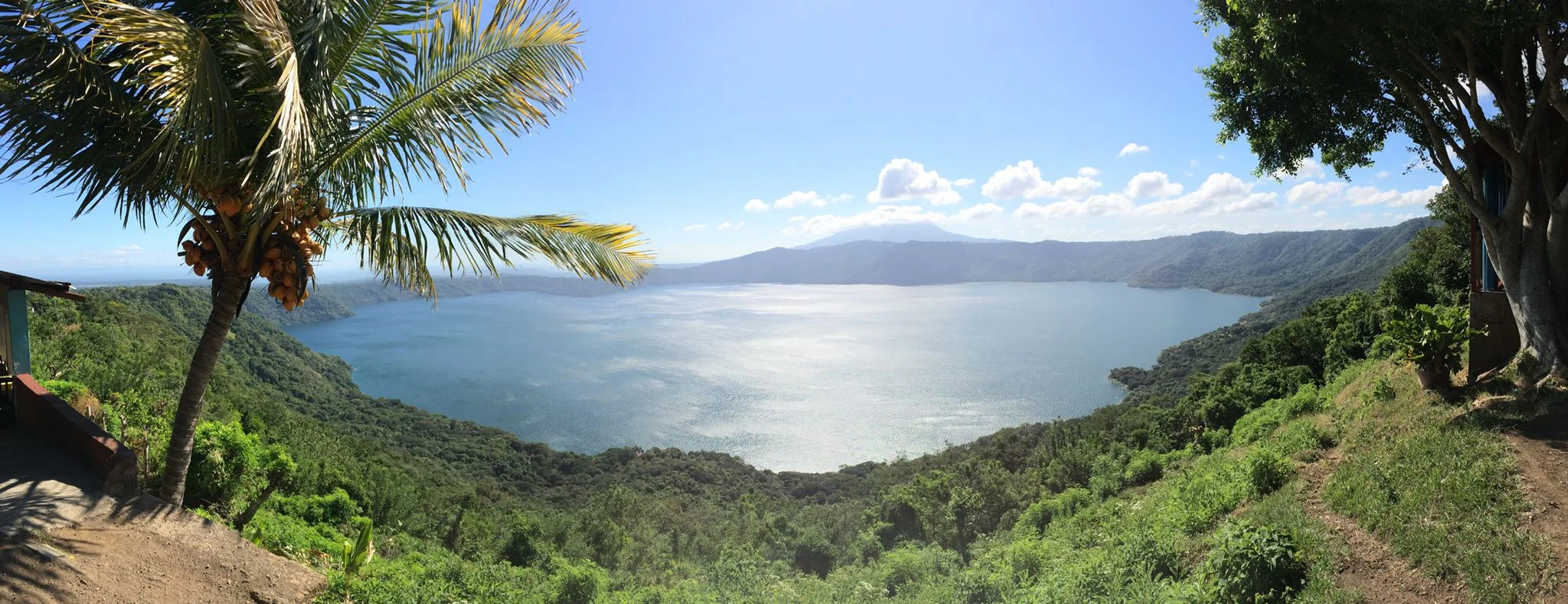
The defining feature of Laguna de Apoyo Nature Reserve is its volcanic origin. The lake occupies the caldera of an extinct volcano, forming a near-circular body of water roughly 6.6 kilometers in diameter. The caldera walls rise above the surrounding landscape, framing the lake in a continuous arc of forested slopes and creating the quiet, sheltered atmosphere that defines the reserve.
The lake itself is unusually deep, reaching about 175 meters, and covers an area of roughly 19 square kilometers within a drainage basin that extends to about 38 square kilometers. Because the lake is endorheic, with no surface outflow, its shoreline is shaped by water level rather than by rivers exiting the basin. Pumice is common along the lakebed and along the shore, giving the beaches a pale, dark-toned volcanic sand.
Above the waterline, the caldera's slopes carry tropical dry forest vegetation. The terrain rises from lakeshore to crater rim, with hiking trails and viewpoints strung along the higher elevations offering sweeping views of the lake. The mix of steep forested slopes, lakeshore flats, and exposed pumice gives the landscape a layered visual character that is unusual within Nicaragua's protected areas.
Laguna de Apoyo Nature Reserve ecosystems, habitats, and plant life
Laguna de Apoyo Nature Reserve protects a tropical dry forest ecosystem covering the slopes and shoreline of the Apoyo caldera. The forest is dominated by tree species typical of Central American dry forest, including pochote, black rosewood, mahogany, hogplum, and guacuco, with orchids appearing in significant numbers among the understory. More than 500 plant species have been documented within the reserve.
The lake environment is equally important. Its endorheic, deep, and relatively stable waters have supported the evolution of an isolated flock of cichlid fish in the genus Amphilophus, six species of which are endemic to Laguna de Apoyo. The presence of non-native cichlids introduced by humans adds a layer of conservation concern, but the native endemic flock remains a defining ecological feature of the reserve.
Laguna de Apoyo Nature Reserve wildlife and species highlights
Wildlife within Laguna de Apoyo Nature Reserve reflects the broader tropical dry forest fauna of Pacific Nicaragua, combined with rich lacustrine populations.
Mammals recorded in the reserve include variegated squirrels, opossums, anteaters, pacas, jaguarundis, howler monkeys, and white-faced capuchin monkeys. Reptiles include green iguanas and common boas, among others. The reserve has documented more than 230 bird species, a count that includes oropendolas, falcons, and hummingbirds, as well as a substantial contingent of migratory species. Butterflies are also strongly represented, with roughly 220 species recorded, including 25 species described as first records for Nicaragua.
In the lake, six cichlid fish in the genus Amphilophus are endemic to Laguna de Apoyo, including the arrow cichlid. Additional non-native cichlid species have been introduced into the lake by humans. Freshwater mollusks round out the aquatic fauna. The combination of mammals, birds, reptiles, butterflies, and endemic fish gives the reserve a notably broad faunal profile for an area of its size.
Laguna de Apoyo Nature Reserve conservation status and protection priorities
Laguna de Apoyo Nature Reserve carries conservation significance on several fronts. As a protected landscape within Nicaragua's national system, it represents one of 78 protected areas of the country and one of the more distinctive volcanic lake reserves in the Pacific region. Its formal declaration in 1991, followed by a 2010 management plan, established a regulatory framework intended to shield the lake and its forests from uncontrolled development.
The lake's endemic cichlids are a major conservation focus. Six species in the genus Amphilophus occur only in Laguna de Apoyo, and several of them were described only in the last two decades. The presence of introduced cichlid species in the same waters raises concerns about hybridization and ecological pressure on the native flock, making the lake a focal site for freshwater conservation research in Central America.
Management of the reserve also addresses habitat integrity more broadly. Construction of housing within the reserve and the use of motorized vehicles on the lake are prohibited under the management plan, and residential projects inside the reserve have been halted through enforcement actions. Where the lake's water level has shown signs of decline, attention from hydrologists has underscored the importance of managing groundwater flow, land use in the drainage basin, and the impact of tourism infrastructure on the surrounding slopes.
Laguna de Apoyo Nature Reserve cultural meaning and human context
The cultural dimension of Laguna de Apoyo Nature Reserve is rooted both in traditional land use and in more recent archaeological findings. Pumice stones from the lake have long been harvested by local communities for use in the clothing industry, providing a tangible link between the reserve's volcanic geology and everyday economic life in the surrounding region.
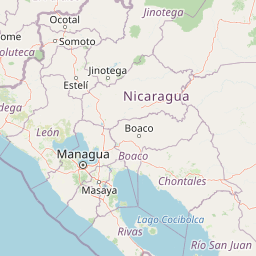
More recently, petroglyphs and artifacts of indigenous peoples have been discovered within the reserve, indicating that the Apoyo caldera has a deeper human history than its formal protection history alone would suggest. These findings complicate the older perception of the area as purely natural and add a cultural layer to the reserve's identity. The reserve lies between the departments of Masaya and Granada, regions that are themselves central to Nicaragua's colonial and precolonial heritage, lending the broader landscape a strong cultural backdrop.
Top sights and standout views in Laguna de Apoyo Nature Reserve
Laguna de Apoyo stands out for the unusual combination of a deep volcanic caldera lake, tropical dry forest, and rich freshwater biodiversity within a single protected area. The lake's near-circular shape, endorheic hydrology, and 175-meter depth make it one of the most distinctive volcanic lakes in Central America.
The reserve also stands out for its endemic cichlid flock, with six Amphilophus species found nowhere else, and for its exceptionally high bird count, which includes both resident species and migratory visitors. Discoveries of indigenous petroglyphs, the long tradition of pumice harvesting, and the regulated management of construction and motorized watercraft add further layers of interest, giving the reserve a profile that bridges geology, ecology, conservation, and local culture.
Best time to visit Laguna de Apoyo Nature Reserve
The character of Laguna de Apoyo Nature Reserve shifts with the dry and wet seasons typical of Nicaragua's Pacific region. During the drier months, the tropical dry forest vegetation is at its most open, trails along the caldera slopes are generally easier to walk, and conditions for hiking, paragliding from the crater rim, and lake-based activities tend to be most reliable. Birdwatching remains productive year-round, but the dry season tends to make forest species easier to observe along the edges and clearings.
In the wetter months, the vegetation becomes noticeably greener and denser, and the dry forest canopy fills out with fresh leaf growth. This is often the most visually lush period for the reserve, with orchids and understory plants in active growth, though rains can interrupt outdoor plans and muddy some trails. Migratory bird presence adds to the birdwatching interest during parts of this period. The lake itself, with its calm endorheic waters and volcanic shoreline, remains a focal feature in any season, though water levels have shown variation over time.