Why Chitwan National Park stands out
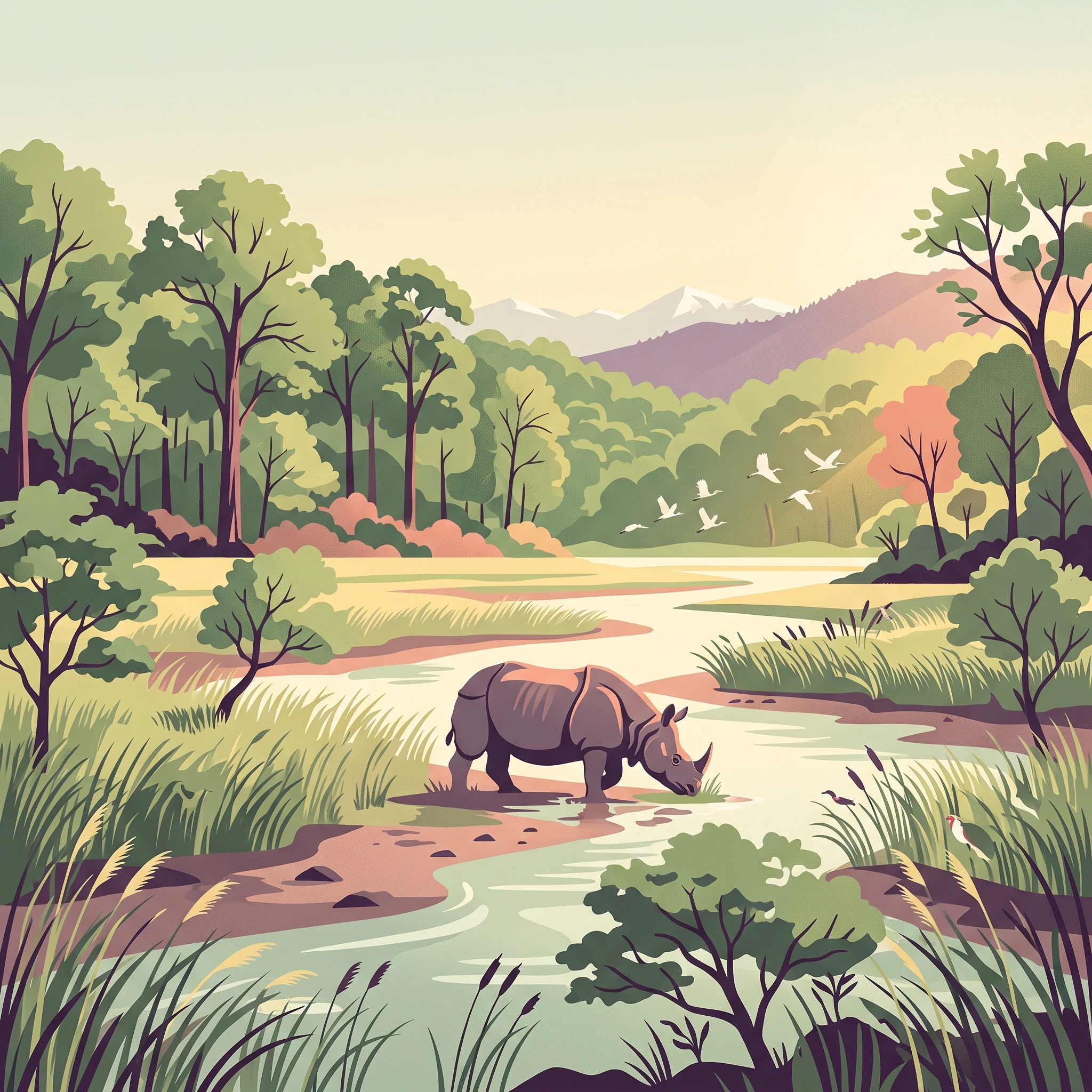
Chitwan National Park is renowned as one of the finest examples of Terai ecosystem preservation in South Asia and serves as a critical stronghold for some of the region's most endangered large mammals. The park is famous for its population of Indian rhinoceros, which has recovered from fewer than 100 individuals in the late 1960s to over 600 today, representing the largest population in Nepal. It is also recognized as one of the best tiger habitats in the world, with the highest recorded tiger density in the region. The park's extensive grasslands provide crucial habitat for the critically endangered Bengal florican, while its river systems support the endangered gharial. The combination of sal forests, riverine ecosystems, and grasslands creates an exceptionally diverse habitat that supports over 700 wildlife species.
Chitwan National Park history and protected-area timeline
The history of Chitwan National Park reflects a dramatic transformation from exclusive hunting grounds to one of South Asia's most important protected areas. From the end of the 19th century until the 1950s, the dense forests and grasslands of Chitwan served as the favored hunting destination for Nepal's ruling class, where feudal big game hunters shot hundreds of tigers, rhinoceroses, elephants, leopards, and sloth bears during winter seasons. By 1950, the forest and grasslands extended over 2,600 square kilometers and supported approximately 800 rhinos. However, when poor farmers from the mid-hills began settling in the Chitwan Valley in search of arable land, the area underwent rapid transformation. Malaria eradication efforts using DDT in the 1960s enabled further human settlement, and by the end of the decade, 70% of the jungle had been cleared with only 95 rhinos remaining. The dramatic decline prompted the government to establish the Gaida Gasti, an armed rhino reconnaissance patrol, and gazette Chitwan National Park in December 1970, officially established in 1973 with an initial area of 544 square kilometers. In 1977, the park was enlarged to its present size, and a buffer zone was added in 1997. The word Royal was removed from the name in 2006 following the Nepalese Civil War.
Chitwan National Park landscape and geographic character
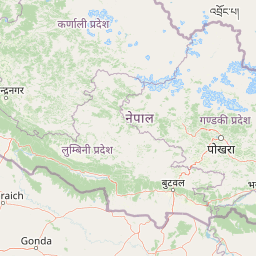
The physical landscape of Chitwan National Park encompasses a remarkable variety of terrain within its 952 square kilometer boundary. The park lies in the Terai, Nepal's lowland plain region, where elevation ranges from approximately 100 meters in the river valleys along the Narayani and Rapti rivers to 815 meters on the lower slopes of the Sivalik Hills. The Narayani-Rapti river system forms a natural boundary to human settlements in the north and west, creating a natural hydrological framework that shapes the park's interior. The terrain features a mix of flat alluvial floodplains, gently undulating hills, and the distinctive Churia Hills in the southern portion. The river system includes numerous oxbow lakes, small tributaries, and seasonal wetlands that create a dynamic aquatic landscape. The alluvial soils deposited by the rivers support the park's extensive grasslands, while the hill slopes bear the characteristic subtropical broadleaf forests that once covered much of the Himalayan foothills.
Chitwan National Park ecosystems, habitats, and plant life
The ecological character of Chitwan National Park is defined by two primary vegetation types that create a diverse habitat mosaic. Himalayan subtropical broadleaf forests, dominated by sal trees, cover approximately 70% of the park's area, with the purest stands occurring on well-drained lowland ground in the center. Along the southern face of the Churia Hills, sal forest mingles with chir pine, while northern slopes feature associations with smaller flowering trees and shrubs including beleric, rosewood, axlewood, elephant apple, and numerous climbing species. The Terai-Duar savanna and grasslands cover about 20% of the park and represent one of the most significant habitat types, featuring more than 50 grass species including some of the world's tallest grasses. Seasonal bushfires, flooding, and erosion create an ever-changing mosaic of riverine forest and grasslands along the river banks. The riverine forests along the Narayani and Rapti support distinct communities of catechu, rosewood, and kapok trees, with understory shrubs providing shelter for diverse species.
Chitwan National Park wildlife and species highlights
Chitwan National Park supports an extraordinary diversity of wildlife, with more than 700 species documented within its boundaries. The park is home to 68 mammal species, most notably the Bengal tiger, whose population has increased from approximately 25 individuals at the park's establishment to between 70 and 110 by 1980, with recent surveys indicating densities of 4 to 6 tigers per 100 square kilometers. The Indian rhinoceros represents perhaps the park's greatest conservation success, with populations recovering from near extinction in the 1960s to over 600 individuals today, representing the largest population in Nepal. The park supports significant populations of wild elephants, gaurs, and wild water buffalo, along with various deer species including chital, sambar, red muntjac, and hog deer. The avifauna is equally remarkable, with 543 bird species recorded, making Chitwan the most bird-diverse protected area in Nepal. Critically endangered species include the Bengal florican in the grasslands, while the river systems support endangered gharials and mugger crocodiles. The park also hosts diverse reptile populations including pythons, king cobras, and over 17 snake species, alongside 113 recorded fish species.
Chitwan National Park conservation status and protection priorities
Chitwan National Park holds significant conservation importance as one of South Asia's most successful protected area stories and a critical component of regional biodiversity preservation. The park's designation as a UNESCO World Heritage Site in 1984 recognizes its outstanding universal value as a natural habitat. The park forms the core of the Tiger Conservation Unit Chitwan-Parsa-Valmiki, representing a coherent transboundary protected landscape of over 2,000 square kilometers that serves as one of the most important tiger habitats in the world. Conservation efforts have focused on species recovery, with the Indian rhinoceros population recovering from fewer than 100 individuals to become the largest population in Nepal. The gharial conservation program collects eggs from wild populations and rears juveniles for release into the river system. The park also serves as a source population for translocating rhinos to other protected areas including Bardia National Park and Shuklaphanta National Park to ensure species survival in case of epidemics. The establishment of a buffer zone in 1997 extends protection beyond the core area, engaging local communities in conservation stewardship.
Chitwan National Park cultural meaning and human context
The cultural context of Chitwan National Park includes the traditional lands of the Tharu people, an indigenous group who have historically inhabited the Terai region. When the first protected areas were established, Tharu communities were forcibly relocated from their traditional lands within the park boundaries, a process that resulted in displacement and economic hardship. The Tharu people, who had lived in the area for generations and developed unique cultural practices adapted to the forest environment, were denied land ownership rights and forced to leave at gunpoint, with Nepalese soldiers destroying villages and fields. This historical displacement remains a significant aspect of the park's social history and has implications for contemporary conservation approaches that seek to balance protection with community rights and livelihoods.
Top sights and standout views in Chitwan National Park
Chitwan National Park offers visitors exceptional opportunities to experience one of South Asia's most biodiverse wilderness areas. The park's combination of sal forests, riverine ecosystems, and extensive grasslands creates varied landscapes that support remarkable wildlife viewing opportunities. Elephant safaris provide access to the interior grasslands and forests, offering chances to observe rhinos, deer, and a variety of bird species. The Narayani River supports populations of mugger crocodiles and the critically endangered gharial, while boat trips along the river provide opportunities to view these species and numerous waterfowl. The park's status as an Important Bird Area makes it particularly significant for birdwatchers, with over 540 species including the critically endangered Bengal florican and numerous migratory species. The Tharu cultural village outside the park offers insights into the traditional lifestyle of the indigenous communities of the Terai.
Best time to visit Chitwan National Park
The optimal time to visit Chitwan National Park is during the dry season from October through March, when weather conditions are most favorable for wildlife viewing. During these months, temperatures are comfortable, ranging from warm days to cool nights, and the reduced vegetation density in the grasslands makes animals easier to spot. The period from November to February offers the most pleasant climate, with clear skies and minimal rainfall. The monsoon season from mid-June to late September brings heavy rainfall, with approximately 2,500 millimeters of annual precipitation occurring during this period, which can restrict access and make wildlife viewing more challenging. However, the monsoon transforms the landscape into a lush green environment that may appeal to visitors interested in seeing the ecosystem at its most vibrant. Early mornings and late afternoons remain the best times for wildlife observation throughout the year, as animals are most active during these cooler periods.