
Mori Atlas logo
National parkMakalu Barun National Park

Detailed mapped boundaries and geographic context for this national park.

Makalu Barun National Park: Nepal's Protected Landscape in Koshi Province

Makalu Barun National Park represents a significant protected area within the diverse geography of Koshi Province, Nepal. This page provides an in-depth look at the park's identity as a national park, focusing on its mapped boundaries and the regional landscape context. Explore the protected land's geographic setting and its role within the atlas of natural areas for structured discovery.

Himalayan national parksMountain protected areasTransboundary conservation areasEastern HimalayasAlpine ecosystemsSubtropical forests
Illustration of mountains, waterfall, river, small house, evergreen trees, and wildflowers.

Makalu Barun National Park

National park

Park overview

Structured park overview, official facts, and landscape profile for Makalu Barun National Park

Makalu Barun National Park park facts, protected area profile, and essential visitor context
Review the core facts for Makalu Barun National Park, including designation, size, terrain, visitor scale, habitats, and operating context in one park-focused overview.

About Makalu Barun National Park

Makalu Barun National Park represents one of the most ecologically significant protected areas in the Himalayas, distinguished by its extraordinary vertical profile that encompasses virtually every ecosystem type found in the Eastern Himalayas within a single management boundary. The park covers 1,500 square kilometers in eastern Nepal, extending approximately 66 kilometers from west to east and 44 kilometers from north to south. The landscape is dominated by the rugged, glaciated peaks surrounding Makalu, which rises to 8,463 meters as the fifth-highest mountain globally, along with Chamlang, Baruntse, and Mera Peak forming the core of the high mountain environment. The Barun River, a glacier-fed tributary to the Arun River, has carved deeply incised valleys that descend to the southeastern boundary where elevations fall to around 344-377 meters. This dramatic topographical variation creates diverse microclimates and supports remarkable ecological zonation. The park shares its northern boundary with China's Qomolangma National Nature Preserve in the Tibet Autonomous Region, forming a transboundary conservation landscape of international significance. Beyond its ecological value, the park holds cultural importance for the local communities belonging to the Limbu, Sherpa, Yakkha, Gurung, Tamang, Magar, Newar, Brahmin, and Chhetri ethnic groups, who have historically maintained a symbiotic relationship with the mountain environment.

Quick facts and research context for Makalu Barun National Park

Located in Koshi Province, eastern Nepal, Makalu Barun National Park spans 1,500 square kilometers across two districts. The park features the world's steepest elevation gradient within a protected area, rising from approximately 344 meters in the Arun River valley to 8,463 meters at Makalu Peak. Established in 1992 following surveys in the 1980s that revealed the area's exceptional biological richness, the park was initially managed as the Makalu-Barun Conservation Area Project before becoming a national park with buffer zone status in 1999. The park contains the Barun Valley, Nepal's first designated Strict Nature Reserve, protecting pristine forests and alpine ecosystems. Local communities from nine ethnic groups, primarily subsistence farmers, have been integrated into conservation through community-based forest management programs.

Park context

Deeper park guide and search-rich context for Makalu Barun National Park

Makalu Barun National Park history, landscape, wildlife, and travel context
Explore Makalu Barun National Park through its history, landscape character, ecosystems, wildlife, conservation priorities, cultural context, and seasonal travel timing in a structured park guide built for atlas discovery and search intent.

Why Makalu Barun National Park stands out

Makalu Barun National Park is best known for its unparalleled vertical extent, protecting the complete ecological spectrum from tropical dipterocarp forests at low elevations through subtropical, temperate, subalpine, and alpine zones to perpetual snow and ice. The park encompasses Makalu, the fifth-highest mountain in the world, and contains exceptional biodiversity including 3,128 flowering plant species, 440 bird species, and 88 mammal species. The red panda, snow leopard, and clouded leopard inhabit its diverse habitats, while the Barun Valley represents one of the last pristine wilderness areas in the Eastern Himalayas. The park's unique combination of extreme altitude range, ecological diversity, and intact ecosystems makes it a globally significant conservation area.
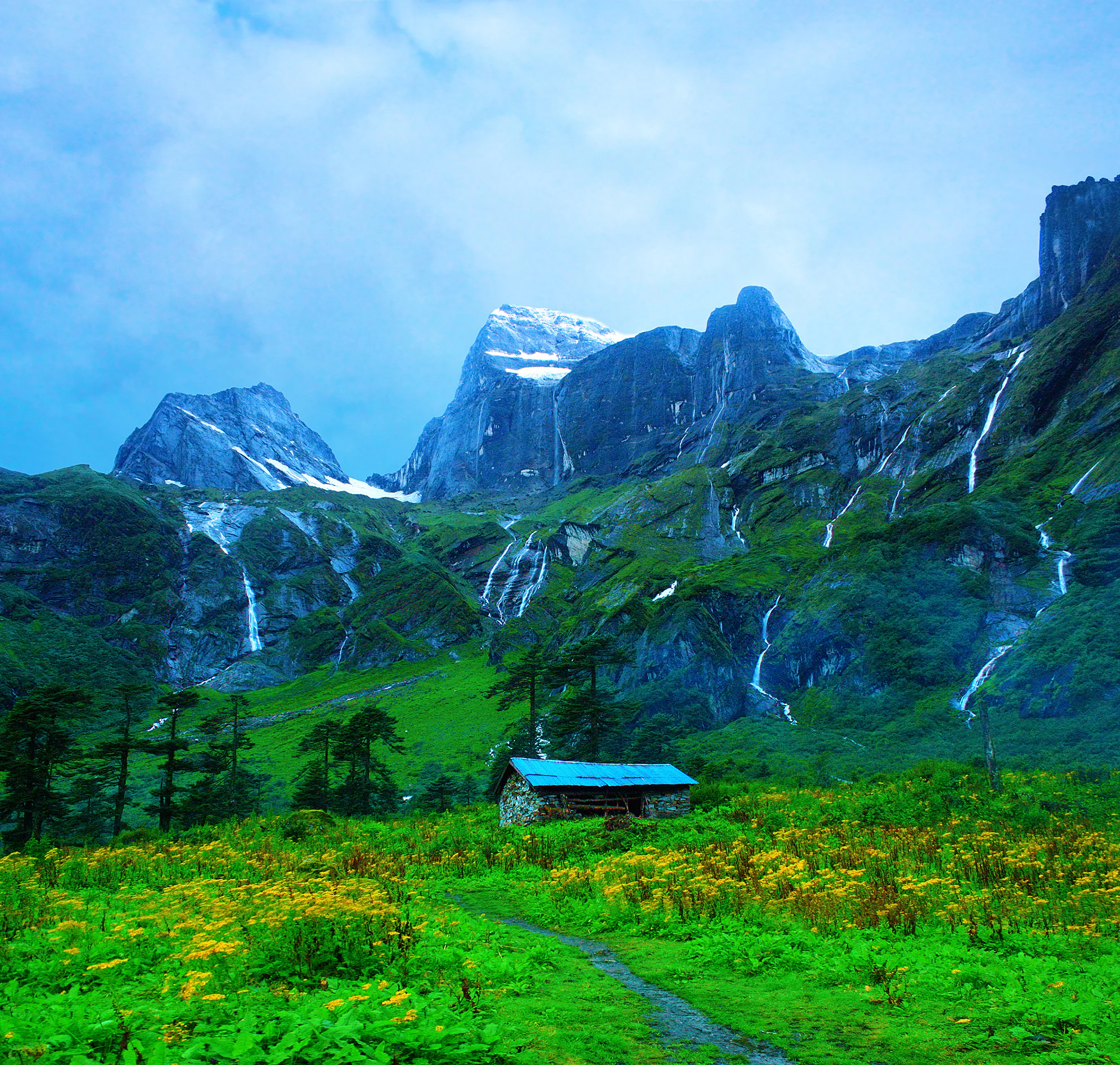
Barun Valley landscape featuring snow-capped mountains, multiple waterfalls, a small wooden hut with a blue roof, and a trail through a lush green meadow with yellow wildflowers
Barun Valley in Makalu Barun National Park with snow-capped peaks, waterfalls, and a small hut in a green meadow

Makalu Barun National Park history and protected-area timeline

The establishment of Makalu Barun National Park emerged from scientific surveys conducted in the Barun Valley during the 1980s by personnel of The Mountain Institute under president Daniel C. Taylor. Initially investigating the possibility of finding evidence for the Yeti legend, the surveys instead revealed the valley's extraordinary biological richness, which prompted interest in creating a new protected area. A formal proposal was formulated in 1985, leading to the initiation of the Makalu-Barun Conservation Area Project (MBNCPA) in 1988 as a joint endeavor between Nepal's Department of National Parks and Wildlife Conservation and The Mountain Institute. The conservation area was officially gazetted in 1991, at which time approximately 32,000 people resided within its boundaries across 12 Village Development Committees. An innovative community-based conservation approach was implemented, emphasizing biodiversity management with local communities and creating Community Forest User Groups with legal rights to sustainably manage designated forested areas. In 1999, the conservation area was converted into a buffer zone under the Buffer Zone Management Guidelines, which prioritized conservation of forests, wildlife, and cultural resources. The inaccessible Barun River valleys, containing some of the last remaining pristine forests and alpine meadows, were designated as Nepal's first Strict Nature Reserve to protect natural ecosystems in an undisturbed state for scientific study and environmental monitoring.

Makalu Barun National Park landscape and geographic character

The landscape of Makalu Barun National Park is defined by extreme topographical variation, with elevations ranging from approximately 344 meters in the Arun River valley to 8,463 meters at the summit of Makalu. The terrain is characterized by dramatic glacial valleys, steep granite walls, and towering Himalayan peaks. The Barun River has carved a deep valley system that descends from the high mountains through progressively lower elevations, creating a continuous ecological gradient. The southeastern portion of the park features the lower Arun valley with its relatively gentle terrain, while the central and northern areas are dominated by the massive, glaciated peaks of the Makalu-Chamlang-Baruntse massif. The park's eastern extension into the Arun valley represents one of the mostremote and least-developed areas in Nepal, with the international border with Tibet running along the northern boundary. The landscape transitions through distinct ecological zones, from the subtropical forests of the lower valleys through temperate oak-laurel forests, subalpine conifer stands, alpine meadows, and finally to the permanent snow and ice of the high peaks.

Makalu Barun National Park ecosystems, habitats, and plant life

The ecological diversity of Makalu Barun National Park is extraordinary, encompassing five distinct bioclimatic zones within its boundaries. Below 1,000 meters, tropical dipterocarp monsoon forest dominates, featuring stands of sal, while the subtropical zone between 1,000 and 2,000 meters contains Schima and Castanopsis forest communities. The temperate zone from 2,000 to 3,000 meters supports predominantly broadleaf evergreen species of the oak and laurel families, alongside deciduous stands of maple and magnolia. Above 3,000 meters, subalpine conifer forests of Himalayan birch and East Himalayan fir extend to approximately 4,000 meters, transitioning into alpine pastures characterized by dwarf rhododendron, juniper, aromatic herbs, and wildflowers. The region above 5,000 meters comprises primarily rock and ice with minimal vegetation. Botanists have recorded 3,128 species of flowering plants in the park, including 25 of Nepal's 30 rhododendron varieties, 48 primrose species, 47 orchids, and 19 bamboo species, making this one of the most botanically rich areas in the Himalayas.

Makalu Barun National Park wildlife and species highlights

Makalu Barun National Park supports remarkable faunal diversity across its diverse habitats. The park is home to 88 mammal species, including several endangered and rare species. The snow leopard and clouded leopard represent the apex predators, while the red panda inhabits the bamboo-rich forests of the middle elevations. Other notable mammals include the Indian leopard, Himalayan wolf, Asian black bear, Himalayan tahr, Himalayan goral, musk deer, and barking deer. The avian fauna is equally impressive, with ornithologists recording 440 bird species ranging from eagles and other raptors to white-necked storks and brilliantly colored sunbirds. Sixteen rare or protected bird species occur in the park, including the rose-ringed parakeet, Blyth's kingfisher, blue-naped pitta, and spiny babbler. The park also supports 315 butterfly species, 43 reptile species, 16 amphibian species, and 78 fish species in its ponds, lakes, and rivers. The first camera trap image of an Asian golden cat in Nepal was obtained in the park at an altitude of 2,517 meters in May 2009, highlighting the ongoing discovery of rare species in this relatively unexplored area.

Makalu Barun National Park conservation status and protection priorities

Makalu Barun National Park holds exceptional conservation significance as the world's only protected area encompassing an elevation gradient of more than 8,000 meters, protecting the complete ecological spectrum from tropical forest to alpine summit. The park is part of the Sacred Himalayan Landscape, a transboundary conservation initiative spanning the borders of Nepal, India, Bhutan, and China. The Barun Valley was designated as Nepal's first Strict Nature Reserve, protecting some of the last remaining pristine forests and alpine meadows in the region for scientific study, environmental monitoring, and genetic resource conservation. Community-based conservation approaches have been integral to the park's management, with local communities granted legal rights to sustainably manage forest resources through Community Forest User Groups. Strict prohibitions on hunting and trapping of endangered species, along with compensation programs for crop and livestock damage caused by wildlife, help reduce human-wildlife conflict. The park shares its northern boundary with China's Qomolangma National Nature Preserve, enabling coordinated transboundary conservation efforts for shared ecosystems and migratory species.

Makalu Barun National Park cultural meaning and human context

The cultural landscape of Makalu Barun National Park is defined by the presence of local communities belonging to nine ethnic groups, primarily the Limbu, Sherpa, Yakkha, Gurung, Tamang, Magar, Newar, Brahmin, and Chhetri peoples. At the time of the park's establishment, approximately 32,000 people resided within the conservation area across 12 Village Development Committees, predominantly practicing subsistence agriculture. The community-based conservation approach implemented in the park recognized the importance of integrating local communities into conservation planning and management. Community Forest User Groups were established with legal rights to use designated forested areas on a sustainable basis, creating a model for collaborative conservation. Ecotourism was promoted as a means of providing alternative income opportunities for local people while minimizing negative environmental impacts. The park's landscape has been shaped by centuries of traditional mountain agriculture and pastoral practices, creating a cultural-ecological landscape that reflects the long relationship between Himalayan communities and their environment.

Top sights and standout views in Makalu Barun National Park

The extraordinary vertical extent of Makalu Barun National Park, spanning over 8,000 meters from tropical forest to the summit of the world's fifth-highest mountain, makes it a globally unique protected area. The Barun Valley contains Nepal's first designated Strict Nature Reserve, protecting pristine ecosystems. The park supports exceptional biodiversity including 3,128 flowering plant species, 440 bird species, and 88 mammal species, with notable inhabitants including snow leopard, clouded leopard, and red panda. The Makalu-Chamlang-Baruntse massif forms a spectacular alpine environment, while the lower Arun valley supports subtropical forest ecosystems. The park's community-based conservation model, integrating local ethnic communities into sustainable resource management, represents an important approach to Himalayan conservation.

Best time to visit Makalu Barun National Park

The park experiences a monsoonal climate with approximately 70 percent of the annual 4,000 millimeters of precipitation falling between June and late September. The first monsoon clouds arrive in April, with the main rainy season extending through summer. For trekking and wildlife viewing, the post-monsoon period from October through November offers clear skies, stable weather, and excellent visibility of the high mountains. Winter months (December to February) can bring heavy snowfall at higher elevations, while spring (March to May) features pleasant temperatures at lower elevations and rhododendron blooms in the middle elevations. The extreme variation in altitude within the park means that weather conditions differ dramatically depending on the specific elevation and region being visited, requiring careful planning appropriate to intended activities and destinations within the park.

Park location guide

Geography guide, regional context, and park location map for Makalu Barun National Park

Makalu Barun National Park park geography, regions, and map view in Nepal
Understand where Makalu Barun National Park sits in Nepal through a broader geographic reading of the surrounding landscape, nearby location context, and its mapped position within the national park landscape.

How Makalu Barun National Park fits into Nepal

Nepal is a federal parliamentary republic in South Asia, landlocked between China and India. It spans the Himalayas and includes eight of the world's ten highest mountains. Kathmandu is the capital and largest city.

Wider geography shaping Makalu Barun National Park in Nepal

Nepal is located in South Asia, landlocked between China to the north and India to the south, east, and west. The country occupies the Himalayan region in the north and extends into the Indo-Gangetic Plain in the south. Terrain includes the Terai lowlands, subalpine hills, and the Himalayas with peaks including Mount Everest.

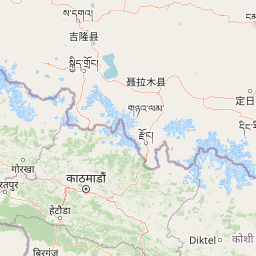
Map view of Makalu Barun National Park

Use this park location map to pinpoint Makalu Barun National Park in Nepal, understand its exact geographic position, and read its mapped placement within the surrounding landscape more clearly.

Pigeon | © OpenStreetMap contributors

Location context for Makalu Barun National Park

Koshi Province

Witness the park's extraordinary vertical gradient: from tropical forests to alpine meadows and snow-capped Himalayan peaks.

Makalu Barun National Park Photos: Explore Himalayan Landscapes and Protected Area Scenery
Explore photography of Makalu Barun National Park to visualize its dramatic Himalayan terrain, vast ecological zones, and unique protected landscapes, from subtropical valleys to glaciated summits. These images provide crucial visual context, detailing the park's unparalleled altitudinal range, rich biodiversity, and critical conservation importance within the Eastern Himalayas.

Barun Valley landscape featuring snow-capped mountains, multiple waterfalls, a small wooden hut with a blue roof, and a trail through a lush green meadow with yellow wildflowers

Green valley with stream flowing over rocks, grassy terrain, and mountains with waterfall in background

Park atlas

Trace the Geographic Spread of Protected Areas and Compare Similar Himalayan Landscapes

Explore Other National Parks Near Makalu Barun National Park and the Eastern Himalayas
Browse additional national parks and protected areas across the Eastern Himalayas, extending exploration from Makalu Barun National Park into adjacent conservation landscapes. Compare their unique ecological features, altitudinal ranges, and geographic context to understand the broader Himalayan protected-area atlas.
National parkKoshi Province

Sagarmatha National Park: Mapped Protected Landscape and Geographic Identity in Koshi Province

Explore the protected area's regional geographic context.

Sagarmatha National Park serves as a distinct protected national park entity. This page facilitates an in-depth understanding of its mapped boundaries and its location within Koshi Province. Users can explore the park's specific landscape characteristics and its position within the broader regional geography, providing a foundation for atlas and map-driven discovery.

Area
1,148 km²
Established
1976
IUCN
II
Visitors
19K annual
National parkDarjeeling District

Singalila National Park: A High-Altitude Protected Landscape on the Eastern Himalayan Ridge

Explore mapped terrain and alpine park geography in Darjeeling District.

Singalila National Park represents a crucial protected natural landscape within the Eastern Himalayas, located in India's Darjeeling District. Defined by its dramatic ridgeline that ascends to over 4,000 meters, the park offers a unique alpine environment with stunning panoramic views. Its designation as a national park highlights its importance for conservation and its role in the regional geographic atlas. Discover the mapped boundaries and ecological context of this remarkable mountain wilderness, from its dense forests to its open alpine meadows.

Area
78.6 km²
Established
1986
IUCN
II
Relief
Mountain
National parkSikkim

Khangchendzonga National Park: National Park in Sikkim with Mapped Boundaries

Explore protected landscapes and regional geography.

Understand Khangchendzonga National Park as a key protected area within Sikkim, India. This entry provides focused atlas information on the park's geographic features, mapped boundaries, and its role as a national park, offering essential context for regional landscape discovery and exploration.

Area
1,784 km²
Established
1977
IUCN
II
Relief
Mountain
A watercolor painting depicting a river flowing through a valley with mountains in the background and green forests
National parkNepal

Langtang National Park: Nepal's Pioneer Himalayan Protected Landscape and Alpine Atlas

Mapped glaciated terrain, sacred lakes, and towering peaks define this national park.

Langtang National Park, established as Nepal's first Himalayan national park, offers a unique window into high-altitude protected landscapes. Its geography is characterized by dramatic glaciated valleys, soaring mountain peaks including Langtang Lirung, and a rich diversity of alpine ecosystems. This page provides an atlas-centric view of the park's boundaries and its significance within the broader Himalayan conservation context.

Area
1,710 km²
Established
1976
IUCN
II
Relief
Mountain
National parkNepal

Shivapuri Nagarjun National Park: National Park Mapping and Geographic Identity in Nepal

Explore protected boundaries and natural terrain.

Shivapuri Nagarjun National Park serves as a prime example of a protected natural area within Nepal, offering valuable geographic context for atlas exploration. This detail page provides insights into the park's mapped boundaries, its designation as a national park, and its place within the country's diverse natural landscapes. Understanding the terrain and regional distribution of protected areas like Shivapuri Nagarjun National Park is crucial for a comprehensive geographic perspective.

Area
159 km²
Established
2002
IUCN
II
Relief
Mountain
National parkKalimpong district

Neora Valley National Park: India's Protected Landscape in Kalimpong District

Explore mapped boundaries and regional geography.

Neora Valley National Park is a significant protected area designated as a national park in India, located within the Kalimpong district. This dedicated page provides detailed geographic information, focusing on its mapped boundaries and its role as a natural landscape within the region. Understand the specific protected-area context of Neora Valley National Park for atlas-based discovery.

Area
88 km²
Established
1986
IUCN
II
Relief
Mountain
National parkJalpaiguri district

Gorumara National Park: India National Park Atlas and Protected Landscape Geography

Discover the mapped boundaries and regional terrain.

Gorumara National Park stands as a vital protected natural area within India's Jalpaiguri district. This entry provides detailed atlas-focused information, detailing the park's geographic identity and its position within the regional landscape context. Understand the mapped protected boundaries and explore the unique terrain that characterizes Gorumara National Park as a key national park entity. It serves as a foundational point for geographic discovery within India's network of protected lands.

Area
79.99 km²
Established
1992
IUCN
II
Relief
Mixed relief
National parkBhutan

Jigme Dorji National Park: Bhutan's Vast Protected Landscape and Himalayan Geography

Explore mapped boundaries and diverse ecosystems within this national park.

Jigme Dorji National Park, located in the heart of Bhutan, is a testament to the country's commitment to conservation, covering over 4,300 square kilometers of pristine Himalayan terrain. This national park encompasses diverse ecosystems, from lush subtropical forests in its lower reaches to barren alpine meadows and permanent snowfields at its highest elevations. The park's extensive mapped boundaries showcase a landscape vital for unique wildlife and sacred cultural sites, offering a comprehensive view for atlas-based geographic discovery.

Area
4,316 km²
Established
1974
IUCN
II
Relief
Mountain

Common questions about visiting, size, designation, and location context for Makalu Barun National Park

Makalu Barun National Park FAQs for park facts, access, geography, and protected area context
Find quick answers about Makalu Barun National Park, including protected-area facts, park geography, trail and visitor context, and how the park fits into its surrounding country and regional landscape.
MoriAtlas Explorer

Continue Your Protected Areas Search Across the Global Atlas

Deepen your exploration by continuing the structured search for national parks and protected areas worldwide. Utilize the comprehensive filtering capabilities to compare different conservation landscapes and refine your understanding of global park geography. Discover more about the distribution and characteristics of protected natural areas.

Global natural geography