
Mori Atlas logo
Wildlife reserveCholistan Wildlife Sanctuary

A vast protected wildlife reserve defined by shifting dunes, saline alluvial flats, and diverse desert-adapted ecosystems.

Cholistan Wildlife Sanctuary: Mapped Boundaries and Arid Desert Geography in Punjab, Pakistan

Cholistan Wildlife Sanctuary represents a monumental protected desert landscape within the Punjab region of Pakistan. This expansive reserve preserves a striking terrain of wind-sorted sand dunes, dry river terraces, and salty alluvial flats, offering a rare look at an intact arid-land ecosystem. The sanctuary provides a critical refuge for desert-specialized wildlife, including rare birds and reptiles, while serving as a prominent feature in the regional geography of the Cholistan Desert.

desert landscapesand dunesarid ecosystemdesert wildlifebustard habitatraptor habitat

Cholistan Wildlife Sanctuary

Wildlife reserve

Park overview

Structured park overview, official facts, and landscape profile for Cholistan Wildlife Sanctuary

Cholistan Wildlife Sanctuary park facts, protected area profile, and essential visitor context

Review the core facts for Cholistan Wildlife Sanctuary, including designation, size, terrain, visitor scale, habitats, and operating context in one park-focused overview.

About Cholistan Wildlife Sanctuary

Cholistan Wildlife Sanctuary occupies a central position in the Cholistan Desert, one of Pakistan's most significant arid landscapes. The region, sometimes referred to locally as Rohi, is part of the larger Thar system that extends into neighbouring India. Within Punjab, the sanctuary represents the most formal protection given to a desert ecosystem that has long been shaped by wind, salt, sparse rainfall, and a long history of pastoral land use.

The geography of the sanctuary divides naturally into two zones. The northern section, Lesser Cholistan, lies closer to settled and canal-irrigated farmland, and is characterized by low sandy ridges alternating with saline alluvial flats called dahars. Soils here tend to be saline or saline-sodic, a condition that strongly influences which plants and animals can survive. The southern section, Greater Cholistan, moves deeper into a wind-sorted sandy desert where river terraces, depressions, and large dunes dominate the scene. Some of these dunes rise to roughly 100 metres, creating the kind of sweeping sandy landscape usually associated with classic desert imagery.

Climate is one of the most defining features of the sanctuary. Summers are brutally hot, with temperatures that can exceed 50 degrees Celsius during peak heat. Nights bring relief, but the daily swing is significant. Rainfall is sparse, erratic, and largely concentrated in the monsoon period, often ranging between 100 and 250 millimetres across the year. This combination of high heat, low moisture, and saline soils has produced a tough but specialised ecological environment.

Despite these stresses, the sanctuary supports a wide variety of mammals, including caracal, jungle cat, Indian grey mongoose, Asiatic wildcat, Indian jackal, Bengal fox, white-footed fox, chinkara, nilgai, honey badger, Indian crested porcupine, Indian hare, and Arabian wolf. Reptiles are particularly well represented, with lizards such as the Indian spiny-tailed lizard, Bengal monitor, and the locally notable Eremias cholistanica sharing the landscape with numerous snake species, including the Sind krait, Indian cobra, and Eastern saw-scaled viper. Birds include the houbara bustard, Great Indian bustard, black-bellied sandgrouse, laggar falcon, saker falcon, tawny eagle, and cinereous vulture, alongside smaller species such as the desert lark and grey francolin.

Together, these features make the sanctuary a stronghold for desert biodiversity within Pakistan and a key reference site for understanding arid-zone ecology in the region. Its size, habitat diversity, and species composition give it both national conservation value and broader ecological interest for the study of desert ecosystems in South Asia.

Quick facts and research context for Cholistan Wildlife Sanctuary

Cholistan Wildlife Sanctuary lies within the Cholistan Desert of Punjab, Pakistan, with the nearest major city being Bahawalpur. The protected area covers approximately 2.6 million hectares, making it one of the largest desert sanctuaries in the region.

The landscape is divided into the northern Lesser Cholistan, which transitions into canal-irrigated areas, and the southern Greater Cholistan, a wind-sorted sandy desert dominated by river terraces, large dunes reaching roughly 100 metres in height, and dry depressions. Saline and saline-sodic soils are widespread, and the climate is sharply arid, with high daytime temperatures and sparse monsoon rainfall.

Protection and recognition

Documented terrestrial protection scope and official recognition details

Cholistan Wildlife Sanctuary Protection Status and Conservation Records

Cholistan Wildlife Sanctuary maintains a defined terrestrial protection scope within its regional landscape. Structured records compile documented management parameters and official conservation designations for the protected area.

Protection details

Protection scope
Terrestrial
Transboundary protection
No
Park context

Deeper park guide and search-rich context for Cholistan Wildlife Sanctuary

Cholistan Wildlife Sanctuary history, landscape, wildlife, and travel context

Explore Cholistan Wildlife Sanctuary through its history, landscape character, ecosystems, wildlife, conservation priorities, cultural context, and seasonal travel timing in a structured park guide built for atlas discovery and search intent.

Why Cholistan Wildlife Sanctuary stands out

The sanctuary is best known for preserving an exceptionally large tract of true desert landscape in Pakistan, where shifting sand dunes, salty flats, and dry river terraces form the backdrop for a community of desert-adapted wildlife. Among its most distinctive residents are the chinkara gazelle, the Asiatic wildcat, the Bengal fox, the Indian spiny-tailed lizard, and rare bird species such as the houbara bustard and the Great Indian bustard. It is also recognized for its reptile diversity, including numerous lizards, snakes, and turtles uniquely suited to sandy and saline environments. Few protected areas in South Asia combine this scale of dune habitat with such a complete suite of arid-land fauna, giving the sanctuary a distinctive place in the region's conservation network.
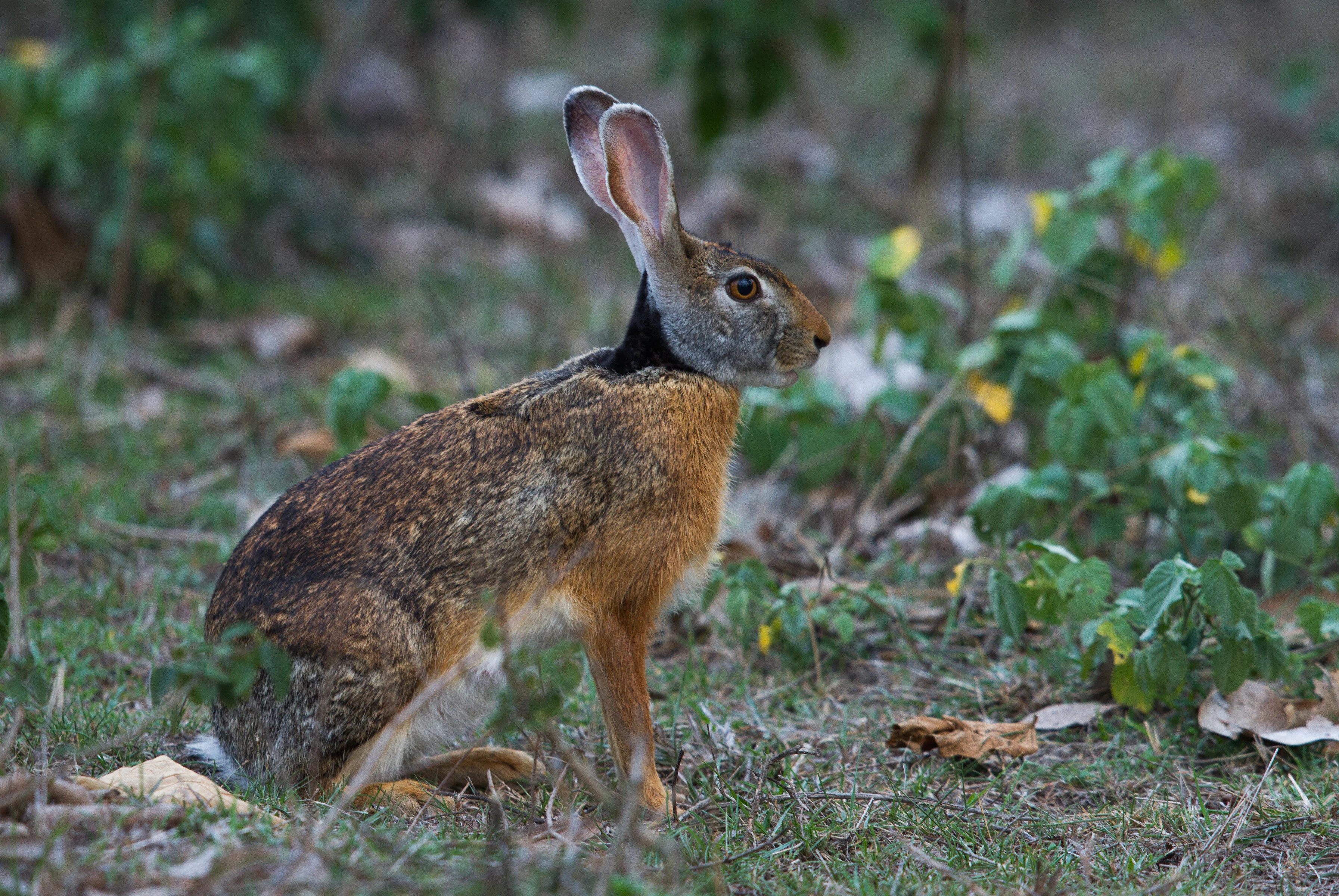
A side profile of an Indian hare with long ears and brown fur, standing on dry ground surrounded by sparse green vegetation.
An Indian hare in its natural environment.

Cholistan Wildlife Sanctuary landscape and geographic character

The landscape of Cholistan Wildlife Sanctuary is a striking example of an arid, dune-dominated environment shaped largely by wind action. The terrain divides into the northern Lesser Cholistan, where low sandy ridges and broad saline flats alternate in a transitional belt close to canal-irrigated farmland, and the southern Greater Cholistan, where true desert conditions take hold. Greater Cholistan is characterised by river terraces, dry depressions, and enormous wind-sorted sand dunes, some of which reach approximately 100 metres in height.

Saline and saline-sodic soils are widespread across the flatter stretches, producing the distinctive dahars, or alluvial flats, that punctuate the landscape. The scattered vegetation, where it exists at all, clings to these harsh substrates. The visual identity of the sanctuary is therefore one of seemingly endless sand, open skies, and undulating dune fields, broken only by shallow depressions and the dry remnants of old river courses. Large areas of the sanctuary feel genuinely remote, with very limited modifications from the natural dune and flat landforms.

Climatically, the landscape is reinforced by extreme conditions. Summer temperatures push beyond 50 degrees Celsius, while cool nights bring strong contrasts within a single day. Rainfall, mostly delivered by the monsoon, is erratic and averages only in the low hundreds of millimetres, leaving the surface dry for most of the year. These conditions, while harsh, are also the defining backdrop for everything the sanctuary protects.
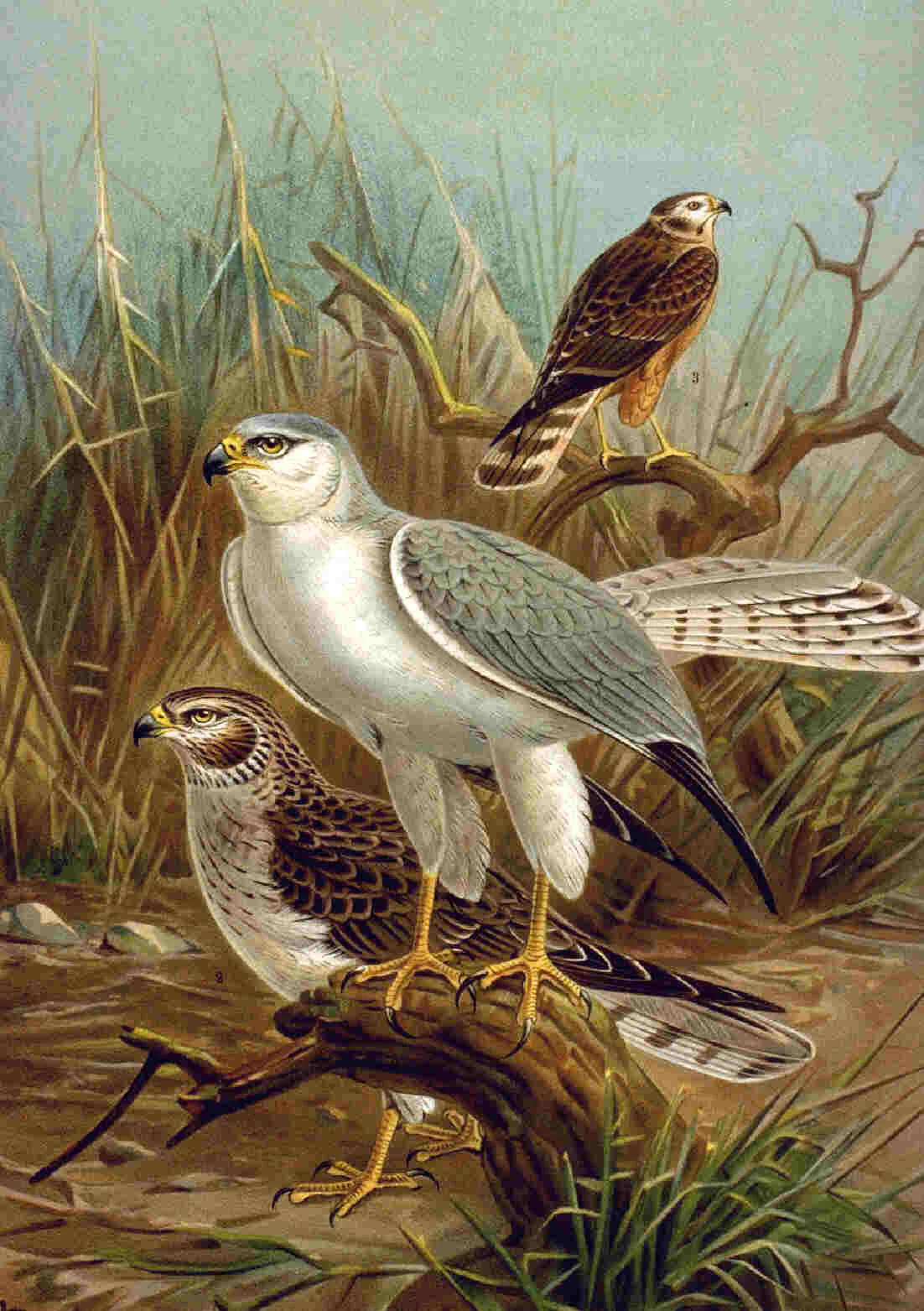
A detailed colored illustration of three Pallid Harriers perched on weathered branches in a marshy or grassland habitat.
A historical scientific illustration of the Pallid Harrier, a bird species found within the desert ecosystems of the region.

Cholistan Wildlife Sanctuary ecosystems, habitats, and plant life

The natural character of Cholistan Wildlife Sanctuary is shaped almost entirely by its aridity. Vegetation across the sanctuary is sparse, hardy, and adapted to saline soils and shifting sands, with plants concentrated around the margins of dahars and along the softer bands between dunes. The sanctuary's ecosystems are essentially variants of desert and semi-desert, ranging from the slightly more vegetated flats of the north to the near-barren dune fields of the south.

This ecological framework is what supports the sanctuary's distinctive wildlife. The availability of microhabitats created by dunes, flats, and depressions allows different species to occupy slightly different niches within an otherwise uniform desert landscape. Reptiles especially benefit from the warm sandy substrate, while birds make use of both open hunting grounds and scattered low vegetation. Even amphibians appear in the sanctuary, taking advantage of temporary water bodies that fill briefly during the monsoon.

Overall, the sanctuary functions as a complete arid-land ecosystem rather than a single habitat type. It preserves the full mosaic of desert features found in the Cholistan region, from dune crests down to saline depressions, and in doing so maintains the ecological processes that sustain its wildlife.
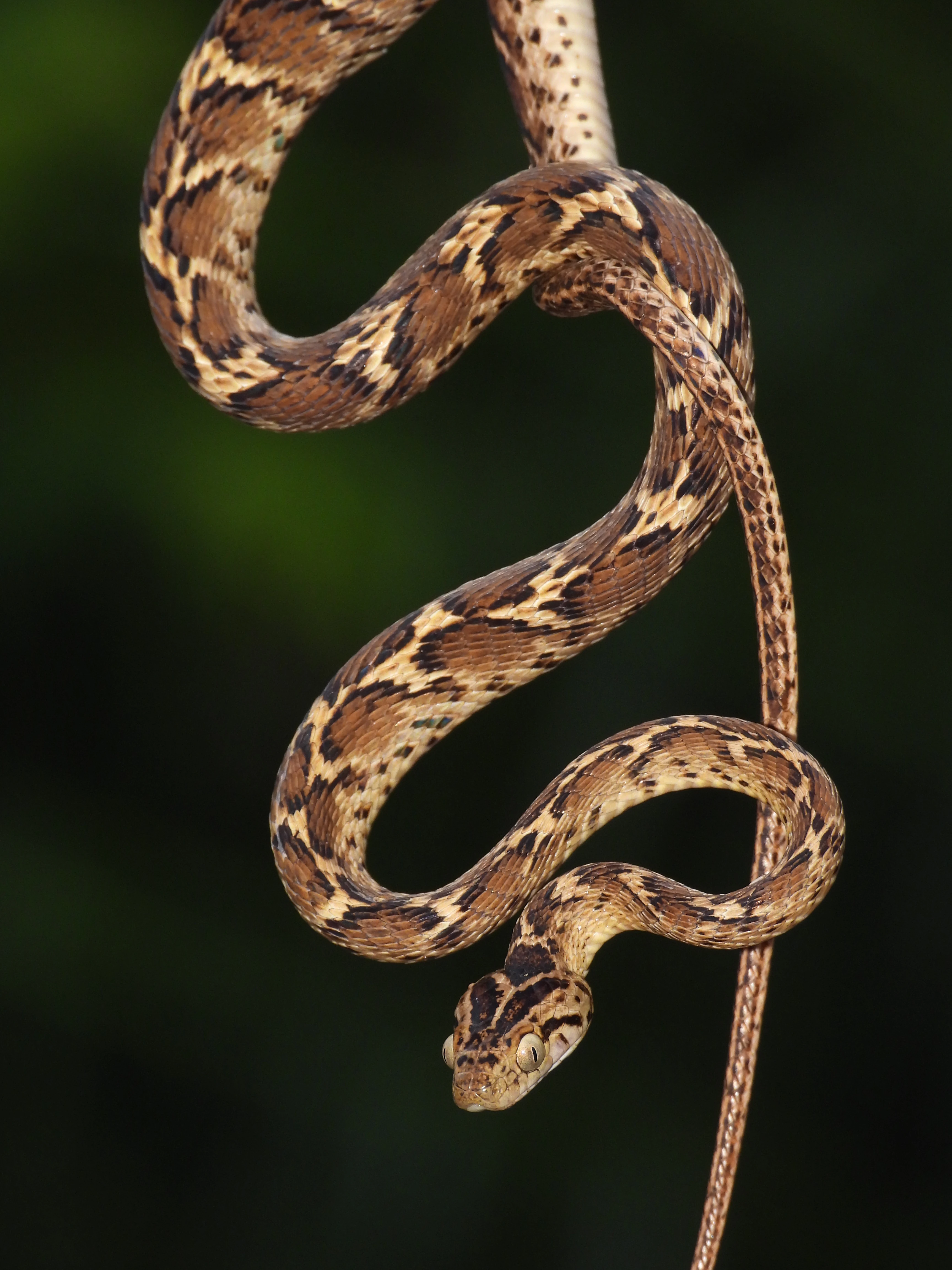
A brown and tan patterned cat snake coiled around a thin twig against a dark, blurred background.
A common cat snake coiled on a branch, showcasing its distinct pattern and eye shape.

Cholistan Wildlife Sanctuary wildlife and species highlights

Wildlife is the most prominent feature of Cholistan Wildlife Sanctuary, and the reserve is notable for the breadth and specialisation of its desert fauna. Mammals are well represented, including the elusive caracal as well as the more frequently encountered jungle cat, Asiatic wildcat, Indian jackal, Bengal fox, and white-footed fox. Smaller carnivores such as the Indian grey mongoose and small Indian mongoose are present alongside insectivores like the long-eared hedgehog, while herbivores include the graceful chinkara gazelle and the larger nilgai. Burrowing or nocturnal species such as the Indian crested porcupine, Indian ratel, and Indian hare round out the mammal community, with the Arabian wolf and Indian wild boar adding a more rare or localised presence.

The sanctuary is particularly important for its reptile fauna, which is exceptionally diverse for a desert reserve. Lizards dominate the landscape, with species such as the Indian spiny-tailed lizard, the brightly coloured oriental garden lizard, the Bengal monitor, and the Indian desert monitor occupying different microhabitats across the dunes and flats. The locally endemic Eremias cholistanica adds scientific interest, while numerous geckos and skinks, including the Sind gecko, yellow-belly gecko, and bronze grass skink, are part of the wider reptile community. Snakes are equally varied, ranging from the heavy-bodied Indian sand boa to fast, open-country racers such as the Pakistan sand racer and the steppe ribbon racer. Dangerous species are also present, including the Indian cobra, Sind krait, and Eastern saw-scaled viper, reflecting a healthy prey base.

Birds add another layer of richness. The sanctuary offers critical habitat for threatened bustards such as the houbara bustard and the Great Indian bustard, alongside a strong raptor community that includes the laggar falcon, saker falcon, tawny eagle, pallid harrier, and cinereous vulture. Ground-dwelling species such as the grey francolin and desert lark, together with the black-bellied sandgrouse and Eurasian collared dove, capture more of the open-country character of the reserve.
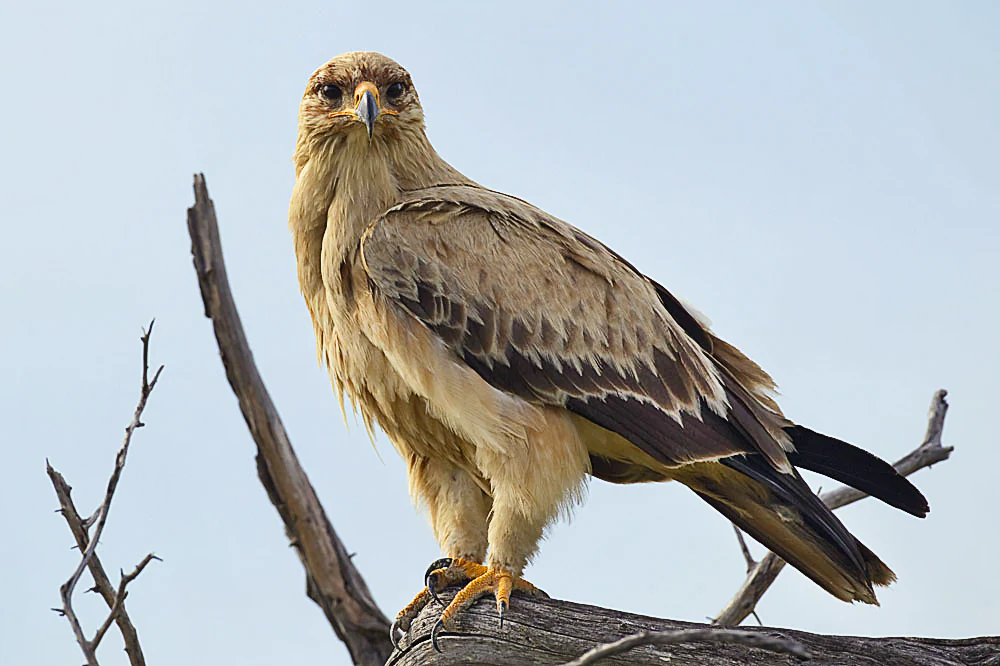
A tawny eagle with brown and buff plumage perched on a dry, bare branch against a bright sky.
A tawny eagle perched on a branch within the Cholistan Wildlife Sanctuary.

Cholistan Wildlife Sanctuary conservation status and protection priorities

Cholistan Wildlife Sanctuary plays an important conservation role by protecting one of the largest continuous blocks of desert habitat within Punjab, Pakistan. Its sheer size provides a buffer against the fragmentation that affects many smaller desert reserves, allowing wildlife populations to maintain more natural movement patterns across dunes, flats, and depressions. This continuity is especially important for wide-ranging species such as the chinkara, desert foxes, and raptors that depend on large open landscapes.

The sanctuary also serves as a stronghold for several species that face pressure elsewhere in South Asia. The presence of houbara and Great Indian bustards gives it particular conservation value, as both species are vulnerable to habitat loss and disturbance in drier landscapes across the region. The survival of predators such as the caracal and Arabian wolf, alongside desert-specialist reptiles, further highlights the reserve's importance for arid-zone biodiversity.

Beyond protecting individual species, the sanctuary preserves the ecological processes that define the Cholistan Desert itself. By maintaining dune systems, saline flats, and natural hydrological patterns, it sustains the broader arid-land ecosystem that has supported desert wildlife in this part of Pakistan for generations.

Cholistan Wildlife Sanctuary cultural meaning and human context

The Cholistan Desert has long been home to pastoral communities whose livelihoods are closely tied to the rhythms of the arid landscape. Traditional land use, centred on livestock grazing and seasonal migration, has shaped much of the human relationship with this environment, and the area carries strong regional identity centred on desert culture, hardy herding traditions, and adaptation to scarce water. While the sanctuary exists primarily to protect wildlife and natural habitat, its setting within a culturally distinctive region gives it broader significance for understanding how people and desert ecosystems coexist in southern Punjab.
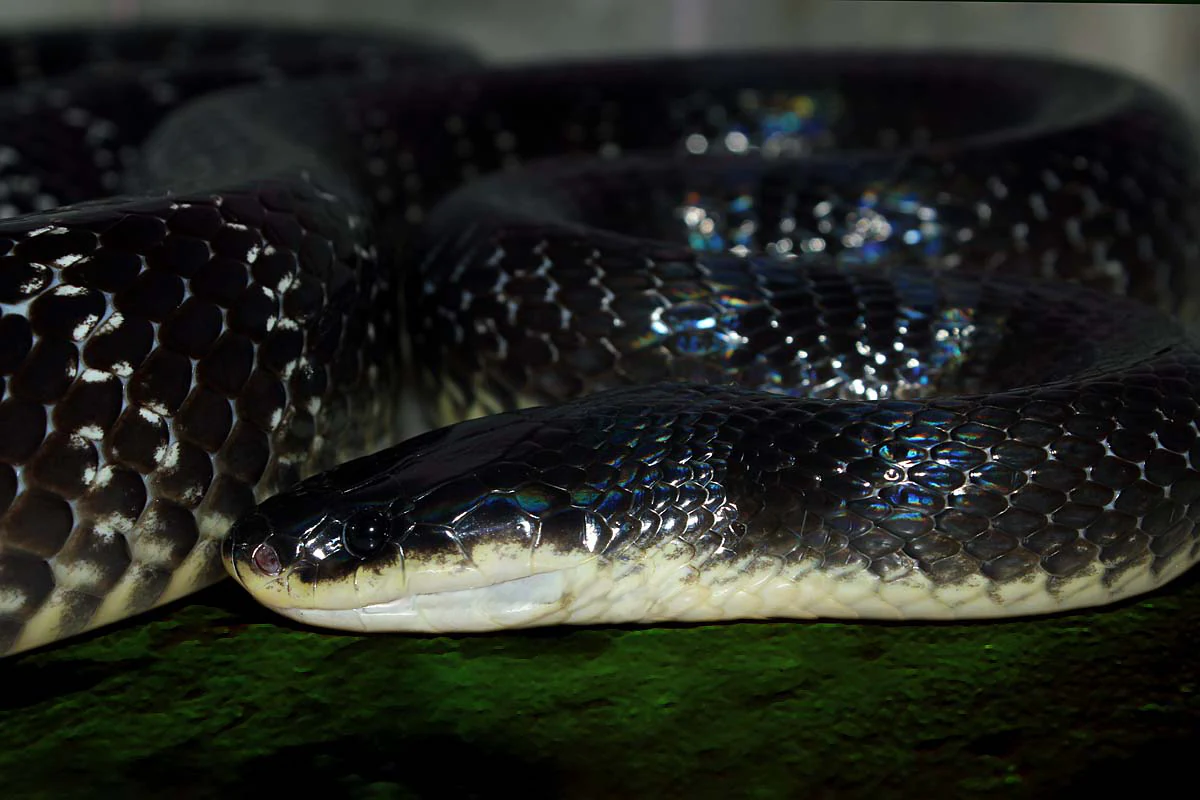
A close up, high angle shot of a shiny, dark-scaled Sind krait snake coiled on a textured, dark mossy surface.
A close up view of a Sind krait, a venomous snake species found in the desert ecosystem of the Cholistan region.

Top sights and standout views in Cholistan Wildlife Sanctuary

The sanctuary's standout qualities include its sheer scale as one of the largest protected desert areas in Pakistan, the dramatic presence of dunes reaching roughly 100 metres in height, and its division between the saline flats of Lesser Cholistan and the deeper sandy tracts of Greater Cholistan. Its fauna is equally impressive, with a complete community of desert-adapted mammals, a remarkable diversity of reptiles, and globally significant bird species such as the houbara bustard and Great Indian bustard. Few reserves in the region combine so much raw desert character with so broad a representation of arid-zone wildlife.

Best time to visit Cholistan Wildlife Sanctuary

The cooler months between late autumn and early spring are widely regarded as the most comfortable time to experience the Cholistan landscape, when temperatures ease and wildlife activity, especially among mammals and birds, tends to be more visible. Summer is extremely hot, with daytime temperatures capable of exceeding 50 degrees Celsius, making the harsh climate a serious constraint for any extended outdoor presence. Monsoon rainfall, while brief, can briefly transform visibility and access across the dunes and flats, but the broader character of the sanctuary remains defined by aridity throughout the year.

Monthly climate preview

Long-term representative monthly temperature and precipitation data patterns

Cholistan Wildlife Sanctuary Climate Normals and Annual Temperature Rhythm

Cholistan Wildlife Sanctuary exhibits a measured annual cycle featuring cool winter minimums and intense summer maximum temperatures alongside low daily precipitation rates. Analyzing the complete monthly climate normals profile provides detailed long-term averages for temperature and rainfall distribution.
Annual mean28 °C
15 °C38 °C
Jan15°
Feb18°
Mar24°
Apr31°
May36°
Jun38°
Jul37°
Aug36°
Sep33°
Oct28°
Nov22°
Dec17°
Warmest month
June

37.9 °C

Coolest month
January

14.6 °C

Wettest month
July

1.1 mm/day

Driest month
December

0.2 mm/day

Park location guide

Geography guide, regional context, and park location map for Cholistan Wildlife Sanctuary

Cholistan Wildlife Sanctuary park geography, regions, and map view in Pakistan

Understand where Cholistan Wildlife Sanctuary sits in Pakistan through a broader geographic reading of the surrounding landscape, nearby location context, and its mapped position within the national park landscape.

How Cholistan Wildlife Sanctuary fits into Pakistan

Pakistan, officially the Islamic Republic of Pakistan, is a federal parliamentary Islamic republic in South Asia. It is the fifth-most populous country and the 33rd-largest by area. The country gained independence from British India in 1947 and has a diverse history spanning ancient civilizations including Mehrgarh and the Indus Valley Civilisation. Pakistan shares maritime borders with Oman and is bounded by the Arabian Sea, Gulf of Oman, and several neighboring countries.

Wider geography shaping Cholistan Wildlife Sanctuary in Pakistan

Pakistan is located in South Asia, bordered by the Arabian Sea to the south, the Gulf of Oman to the southwest, and shares land borders with India to the east, Afghanistan to the west, Iran to the southwest, and China to the northeast. The country also shares a maritime border with Oman in the Gulf of Oman. The Wakhan Corridor in Afghanistan separates Pakistan from Tajikistan in the northwest.

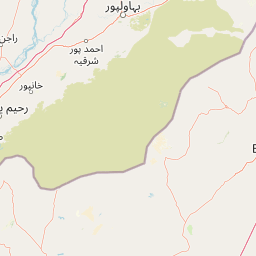
Map view of Cholistan Wildlife Sanctuary

Use this park location map to pinpoint Cholistan Wildlife Sanctuary in Pakistan, understand its exact geographic position, and read its mapped placement within the surrounding landscape more clearly.

Pigeon | © OpenStreetMap contributors

Location context for Cholistan Wildlife Sanctuary

Punjab

Visualizing sand dunes, saline flats, and arid desert habitats across protected Punjab terrain

Cholistan Wildlife Sanctuary Photos and Landscape Scenery

Visual documentation captures the expansive dune systems and harsh saline flats that define Cholistan Wildlife Sanctuary. Examining protected area photography reveals the unique terrain and desert habitats supporting specialized regional wildlife.

A side profile of an Indian hare with long ears and brown fur, standing on dry ground surrounded by sparse green vegetation.

A detailed colored illustration of three Pallid Harriers perched on weathered branches in a marshy or grassland habitat.

A brown and tan patterned cat snake coiled around a thin twig against a dark, blurred background.

A tawny eagle with brown and buff plumage perched on a dry, bare branch against a bright sky.

A red sand boa snake with reddish-brown scales and dark bands coiled on sandy ground, with its tongue flickering.

A close up, high angle shot of a shiny, dark-scaled Sind krait snake coiled on a textured, dark mossy surface.

Park atlas

Compare regional park geography and connected desert landscapes across Punjab

Explore Parks Near Cholistan Wildlife Sanctuary and Surrounding Protected Areas

Continue browsing other protected areas near Cholistan Wildlife Sanctuary to evaluate regional arid ecosystems and desert habitats. Expanding the geographic comparison reveals broader ecological patterns across the surrounding dryland conservation network.
National parkPunjab
About 47 km away#1 closest

Northwest

Lal Suhanra National Park: Protected Landscape in Punjab, Pakistan with Desert, Forest, and Wetland

Explore the mapped boundaries and unique geography of this national park.

Lal Suhanra National Park, a expansive national park in Pakistan's Punjab province, is distinguished by its extraordinary ecological mosaic. This UNESCO Biosphere Reserve seamlessly integrates desert regions characterized by dynamic sand dunes with areas of dense forest plantations and vital wetland habitats. The park's terrain offers a fascinating study in contrasts, showcasing how diverse ecosystems can coexist and thrive within a protected area, providing rich context for geographic and landscape exploration. Understand its mapped protected area and its significance within the regional geography.

Area
657.91 km²
Established
1972
IUCN
II
Relief
Lowland
Protected areaIran
About 257 km away#2 closest

Northwest

Koh-e-Sulaiman Protected Area: Sacred Mountain Geography and Landscape Context in Iran

Discover unique terrain and cultural heritage within this protected mountain range.

Koh-e-Sulaiman is a vital protected area within Iran, distinguished by the sacred Takht-e-Sulaiman peak, a site of deep spiritual importance. This landscape features rugged mountains, steep ridges, and deep valleys, contrasting sharply with surrounding plains. The protected area's unique geological complexity and dramatic terrain make it a significant natural and cultural landmark. MoriAtlas offers detailed geographic context to understand its protected boundaries and its role in the regional atlas, focusing on landscape discovery and natural features.

Area
6,475 km²
Relief
Mountain
Climate
Arid
Access
Remote access
Wildlife reservePunjab
About 296 km away#3 closest

Northeast

Changa Manga Wildlife Reserve: An Atlas of Punjab's Historic Man-Made Forest Landscape

Examining protected boundaries and plantation geography in the Punjab region

Changa Manga represents a unique intersection of industrial heritage and conservation, standing as one of the world's oldest and largest artificial forest plantations. Situated on the flat alluvial terrain of the Punjab, the reserve is defined by its regimented rows of sheesham and kikar trees. Beyond its historical roots as a fuel source, the area now functions as an essential wildlife refuge, maintaining critical habitats for endangered species and offering a look into the ongoing restoration of its protected boundaries.

Area
48.6 km²
Established
1866
Relief
Lowland
Climate
Subtropical
Wildlife reservePunjab
About 306 km away#4 closest

North

Chashma and Taunsa Barrage Dolphin Sanctuary: Protected Riverine Geography in Punjab

Freshwater habitat boundaries and Indus River landscape context

Chashma and Taunsa Barrage Dolphin Sanctuary serves as a key protected site for the Indus river dolphin, offering a unique look at riverine conservation in Punjab. This habitat, defined by its hydrology between two major barrages, acts as an essential wetland and wildlife corridor. The area provides a specialized landscape study for those tracing the ecological features of the Indus River system through this significant protected zone.

Established
1972
Water
Major water bodies
National parkRajasthan
About 364 km away#5 closest

Southwest

Desert National Park: A Sprawling National Park in Rajasthan's Thar Desert

Explore unique desert geography, mapped terrain, and fossil discoveries.

Desert National Park offers an expansive atlas view of the Thar Desert's unique aeolian sand deposits and arid terrain. Covering over 3,100 square kilometers across Rajasthan's Jaisalmer and Barmer districts, this national park is a critical landscape for desert conservation. Its features include iconic sand dunes, rocky formations, and ancient fossil beds, providing a profound geographic context for understanding desert ecosystems and prehistoric life.

Area
3,162 km²
Established
1981
IUCN
II
Relief
Lowland
Protected areaIndia
About 365 km away#6 closest

Southeast

Sambhar Salt Lake: Geographic Boundaries and Saline Landscape Profile in Rajasthan, India

A vital Ramsar wetland and inland salt-pan ecosystem

Sambhar Salt Lake is characterized by its dramatic shifts in surface area, ranging from shallow brine to vast arid flats depending on seasonal monsoon cycles. Framed by the ancient Aravali Range, this protected area features a unique mosaic of natural hypersaline waters and centuries-old salt harvesting pans. Its status as an essential migratory bird sanctuary makes it a central site for understanding the geography and conservation challenges of desert wetlands.

Water
Water-dominated
Wildlife reservePunjab
About 365 km away#7 closest

Northeast

Beas Conservation Reserve: Geographic Atlas of a Punjab Protected Wildlife Landscape

Braided River Systems and Freshwater Biodiversity

Located in northwestern India, the Beas Conservation Reserve protects a vital 185 km river corridor. The reserve is characterized by a complex, shifting mosaic of sand bars and islands that support rare freshwater species. This entry provides detailed insight into the protected boundaries, hydrological features, and regional geography of this unique wetland conservation area in Punjab.

Established
2017
Relief
Lowland
Scope
Terrestrial
Water
Water-dominated
Wildlife reserveKhairpur District
About 369 km away#8 closest

West

Mehrano Wildlife Sanctuary: Protected Forest Landscapes and Geography in Khairpur District

A historic wildlife reserve along the Indus riverine corridor.

Mehrano Wildlife Sanctuary represents a unique intersection of private historical stewardship and modern conservation. This riverine forest in Khairpur District provides a critical habitat for large game and migratory bird populations, functioning as a lush ecological refuge at the edge of the Cholistan desert. The terrain offers a distinct study in Indus floodplain geography and long-standing protected land management.

Area
2.8 km²
Established
1790
Relief
Lowland
Scope
Terrestrial

Common questions about visiting, size, designation, and location context for Cholistan Wildlife Sanctuary

Cholistan Wildlife Sanctuary FAQs for park facts, access, geography, and protected area context

Find quick answers about Cholistan Wildlife Sanctuary, including protected-area facts, park geography, trail and visitor context, and how the park fits into its surrounding country and regional landscape.
MoriAtlas Explorer

Continue Your Protected Areas Search Across the Global Atlas

Deepen your exploration by continuing the structured search for national parks and protected areas worldwide. Utilize the comprehensive filtering capabilities to compare different conservation landscapes and refine your understanding of global park geography. Discover more about the distribution and characteristics of protected natural areas.

Global natural geography