Mori Atlas logo
National parkHaleakalā National Park

Navigate the mapped boundaries and unique regional terrain of this protected natural area.

Haleakalā National Park: A National Park Defined by Protected Landscape and Geographic Context

Haleakalā National Park stands as a significant protected landscape within Maui County, offering a distinct geographic identity for atlas exploration. This page serves as the canonical entry point for understanding the park's mapped boundaries and its place within the region's natural terrain. Users can discover the park's protected-area status and its unique landscape characteristics, contributing to a richer understanding of its geographic context for structured discovery.

volcanic landscapeendemic speciesHawaiian ecosystemssilverswordnational parkwilderness area

Haleakalā National Park

National park

Park overview

Structured park overview, official facts, and landscape profile for Haleakalā National Park

Haleakalā National Park park facts, protected area profile, and essential visitor context
Review the core facts for Haleakalā National Park, including designation, size, terrain, visitor scale, habitats, and operating context in one park-focused overview.

About Haleakalā National Park

Haleakalā National Park represents one of the most ecologically significant protected areas in the United States, protecting unique Hawaiian ecosystems that evolved in isolation over millions of years. The park sits atop the massive shield volcano that forms the eastern portion of Maui, with its summit crater representing a dramatic landscape of cinder cones, volcanic vents, and ancient lava flows. The mountain last erupted between 1480 and 1600 AD, making it a relatively young volcanic system in geological terms. The park's two distinct sections, the summit area and the coastal Kipahulu region, are separated by the Kipahulu Valley and cannot be directly connected by road; visitors must travel the winding Hana Highway to reach the coastal section. The summit area features a well-maintained scenic drive with numerous overlooks, leading to a visitor center at approximately 9,740 feet elevation where visitors can witness the famous sunrise and sunset phenomena. The Kipahulu section preserves fragile Hawaiian tropical rainforest and contains the famous 'Ohe'o pools along Palikea Stream, where visitors can swim in natural freshwater pools fed by waterfalls descending from the valley above.

Quick facts and research context for Haleakalā National Park

Haleakalā National Park is located on the island of Maui in Maui County, Hawaii, approximately 20 miles east of the town of Pukalani. The park features a massive erosional crater 6.99 miles across, 2 miles wide, and 2,600 feet deep. The summit rises to over 10,000 feet, creating dramatic climate zones from tropical rainforest at lower elevations to alpine conditions at the peak. The park maintains more than 24,700 acres of designated wilderness and receives approximately one million visitors annually who come to witness sunrise from the summit, explore the crater trails, and experience the unique Hawaiian ecosystems.

Park context

Deeper park guide and search-rich context for Haleakalā National Park

Haleakalā National Park history, landscape, wildlife, and travel context
Explore Haleakalā National Park through its history, landscape character, ecosystems, wildlife, conservation priorities, cultural context, and seasonal travel timing in a structured park guide built for atlas discovery and search intent.

Why Haleakalā National Park stands out

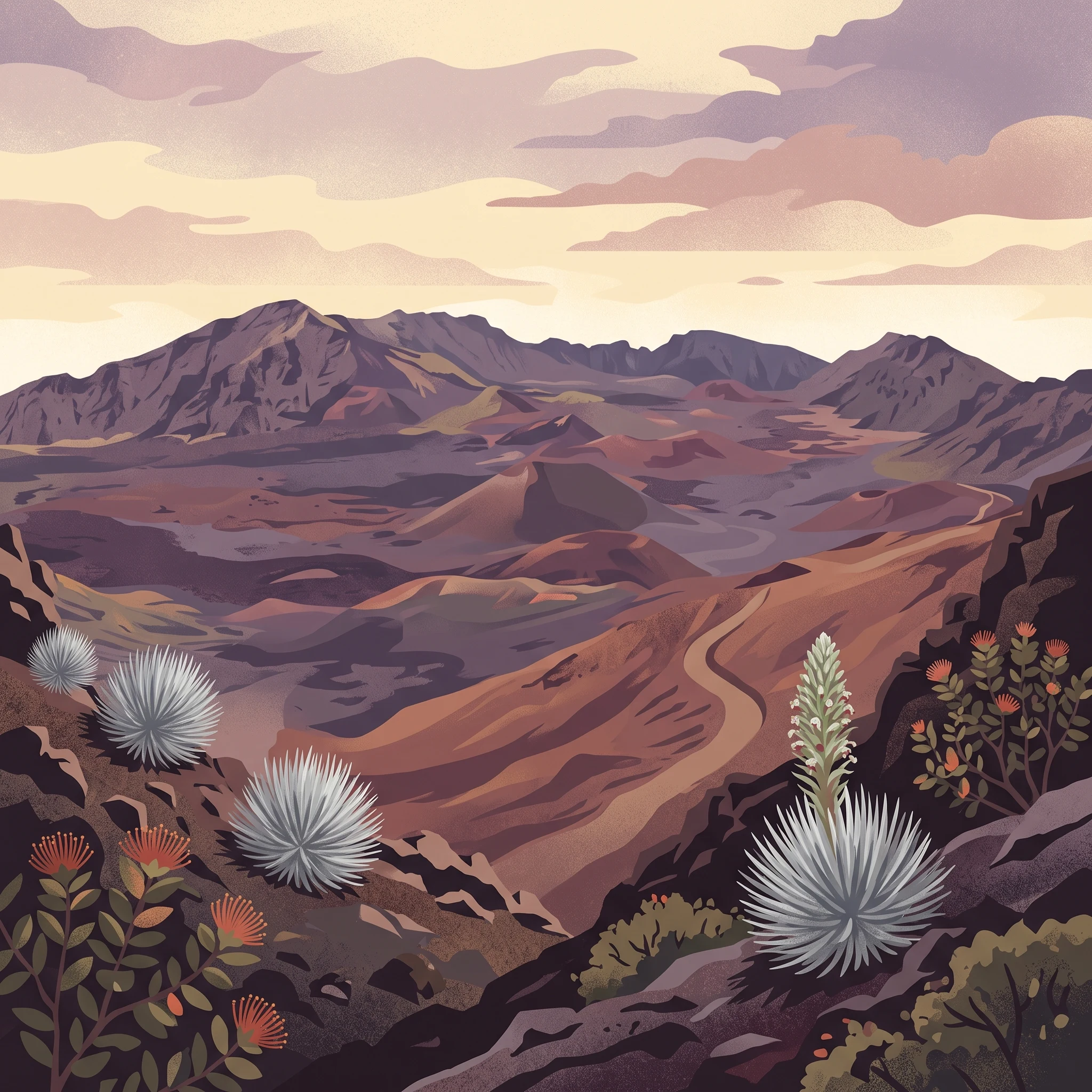
Haleakalā is best known for its dramatic volcanic crater landscape, which despite its name is technically an erosional valley formed by centuries of erosion. The park is famous for the endangered Haleakalā silversword, a silver-haired plant that grows nowhere else on Earth and once blanketed the mountain slopes in such quantities that the landscape appeared snow-covered. The summit is renowned as one of the best stargazing locations in the United States, lying above the tropical inversion layer with exceptionally clear skies. Visitors flock to witness sunrise and sunset from the volcanic rim, and the park's Hosmer's Grove contains an unusual collection of non-native conifer species from the Himalayas, Japan, Australia, and North America.

Haleakalā National Park history and protected-area timeline

The land that now comprises Haleakalā National Park was originally part of Hawaii National Park, established in 1916 alongside the volcanoes of Mauna Loa and Kilauea on the island of Hawai'i. In 1961, Hawaii Volcanoes National Park was separated into its own unit, and the Maui parklands were redesignated as Haleakalā National Park. The park was officially designated on July 1, 1961, with its boundaries significantly expanded in 2005 to protect additional wilderness areas. In 1980, the park was designated as an International Biosphere Reserve, recognizing its global significance for biodiversity conservation. The park has faced ongoing challenges from introduced feral species including deer, goats, and pigs that graze on native vegetation, and conservation efforts have focused on protecting endangered species including the reintroduction of the nēnē (Hawaiian goose) in 1946 with assistance from the Boy Scouts. The current superintendent is Natalie Gates, who has led the park since 2013.

Haleakalā National Park landscape and geographic character

The landscape of Haleakalā National Park is defined by its dramatic volcanic terrain, transitioning from tropical coastal environments through cloud forest and subalpine shrubland to alpine desert at the summit. The central feature is Haleakalā Crater, a massive erosional valley measuring nearly 7 miles across and 2,600 feet deep, dotted with numerous cinder cones and volcanic features. The interior of the crater presents an almost lunar landscape of exposed lava flows, ash deposits, and twisted volcanic rock. Above the crater rim, the summit area offers panoramic views of the surrounding Pacific Ocean and, on clear days, the neighboring islands of Lana'i, Moloka'i, and Hawai'i. The Kipahulu coastal section features lush rainforest, cascading waterfalls, and the series of pools known as 'Ohe'o that follow Palikea Stream to the ocean. The entire landscape sits within the trade wind belt, with moisture-laden clouds typically banking against the eastern slopes while the summit often protrudes above the cloud layer into brilliant sunshine.

Haleakalā National Park ecosystems, habitats, and plant life

Haleakalā National Park protects remarkable ecological diversity across its dramatic elevation gradient, from tropical rainforest to alpine environments. The park contains multiple distinct habitat zones including coastal wetlands, tropical rainforest, subalpine shrubland, and alpine lava fields. Over 850 species of plants grow within the park, including four endemic species of geraniums. The park is famous for the Haleakalā silversword (Argyroxiphium sandwicense subsp. macrocephalum), a remarkable plant that lives only on the volcano's slopes and can live for decades before producing a dramatic flowering stalk. Hosmer's Grove at the summit represents an unusual anthropogenic forest planted with species from around the world including deodar cedar from the Himalayas, Japanese cedar, Australian eucalyptus, and various North American conifers. The park's elevation and isolation create unique conditions that support extraordinary biodiversity, including a remarkable concentration of tardigrade species discovered by biologist Sam Gon III in the 1980s, who described Haleakalā as the richest place on Earth for these microscopic organisms.

Haleakalā National Park wildlife and species highlights

Haleakalā National Park is home to an extraordinary concentration of endangered species, more than any other national park in the United States. Three endemic Hawaiian honeycreepers are found only in the park's forests on East Maui: the Maui 'alauahio, the 'akohekohe, and the critically endangered kiwikiu (Maui parrotbill), with only approximately 200 individuals remaining. The park supports the largest remaining population of the Hawaiian goose, known as nēnē, which was reintroduced to the park in 1946 after being extirpated. The invertebrate fauna is exceptionally diverse, with many endemic snail species in the Partulina genus living in the rainforest understory, and the Haleakalā flightless moth found only in the alpine summit area. Yellow-faced bees (Nalo Meli Maoli) inhabit various habitats throughout the mountain. However, native forest birds face severe threats from mosquito-borne avian malaria, and conservation efforts including incompatible insect technique releases are underway to control mosquito populations.

Haleakalā National Park conservation status and protection priorities

Haleakalā National Park holds global significance as a biosphere reserve and protects species found nowhere else on Earth, making it critical for conservation of Hawaiian endemic biodiversity. The park's endangered species face multiple threats including habitat loss from development, predation by introduced mammals, disease carried by mosquitoes, and climate change impacts on fragile alpine ecosystems. The Haleakalā silversword has been particularly threatened by climate change, with hotter temperatures and reduced rainfall affecting population health, leading the National Park Service to install protective fences. The park participates in the Birds Not Mosquitoes program, which releases male mosquitoes carrying Wolbachia bacteria to suppress populations through incompatible mating. Invasive feral ungulates including deer, goats, and pigs continue to damage native vegetation and cause soil erosion, and ongoing management efforts focus on controlling these populations. As of 2018, the park faced deferred maintenance costs exceeding $24 million, with the Haleakalā Friends group conducting monthly volunteer service trips to assist with conservation work.

Haleakalā National Park cultural meaning and human context

The name Haleakalā carries deep cultural significance in Hawaiian tradition, meaning "house of the sun" and referencing a legendary encounter between the demigod Maui and the sun. According to the traditional story, Maui climbed the mountain and lassoed the sun to slow its journey across the sky, lengthening the day so that his mother's tapa cloth could dry. The mountain holds significance in Hawaiian cultural and spiritual traditions as a place where supernatural events were believed to occur. The park contains sites of traditional Hawaiian importance, and the landscape itself is integral to Hawaiian identity and history. The park's management acknowledges the cultural context of the landscape and works to incorporate indigenous perspectives in conservation and interpretation. The Hawaiian language names for features throughout the park preserve the linguistic heritage of the islands, with terms like 'Ohe'o for the pools and Kipahulu for the coastal valley.

Top sights and standout views in Haleakalā National Park

The summit of Haleakalā offers one of the most spectacular sunrise experiences in the world, with visitors often arriving before dawn to secure viewing spots at the crater rim. The two main trails descending into the crater, the Halemau'u and Sliding Sands trails, provide access to the volcanic interior and overnight stays in three backcountry cabins. The coastal Kipahulu section features the famous 'Ohe'o pools where visitors can swim in natural freshwater basins beneath waterfalls. The astronomy opportunities at the summit are exceptional, with the park lying above the tropical inversion layer and offering views of both celestial objects and Earth-orbiting satellites tracked by the Maui Space Surveillance System at the adjacent observatory. Hosmer's Grove provides a unique collection of introduced conifer species creating an unusual high-altitude forest environment. The endangered silversword, appearing as a silver-gray rosette of leaves on the volcanic slopes, represents one of the most iconic and sought-after sightings for visitors.
Park location guide

Geography guide, regional context, and park location map for Haleakalā National Park

Haleakalā National Park park geography, regions, and map view in United States of America
Understand where Haleakalā National Park sits in United States of America through a broader geographic reading of the surrounding landscape, nearby location context, and its mapped position within the national park landscape.

How Haleakalā National Park fits into United States of America

The United States of America is a federal presidential republic and one of the world's largest countries by area and population. It consists of 50 states across a vast territory spanning multiple time zones, with its capital in Washington, D.C. and largest city in New York City. The nation has a diverse economy, influential political system, and significant cultural and military presence globally.

Wider geography shaping Haleakalā National Park in United States of America

The United States occupies a vast territory in North America, bordered by Canada to the north and Mexico to the south. The 48 contiguous states stretch from the Atlantic to the Pacific Ocean, while Alaska occupies the northwestern region and Hawaii is an archipelago in the Pacific. The country encompasses diverse terrain including the Rocky Mountains, Appalachian Mountains, Great Plains, and extensive river systems.

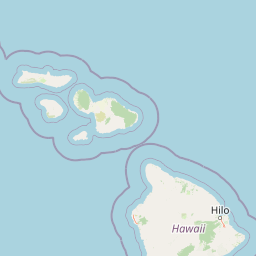
Map view of Haleakalā National Park

Use this park location map to pinpoint Haleakalā National Park in United States of America, understand its exact geographic position, and read its mapped placement within the surrounding landscape more clearly.

Pigeon | © OpenStreetMap contributors

Location context for Haleakalā National Park

HawaiiMaui County
Park atlas

Compare surrounding protected landscapes and map the regional spread of parks across the Hawaiian Islands.

Discover Other National Parks and Protected Areas Near Haleakalā National Park
Continue your park discovery beyond Haleakalā National Park by browsing other national parks and protected natural areas across the Hawaiian Islands, tracing their diverse terrains and conservation landscapes. Use this geographic overview to compare unique volcanic features, diverse ecosystems, and regional protected area spreads, gaining a deeper atlas perspective.
National parkUnited States of America

Hawaiʻi Volcanoes National Park: National Park Geographic Atlas and Protected Landscape

Mapped volcanic terrain and regional protected area context.

Delve into the geographic identity of Hawaiʻi Volcanoes National Park, a notable protected area within the United States of America. This park offers unique volcanic landscapes and provides an invaluable resource for understanding mapped terrain, regional geography, and the specific boundaries of conservation lands. Explore its distinct environmental features and discover its significance through a detailed atlas-oriented lens.

Area
1,434.45 km²
Established
1916
IUCN
II
Visitors
1.4M annual
National parkCalifornia

Redwood National and State Parks: Protected Landscape Geography and Mapped Boundaries

Explore California's protected area atlas.

Gain a structured understanding of Redwood National and State Parks as a protected national park within the geographic context of California. This dedicated page focuses on its mapped boundaries and protected landscape identity, offering critical atlas-level insights for regional geography exploration and conservation land context. Discover how this protected area fits into the larger mapped terrain.

Area
562.88 km²
Established
1968
IUCN
V
Visitors
458.4K annual
National parkCalifornia

Pinnacles National Park: California National Park Geographic Discovery and Map Context

Explore unique protected landscape and regional terrain.

Delve into the protected landscape of Pinnacles National Park, a significant natural area within California. This page offers an atlas-centered view of its unique geological formations and mapped terrain, providing essential context for understanding its geographic identity. Explore the park's specific landscape characteristics and its relation to the broader regional geography and protected areas.

Area
107.67 km²
Established
2013
IUCN
II
Visitors
275K annual
National parkCalifornia

Channel Islands National Park: A Protected Landscape within California's Geography

Explore its unique mapped terrain and protected area context.

Channel Islands National Park stands as a key protected area, providing critical insight into California's unique geographic features and natural landscapes. This entry focuses on the park's identity as a protected entity, detailing its mapped boundaries and the surrounding regional geography. It offers an atlas-level view, essential for understanding the park's contribution to the broader landscape context of the United States and its conservation importance.

Area
1,009.94 km²
Established
1980
IUCN
II
Visitors
323.2K annual
National parkCalifornia

Lassen Volcanic National Park: Protected Landscape Identity and Geographic Context

Discover the mapped boundaries and natural terrain of this California national park.

Gain a structured understanding of Lassen Volcanic National Park as a protected landscape. This detail page provides essential geographic context, focusing on the park's mapped boundaries and its specific terrain characteristics within California. It is designed for users seeking detailed information about the park's protected status and its placement within the broader atlas of natural areas, emphasizing its unique geographic identity and conservation significance.

Area
430.8 km²
Established
1916
IUCN
II
Visitors
504.8K annual
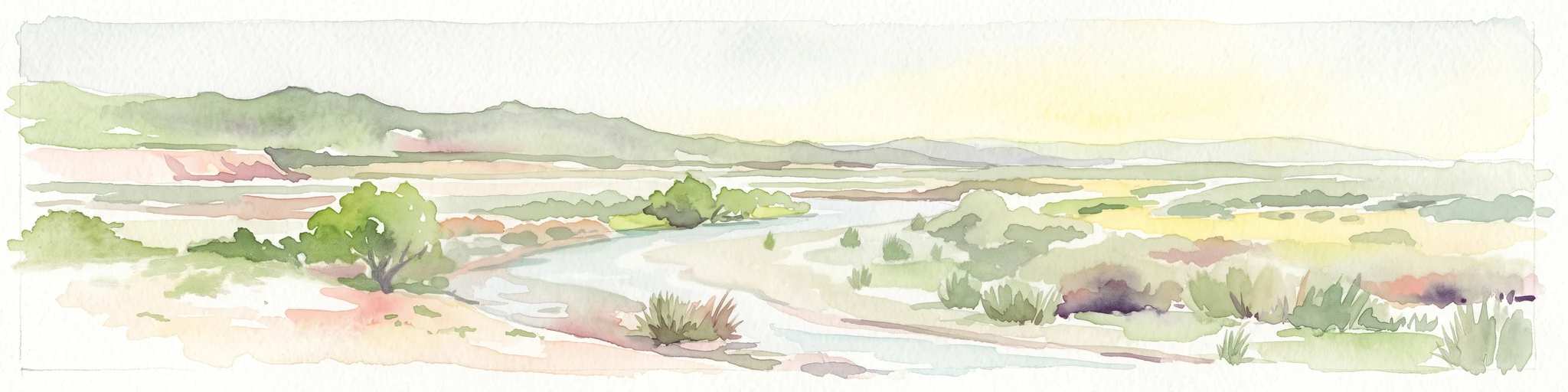
Watercolor painting showing mountains, a winding river, and green forests in the foreground and background
National parkCalifornia

Yosemite National Park: Protected Landscape Identity and Geographic Atlas Context

Mapped boundaries and regional setting for a key California national park.

Delve into the protected landscape identity of Yosemite National Park, examining its specific geographic features and its place within the broader atlas of California's natural areas. This entry provides detailed context on its mapped boundaries, regional positioning, and significance as a protected natural site, essential for understanding its landscape and conservation geography.

Area
3,070 km²
Established
1890
IUCN
II
Visitors
3.9M annual
National parkOregon

Crater Lake National Park: Oregon National Park Atlas of Volcanic Landscapes

Explore mapped boundaries and unique caldera geography.

Crater Lake National Park represents a significant protected area within Oregon, defined by the dramatic volcanic caldera it contains. This national park is celebrated for its exceptionally deep, clear blue lake, formed by the collapse of Mount Mazama, offering a unique subject for geographic and landscape study. Users can explore its mapped boundaries and understand its position within the broader atlas of protected lands and mountainous terrain of the Cascade Range.

Area
741.48 km²
Established
1902
IUCN
II
Visitors
527K annual
National parkCalifornia

Sequoia National Park National Park: Geographic Identity and Protected Landscape Atlas

Explore mapped boundaries and the terrain of this California protected area.

Gain a structured understanding of Sequoia National Park as a protected landscape, focusing on its mapped geographic boundaries and its context within California. This entry provides foundational data for exploring the park's natural terrain and its role in a broader atlas of conservation lands, ideal for users seeking detailed geographic information.

Area
1,635.19 km²
Established
1890
IUCN
II
Visitors
1.2M annual

Common questions about visiting, size, designation, and location context for Haleakalā National Park

Haleakalā National Park FAQs for park facts, access, geography, and protected area context
Find quick answers about Haleakalā National Park, including protected-area facts, park geography, trail and visitor context, and how the park fits into its surrounding country and regional landscape.
MoriAtlas Explorer

Continue Your Protected Areas Search Across the Global Atlas

Deepen your exploration by continuing the structured search for national parks and protected areas worldwide. Utilize the comprehensive filtering capabilities to compare different conservation landscapes and refine your understanding of global park geography. Discover more about the distribution and characteristics of protected natural areas.

Global natural geography