Why Kārewa / Gannet Island stands out
Kārewa / Gannet Island is best known for hosting one of New Zealand's largest single breeding colonies of Australasian gannets, with around 8000 breeding pairs recorded in the 1980 census and the island subsequently recognized as an Important Bird Area by BirdLife International. The colony's size, combined with the island's compact and exposed setting, gives it an outsized importance for the regional population of this species. Equally distinctive is the island's geology. It is the eroded remnant of a tuff ring roughly half a million years old, noticeably younger than and chemically distinct from the surrounding onshore Alexandra and Okete volcanics, giving the island a special place in the wider volcanic history of the western North Island.
Kārewa / Gannet Island history and protected-area timeline
Kārewa's history spans two distinct narratives: its deep geological past and its more recent ecological recognition. The underlying geology of the island dates back roughly half a million years, when a tuff ring eruption formed the foundation of what would become the present-day island. This eruption was an independent volcanic event, distinct from the older Alexandra and Okete volcanic episodes that shaped much of the surrounding mainland.
In modern times, the island's significance shifted from a curiosity of offshore geology to a focus of conservation attention. A 1980 census revealed that it held New Zealand's largest single breeding colony of Australasian gannets, with approximately 8000 breeding pairs. The colony's scale led to formal protection through wildlife sanctuary status, and BirdLife International subsequently recognised the island as an Important Bird Area. These steps cemented the island's place in New Zealand's protected natural heritage, even as it remains uninhabited by people.
Kārewa / Gannet Island landscape and geographic character
Kārewa / Gannet Island is a tiny, low-lying landform in the open sea, rising only 15 metres above sea level from a submarine base about 65 metres deep. Its modest height, combined with its exposure to heavy ocean swells, means the island is regularly washed over by waves. As a result, only around three square metres of the island retains any visible vegetation, and even that is restricted to communities of Prasiola algae, Tortula moss, Xanthoria lichens, and Xanthoparmelia lichens capable of surviving the salt-laden conditions.
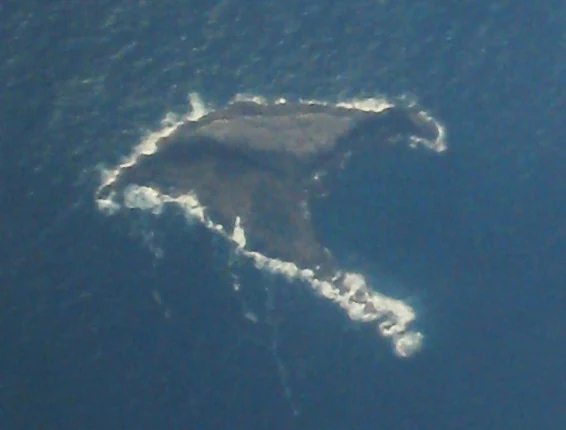
The island's profile is the eroded remnant of an ancient tuff ring, whose softer outer materials have been worn away over time to leave a compact rocky core. It lies on the eastern edge of the North Taranaki Graben, a structural feature of the wider North Island geology that continues to influence the shape and stability of the surrounding seafloor. The contrast between the low island and the surrounding deep water gives the site a distinctive visual character from the air, as captured in the classic aerial view of the gannet-strewn rock.
Kārewa / Gannet Island ecosystems, habitats, and plant life
The natural character of Kārewa is defined less by lush vegetation than by the extreme conditions that shape life on the island. Persistent swell and salt spray leave only the hardiest organisms able to establish themselves on the small patch of stable ground where vegetation persists. Even there, the cover is made up primarily of algae such as Prasiola, mosses of the genus Tortula, and two genera of lichens, Xanthoria and Xanthoparmelia.
These species represent an ecological community adapted to constant exposure, sparse substrate, and nutrient inputs from seabird droppings. While the island's flora is minimal, the surrounding marine environment supports an exceptionally rich feeding zone for seabirds, sustaining large breeding populations over a very small area of land.
Kārewa / Gannet Island wildlife and species highlights
The wildlife significance of Kārewa / Gannet Island is overwhelmingly shaped by its gannet colony. The 1980 census identified the island as the location of New Zealand's largest single breeding colony of Australasian gannets, with roughly 8000 breeding pairs. This makes the island a cornerstone of the country's Australasian gannet population, particularly given how gannets concentrate their breeding on a relatively small number of offshore sites.
The dense concentration of breeding birds also contributes to conditions on the island itself, enriching the limited terrestrial habitat with nutrients. The colony's size and persistence were central to BirdLife International's decision to recognise the island as an Important Bird Area, placing it in the international framework used to identify the most critical sites for bird conservation. Beyond gannets, the island's remote and largely predator-free character provides additional refuge value for seabirds in the region.
Kārewa / Gannet Island conservation status and protection priorities
Kārewa / Gannet Island's conservation importance rests on the protection of one of New Zealand's most significant seabird colonies and on the preservation of its distinctive volcanic and ecological character. The island is formally protected as a wildlife sanctuary, a designation reflecting both the colony's size and the island's value as a refuge free from terrestrial predators.
Recognition by BirdLife International as an Important Bird Area further underscores the site's international conservation standing. This classification highlights the colony's contribution to the regional population of Australasian gannets and acknowledges the broader land-and-sea ecosystem that supports them. The combination of sanctuary status and international recognition places Kārewa firmly within New Zealand's protected natural heritage network, even though the island is uninhabited and physically small.
Top sights and standout views in Kārewa / Gannet Island
Kārewa / Gannet Island's most distinctive quality is the sheer scale of its Australasian gannet breeding colony, recognised in a 1980 census as the largest single colony of the species in New Zealand, with about 8000 breeding pairs. The colony's size is extraordinary relative to the island's footprint, and it has earned the site formal recognition as an Important Bird Area by BirdLife International.
Equally notable is the island's geological identity. As a half-million-year-old tuff ring remnant, distinctly younger than and compositionally different from the older Alexandra and Okete volcanic formations on the adjacent mainland, it provides a rare and well-defined piece of New Zealand's offshore volcanic record. Its combination of conservation significance, restricted-access setting, and geological distinctiveness gives Kārewa a uniquely concentrated natural value in the country's protected-area network.