Why Mierzeja Sarbska Nature Reserve stands out
Mierzeja Sarbska is best known for its combination of active parabolic dune systems and exceptionally intact interdunal vegetation communities, which are considered unusual for the Polish Baltic coast. The reserve's crowberry pine forests and relict wetland plant stands occupy the hollows between the dunes, creating a habitat mosaic that is rare in this part of the southern Baltic. The protected vascular flora, including species such as royal fern, bog violet, long-leaved sundew, marsh sedge, and European waxflower, gives the reserve additional botanical significance. The setting on a narrow sandy barrier between Lake Sarbsko and the sea further reinforces its identity as a classic Polish coastal mierzeja reserve.
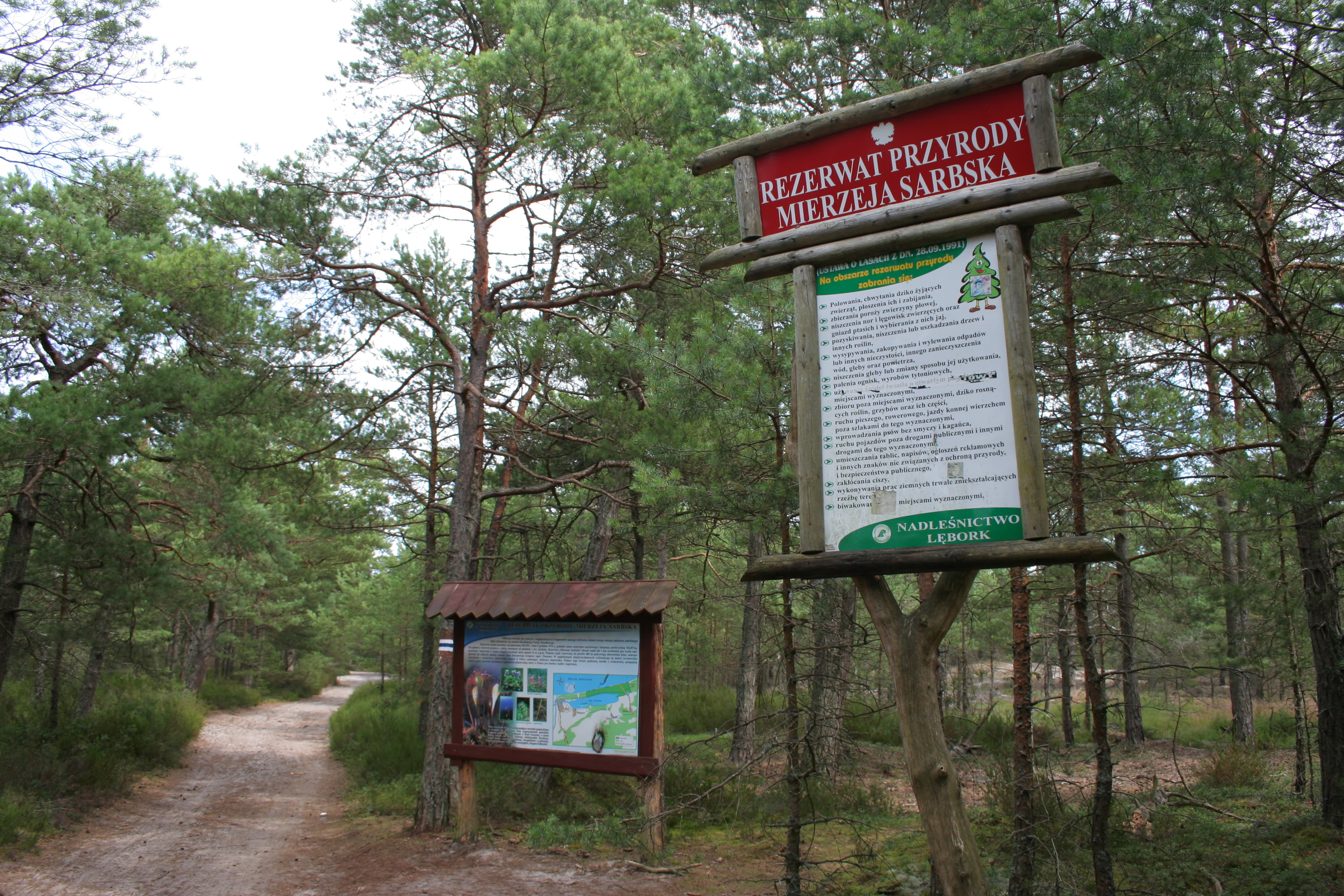
Mierzeja Sarbska Nature Reserve history and protected-area timeline
The Mierzeja Sarbska Nature Reserve was formally established in 1976, when Polish authorities designated the area as a landscape-level nature reserve (rezerwat krajobrazowy). Its legal foundation is recorded in the official Polish gazette Monitor Polski (1976, No. 42, item 206), which set the framework for protection of the dune and forest mosaic on the barrier between Lake Sarbsko and the Baltic.
The reserve's creation reflected the broader 1970s emphasis in Poland on protecting representative coastal landscapes, particularly dune systems and their associated forest stands, before such habitats faced stronger pressure from tourism and infrastructure development along the Baltic shore. By placing the mobile parabolic dunes and their interdunal plant communities under formal protection, the state aimed to secure both the geomorphological dynamics of the barrier and the unusually rich botanical assemblages documented there.
Since its designation, the reserve has remained a recognized component of the regional network of protected areas in the Pomorskie Voivodeship, situated near the well-known coastal town of Łeba and not far from the larger Słowiński National Park, reinforcing its role within the broader Baltic coastal conservation landscape.
Mierzeja Sarbska Nature Reserve landscape and geographic character
The defining landscape of Mierzeja Sarbska is a narrow, sandy coastal barrier shaped by wind and sea. The reserve's terrain is dominated by parabolic dunes, including formations that rise to about 24 meters above sea level and remain sufficiently active to qualify as 'ruchy' (mobile) dunes. Between these dunes sit deflation hollows where finer material has been removed by wind, leaving behind wetter, more sheltered basins that sustain distinctive vegetation.
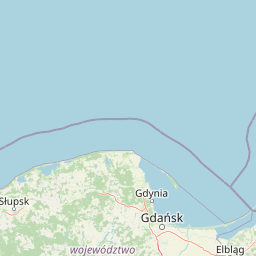
To the north, the Baltic Sea frames the barrier; to the south lies Lake Sarbsko, a large coastal lagoon that parallels the dune belt. The southern edge of the reserve is also traced by the lower Chełst River as it flows toward its mouth. The result is a landscape strongly bounded by water on both sides, with the dunes, their intervening wetlands, and the bordering forests all compressed into a relatively narrow coastal strip.
Beyond the open dunes, the landscape becomes more forested, with crowberry pine stands on the drier ridges and birch woodland, bog pine communities, and alder carrs occupying the wetter depressions. Together, these elements form a compact, layered coastal scene typical of the southern Baltic mierzeja systems, while the proximity to Łeba and Osetnik ties the reserve firmly into the lived-in coastal geography of the region.
Mierzeja Sarbska Nature Reserve ecosystems, habitats, and plant life
Ecologically, Mierzeja Sarbska is defined by the interplay between active dune processes, coniferous and birch-dominated forest stands, and relict wetland patches. On the drier, shifting sands, the reserve protects crowberry pine forest (bór bażynowy), a distinctive vegetation type tied closely to the nutrient-poor, acidic dune substrates of the southern Baltic coast.
In the more sheltered interdunal depressions, the reserve harbors plant communities that are unusual for the Polish coast. These deflation hollows support bog and mire vegetation with relict character, including birch woodland, bog pine communities, and alder carr (ols) clusters. The combination of such wetland patches within an otherwise dry, sandy dune belt is ecologically unusual along the Baltic and is one of the main reasons the site was given protected status.
Surveys have documented approximately 340 vascular plant species within the reserve, a high figure for such a limited area and one that reflects the strong habitat contrasts across the dune and forest mosaic. These include protected and regionally rare taxa such as royal fern (długosz królewski), bog violet (fiołek torfowy), long-leaved sundew (rosiczka długolistna), intermediate sundew (rosiczka pośrednia), marsh sedge (turzyca bagienna), bog grooveburreed (wątlik błotny, long unrecorded), turf-like cottongrass (wełnianeczka darniowa), and European waxflower (woskownica europejska).
Mierzeja Sarbska Nature Reserve wildlife and species highlights
The wildlife profile of Mierzeja Sarbska is tightly linked to its dune, pine forest, and bog habitat mosaic, characteristic of Poland's Baltic coastal barriers. The reserve's vegetation layers, from open mobile sand to dense pine and birch stands and wetter alder carrs, support a range of invertebrates, amphibians, and breeding birds typical of this kind of mosaic.
The presence of sundews, sedges, and other bog plants indicates a thriving community of moisture-loving insects, while the surrounding pine forests and dune hollows provide nesting and shelter for typical Baltic woodland and dune-breeding bird species. Reptiles and amphibians associated with damp dune slacks and boggy pools are also part of the expected fauna, although detailed species inventories are not central to the public record of the reserve.
Beyond species lists, the wildlife significance of Mierzeja Sarbska lies in its role as a protected refuge within a larger coastal landscape near Łeba and the Słowiński National Park area, helping maintain ecological continuity along a stretch of Polish Baltic shoreline that is otherwise heavily used for tourism and settlement.
Mierzeja Sarbska Nature Reserve conservation status and protection priorities
From a conservation perspective, Mierzeja Sarbska is significant because it protects an integrated dune-forest-wetland system rather than an isolated habitat type. Active parabolic dunes, crowberry pine communities, birch woodland, and alder carrs all occur within the same protected block, which is rare on the Polish coast and gives the reserve strong ecological coherence.
The interdunal deflation hollows are particularly important: they host plant communities described in the scientific literature as unique to the Polish seashore, including relict bog and mire species with protected status. Safeguarding these species in situ is a key conservation goal, since such communities are highly sensitive to changes in groundwater, dune movement, and human pressure.
The reserve's formal status as a landscape nature reserve under the 1976 Monitor Polski designation places it within Poland's national system of protected areas. Combined with its location within the Pomorskie Voivodeship and adjacent to other major coastal protected landscapes, including the well-known dunes near Łeba, Mierzeja Sarbska is a meaningful component of regional conservation planning for the southern Baltic coast.
Mierzeja Sarbska Nature Reserve cultural meaning and human context
The protected area sits within the broader cultural-geographical framework of the Pomeranian Baltic coast, near the town of Łeba and the small locality of Osetnik. These settlements form part of the wider landscape of the former Słowińskie and Kashubian coastal communities, whose traditional relationships with the dunes, fishing, and coastal lagoons shaped the human geography of the area long before modern tourism arrived.
The reserve itself is named after the regional mierzeja (sand barrier) and Lake Sarbsko, both of which carry local toponyms rooted in the coastal communities of this part of northern Poland. While the reserve is managed primarily for natural values, its position next to historically important coastal settlements gives it a clear place within the regional identity of the Pomorskie coast.
Top sights and standout views in Mierzeja Sarbska Nature Reserve
The reserve's most notable features are its active parabolic dunes and the unusual interdunal plant communities that have developed in the deflation hollows between them. Crowberry pine forest on the dune ridges and bog woodland with relict plant species in the depressions create a compact, easily readable ecological story that is relatively rare along the Polish Baltic coast.
Additional highlights include the documented presence of around 340 vascular plant species, the protected relict species such as royal fern, sundews, and European waxflower, and the reserve's position on the barrier between Lake Sarbsko and the Baltic Sea, near the coastal town of Łeba and along the lower Chełst River corridor.
Best time to visit Mierzeja Sarbska Nature Reserve
The most rewarding time to visit Mierzeja Sarbska depends on what a visitor hopes to experience along the Baltic coast. Late spring and early summer are broadly favorable for observing the dune flora and the characteristic interdunal wetland vegetation, when protected plants such as royal fern, sundews, and bog violet are most visible and the dune pines and birch stands are in full leaf.
Autumn brings softer light across the dune belt and quieter conditions along the barrier, useful for appreciating the broader landscape between Lake Sarbsko and the Baltic. Winter, though harsher, can reveal the structure of the dunes and the openness of the coastal pine forest more clearly, while the surrounding foregrounds of Lake Sarbsko and the sea create strong scenic contrast throughout the year.