Mori Atlas logo
Nature reserveRezerwat przyrody Mszana i Obłoga

A preserved woodland reserve in the Pogórze Kaczawskie foothills of southwestern Poland.

Rezerwat przyrody Mszana i Obłoga: Mapping the Volcanic Basalt Landscapes and Forest Habitats

Rezerwat przyrody Mszana i Obłoga protects vital forest communities and rare volcanic geology across the summit slopes of the Mszana and Obłoga hills. This nature reserve, nestled within the broader Chełmy Landscape Park in Lower Silesia, serves as a crucial area for maple-lime and oak-hornbeam forest conservation. Its geography is defined by irregular basalt rock outcrops and dense deciduous woodland, forming a distinct protected landscape within the eastern Pogórze Kaczawskie region.

forest reservenatural forestdeciduous woodlandmaple-lime forestoak-hornbeam forestbasalt outcrops

Rezerwat przyrody Mszana i Obłoga

Nature reserve

Park overview

Structured park overview, official facts, and landscape profile for Mszana i Obłoga Nature Reserve

Mszana i Obłoga Nature Reserve park facts, protected area profile, and essential visitor context

Review the core facts for Mszana i Obłoga Nature Reserve, including designation, size, terrain, visitor scale, habitats, and operating context in one park-focused overview.

About Mszana i Obłoga Nature Reserve

Mszana i Obłoga Nature Reserve occupies the upper parts of two neighboring hills on the eastern rim of the Pogórze Kaczawskie, a low mountain foreland in the Sudetes region of southwestern Poland. The reserve lies within Jawor Forest District and overlaps the protected boundaries of the Chełmy Landscape Park, reinforcing the layered protection that surrounds these hill forests. Although small, roughly 100 hectares, it captures a combination of features that is rare in the region: surviving natural forest communities on steep basalt-influenced slopes.

The broader landscape belongs to a volcanic foreland where small hills rise above agricultural valleys. Mszana and Obłoga are part of this pattern, and their summit areas expose dark basalt rocks that contrast sharply with the surrounding fields and mixed forests. The reserve was created in part to keep these outcrops and their associated rockslides from being damaged, while also preserving the forests that cloaked the slopes above them. Because of this, the reserve is best understood as a place where geological history, in the form of long-cooled volcanic terrain, and current forest biodiversity meet on the same hilltops.

The forests are the heart of the reserve. Steep sections of Mszana are clothed in Aceri-Tilietum, a maple-lime forest type with an unusually rich herb layer in which several rare and protected species are protected. Gentler summit sections support Galio-Carpinetum, the Central European oak-hornbeam groves, which in early spring are notable for geophytes such as hollow-root, wood anemone, yellow anemone, common toothwort and ramsons. Together these communities give the reserve a layered ecological structure that goes beyond typical commercial forest in the region.

Botanical surveys have documented around 188 species, subspecies and varieties of vascular plants in the reserve, a high figure relative to its size. Several protected species are part of this count, including sword-leaved helleborine, martagon lily, common columbine, wild garlic, snowdrop and mezereon. Because the forest communities remain largely natural, with little plantation forestry in the core area, the mosaic of these species across slopes and summits has been allowed to persist.

For visitors, the reserve is integrated into the wider trail network of the Kaczawskie foothills. The green long-distance trail Szlak Doliną Nysy Małej passes through the reserve, linking it with nearby attractions such as the Siedmica hill, the Siedmicki Gorge, Świniec Forest and the settlement of Muchów. On the summit of Mszana stands a stone tower, a curiosity on the landscape, although it does not function as a true viewpoint because the surrounding trees rise higher than its viewing platform. Even so, the combination of woodland trails, basalt scenery and a quiet, lightly visited atmosphere gives the reserve a compact but distinctive presence in the Chełmy Landscape Park.

Quick facts and research context for Mszana i Obłoga Nature Reserve

Mszana i Obłoga Nature Reserve is a forest reserve (rezerwat leśny) in Lower Silesian Voivodeship, in Jawor County, Poland. It lies on the eastern edge of the Pogórze Kaczawskie mesoregion and is administered through Jawor Forest District.

The reserve covers about 99.92 hectares and includes the summit areas of the Mszana and Obłoga hills. It was established on 11 May 2015 by order of the Regional Director for Environmental Protection in Wrocław. The reserve also lies within the larger Chełmy Landscape Park.

Protection and recognition

Documented terrestrial conservation framework and administrative parameters

Rezerwat przyrody Mszana i Obłoga Protection Status and Recognition

Rezerwat przyrody Mszana i Obłoga maintains a documented terrestrial protection status with established administrative parameters. Official recognition records outline the conservation framework governing this protected area within the regional landscape.

Protection details

Protection scope
Terrestrial
Transboundary protection
No
Park context

Deeper park guide and search-rich context for Mszana i Obłoga Nature Reserve

Mszana i Obłoga Nature Reserve history, landscape, wildlife, and travel context

Explore Mszana i Obłoga Nature Reserve through its history, landscape character, ecosystems, wildlife, conservation priorities, cultural context, and seasonal travel timing in a structured park guide built for atlas discovery and search intent.

Why Mszana i Obłoga Nature Reserve stands out

The reserve is best known for two interrelated features. The first is its natural forest communities, particularly the maple-lime forest Aceri-Tilietum that drapes the steep slopes of Mszana and the Central European oak-hornbeam grove Galio-Carpinetum on the upper slopes, both hosting rare and protected understory plants. The second is the volcanic geological heritage, expressed in the basalt outcrops and basalt block fields on the hilltops. These contrasting elements, an unusually intact forest flora growing directly above relict basalt formations, give the reserve its distinctive ecological and scenic identity.
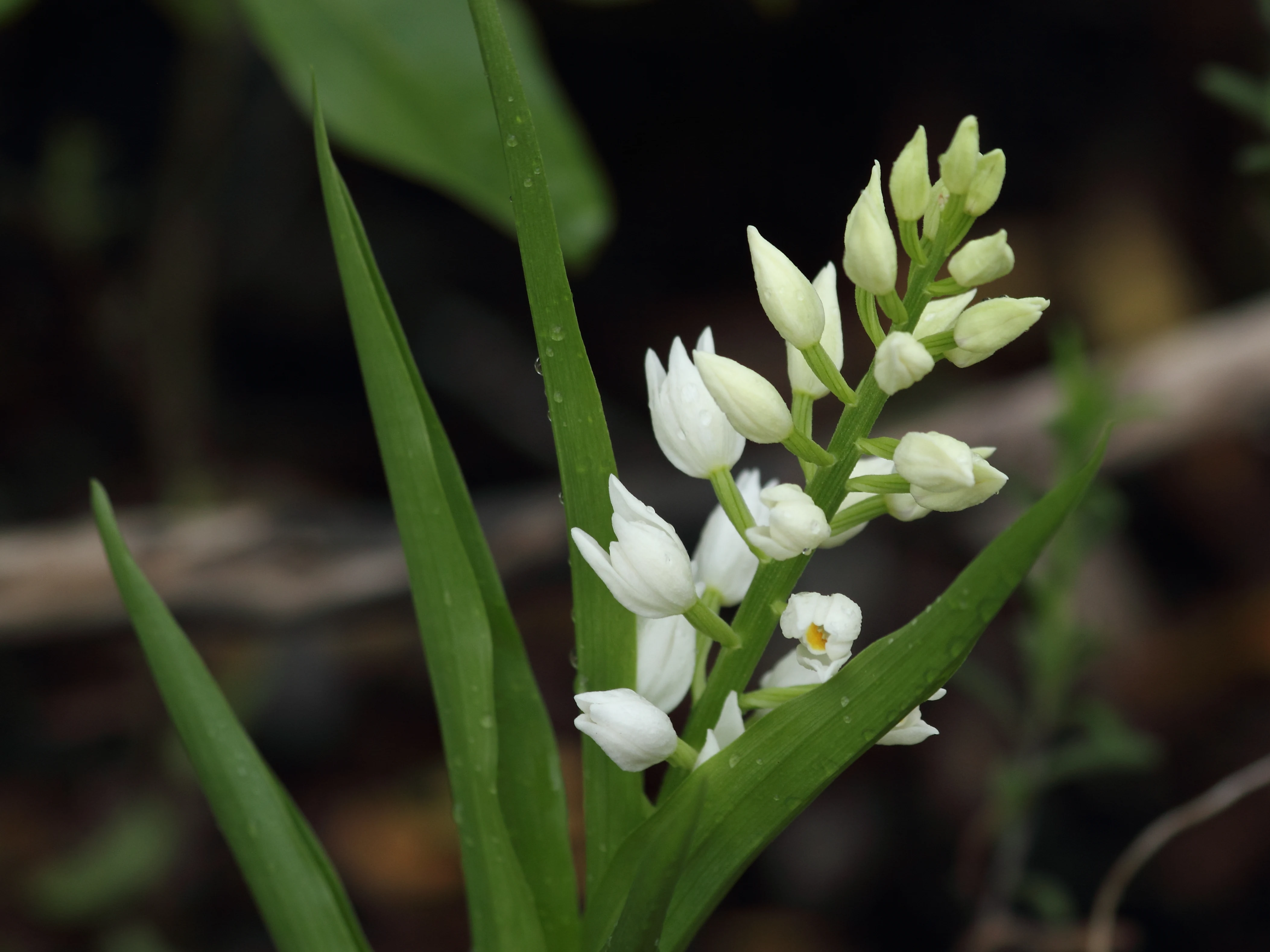
Close-up of a white-flowered orchid, the narrow-leaved helleborine, showing its distinctive upright spike of blossoms and long, slender green leaves against a blurred natural background.
A narrow-leaved helleborine (Cephalanthera longifolia) bloom, a notable orchid species found within the reserve.

Mszana i Obłoga Nature Reserve history and protected-area timeline

The reserve was established on 11 May 2015 by an order of the Regional Director for Environmental Protection in Wrocław, formally creating the forest nature reserve Mszana i Obłoga.

Its establishment recognized that the summit forests of Mszana and Obłoga had retained a largely natural character, with rare forest communities and unusually rich understory flora, while also sitting on top of geologically significant basalt outcrops. By carving out a roughly 100-hectare reserve within the existing Jawor Forest District, and within the already protected Chełmy Landscape Park, regional authorities added a stronger layer of protection to a small but ecologically rich corner of the Pogórze Kaczawskie.

The detailed inventory of around 188 vascular plant species, subspecies and varieties, including protected species such as sword-leaved helleborine, martagon lily, common columbine, wild garlic, snowdrop and mezereon, forms part of the baseline documentation used to justify and define the reserve.

Mszana i Obłoga Nature Reserve landscape and geographic character

The reserve's landscape is shaped by the Pogórze Kaczawskie, a low, rolling foreland that rises between deeper Sudeten valleys. Within this pattern, Mszana and Obłoga are typical local hills, with summit elevations that are modest but create noticeable relief above the surrounding farmland.

The defining geological feature is basalt. Long-extinct volcanic activity left hard basalt among softer surrounding rocks, and erosion has since exposed the basalt as rugged outcrops and rubble fields along the upper parts of both hills. These dark, irregular rock surfaces, sometimes forming coarse basalt block fields near the summits, contrast with the green forest cover of the slopes and occasionally break through the canopy as open rock.

The slopes themselves are often steep, especially on Mszana, where the Aceri-Tilietum forest clings to the incline. Flatter upper sections host the oak-hornbeam groves. Together, the exposure of volcanic rock along the skyline and the dense, sometimes near-natural forest on the slopes give the reserve a layered, hilly scenery typical of the eastern Kaczawskie foothills.
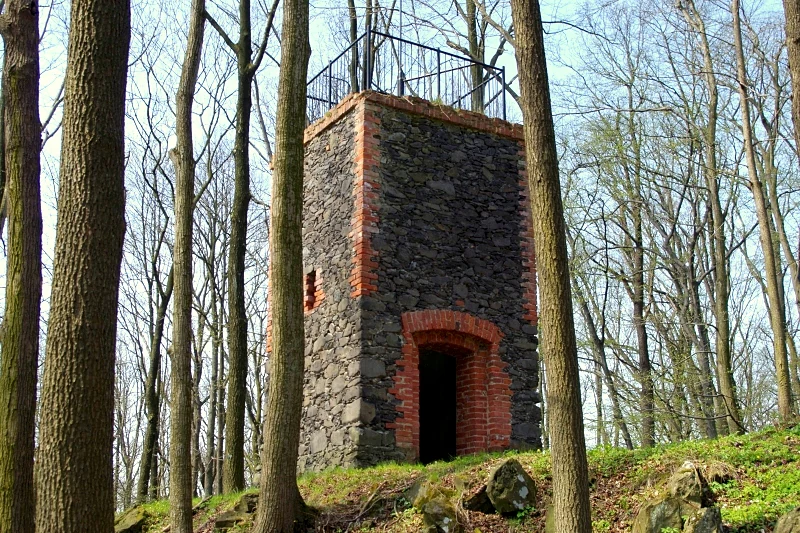
A square stone observation tower with brick detailing stands in a deciduous forest, surrounded by tall tree trunks.
The stone observation tower located on Mszana mountain within Rezerwat przyrody Mszana i Obłoga.

Mszana i Obłoga Nature Reserve ecosystems, habitats, and plant life

Ecologically, the reserve is dominated by forest. Its most distinctive plant communities are two natural forest types that, in this region, have largely been replaced by planted commercial stands. Steep slopes, especially on Mszana, are covered by Aceri-Tilietum, a maple-lime forest in which sycamore maple and small-leaved lime form the canopy and the ground beneath is rich in herbs, including rare and protected species. Summit and upper-slope areas instead support Galio-Carpinetum, the classic Central European oak-hornbeam woodland, with a strong showing of spring geophytes in the understory.

The combination of canopy type, slope aspect and basalt-derived soils produces a noticeable small-scale mosaic. Different microhabitats support different combinations of protected and rare plants: spring ephemerals on the upper plateau woodland, woodland orchids and lilies in the herb layer, and specialized rock flora around the basalt outcrops. The presence of around 188 recorded vascular plant taxa within this small reserve reflects the resulting habitat diversity.

Because the forests have been kept largely free of intensive plantation forestry, dead wood, natural regeneration and a varied age structure are present across much of the area. These features, together with the protected outcrops, support a wide range of insects and fungi typical of old-growth deciduous forests in the Sudeten foreland.

Mszana i Obłoga Nature Reserve wildlife and species highlights

The reserve's primary wildlife significance lies in its forest-floor and woodland-edge fauna rather than in large mammals. The combination of natural deciduous forest with rock outcrops and block fields supports a community typical of old deciduous woodland in the Sudeten foreland.

Spring geophyte-rich oak-hornbeam groves sustain pollinators and other insects adapted to early-season mass flowering, while the maple-lime forests on the steeper slopes provide shaded, humid conditions for soil fauna and woodland invertebrates. Fallen and decaying wood, which remains in parts of the reserve, supports saproxylic insects and associated fungi.

Larger forest fauna typical of the Pogórze Kaczawskie, such as roe deer, red deer, wild boar and common forest predators, can be expected across the wider landscape, with the reserve forming part of their continuous woodland habitat. The reserve's small core area and quiet, lightly visited character also provide favorable conditions for forest birdlife associated with mature deciduous stands.

Mszana i Obłoga Nature Reserve conservation status and protection priorities

The reserve was created to combine the protection of valuable forest communities with the protection of notable geological features, an unusual dual focus in Polish nature reserves. By designating the upper parts of Mszana and Obłoga, the order of the Regional Director for Environmental Protection in Wrocław aimed to lock in the existing mosaic of natural forest types and to keep the exposed basalt outcrops and rubble fields from being disturbed.

The forest communities being protected, Aceri-Tilietum and Galio-Carpinetum, are increasingly rare in Lower Silesia because of historical conversion to spruce plantations. The reserve therefore safeguards both a particular set of tree species and a much richer herb layer, including protected vascular plants and woodland orchids, than is typical of surrounding forests. The basalt outcrops, in turn, preserve a tangible record of the volcanic history that shaped much of the Pogórze Kaczawskie.

The reserve also benefits from being nested within the Chełmy Landscape Park, so that its core forest receives the strictest protection while the surrounding hills continue to be managed under the broader landscape-park framework. This combination of local and regional protection helps maintain the ecological and geological character of the area in the long term.

Top sights and standout views in Mszana i Obłoga Nature Reserve

The reserve is small but tightly defined, with a clear ecological and geological theme. Its summit forests of maple-lime and oak-hornbeam remain close to their natural state and support a spring display of geophytes, woodland orchids, martagon lily and wild garlic. The basalt outcrops and block fields along the tops of Mszana and Obłoga, together with the stone tower on Mszana's summit, give the area a distinctive local character beyond pure forest cover.

The reserve's position inside the Chełmy Landscape Park and along the green Szlak Doliną Nysy Małej trail links it with nearby attractions such as the Siedmica hill, the Siedmicki Gorge, Świniec Forest and Muchów, making it a compact but well-connected stop on any exploration of the eastern Pogórze Kaczawskie.

Best time to visit Mszana i Obłoga Nature Reserve

Late spring is the most rewarding season in the reserve. As the oak-hornbeam groves on the upper slopes leaf out, the understory fills with geophytes such as hollow-root, wood anemone, yellow anemone and common toothwort, while wild garlic forms broad carpets in damper sections. Woodland orchids and the martagon lily also come into flower in this period, and the basalt outcrops are easiest to reach along dry, bright days.

Summer brings deep shade under the maple-lime canopy on the steeper slopes, cooler conditions for walking and a quieter atmosphere, although the dense foliage reduces the sense of openness around the upper rock faces. Autumn emphasizes the contrast between the deciduous forest colors and the dark basalt, while winter exposes the structure of the forests and the line of the basalt outcrops most clearly, though trails can be wet or icy.

Monthly climate preview

Long term temperature and precipitation patterns recorded at representative park coordinates

Rezerwat przyrody Mszana i Obłoga Climate Normals and Annual Weather by Month

Historical climate data for Rezerwat przyrody Mszana i Obłoga reveals a measured annual temperature range from deep winter subzero minimums to warm summer maximums alongside distinct monthly precipitation rates. Exploring the full twelve month profile provides detailed context on long term meteorological normals across the protected area.
Annual mean8 °C
-2 °C19 °C
Jan-2°
Feb-1°
Mar
Apr
May13°
Jun17°
Jul19°
Aug19°
Sep14°
Oct
Nov
Dec-1°
Warmest month
July

19.2 °C

Coolest month
January

-2.5 °C

Wettest month
July

3.1 mm/day

Driest month
April

1.3 mm/day

Park location guide

Geography guide, regional context, and park location map for Mszana i Obłoga Nature Reserve

Mszana i Obłoga Nature Reserve park geography, regions, and map view in Poland

Understand where Mszana i Obłoga Nature Reserve sits in Poland through a broader geographic reading of the surrounding landscape, nearby location context, and its mapped position within the national park landscape.

How Mszana i Obłoga Nature Reserve fits into Poland

Poland, officially the Republic of Poland, is a Central European country spanning from the Baltic Sea in the north to the Carpathian Mountains in the south. It borders Germany, Czech Republic, Slovakia, Ukraine, Belarus, Lithuania, and Kaliningrad Oblast. The country has a temperate climate, diverse landscapes, and is known for its rich history, cultural heritage, and strong economic position within the EU.

Wider geography shaping Mszana i Obłoga Nature Reserve in Poland

Poland occupies 312,696 km2 in Central Europe, extending from the Baltic Sea coast in the north to the Sudetes and Carpathian Mountains in the south. It borders Germany to the west, Czech Republic and Slovakia to the south, Ukraine and Belarus to the east, and Lithuania and Kaliningrad Oblast to the northeast. The landscape includes lowland plains, uplands, and mountain ranges.

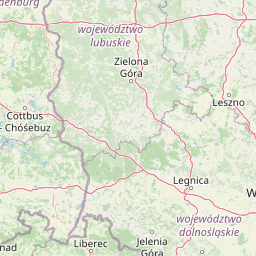
Map view of Mszana i Obłoga Nature Reserve

Use this park location map to pinpoint Mszana i Obłoga Nature Reserve in Poland, understand its exact geographic position, and read its mapped placement within the surrounding landscape more clearly.

Pigeon | © OpenStreetMap contributors

Location context for Mszana i Obłoga Nature Reserve

Lower Silesian Voivodeship

Visual exploration of basalt outcrops, volcanic geology, and forest habitats

Rezerwat przyrody Mszana i Obłoga Photos and Landscape Scenery

Visual records capture the striking basalt outcrops and mature deciduous forest communities that define the protected landscape. Examining these field photographs reveals the rugged volcanic topography and rich understory flora characteristic of the Kaczawskie foothills.

Close-up of a white-flowered orchid, the narrow-leaved helleborine, showing its distinctive upright spike of blossoms and long, slender green leaves against a blurred natural background.

A close-up view of vertical, hexagonal basalt columns forming a cliff face within a forest.

A square stone observation tower with brick detailing stands in a deciduous forest, surrounded by tall tree trunks.

Park atlas

Compare nearby regional forests, volcanic hills, and protected landscapes in Lower Silesia

Parks near Rezerwat przyrody Mszana i Obłoga and surrounding protected areas

Continue geographic exploration by comparing Rezerwat przyrody Mszana i Obłoga with other protected forest reserves and volcanic foothill landscapes across the surrounding region. Analyzing adjacent natural areas reveals broader ecological patterns, regional topography, and connected conservation terrain throughout the Sudeten foreland.
Protected landscapeLower Silesian Voivodeship
Mapped location lies within the park boundary#1 closest

North

Park Krajobrazowy Chełmy: Protected Landscape and Volcanic Geography in Southwestern Poland

Geological atlas of the Kaczawskie Foothills

Deep dive into the complex terrain of Park Krajobrazowy Chełmy, a protected area in Lower Silesia renowned for its layered volcanic history and unique floristic composition. This site showcases an intricate network of ravines and basalt-crowned hills that define the edge of the Sudetes, offering a comprehensive look at the region's ancient geological development and ecological heritage.

Area
159.91 km²
Established
1992
Relief
Mountain
Climate
Temperate
Protected areaLower Silesian Voivodeship
About 18 km away#2 closest

Southwest

Trzcińskie Mokradła Protected Area: Geographic Overview and Mapped Sudeten Wetland Landscape

Located in the Lower Silesian Voivodeship of Poland

Trzcińskie Mokradła stands as a significant mire complex in the Jelenia Góra Basin, providing a rare look at peat-forming habitats in the Sudetes. This protected area offers deep insight into regional wetland conservation and the environmental history of southwestern Poland, serving as an essential reference for researchers and landscape enthusiasts interested in intramontane basin geography.

Area
0.753 km²
Established
2011
Scope
Terrestrial
Water
Major water bodies
A soft watercolor painting of a river flowing through a hilly, forested landscape with light green and pastel tones.
Nature reserveLower Silesian Voivodeship
About 19 km away#3 closest

West

Ostoja nad Bobrem Nature Reserve and Bóbr River Valley Geographic Atlas

Protected Sudetes foothills landscape in Poland

Ostoja nad Bobrem represents a significant protected area within the Lower Silesian Voivodeship, characterized by its winding river corridor and hilly topography. The reserve supports a range of habitats including rare orchid-rich grasslands and dense slope forests. This atlas entry provides a detailed look at the geographic distribution and ecological importance of this essential Polish nature reserve.

Area
153.73 km²
Established
2009
Relief
Upland
Climate
Temperate
Watercolor illustration of a mountain range with green hills, pink and yellow sky, and sparse vegetation
National parkPoland
About 30 km away#4 closest

Southwest

Karkonosze National Park: A Premier National Park in Poland's Giant Mountains

Discover alpine terrain and unique glacial landscapes.

Karkonosze National Park is a significant protected area in Poland, renowned for its dramatic alpine topography carved by ancient glaciers. As the highest range in the Polish Sudetes, it features striking U-shaped valleys, U-shaped glacial cirques, and diverse subalpine to alpine ecosystems. This national park provides a rich context for understanding Central European mountain geography and exploring its mapped protected boundaries.

IUCN
II
Relief
Mountain
Scope
Terrestrial
A minimalist, flat-design vector illustration showing a tall waterfall flowing down a rocky canyon flanked by pine trees and layers of cliffs.
Protected landscapeLower Silesian Voivodeship
About 30 km away#5 closest

South

Park Krajobrazowy Sudetów Wałbrzyskich: Protected Mountain Landscape Map

Geographic overview of forested ridges and rock formations

Gain insight into the topography of Park Krajobrazowy Sudetów Wałbrzyskich, where elevations reach 936 meters. This atlas entry details the forested Central Sudetes landscape, highlighting protected geological monuments like Małpia Skała and the unique hydrology of the Rybna river capture.

Area
64.93 km²
Established
1998
Relief
Mountain
Climate
Temperate
A minimalist watercolor illustration depicting rolling, layered mountain ridges in soft shades of green, yellow, and light pink against a white background.
National parkDolnośląskie Voivodeship
About 33 km away#6 closest

Southwest

Karkonoski Park Narodowy: Mapping Protected Granite Peaks and Glacial Terrain in Poland

High-mountain landscapes in the Dolnośląskie Voivodeship

Trace the diverse geography of Karkonoski Park Narodowy, where granite blockfields and glacial cirques define the high-altitude terrain. This protected area represents one of Central Europe's most significant upland ecosystems, showcasing a vertical transition from dense forest to alpine tundra.

Area
59.51 km²
Established
1959
Visitors
2M annual
Relief
Mountain
Watercolor painting showing green forests, a valley, and distant mountains under a soft sky
National parkLiberec Region
About 34 km away#7 closest

Southwest

Krkonoše National Park: Central European Alpine Protected Area and Map Context

Discover glacial landforms and unique ecosystems in the Giant Mountains.

Krkonoše National Park, situated in the Liberec Region, is a premier example of a protected alpine landscape in Central Europe. This page facilitates exploration of its significant glacial geography, including distinct cirques, rockfields, and valleys, providing vital context for understanding its protected area status. Engage with the mapped terrain and discover the unique ecological features that make this national park a cornerstone of conservation and geographic study within the Czech Republic.

Area
363.52 km²
Established
1963
IUCN
II
Visitors
12.1M annual
Nature reserveLower Silesian Voivodeship
About 34 km away#8 closest

Northwest

Żerkowice-Skała Nature Reserve: Mapped Sandstone Cuestas and Forest Habitats in Lower Silesia

A study of Cretaceous geology and protected forest landscapes in Poland

Żerkowice-Skała offers a window into the geological complexity of the Pogórze Izerskie. This nature reserve protects a vital sandstone cuesta edge, creating a mosaic of cliff habitats and old-growth deciduous forest communities. As a key Natura 2000 site, it serves as a crucial reference point for understanding the distribution of rare species and the northernmost Cretaceous exposures linked to the broader Bohemian Massif region.

Area
0.849 km²
Established
2011
Relief
Upland
Climate
Temperate

Common questions about visiting, size, designation, and location context for Mszana i Obłoga Nature Reserve

Mszana i Obłoga Nature Reserve FAQs for park facts, access, geography, and protected area context

Find quick answers about Mszana i Obłoga Nature Reserve, including protected-area facts, park geography, trail and visitor context, and how the park fits into its surrounding country and regional landscape.
MoriAtlas Explorer

Continue Your Protected Areas Search Across the Global Atlas

Deepen your exploration by continuing the structured search for national parks and protected areas worldwide. Utilize the comprehensive filtering capabilities to compare different conservation landscapes and refine your understanding of global park geography. Discover more about the distribution and characteristics of protected natural areas.

Global natural geography