Why Poás Volcano National Park stands out
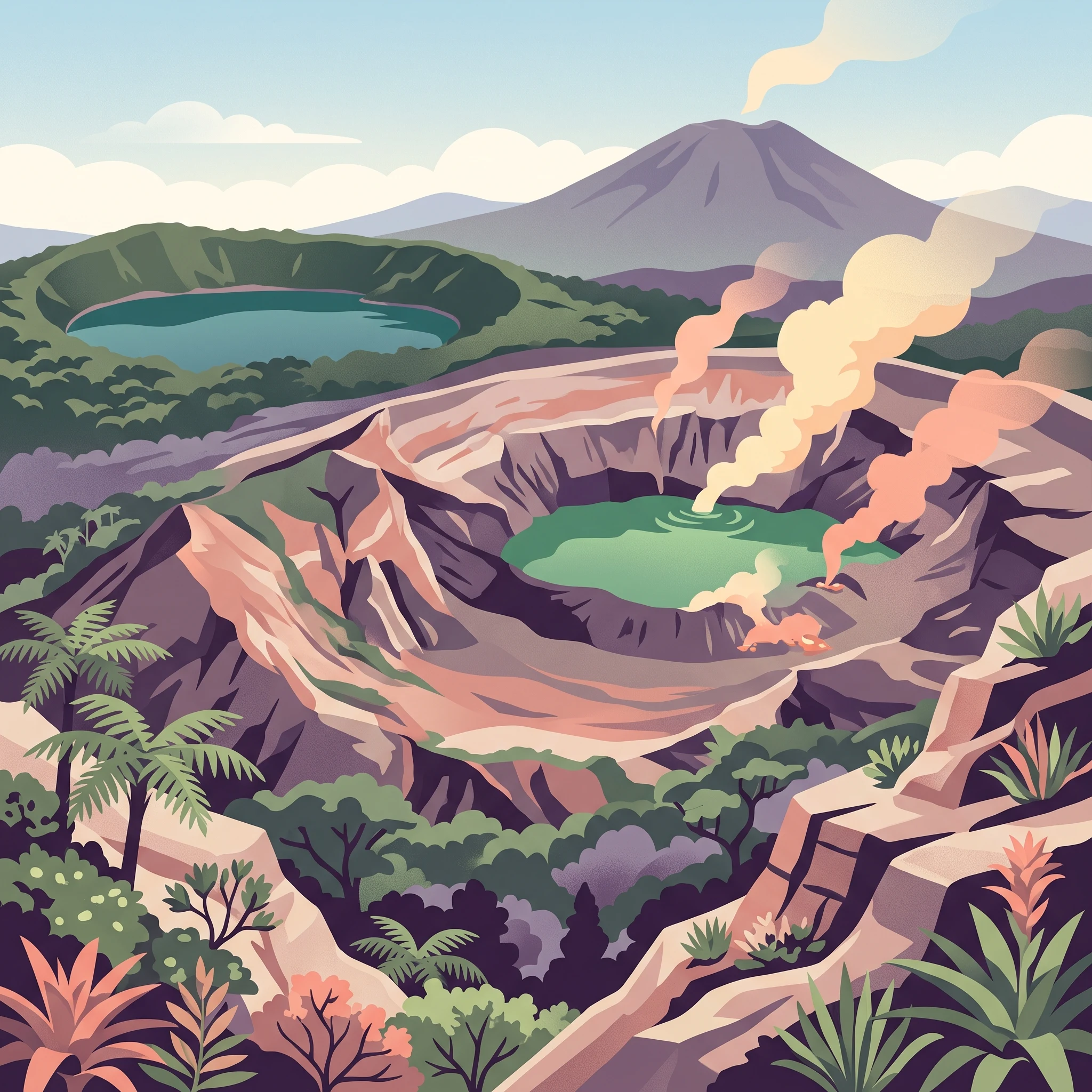
Poás Volcano National Park is renowned for its spectacular active crater, one of the world's most accessible continuously erupting volcanoes. The park's defining feature is the main crater's frequent geyser and lava eruptions, which create an otherworldly landscape of sulfur deposits, bubbling mud pots, and steam vents. The emerald-green waters of Lake Botos, filling the ancient Botos crater, provide a striking contrast to the active volcanic terrain. The park also features the rare combination of accessible high-altitude volcanic environments with preserved cloud forest ecosystems, allowing visitors to walk from the crater rim through forested trails to tranquil crater lakes.
Poás Volcano National Park history and protected-area timeline
Poás Volcano National Park was formally established on January 25, 1971, as part of Costa Rica's expanding network of protected areas during a period when the country was developing its modern conservation framework. The creation of the park coincided with growing scientific understanding of volcanic ecosystems and recognition that active volcanic landscapes required specific protections to preserve their geological and ecological values. The park became part of the National System of Conservation Areas, Costa Rica's coordinated approach to managing protected territories across diverse ecological zones.
The park has experienced several significant closures that have shaped both its management approach and public understanding of volcanic hazards. The most substantial closure occurred following a powerful explosive eruption on April 12, 2017, which generated concern about visitor safety and led to extended closures extending until August 2018. Subsequent eruptive activity in September 2019 prompted additional temporary closures. These events have refined the park's risk assessment protocols and visitor management strategies, establishing clear procedures for monitoring volcanic activity and determining safe access levels. The recurring nature of elevated activity at Poás has made the park a case study in managing accessible volcanic attractions while maintaining appropriate safety margins.
Poás Volcano National Park landscape and geographic character
The landscape of Poás Volcano National Park presents an extraordinary combination of active volcanic terrain, ancient crater formations, and high-altitude vegetation zones. The main crater, measuring approximately 290 meters in diameter, functions as a constantly active geothermal system where pressurized gases and superheated water escape through multiple vents, creating perpetual geyser-like eruptions and pools of bubbling sulfurous mud. The crater floor shows the accumulated mineral deposits from decades of volcanic emissions, creating a terrain that resembles another planet more than a typical tropical forest environment.
Above the active crater, the slopes of Poás Volcano rise to the summit at 2,700 meters, where the boundaries between volcanic rock and developing vegetation become increasingly apparent. The landscape transitions from the barren mineral surfaces near the active vent to zones of scrub vegetation, then to the more developed cloud forest that characterizes lower elevations within the park. The Botos crater, located within the park boundaries, offers a dramatically different landscape: a calm lake approximately 370 meters in diameter with cold, green-tinted water surrounded by forest-covered slopes. This inactive crater, dormant for roughly 7,500 years, demonstrates the long-term ecological succession that follows volcanic activity.
The surrounding terrain includes the remnants of the Von Frantzuis crater, another extinct volcanic depression that contributes to the park's geological diversity. Throughout the park, the interaction between volcanic geology and tropical highland climate creates distinctive visual patterns, with mist swirling around crater rims, steam rising from active vents, and the vibrant green of cloud forest contrasting against dark volcanic rock. The elevation range within the park, spanning from around 1,800 meters to the summit, creates multiple distinct ecological zones within a relatively compact area.
Poás Volcano National Park ecosystems, habitats, and plant life
The nature of Poás Volcano National Park reflects the harsh yet regenerative conditions found in high-altitude volcanic environments. The park occupies a transition zone between tropical lowland ecosystems and the specialized communities adapted to cool, cloudy conditions at elevation. The volcanic soil, despite its mineral-rich and sometimes toxic composition near active vents, supports surprisingly diverse vegetation communities as plants gradually colonize the cooling lava fields and accumulate organic matter in the thin soils.
The cloud forest that covers much of the park's lower slopes receives frequent mist and precipitation, creating the moist conditions that support epiphytic plants including numerous bromeliad and orchid species. The Poás magnolia (Magnolia poasana) represents a particularly significant botanical element, with this species particularly associated with the highland forests of the region. The forest structure varies with elevation and proximity to volcanic activity, transitioning from more developed canopy forest at lower elevations to more open paramo-like vegetation near the summit areas where temperature extremes and wind create more challenging growing conditions.
The ecological relationship between volcanic activity and biological communities in the park demonstrates nature's capacity for adaptation and recovery. Areas distant from active vents have developed stable forest communities, while the gradients of disturbance radiating from the main crater create a natural experiment in succession and colonization. This dynamic interaction between geological processes and ecological development makes the park valuable for understanding ecosystem resilience in volcanic landscapes.
Poás Volcano National Park wildlife and species highlights
The wildlife of Poás Volcano National Park reflects the park's position in the highland transitional zone between Central America's tropical and temperate faunal communities. The bird species found within the park include several species associated with cloud forest environments, with the resplendent quetzal representing perhaps the most iconic avian resident. This spectacular bird, revered in Mesoamerican cultures and considered a symbol of Central American wilderness, inhabits the mature forest areas where it feeds on fruit and small prey while nesting in the large trees that characterize older growth areas.
Additional bird species including the clay-colored robin, black guan, various hummingbirds, tanagers, flycatchers, and toucans contribute to the park's avifaunal diversity. The hummingbird species, in particular, are drawn to the flowering plants that thrive in the cloud forest understory, where their specialized feeding behaviors support pollination relationships with local flora. The forest canopy supports toucan species that move through the trees searching for fruit, while the more open areas near trails and clearings provide habitat for flycatcher species that hunt flying insects.
Mammalian residents include coyotes, rabbits, and marmots, representing species adapted to the cool highland conditions. These animals utilize the various habitat types within the park, from the more open volcanic terrain to the denser forest areas. The presence of these mammal species, while less visible than the colorful birdlife, indicates the park's role in maintaining ecological connectivity across the highland landscape. The overall wildlife community demonstrates adaptation to the unique conditions of volcanic highland environments, with species distributions shaped by the interaction of elevation, vegetation structure, and the availability of resources in this distinctive protected area.
Poás Volcano National Park conservation status and protection priorities
Poás Volcano National Park serves as a critical protected area within Costa Rica's Central Conservation Area, representing the intersection of geological preservation and ecological protection in a country renowned for its conservation commitments. The park's designation as an IUCN Category II protected area reflects its role in preserving natural ecosystems while allowing for sustainable visitor access and environmental education. This dual focus on protection and public engagement makes the park a model for managing volcanic landscapes where both scientific and recreational values intersect.
The conservation significance of the park extends beyond its immediate boundaries to include watershed protection for the surrounding regions. The high-altitude ecosystems within the park capture and filter precipitation, contributing to water quality downstream while stabilizing soils on the volcanic slopes. The forest vegetation also plays a role in regulating the release of volcanic gases through chemical weathering and biological processes, demonstrating the complex interactions between geological and ecological systems that conservation in this landscape must consider.
The ongoing volcanic activity presents unique conservation challenges, as eruptions can temporarily alter or destroy existing habitats while also creating opportunities for ecological research into succession and recovery. The park management must balance visitor safety with access to this remarkable natural feature, implementing monitoring systems that track volcanic activity levels and adjust access accordingly. This adaptive management approach reflects the recognition that volcanic landscapes are dynamic systems where conservation must accommodate natural change rather than assuming static conditions.
Poás Volcano National Park cultural meaning and human context
The cultural context of Poás Volcano National Park relates to the broader significance of volcanic landscapes in Costa Rican and Central American heritage. The Poás Volcano has been a landmark in the regional landscape for millennia, visible from the Central Valley where the majority of Costa Rica's population concentrates. Indigenous peoples of the region would have encountered the volcano as both a geographic feature and a spiritual presence in their world view, though detailed historical documentation of pre-colonial relationships with the mountain is limited.
Modern Costa Rican culture has integrated the volcano into national identity, with the park representing one of the country's most visited natural attractions and an important educational resource. The mountain's visibility from populated areas makes it a touchstone for understanding volcanic risk and the country's position along the Pacific Ring of Fire. The frequent closures due to volcanic activity have also generated public discussion about balancing the tourism value of such sites with the responsibility to protect visitors and the integrity of natural systems.
Top sights and standout views in Poás Volcano National Park
The most compelling highlight of Poás Volcano National Park remains the active main crater, where visitors can witness ongoing volcanic activity including geyser eruptions, steam vents, and the constant release of volcanic gases. The experience of standing at the rim and observing these geothermal processes creates an unforgettable encounter with Earth's internal forces. Lake Botos, filling the dormant Botos crater with its striking green waters, provides a contrasting highlight that demonstrates the long-term evolution from active volcano to peaceful lake. The trail system connecting these features allows visitors to experience the geological diversity within a single visit. The accessibility of the volcanic landscape, combined with the infrastructure that facilitates safe viewing, makes this one of the world's premier volcanic visitor experiences.
Best time to visit Poás Volcano National Park
The best time to visit Poás Volcano National Park depends significantly on volcanic activity levels, which can lead to closures regardless of typical seasonal patterns. Generally, the dry season from December through April offers more stable weather conditions and lower likelihood of rainfall interfering with crater viewing. However, the highland location means that mist and cloud cover can occur throughout the year, creating the characteristic cloud forest environment. Visitors should check current park status before traveling, as the active nature of the volcano means conditions can change rapidly. The morning hours typically offer the best visibility and fewer crowds, though the afternoon atmosphere can create dramatic photographic conditions when steam and light interact.