
Why Pusch Ridge Wilderness stands out
Pusch Ridge Wilderness is best known for its role in protecting Desert Bighorn Sheep in the Santa Catalina Mountains, including the landmark 2013 reintroduction that produced the first lambs born in the range in nearly twenty-five years. It is also recognized for its stark ecological transitions, where classic Sonoran Desert cacti give way to pine forests and high-elevation aspen-fir woodlands within just a few thousand feet of vertical rise. Equally distinctive is the area's geology, centered on a dome-shaped core of ancient Catalina granite surrounded by steep, folded formations of gneiss and quartzite. Together, these features make Pusch Ridge one of the most concentrated examples of Sky Island ecology in the Arizona desert region, despite its close proximity to a major American city.
Pusch Ridge Wilderness history and protected-area timeline
Pusch Ridge Wilderness was formally designated in 1978 under the National Wilderness Preservation System. Its primary purpose was to protect the Desert Bighorn Sheep population of Pusch Ridge, one of the last remaining populations of this species still present in Arizona at the time.
Throughout the late twentieth century, the bighorn population inside the wilderness declined sharply. Habitat pressure, combined with rapid residential and commercial growth around the Santa Catalina Mountains, particularly in Oro Valley and the Catalina Foothills, effectively cut the animals off from traditional movement corridors and water sources. By the early 2000s, sightings of bighorns in the wilderness had become extremely rare.
In November 2013, a major reintroduction effort brought 31 adult Desert Bighorn Sheep back to Pusch Ridge. The program quickly showed signs of success: in early February 2014, an Arizona Game and Fish Department official documented two newborn lambs, the first Desert Bighorn lambs born in the Santa Catalina Mountains in nearly twenty-five years. This event marked a turning point in the wilderness's conservation history and reaffirmed its original purpose as a sanctuary for one of the Southwest's most iconic large mammals.
Pusch Ridge Wilderness landscape and geographic character
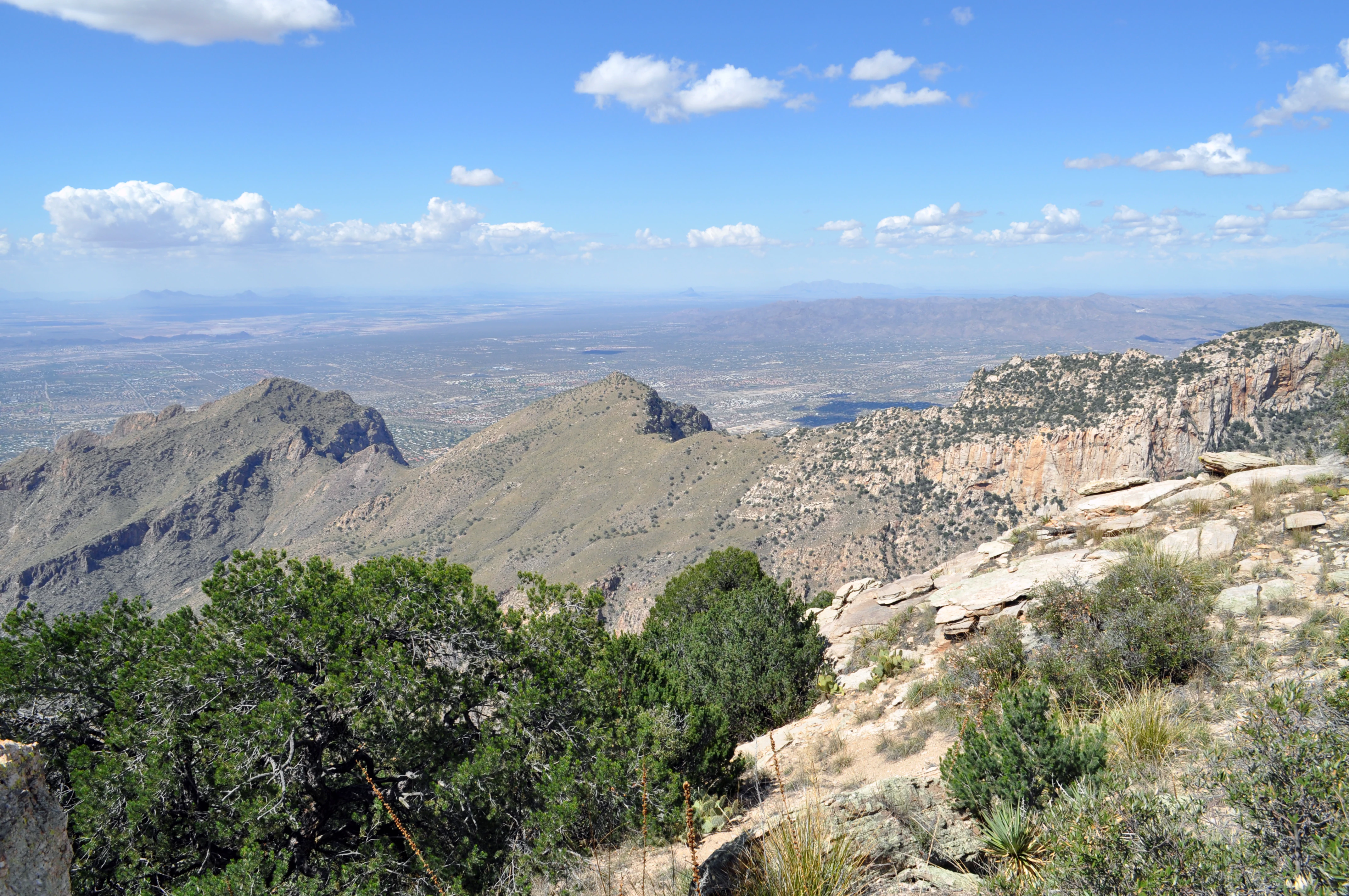
The landscape of Pusch Ridge Wilderness is dominated by the eastern escarpment of the Santa Catalina Mountains, a steep and rugged fault-block range that rises directly out of the Sonoran Desert. The terrain is shaped by sharp ridgelines, deep canyons, and boulder-strewn slopes that funnel runoff down toward the desert basins near Tucson.
Geologically, the range is built around a dome-shaped core of Catalina granite that formed during the Triassic period. The southern face of the mountains is composed of Catalina gneiss interlayered with bands of white quartzite, forming a steep anticline that is separated from the rest of the range by a series of valleys. This combination of resistant granite uplifts and folded metamorphic rocks gives Pusch Ridge its characteristic jagged skyline and visually dramatic cliffs.
The wilderness captures both faces of this range transition. Below, the terrain opens into classic Sonoran Desert bajadas dotted with saguaros. Above, the slopes tighten into rocky canyons and forested ridges, with elevation emphasizing the contrast between arid lowlands and cool, forested high country. This sharp transition between desert and mountain is one of the wilderness's most defining landscape features.
Pusch Ridge Wilderness ecosystems, habitats, and plant life
Because of its sharp elevation range, Pusch Ridge Wilderness compresses multiple Southwestern vegetation zones into a relatively small area. At the lowest elevations, the terrain supports classic Sonoran Desert flora, with saguaro cactus and other heat-adapted desert plants dominating the rocky bajadas and lower slopes.
Mid-elevations are characterized by mountain mahogany, juniper, and pinyon pine, forming open woodlands that occupy much of the wilderness's transitional zone. Above roughly 8,000 feet, the vegetation shifts into denser forests of fir and aspen, with cooler, moister conditions supporting a very different suite of plant communities than those found on the desert floor.
The juxtaposition of desert, woodland, and mixed conifer vegetation within a single wilderness unit makes Pusch Ridge a vivid example of Sky Island ecology. Each elevation band functions almost like a separate habitat, and the interfaces between these bands are especially rich zones for birds, mammals, and plant diversity.
Pusch Ridge Wilderness wildlife and species highlights
Wildlife has always been central to the identity of Pusch Ridge Wilderness. The area was originally designated specifically to protect Desert Bighorn Sheep, which historically used the rugged cliffs and ridges of Pusch Ridge as core habitat. Although the population declined sharply in the late twentieth century due to surrounding development, the 2013 reintroduction of 31 adult sheep, followed by the 2014 birth of the first Catalina-born lambs in nearly twenty-five years, marked an important recovery milestone overseen by the Arizona Game and Fish Department.
Beyond bighorn sheep, the wide elevation range of the wilderness supports a broad mix of species, ranging from typical Sonoran Desert fauna in the lower reaches to montane species in the higher forests. The dense stands of pinyon-juniper and the fir-aspen forests above 8,000 feet provide seasonal habitat for a variety of birds and mammals adapted to cooler, more forested terrain, while the desert lowlands host desert-adapted species typical of the Tucson Basin ecosystem.
Pusch Ridge Wilderness conservation status and protection priorities
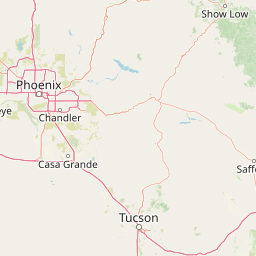
Pusch Ridge Wilderness plays a disproportionate conservation role for its size because of its proximity to a major urban area. Sitting directly north of Tucson and adjacent to the rapidly growing communities of Oro Valley and Catalina Foothills, the wilderness represents one of the most important undeveloped buffers for wildlife in the region, particularly for species sensitive to human encroachment.
The wilderness's conservation value is anchored in its role as a refuge for Desert Bighorn Sheep. The decline of the local population through the late twentieth century, and the subsequent reintroduction program, have made Pusch Ridge a case study in how suburban development pressures can fragment wildlife habitat in Sky Island ecosystems, and in how targeted management can partially reverse those losses.
At a broader scale, the protection of this steep, elevation-rich terrain helps preserve vegetation communities and ecological processes that would otherwise be lost to development, fire, or invasive species. By keeping the transition between desert and mountain intact, the wilderness safeguards a key node in the larger network of protected lands in the Coronado National Forest.
Top sights and standout views in Pusch Ridge Wilderness
Pusch Ridge Wilderness stands out for the sheer diversity of landscapes compressed into a single protected area: saguaro-studded desert lowlands just miles below high-country fir and aspen forests, all overlain on a dramatic geology of Triassic granite and folded gneiss.
Its conservation story is equally distinctive, anchored by the successful 2013 reintroduction of Desert Bighorn Sheep to a range where the species had nearly disappeared after decades of suburban growth at the base of the mountains. Together, these qualities make Pusch Ridge one of the most ecologically rich and historically significant wilderness areas in southern Arizona.
Best time to visit Pusch Ridge Wilderness
Pusch Ridge Wilderness is approachable year-round, but the character of a visit changes sharply with elevation. Winter and early spring are typically the most comfortable seasons for exploring the lower desert portions of the wilderness, when daytime temperatures are mild and saguaro landscapes are at their most accessible.
Late spring through early fall brings intense heat at lower elevations, but the cooler, forested high country above 8,000 feet becomes increasingly attractive as the desert lowlands warm. Summer monsoon storms can produce dramatic skies but also bring flash flood risk in canyons and rough trail conditions. Many visitors target the shoulder seasons of spring and fall to experience both the desert and forested zones of the wilderness in a single trip.