
Mori Atlas logo
Wildlife reserveSri Penusila Narasimha Wildlife Sanctuary

Mapping the rare dry evergreen forests and diverse wildlife corridors of this southern Indian reserve.

Sri Penusila Narasimha Wildlife Sanctuary: An Essential Protected Landscape in the Eastern Ghats

Sri Penusila Narasimha Wildlife Sanctuary represents a vital conservation anchor within the Andhra Pradesh hill systems, protecting fragmented dry evergreen forests that are increasingly rare across the region. This sanctuary encompasses a rugged transition zone where ridges and valley catchments sustain apex predator populations and critically endangered avian species. Through this detailed geographic overview, identify the physical boundaries and ecological mosaic that define this significant protected habitat.

dry evergreen forestEastern Ghatsandhra pradeshwildlife sanctuaryendemic birdsJerdon's courser

Sri Penusila Narasimha Wildlife Sanctuary

Wildlife reserve

Park overview

Structured park overview, official facts, and landscape profile for Sri Penusila Narasimha Wildlife Sanctuary

Sri Penusila Narasimha Wildlife Sanctuary park facts, protected area profile, and essential visitor context

Review the core facts for Sri Penusila Narasimha Wildlife Sanctuary, including designation, size, terrain, visitor scale, habitats, and operating context in one park-focused overview.

About Sri Penusila Narasimha Wildlife Sanctuary

Sri Penusila Narasimha Wildlife Sanctuary is a large protected area in the southern Indian state of Andhra Pradesh, spanning parts of Nellore, Tirupati, and Kadapa districts. It is managed as a habitat and species management area under the Andhra Pradesh Forest Department, and is notable for protecting one of the rarest forest formations in the country: dry evergreen forest, which survives in scattered pockets across the Eastern Ghats and adjoining hill systems.

Protection and recognition

Examine documented terrestrial conservation frameworks and official recognition parameters.

Sri Penusila Narasimha Wildlife Sanctuary Protection Status and Designation Records

Sri Penusila Narasimha Wildlife Sanctuary encompasses a documented terrestrial protection scope within its designated conservation boundaries. Review official administrative records and international recognition parameters associated with this protected natural area.

Protection details

Protection scope
Terrestrial
Transboundary protection
No
Park context

Deeper park guide and search-rich context for Sri Penusila Narasimha Wildlife Sanctuary

Sri Penusila Narasimha Wildlife Sanctuary history, landscape, wildlife, and travel context

Explore Sri Penusila Narasimha Wildlife Sanctuary through its history, landscape character, ecosystems, wildlife, conservation priorities, cultural context, and seasonal travel timing in a structured park guide built for atlas discovery and search intent.

Sri Penusila Narasimha Wildlife Sanctuary landscape and geographic character

The sanctuary lies across the hill and valley systems of the southern Eastern Ghats transition zone, where the terrain of Nellore, Tirupati, and Kadapa districts converges. Its physical character is shaped by hilly slopes and rolling forested ridges that alternate with low valleys, producing a contoured landscape of crests, dips, and sheltered basins.

This rugged topography supports the dry evergreen forest type that defines the sanctuary, with vegetation clinging to slopes and stabilizing soils across a large contiguous block. The combination of undulating terrain, valley catchment zones, and exposed hill crests gives the area strong habitat diversity within a relatively uniform regional climate.

nature The sanctuary is best understood ecologically as a stronghold of the rare dry evergreen forest formation of southern India, a forest type that occurs only in limited, fragmented pockets and is considered endangered as a habitat. Typical species associated with this formation in the sanctuary include acacias, cassias, Pongamia, and Carissa, which together form a dense and evergreen but seasonably dry-adapted canopy.

These forests sit at the intersection of the Eastern Ghats ecosystem and the drier inland Deccan fringe, producing a transitional ecological character. The mix of slopes, valleys, and forest cover creates a mosaic of shaded interiors, drier ridges, and valley-side thickets that support a wide range of resident and seasonal fauna.

wildlife Sri Penusila Narasimha is particularly significant for its combination of large mammals and rare birds. The sanctuary supports populations of tigers and leopards, giving it a role as apex predator habitat within the regional forest network. Other mammals present include panthers, chital, nilgai, four-horned antelope (chowsingha), sloth bear, jackal, and wild boar, indicating a broad prey base and healthy habitat structure.

Beyond mammals, the sanctuary hosts reptile species typical of dry forest environments and a diverse avifauna. Its most important wildlife asset is Jerdon's courser, a critically endangered nocturnal ground bird endemic to this part of southern India. The presence of this species makes the sanctuary globally significant for bird conservation, complementing its role as a refuge for larger mammals and dry evergreen forest.

conservation The sanctuary's conservation value lies primarily in its protection of the dry evergreen forest type, which is rare and shrinking across southern India. By placing a large block of this habitat under formal protection, the sanctuary helps maintain ecological processes and genetic reservoirs for the species that depend on it.

Its role in safeguarding Jerdon's courser, one of the rarest birds in the world, gives it international conservation relevance. Management by the Andhra Pradesh Forest Department under a habitat and species management framework also positions the area as a working conservation landscape where habitat connectivity, prey base maintenance, and protection of large carnivores are central priorities.

culturalContext null,
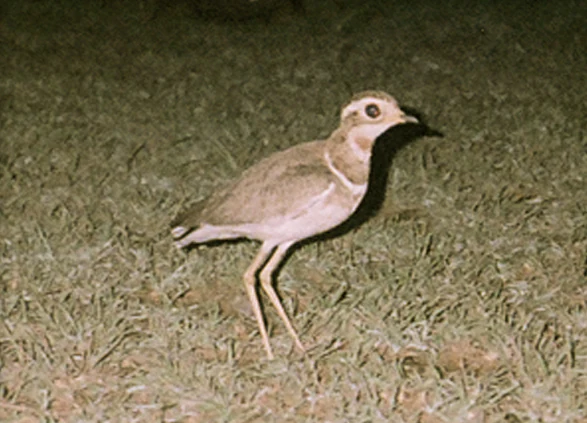
A side profile view of a Jerdon's Courser bird standing on short dry grass at night.
A Jerdon's Courser, a rare bird species, captured on a camera trap.

Top sights and standout views in Sri Penusila Narasimha Wildlife Sanctuary

Sri Penusila Narasimha stands out for the unusual combination of dry evergreen forest, large mammal fauna, and one of India's rarest birds. The sanctuary's most distinctive features are its endangered forest type, its tiger and leopard populations, and the presence of Jerdon's courser, a globally significant endemic species. Together these qualities make it both a regional conservation anchor and a sanctuary of considerable ecological interest.

bestTimeToVisit null,

Monthly climate preview

Long term temperature and precipitation normals for Andhra Pradesh terrain

Sri Penusila Narasimha Wildlife Sanctuary Climate and Monthly Weather Patterns

Representative coordinates record measured monthly temperature swings and shifting precipitation averages across the protected landscape from nineteen ninety one to twenty twenty. Analyzing the complete twelve month data profile reveals detailed long term climate normals for Sri Penusila Narasimha Wildlife Sanctuary.
Annual mean27 °C
22 °C32 °C
Jan22°
Feb25°
Mar29°
Apr31°
May32°
Jun30°
Jul29°
Aug28°
Sep27°
Oct26°
Nov24°
Dec22°
Warmest month
May

32.3 °C

Coolest month
December

21.8 °C

Wettest month
November

6.3 mm/day

Driest month
February

0.2 mm/day

Park location guide

Geography guide, regional context, and park location map for Sri Penusila Narasimha Wildlife Sanctuary

Sri Penusila Narasimha Wildlife Sanctuary park geography, regions, and map view in India

Understand where Sri Penusila Narasimha Wildlife Sanctuary sits in India through a broader geographic reading of the surrounding landscape, nearby location context, and its mapped position within the national park landscape.

How Sri Penusila Narasimha Wildlife Sanctuary fits into India

India is a South Asian country bordered by the Indian Ocean, Arabian Sea, and Bay of Bengal. It shares land borders with Pakistan, China, Nepal, Bhutan, Bangladesh, and Myanmar. The country has a population of over 1.4 billion people and operates as a federal parliamentary republic with its capital in New Delhi.

Wider geography shaping Sri Penusila Narasimha Wildlife Sanctuary in India

India occupies the Indian subcontinent in South Asia, bordered by the Arabian Sea to the southwest, the Bay of Bengal to the southeast, and the Indian Ocean to the south. It shares land borders with Pakistan to the west, China, Nepal, and Bhutan to the north, and Bangladesh and Myanmar to the east. The territory also includes the Andaman and Nicobar Islands in the Indian Ocean.

Map view of Sri Penusila Narasimha Wildlife Sanctuary

Use this park location map to pinpoint Sri Penusila Narasimha Wildlife Sanctuary in India, understand its exact geographic position, and read its mapped placement within the surrounding landscape more clearly.

Pigeon | © OpenStreetMap contributors

Location context for Sri Penusila Narasimha Wildlife Sanctuary

Andhra Pradesh

Visual reference of dry evergreen forest habitats and Eastern Ghats terrain

Sri Penusila Narasimha Wildlife Sanctuary Landscape and Scenery Photos

Photographic documentation reveals the rugged topography, forested ridges, and valley systems that shape the sanctuary environment. Examining these protected area views provides deeper insight into the rare dry evergreen forest formations and regional habitat structures.

A side profile view of a Jerdon's Courser bird standing on short dry grass at night.

Park atlas

Compare surrounding hill forests, dry evergreen reserves, and Eastern Ghats habitats

Parks Near Sri Penusila Narasimha Wildlife Sanctuary And Regional Protected Areas

Browsing other protected areas near Sri Penusila Narasimha Wildlife Sanctuary reveals connected wildlife corridors across the southern Eastern Ghats transition zone. Comparing adjacent regional reserves helps place rare dry evergreen forest formations and apex predator habitats within a broader conservation context.
National parkAndhra Pradesh
About 32 km away#1 closest

Southwest

Sri Venkateswara National Park: Andhra Pradesh National Park Protected Landscape Atlas

Mapped protected area, regional geography, and natural terrain.

Uncover the core geographic identity of Sri Venkateswara National Park, a designated national park within Andhra Pradesh. This resource delves into its protected landscape features, providing a mapped perspective on its boundaries and natural terrain. It serves as a crucial point for understanding the park's regional context and its significance as a mapped natural area for atlas-based exploration.

Area
353 km²
Established
1989
IUCN
II
Relief
Mountain
Wildlife reserveTirupati district
About 55 km away#2 closest

East

Nelapattu Bird Sanctuary: Wetland Geography and Wildlife Reserve in Tirupati District

Mapping the freshwater swamp forest and scrub landscapes of Andhra Pradesh.

Nelapattu Bird Sanctuary serves as a crucial protected area in Tirupati district, featuring an 83 hectare reservoir tank fringed by productive Barringtonia swamp forest. This reserve integrates dry upland ridges with aquatic lowland terrain to support significant breeding colonies and migratory bird life within the Deccan region.

Area
4.59 km²
Established
1976
IUCN
IV
Relief
Lowland
Watercolor illustration showing a landscape with rolling green hills, pale mountains in the background, and clusters of trees in soft shades of green and pink on the sides.
Wildlife reserveAndhra Pradesh
About 91 km away#3 closest

Northwest

Sri Lankamalleswara Wildlife Sanctuary: Protected Geography and Forest Landscapes

A critical dry forest refuge in Andhra Pradesh, India

Located in the Eastern Ghats, Sri Lankamalleswara Wildlife Sanctuary provides a critical sanctuary for the rare Jerdon's courser. The landscape features deep gorges, rocky outcrops, and dry deciduous thorn forests that remain essential for maintaining the ecological integrity of Andhra Pradesh. This protected area represents one of the most distinctive dry-forest systems in the southern part of India.

Area
464.42 km²
IUCN
IV
Relief
Upland
Access
Access unknown
Wildlife reserveAndhra Pradesh
About 93 km away#4 closest

Southeast

Pulicat Lake Bird Sanctuary: Coastal Wetland and Wildlife Reserve in Andhra Pradesh

Mapped landscapes and protected brackish water habitats

Explore the expansive Pulicat Lake Bird Sanctuary, an essential coastal wetland ecosystem in Andhra Pradesh. This wildlife reserve features a vast brackish lagoon, mudflats, and salt-tolerant vegetation, serving as a primary refuge for migratory waterbirds along the southeastern coast of India.

Area
759 km²
Established
1976
IUCN
IV
Relief
Lowland
National parkAndhra Pradesh
About 126 km away#5 closest

Northwest

Rajiv Gandhi National Park (Rameswaram) National Park: Exploring Andhra Pradesh's Protected Landscapes

Mapped geography and protected area context for Rajiv Gandhi National Park (Rameswaram).

Delve into the geographic identity of Rajiv Gandhi National Park (Rameswaram), a key protected area within Andhra Pradesh. This detail page serves as an atlas anchor for understanding the park's landscape, mapped features, and its significance as a national park. Users can explore its protected boundaries and appreciate its role within the regional geography of Andhra Pradesh.

Area
2.4 km²
Established
2005
IUCN
II
Relief
Lowland
National parkTamil Nadu
About 139 km away#6 closest

Southeast

Guindy National Park: Exploring its Protected Area Identity and Geographic Setting in Tamil Nadu

National park terrain and mapped boundaries for regional context.

Guindy National Park represents a significant protected natural landscape within Tamil Nadu, India. This entry provides detailed geographic context, focusing on the park's mapped boundaries and its identity as a national park. Users can delve into the regional landscape, understanding how Guindy National Park contributes to the atlas of protected areas in South India and appreciating its specific natural terrain.

Area
2.706 km²
Established
1977
IUCN
II
Visitors
700K annual
A pale, soft-focus watercolor illustration depicting rolling hills, sparse trees, and a light sky, arranged as a wide panoramic strip.
Wildlife reserveAndhra Pradesh
About 140 km away#7 closest

Southwest

Koundinya Wildlife Sanctuary: Mapped Landscapes and Protected Area Geography in Andhra Pradesh

Essential insights into regional elephant habitat and plateau ecosystems

Koundinya Wildlife Sanctuary serves as the primary elephant reserve of Andhra Pradesh, protecting a rugged mosaic of dry deciduous woodlands and rocky valleys along the Kolar Plateau. This sanctuary provides critical sanctuary space characterized by seasonal waterfalls, dry forest canopy, and a diverse range of terrain that facilitates the movement of significant Asian elephant populations within this distinct southern Indian ecological zone.

Area
357.6 km²
Established
1990
IUCN
IV
Relief
Mountain
Wildlife reserveAndhra Pradesh
About 198 km away#8 closest

Northwest

Gundla Brahmeswaram Wildlife Sanctuary: Mapped Geography and Protected Forest Landscapes

A vital plateau sanctuary within the Andhra Pradesh Eastern Ghats

Positioned across the rugged Nallamala Forest, this sanctuary protects a diverse array of dry deciduous woodlands and riparian corridors along the Gundlakamma River. As a key segment of the broader regional tiger habitat, the sanctuary provides essential biodiversity protection through its varied hill-pass topography and isolated plateau environment.

Area
1,194 km²
Established
1990
IUCN
IV
Relief
Mountain

Common questions about visiting, size, designation, and location context for Sri Penusila Narasimha Wildlife Sanctuary

Sri Penusila Narasimha Wildlife Sanctuary FAQs for park facts, access, geography, and protected area context

Find quick answers about Sri Penusila Narasimha Wildlife Sanctuary, including protected-area facts, park geography, trail and visitor context, and how the park fits into its surrounding country and regional landscape.
MoriAtlas Explorer

Continue Your Protected Areas Search Across the Global Atlas

Deepen your exploration by continuing the structured search for national parks and protected areas worldwide. Utilize the comprehensive filtering capabilities to compare different conservation landscapes and refine your understanding of global park geography. Discover more about the distribution and characteristics of protected natural areas.

Global natural geography