Why Bolimowski Landscape Park stands out
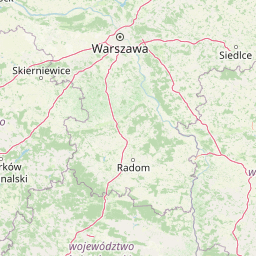
Bolimowski Landscape Park is best known for the remaining forests of Puszcza Bolimowska, a rare stretch of woodland in the heavily farmed central Polish plains, and for the Rawka River valley, which flows through the park as a near-natural lowland river with abundant meanders and oxbows. The park is also recognized for its mosaic of forest types, from fresh and dry pine forests to oak-hornbeam grądy and light oak groves, for its rich flora including a number of glacial relicts among the bryophytes, and for a distinctive faunal mix that combines permanent residents such as moose and beaver with reintroduced fallow deer, wandering lynx from the Kampinos Forest, and more than one hundred breeding bird species.
Bolimowski Landscape Park history and protected-area timeline
Bolimowski Landscape Park was established in 1986 by a resolution of the voivodeship council in Skierniewice, in recognition of the natural value of the remaining forests of Puszcza Bolimowska and the Rawka River valley. Over the following decades it was expanded several times, gradually incorporating additional forest, meadow and river valley areas into the protected zone, and now encompasses a substantial area of woodland plus a buffer zone.
Long before its formal protection, the forests that today make up the park carried a layered human history. During the First World War, between December 1914 and July 1915, the Rawka and Bzura rivers formed a major section of the German-Russian front, and the conflict here assumed a deeply entrenched, positional character. Trenches and field fortifications can still be traced in the forest, especially along the Rawka valley scarp, and several war cemeteries, at Joachimów-Mogiły, Kamion, Budy Grabskie and other locations, hold the remains of soldiers who fell in the fighting. This military heritage is now an integral part of the park's cultural landscape, alongside centuries-old rural settlement, manor houses, churches and pilgrimage sites in the surrounding towns and villages.
Bolimowski Landscape Park landscape and geographic character
The landscape of Bolimowski Landscape Park is shaped by a gently undulating postglacial plain incised by the meandering valley of the Rawka River. Although the regional relief is modest, the Rawka valley introduces a striking element of vertical structure into the terrain, cutting down several dozen meters and creating a sequence of terraces, slopes, and gorge-like narrows along its course.
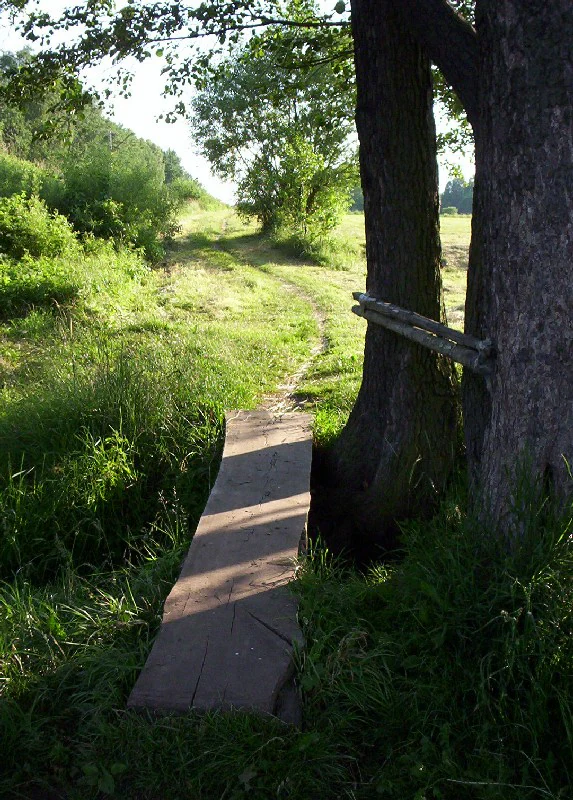
The river itself defines the visual rhythm of the park. It winds through the forest in tight loops, carving out broad basins and cutting through bottleneck sections, and leaves behind a string of abandoned channels and shallow oxbow lakes along the valley floor. Flat wet meadows, peat bogs, sedge beds and willow thickets fill the lowest parts, while ash-alder and oak-hornbeam woods clothe the slopes. Higher up, the plateau carries extensive pine forests, interrupted by occasional inland dunes, mid-forest clearings, small fishpond complexes, and thin patches of light oak woodland.
Beyond the Rawka valley the park extends across a wider forested plain dotted with villages, farmsteads, meadows and small ponds. The result is a tapestry of alternating dark pine stands, bright broadleaf valleys and open clearings that gives the protected area both ecological richness and a varied, visually appealing character uncommon in this intensively farmed part of Poland.
Bolimowski Landscape Park ecosystems, habitats, and plant life
Ecologically, Bolimowski Landscape Park is defined by the interplay between extensive lowland pine forests, the diverse broadleaf communities of the Rawka valley, and a network of open wet habitats along the river and around forest clearings. Roughly seven tenths of the park is forested, and the remainder is occupied mainly by meadows, peatlands, ponds, river waters and scattered settlements, producing a richly varied habitat mosaic.
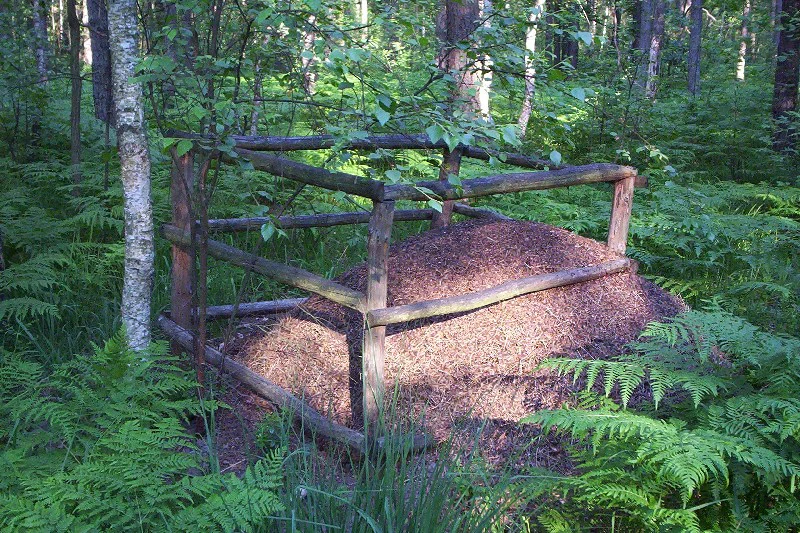
The forest vegetation is dominated by Scots pine on poorer sandy soils, with extensive fresh, moist, dry and mixed pine stands forming the majority of the wooded area. On the richer soils of the Rawka valley slopes and in the northern and eastern parts of the park, mixed deciduous forest with oak, hornbeam, lime, maple, birch and aspen develops into characteristic grąd communities. Small remnants of light oak woodland survive in the Bolimów, Sokule, Mokra and Jeruzal forest sections, while wet alder swamp forests, ash-alder riverside woodlands and willow thickets line the river.
Non-forest habitats are equally important. Mid-forest clearings such as Siwica, Starożyska and Serwituty support dry and wet meadows, peatlands and rush communities, and numerous small fishpond complexes around Nieborów, Kamion, Wycześniak, Patoki and Jeruzal provide additional wetland habitat. Together these environments sustain species-poor marshland flora as well as flowering-rich meadow and forest-floor communities, and provide a habitat continuum that links forest, wetland and river ecosystems across the park.
Bolimowski Landscape Park wildlife and species highlights
The wildlife of Bolimowski Landscape Park is shaped by the combination of large forest tracts, the Rawka river corridor and a network of meadows, peatlands and ponds. Mammals are particularly well represented. Moose have been a permanent presence since the 1980s, beavers were reintroduced in 1983 and now inhabit burrows along the Rawka, and otters are often observed along the watercourses. A long-established herd of fallow deer, with roots in seventeenth-century introductions, is one of the park's distinctive features. Lynx are occasional visitors, arriving from neighbouring Kampinos Forest, while wild boar, roe deer, red fox, European hare, raccoon dog, badger, polecat and both pine and stone marten are regular residents. Smaller mammals include the hazel dormouse, common shrew, Eurasian pygmy shrew and the water shrew.
Birdlife is rich, with more than one hundred and thirty breeding species recorded. The Rawka valley and fishpond complexes support waterbirds such as grey heron, mute swan, common teal, common pochard, little grebe, bittern, little bittern and greylag goose, as well as waders including common snipe, curlew and lapwing. Forest and clearings host black stork, white stork, common crane, lesser spotted eagle, honey buzzard, Eurasian hobby, common kestrel, long-eared owl, Eurasian nightjar, Eurasian hoopoe, common kingfisher, middle spotted woodpecker and white-winged crossbill, while the reedbeds and meadows attract penduline tit, savi's warbler and aquatic warbler. White stork nests are particularly numerous, with several dozen active nests inventoried in the park.
Reptiles and amphibians include the adder, grass snake, slow-worm, great crested newt, fire-bellied toad, European tree frog and natterjack toad. The Rawka and its tributaries support around twenty-five fish species, among them reophilous specialists such as the bullhead, the European bullhead, the brook lamprey and brown trout. Insects are also exceptionally diverse, with nearly eight hundred recorded species, including threatened butterflies such as the swallowtail and scarce swallowtail, large beetles like the stag beetle and the musk beetle, ground beetles of the Carabus genus, and several invertebrates for which the park holds their only known national populations.
Bolimowski Landscape Park conservation status and protection priorities
Bolimowski Landscape Park serves a clear conservation role by protecting one of the largest surviving forest complexes in central Poland, the Bolimowska Forest, and the natural Rawka River valley that bisects it. Within a region dominated by farmland, this wooded stronghold provides essential habitat continuity for forest-dependent mammals, breeding birds, amphibians and invertebrates that would otherwise be confined to much smaller and more isolated refuges.
The park's conservation framework is multilayered. Six nature reserves lie within its boundaries: Kopanicha, Polana Siwica, Puszcza Mariańska, Rawka, Rokita and Ruda Chlebacz, each protecting specific features such as meadow clearings, peatlands, river ecosystems or old-growth forest stands. Part of the park and its buffer zone is also covered by the European Natura 2000 network, including the habitat sites Dolina Rawki, Polany Puszczy Bolimowskiej, Grabinka and Łąki Żukowskie, which extend protection to the river valley and associated meadows.
Wider protection efforts focus on maintaining the ecological corridor of the Rawka valley, from sources in the Wiskitki area to its mouth on the Bzura, and on preserving the mosaic of forest, meadow and wetland habitats that gives the park its ecological character. The presence of rare and relict species, including glacial relict bryophytes, several orchid species protected under national law, and animals such as the lynx and black stork, underlines the park's importance for nature conservation at both national and European scales.
Bolimowski Landscape Park cultural meaning and human context
The cultural landscape around Bolimowski Landscape Park blends rural Polish, ecclesiastical and aristocratic heritage with a more recent layer of military history. Small towns and villages within and around the park retain Renaissance churches and traditional small-town architecture, as exemplified by Bolimów, while nearby Nieborów is home to a distinguished palace-and-park complex and the romantic landscape park at Arkadia, the latter historically associated with the Radziwiłł family and the Polish Enlightenment.
Religious heritage forms an important strand of the regional identity. The area contains Catholic sanctuaries such as Miedniewice, the historic churches of Łowicz with its basilica, Piarist church and eighteenth-century town halls, and the surviving and lost parish churches of Puszcza Mariańska, Jeruzal, Bartniki, Bełchów and Wiskitki. The presence of inactive Protestant, Jewish and Mariavite cemeteries in places such as Sewerynów, Arkadia, Sierakowice Prawe, Wólka Jeruzalska and Wiskitki reflects the religious diversity of the surrounding communities.
Industrial and railway history is represented by the nineteenth-century linen factory settlement at Żyrardów and the station building at Radziwiłłów, both recognized as material cultural monuments. World War I adds another distinct cultural layer. The Rawka Bzura battlefield of 1914 to 1915 left an enduring presence in the local landscape, with visible trench lines, military cemeteries spread across Joachimów-Mogiły, Kolonia Bolimowska-Wieś, Wólka Łasiecka, Budy Grabskie, Kamion, Wiskitki and Huminia, and the emotional weight of a heavily fought-over front that once divided forested country between two armies.
Top sights and standout views in Bolimowski Landscape Park
The defining highlights of Bolimowski Landscape Park are the surviving forests of Puszcza Bolimowska, the near-natural Rawka River valley, and the unusual faunal mix that ranges from reintroduced beaver and permanent resident moose to old-established fallow deer and occasional lynx.
Among its most recognizable features are the lily of the valley carpets in spring, the rich orchid flora of meadow clearings, the broadleaf forests of the Rawka valley, and the chain of small fishponds and forest meadows that give the park its mosaic character. Six nature reserves and the overlapping Natura 2000 sites underline the conservation significance of these landscapes, and the surrounding towns add a striking cultural backdrop of palaces, romantic gardens, historic churches and First World War heritage.
Best time to visit Bolimowski Landscape Park
Spring and early summer are probably the most rewarding seasons for enjoying Bolimowski Landscape Park, when forest floors are carpeted with flowering herbaceous plants including lily of the valley, the park's symbolic species, and when wetland and meadow orchids are at their best in clearings along the Rawka valley. Late spring also brings the richest bird song of the year, with breeding warblers, woodpeckers and species such as the black stork most easily observed.
Late summer and early autumn offer quieter walks through the pine and mixed forests, with mushrooms and the first hints of colour in the broadleaf stands. Winter can also be attractive, when animal tracks in the snow make mammal activity easy to read and the river valley acquires a still, graphic quality beneath frost and snow, though visitors should be prepared for cold conditions and reduced daylight hours typical of inland central Poland.