Mori Atlas logo
National parkBruce Peninsula National Park

Discover the mapped boundaries and regional context of this national park in Ontario.

Bruce Peninsula National Park: Ontario's National Park Protected Landscape and Geography

Bruce Peninsula National Park represents a significant protected area within Ontario, Canada, offering a distinct landscape for geographic exploration. This national park's mapped boundaries are key to understanding its protected status and its place within the regional geography. MoriAtlas provides structured data for exploring the natural terrain and conservation landscapes that define this unique Canadian protected territory.

Niagara EscarpmentGeorgian BayDolomite CliffsKarst FormationsDark Sky PreserveBiodiversity Hotspot

Bruce Peninsula National Park

National park

Park overview

Structured park overview, official facts, and landscape profile for Bruce Peninsula National Park

Bruce Peninsula National Park park facts, protected area profile, and essential visitor context
Review the core facts for Bruce Peninsula National Park, including designation, size, terrain, visitor scale, habitats, and operating context in one park-focused overview.

About Bruce Peninsula National Park

Bruce Peninsula National Park represents a crown jewel in Canada's protected areas network, preserving a unique segment of the Niagara Escarpment where 400-million-year-old Ordovician limestone and dolomite create a landscape of extraordinary geological and ecological significance. The park's location at the northern terminus of the Bruce Peninsula places it at the confluence of two Great Lakes, Georgian Bay to the east and Lake Huron to the west, creating a maritime-influenced environment that supports species more typical of boreal or coastal ecosystems. The dramatic shoreline features towering cliffs, arching rock formations, cobblestone beaches, and deep blue waters that have earned the region its reputation as one of Ontario's most scenic destinations. The park's interior contains a mosaic of habitats including mixed-wood forests, wetlands, alvars, talus slopes, and cliff faces, each supporting distinctive communities of plants and animals adapted to the challenging terrain. The Bruce Trail, Canada's longest hiking trail, traverses the park's length, providing access to some of the most spectacular viewpoints in the region where sunrise and sunset paint the dolomite cliffs in brilliant hues. This combination of accessible wilderness, geological wonder, and ecological diversity makes the park a destination of lasting importance.

Quick facts and research context for Bruce Peninsula National Park

Located on the Bruce Peninsula in Ontario, Canada, the park sits along the Niagara Escarpment formation that stretches from New York State through to Manitoulin Island. The nearest community is Tobermory, situated at the peninsula's northern tip. The park features over 100 kilometres of hiking trails connected to the Bruce Trail system, ranging from easy boardwalks to expert rock-climbing routes. The region experiences a humid continental climate moderated by Lake Huron and Georgian Bay, creating conditions that support unusual biodiversity for this latitude. The park was designated a Dark Sky Preserve in 2009, offering exceptional stargazing opportunities in southern Ontario.

Park context

Deeper park guide and search-rich context for Bruce Peninsula National Park

Bruce Peninsula National Park history, landscape, wildlife, and travel context
Explore Bruce Peninsula National Park through its history, landscape character, ecosystems, wildlife, conservation priorities, cultural context, and seasonal travel timing in a structured park guide built for atlas discovery and search intent.

Why Bruce Peninsula National Park stands out

Bruce Peninsula National Park is best known for the spectacular intersection of the Niagara Escarpment's dolomite cliffs with the pristine waters of Georgian Bay, creating one of the most visually striking landscapes in eastern North America. The Grotto, a naturally carved sea cave accessible via the Marr Lake Trail, exemplifies the park's dramatic karst geology and draws visitors from across the continent. The park protects half of the world's remaining population of the dwarf lake iris, one of North America's rarest orchids, alongside 34 other orchid species and 32 fern species. Its designation as part of the Niagara Escarpment World Biosphere Reserve underscores its global significance as a conservation area.

Bruce Peninsula National Park history and protected-area timeline

Bruce Peninsula National Park was established in 1987 through the federal parks creation process, specifically designated to protect the rock formations and shoreline of the Niagara Escarpment within this region. The establishment of the park represented recognition that this landscape, while remote in some respects, faced increasing pressure from development and tourism that threatened its unique geological and ecological features. Prior to national park designation, the area had been managed under various provincial protections, but the federal designation elevated its conservation status and brought comprehensive management through Parks Canada. The park's visitor infrastructure was significantly enhanced in 2006 with the opening of a modern visitors' centre designed by Andrew Frontini of Shore Tilbe Irwin + Partners, a CAD $7.82 million facility featuring sustainable design elements including greenhouse gas reduction technology. In 2009, the park was designated a Dark Sky Preserve, joining a small network of protected areas committed to preserving natural night sky conditions. The park's cultural history extends beyond its protected area status, having been the subject of a 2011 short film as part of the National Parks Project, directed by Daniel Cockburn and scored by Canadian musicians.

Bruce Peninsula National Park landscape and geographic character

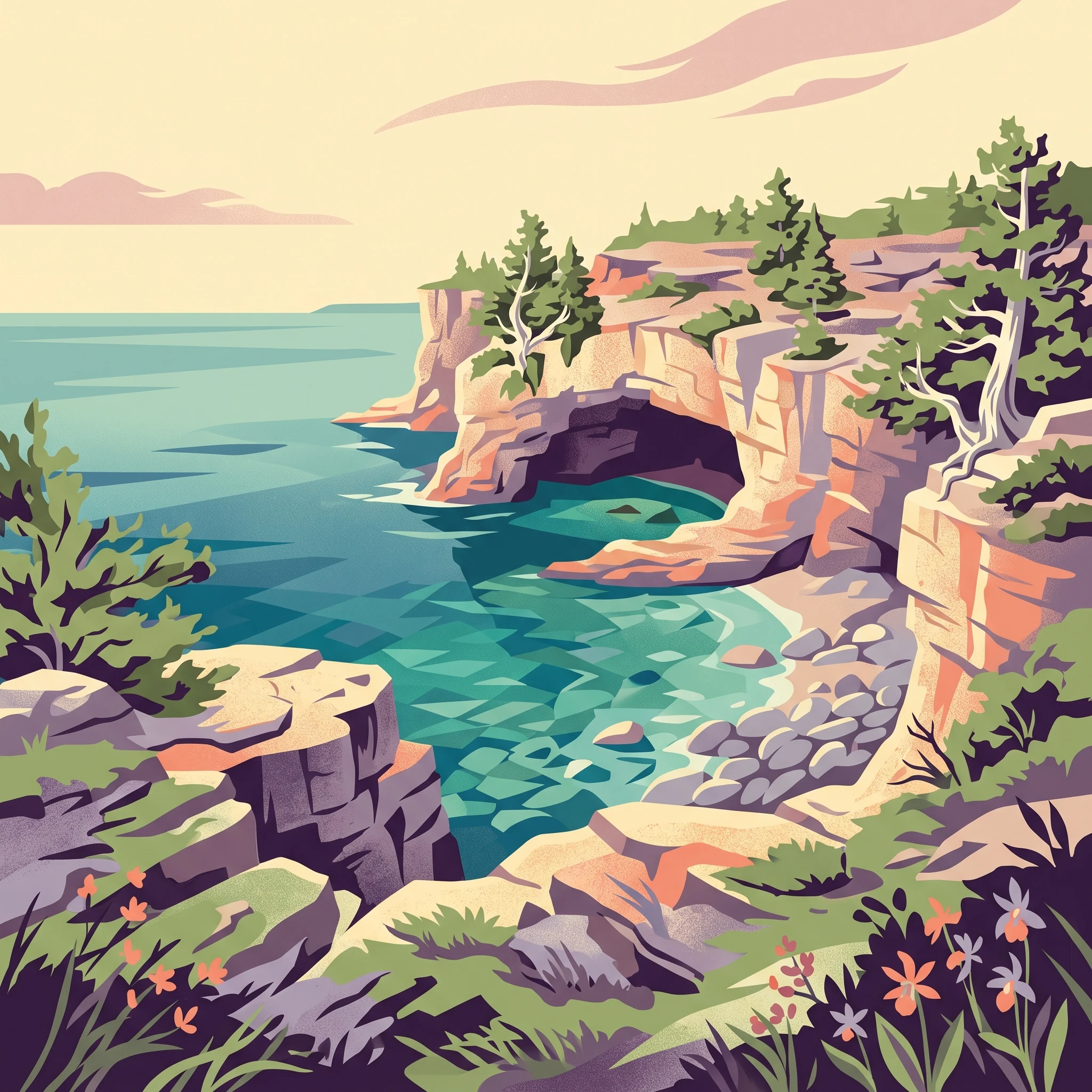
The landscape of Bruce Peninsula National Park is defined by the massive geological force of the Niagara Escarpment, a formation that shapes the peninsula's backbone and creates the dramatic boundary between upland and shore. The escarpment's dolomite cliffs, harder and more resistant than the underlying limestone, form spectacular vertical faces along the Georgian Bay shoreline where wave action has carved arches, caves, and the renowned Grotto. The geological story written in these rocks dates back approximately 400 million years when this area lay beneath a shallow tropical sea, teeming with life similar to today's Great Barrier Reef. As the ancient sea evaporated, magnesium-rich waters transformed limestone into the harder dolomite that now dominates the cliff faces. Erosion since the last ice age has sculpted the softer limestone into overhangs, caves, and the distinctive karst topography that characterizes the interior trails. The shoreline transitions from cobblestone beaches to sheer cliff faces, while inland, the terrain rises through forested slopes to the exposed alvars and cliff tops of the escarpment plateau. Views from the cliff edges stretch across Georgian Bay toward the islands of Fathom Five National Marine Park, creating panoramic vistas that rank among the most impressive in the Great Lakes region.

Bruce Peninsula National Park ecosystems, habitats, and plant life

The ecological diversity of Bruce Peninsula National Park stems from its position at the intersection of multiple habitat types and the unique microclimates created by the Great Lakes and the escarpment topography. The park contains a remarkable variety of natural communities including mixed-wood forests dominated by eastern white cedar, spruce, fir, birch, poplar, maple, and beech, interspersed with wetlands, alvars, talus slopes, and cliff face ecosystems. The floral significance of the park cannot be overstated, with over 34 species of orchids recorded within its boundaries, including the eastern prairie fringed orchid, one of North America's rarest species, and the dwarf lake iris, of which the park protects half the global population. The park supports 32 species of ferns and maintains significant populations of wildflowers, algae, mosses, and lichen. The proximity of Georgian Bay and Lake Huron creates moderated temperatures that allow species at the northern edge of their range to thrive, while the varied elevation and aspect of the terrain creates numerous microhabitats supporting species from boreal, temperate, and alpine zones.

Bruce Peninsula National Park wildlife and species highlights

The wildlife community of Bruce Peninsula National Park reflects the park's position as a corridor between northern and southern ecosystems, supporting species typical of both boreal forests and Great Lakes coastal environments. Large mammals including black bears, white-tailed deer, coyotes, and porcupines inhabit the forested interior, while smaller mammals such as chipmunks, red foxes, raccoons, snowshoe hares, and skunks are common throughout the park. The park holds particular significance for reptile conservation as one of the last strongholds of the massasauga rattlesnake, a species now extirpated from much of its former range in southern Ontario. Birdlife is diverse, with migratory species using the peninsula as a flyway and numerous resident species inhabiting the various forest and cliff habitats. The wetlands and shoreline support waterfowl and shorebirds, while the cliff faces provide nesting habitat for raptors. Amphibians and insects are well-represented in the wetland areas, contributing to the park's overall biodiversity.

Bruce Peninsula National Park conservation status and protection priorities

Bruce Peninsula National Park serves as the core protected area within the Niagara Escarpment World Biosphere Reserve, a UNESCO-designated region recognizing the area's exceptional natural values and the need for sustainable human use. The park's protection of the Niagara Escarpment preserves not only geological features of global significance but also the ecological corridors that allow species to move between habitats and adapt to changing conditions. The protection of rare orchid populations, particularly the dwarf lake iris and eastern prairie fringed orchid, demonstrates the park's role in conserving species of continental importance. As a Dark Sky Preserve, the park also protects the nocturnal environment, recognizing that natural darkness is an essential component of ecosystem health and a heritage worth preserving. The management approach balances public enjoyment with conservation imperatives, implementing visitor education, trail management, and research programs that enhance understanding of this complex ecosystem.

Bruce Peninsula National Park cultural meaning and human context

The Bruce Peninsula has been inhabited by Indigenous peoples for thousands of years, with the Anishinaabe and other nations maintaining connections to these lands and waters long before European settlement. The landscape holds cultural significance for local communities, though the national park designation has separated this area from direct Indigenous governance. The modern community of Tobermory serves as the primary service centre for park visitors, a small settlement whose economy depends substantially on tourism related to the park and adjacent Fathom Five National Marine Park. The park's cultural dimension also includes its role in Canadian identity, representing one of the nation's protected natural spaces that embody the values of wilderness preservation and environmental stewardship.

Top sights and standout views in Bruce Peninsula National Park

The Grotto remains the park's signature destination, a sea cave where visitors can swim in the crystal-clear waters of Georgian Bay beneath overhanging cliffs. Lion's Head offers a challenging climb rewarded by panoramic views across the bay from a prominent cliff viewpoint. The Cyprus Lake trails wind through the most dramatic karst terrain, passing arches, caves, and the iconic flowerpot rock formations that give Flowerpot Island its name. The Bruce Trail provides the backbone for exploration, with the Georgian Bay Trail and Marr Lake Trail offering access to the most spectacular shoreline sections. Winter transforms the park into a cross-country skiing and snowshoeing destination, while the dark sky designation makes the cold-season nights ideal for stargazing.

Best time to visit Bruce Peninsula National Park

The park welcomes visitors year-round, with each season offering distinct experiences. Summer brings the warmest conditions for swimming and beach activities, with July and August offering the most reliable weather for exploring the shoreline trails and the Grotto. Fall provides stunning color as the deciduous forests display autumn foliage, and the smaller crowds allow for more contemplative exploration of the trails. Spring brings wildflower season and the chance to see orchids in bloom, though trail conditions may be wetter. Winter offers a completely different character, with snow-covered cliffs and frozen surfaces creating a wilderness experience for cold-weather enthusiasts, though services are limited. The shoulder seasons of May, June, September, and October often provide the most comfortable hiking conditions and the lowest visitor volumes.
Park location guide

Geography guide, regional context, and park location map for Bruce Peninsula National Park

Bruce Peninsula National Park park geography, regions, and map view in Canada
Understand where Bruce Peninsula National Park sits in Canada through a broader geographic reading of the surrounding landscape, nearby location context, and its mapped position within the national park landscape.

How Bruce Peninsula National Park fits into Canada

Canada is a federal parliamentary constitutional monarchy spanning North America from the Atlantic to the Pacific and Arctic Oceans. With a population of over 41 million, it is officially bilingual in English and French at the federal level. The country gained independence from the United Kingdom through a gradual process culminating in 1982.

Wider geography shaping Bruce Peninsula National Park in Canada

Canada occupies the northern portion of North America, sharing its longest international border with the United States. The country extends from the Atlantic Ocean to the Pacific Ocean and northward into the Arctic Ocean, giving it the longest coastline of any nation.

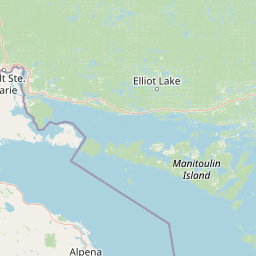
Map view of Bruce Peninsula National Park

Use this park location map to pinpoint Bruce Peninsula National Park in Canada, understand its exact geographic position, and read its mapped placement within the surrounding landscape more clearly.

Pigeon | © OpenStreetMap contributors

Location context for Bruce Peninsula National Park

Ontario
Park atlas

Explore surrounding national parks, compare regional protected areas, and trace the Niagara Escarpment's unique geographic spread.

Discover Related National Parks and Protected Areas near Bruce Peninsula National Park
Continue exploration from Bruce Peninsula National Park by browsing other national parks and protected areas, mapping their geographic spread across the Niagara Escarpment and Great Lakes region. Explore distinct protected landscapes, understand their regional context, and discover adjacent conservation areas through this focused atlas view for comprehensive geographic comparison.
National parkOntario

Georgian Bay Islands National Park: Ontario National Park Protected Landscape Atlas

Explore mapped boundaries and regional geographic context.

Gain a comprehensive understanding of Georgian Bay Islands National Park as a distinct protected area within Ontario. This entry provides detailed geographic context, focusing on the park's mapped landscape, its protected status as a national park, and its position within the regional geography of Canada. It is designed for users seeking structured information about protected lands and their atlas-level significance.

Area
13.5 km²
Established
1929
IUCN
II
Visitors
27.5K annual
National parkOntario

Rouge National Urban Park: Ontario's Mapped Protected Landscape Atlas

Explore national park boundaries and regional geography.

Investigate Rouge National Urban Park, a designated national park situated in Ontario, Canada. This page provides detailed atlas-style information focusing on its mapped boundaries, regional geographic context, and its identity as a significant protected natural landscape. Understand the park's role within the broader Canadian atlas for landscape exploration.

Area
79.1 km²
Established
2015
IUCN
V
Relief
Mixed relief
National parkOntario

Point Pelee National Park: Ontario's National Park Atlas and Protected Landscape Explorer

Mapped geography and protected area context within Ontario.

Point Pelee National Park is a designated national park in Ontario, Canada, offering a unique focus for geographic discovery. This entry details its protected landscape and mapped boundaries, essential for understanding its place within regional park atlases. Explore the core geographic identity of Point Pelee National Park and its significance as a protected natural area.

Area
15 km²
Established
1918
IUCN
II
Visitors
491.1K annual
National parkOhio

Cuyahoga Valley National Park: Detailed Atlas and Protected Landscape Information

Explore the mapped geography and natural terrain of Ohio's National Park.

Access detailed atlas information for Cuyahoga Valley National Park, a vital protected landscape in Ohio. Understand its geographic scope, mapped boundaries, and the surrounding natural terrain. This entry provides essential context for exploring the park's identity as a National Park and its significance within the broader mapped geography of the United States.

Area
132.7 km²
Established
2000
IUCN
II
Visitors
2.9M annual
Watercolor painting of green hills, islands, and a body of water under a pale yellow sky
National parkOntario

Thousand Islands National Park: Exploring Ontario's Protected Landscape Geography

Discover the mapped terrain and regional context of this national park.

Uncover the protected landscape identity of Thousand Islands National Park, a key national park located in Ontario. This resource focuses on its geographic setting, mapped boundaries, and overall atlas context, providing a clear understanding of its role as a protected area. Explore how its unique terrain contributes to the regional geography and the broader national park network, offering valuable insight for landscape-focused discovery.

Area
24.4 km²
Established
1904
IUCN
II
Visitors
109.3K annual
National parkThunder Bay District

Pukaskwa National Park National Park: Explore Its Protected Landscape and Geographic Identity

Discover the mapped boundaries and regional atlas context.

Pukaskwa National Park represents a key protected area, offering critical insights into the regional geography of Thunder Bay District. As a national park, its mapped boundaries and unique landscape identity are central to understanding Canada's protected lands. This entry provides the foundational geographic context for exploring Pukaskwa National Park within a structured atlas framework, detailing its place among other natural landscapes.

Area
1,878 km²
Established
1978
IUCN
II
Visitors
17.3K annual
National parkUnited States of America

Indiana Dunes National Park: Protected Landscape Geography and Map Exploration

Explore the National Park's geographic boundaries and regional context.

Indiana Dunes National Park represents a distinct protected area within the United States of America, characterized by its unique landscape setting. This entry provides a detailed atlas-style view, highlighting the park's mapped boundaries and its contribution to the regional geography. Understanding this National Park means appreciating its specific natural terrain and its place within the conservation landscape of North America.

Area
62.12 km²
Established
1966
IUCN
II
Visitors
2.8M annual
National parkKeweenaw County

Isle Royale National Park: Protected Landscape Atlas and Geographic Context

Explore mapped boundaries and natural terrain of this national park.

Isle Royale National Park offers a distinct opportunity for understanding protected landscapes through detailed map exploration. As a national park within Keweenaw County, its geographic identity and mapped boundaries provide valuable context for regional geography and atlas-based discovery. Investigate the natural terrain and protected land features that define this unique area, contributing to a richer comprehension of the surrounding protected areas.

Area
2,314 km²
Established
1940
IUCN
Ib
Visitors
29K annual

Common questions about visiting, size, designation, and location context for Bruce Peninsula National Park

Bruce Peninsula National Park FAQs for park facts, access, geography, and protected area context
Find quick answers about Bruce Peninsula National Park, including protected-area facts, park geography, trail and visitor context, and how the park fits into its surrounding country and regional landscape.
MoriAtlas Explorer

Continue Your Protected Areas Search Across the Global Atlas

Deepen your exploration by continuing the structured search for national parks and protected areas worldwide. Utilize the comprehensive filtering capabilities to compare different conservation landscapes and refine your understanding of global park geography. Discover more about the distribution and characteristics of protected natural areas.

Global natural geography