
Why Gamkaberg Nature Reserve stands out
Gamkaberg Nature Reserve is best known for its role in the recovery of the Cape mountain zebra, a subspecies once on the brink of extinction in the Little Karoo. The reserve was established specifically around one of the last surviving herds and has become a key site for their conservation and the reintroduction of historical game species to the region. Equally distinctive is the reserve's ecological convergence, where four Cape biomes (Fynbos, Succulent Karoo, Subtropical Thicket, and Evergreen Forest) meet within a single mountain landscape. This unusual biome overlap, combined with rugged Little Karoo scenery, abundant reptile and bird life, and archaeological sites including Stone Age rock art, gives Gamkaberg a layered natural and cultural identity.
Gamkaberg Nature Reserve history and protected-area timeline
Gamkaberg Nature Reserve was established in 1974 with a focused conservation mission: to protect one of the last remaining herds of Cape mountain zebra in the Little Karoo and to reintroduce game species that had been lost from the region. By 1976, the founding Cape mountain zebra herd had dwindled to only five individuals, underscoring the urgency of the reserve's creation.
Over the following decades, Gamkaberg's protected footprint expanded beyond the original core area. The reserve was later declared a World Heritage Site, signaling recognition of its broader ecological and conservation value. It now sits within the larger Gamkaberg Conservation Area, which links Gamkaberg with adjacent protected ranges such as Rooiberg Nature Reserve and Groenefontein Nature Reserve under joint CapeNature management.
Archaeological traces, including Stone Age rock art and fossils, give the landscape a much older human story that predates colonial-era names such as Gamkaberg, which itself blends a Khoi-khoi lion reference with the Afrikaans word for mountain. Remains of herders' huts, repurposed today as remote stone shelters for visitors, reflect later pastoral use of these mountains before the area was formally protected.
Gamkaberg Nature Reserve landscape and geographic character
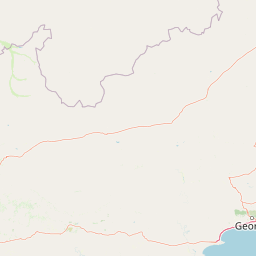
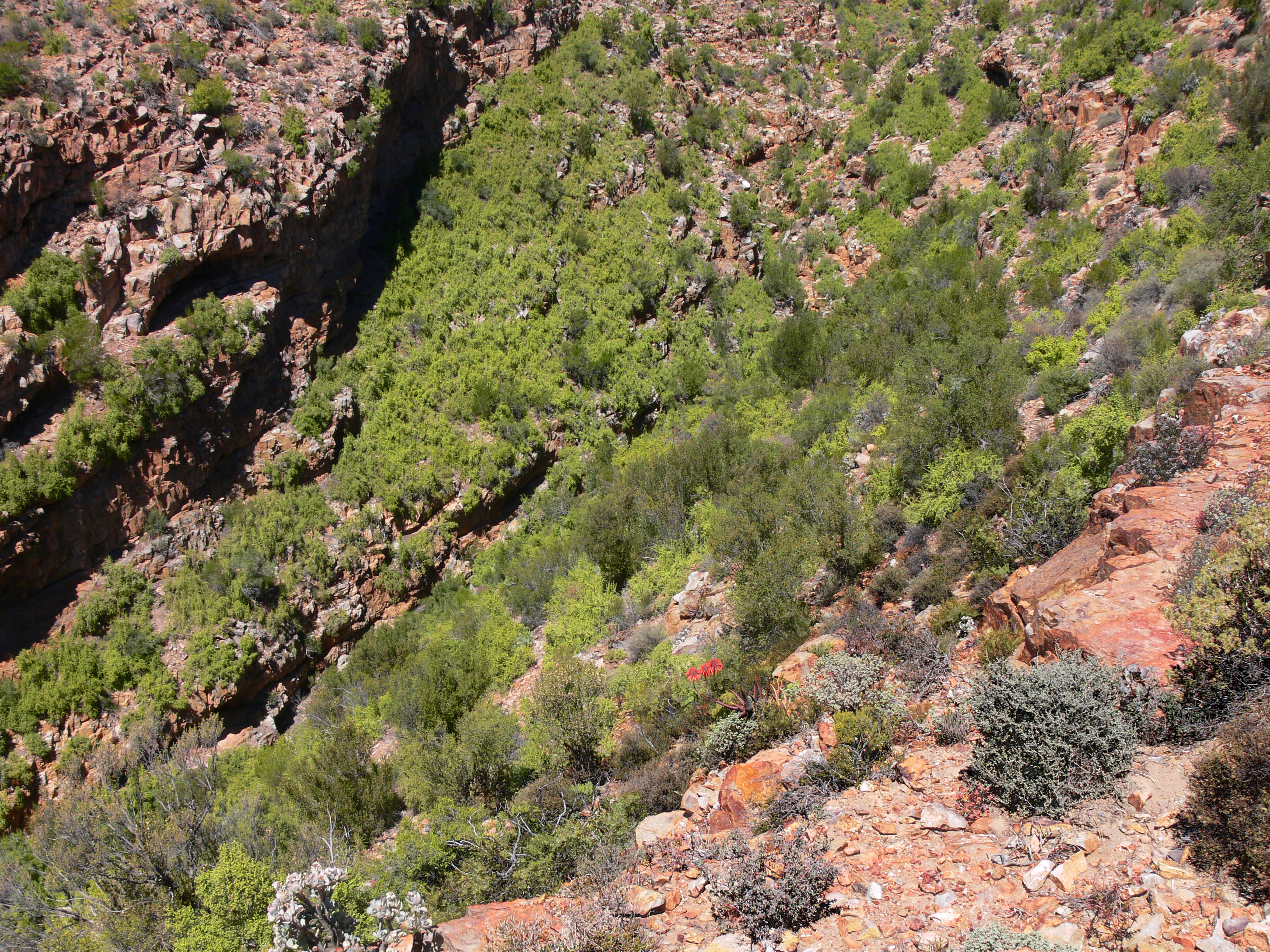
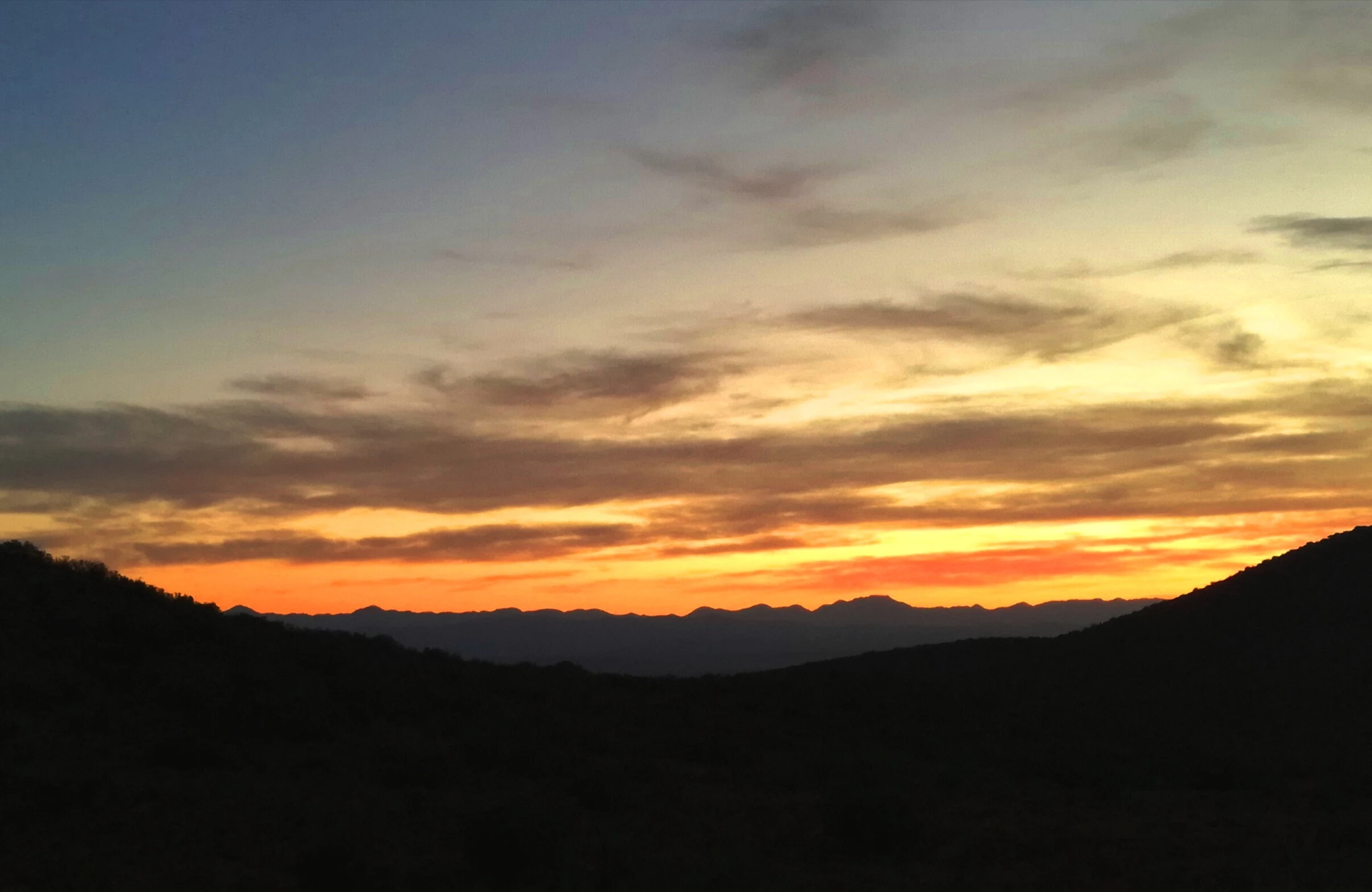
The landscape of Gamkaberg Nature Reserve is shaped by a discrete mountain range within the Little Karoo, with peaks, plateaus, and deeply cut gorges defining the interior terrain. These mountains form a distinct subrange of the broader Little Karoo, flanked by neighboring ranges that are themselves part of the same conservation complex, including Rooiberg and Groenefontein.
The Gamka River traces a long arc through the region, beginning far to the north in the arid Great Karoo and flowing southward toward the ocean. Within the reserve, the interplay of elevation, gorges, and river valleys creates sheltered microclimates that contrast with the open, drier lowlands typical of the surrounding Karoo.
Visible across the mountains are scattered fossils and Stone Age rock art panels, embedded directly in the rocky terrain. Together with the pastoral-era stone shelters (former herders' huts now restored for visitor use), these features give the landscape a strong sense of layered geological and human history alongside its scenic mountain character.
Gamkaberg Nature Reserve ecosystems, habitats, and plant life
Gamkaberg sits at a rare ecological crossroads where four of the Cape's distinct biomes meet within a single landscape: Fynbos, Succulent Karoo, Subtropical Thicket, and Evergreen Forest. The meeting of these vegetation systems is the reserve's defining ecological feature, supporting the unusually high plant diversity for which the greater Cape region is globally famous.
Fynbos contributes fine-leaved shrubland typical of nutrient-poor Cape soils, while Succulent Karoo brings drought-tolerant succulent species adapted to the arid Little Karoo climate. Subtropical Thicket adds denser, broader-leaved vegetation in sheltered valleys and lower slopes, and patches of Evergreen Forest occupy the most sheltered, moister microhabitats within the mountains.
This biome overlap extends beyond plants, supporting an unusually wide range of reptile and bird species alongside the reserve's better-known large mammals. The combination of arid Karoo exposures, rocky gorges, and more mesic thicket and forest patches produces a striking diversity of habitat types within a relatively compact protected area.
Gamkaberg Nature Reserve wildlife and species highlights
The Cape mountain zebra is the species most closely associated with Gamkaberg and remains central to the reserve's conservation identity. The reserve was founded to protect one of the last herds in the Little Karoo, and this subspecies, once reduced to near-extinction, continues to be a flagship species for the property.
Alongside the zebra, Gamkaberg supports a broad community of medium and large mammals adapted to the Little Karoo, including hartebeest, Cape grysbok, and a wide range of other antelope species. Predators and scavengers such as leopard, caracal, aardwolf, and black-backed jackal round out the mammal community, reflecting the reintroduced-game vision behind the reserve's creation.
The reserve is also noted for an unusually rich reptile fauna and a wide variety of bird species, both linked to its position at the meeting point of multiple vegetation biomes. Together, these mammal, reptile, and bird communities make Gamkaberg a significant conservation area for species ranging from charismatic megafauna to smaller, often-overlooked elements of Karoo biodiversity.
Gamkaberg Nature Reserve conservation status and protection priorities
Gamkaberg Nature Reserve was established as a direct conservation intervention: a protected area created around a tiny, isolated herd of Cape mountain zebra and designed to re-establish the broader game community of the Little Karoo. Its conservation significance is therefore rooted not only in habitat protection but also in active species recovery and translocation history.
The reserve's status as a World Heritage Site, together with CapeNature's management of a much larger linked conservation landscape of roughly 80,000 hectares, reflects recognition of its ecological value at multiple scales. The inclusion of neighboring ranges such as Rooiberg and Groenefontein within the same management framework creates connectivity across a substantial portion of the Little Karoo, supporting long-term viability of populations that require extensive range.
The reserve's location at the convergence of four Cape biomes (Fynbos, Succulent Karoo, Subtropical Thicket, and Evergreen Forest) further strengthens its conservation importance, preserving representative samples of multiple vegetation types within a single protected unit. The deliberate, low-impact design of its tourism infrastructure, from rustic eco-lodges to remote stone shelters, is aligned with this conservation mission.
Gamkaberg Nature Reserve cultural meaning and human context
The name Gamkaberg itself reflects the layered cultural history of the region, combining an indigenous Khoi-khoi word for lion with the Afrikaans suffix "berg" (mountain). This linguistic blend mirrors the broader South African heritage of indigenous and European-European colonial languages coexisting in place names across the Karoo.
Within the reserve, Stone Age rock art and fossil sites provide evidence of very long human presence in these mountains, long before formal protection or pastoral land use. The presence of old herders' huts, now restored as remote stone shelters for visitors, points to a more recent pastoral era in which the Little Karoo mountains were actively used by livestock herders.
The reserve's accommodation philosophy, emphasizing rusticity and minimum environmental impact, reflects a contemporary cultural ethic that values the landscape's natural and historical character over high-volume tourism development. This ethos links present-day visitors to both the indigenous and pastoral heritage embedded in the terrain.
Top sights and standout views in Gamkaberg Nature Reserve
The standout feature of Gamkaberg Nature Reserve is its role in saving the Cape mountain zebra in the Little Karoo, a conservation story that began with only five surviving animals and continues to define the reserve's identity today.
Equally compelling for visitors is the unusual overlap of four Cape biomes within a single mountain landscape, supporting exceptional plant diversity, abundant reptile life, varied birdlife, and a full community of reintroduced antelope and predators. Stone Age rock art, fossils, and renovated herder shelters add a tangible archaeological and pastoral dimension, while hiking, 4x4 routes, eco-lodges, and a campsite provide low-impact ways to experience the reserve's rugged scenery.
Best time to visit Gamkaberg Nature Reserve
The Little Karoo experiences a semi-arid climate with hot, dry summers and cooler, wetter winters, and seasonality matters for how Gamkaberg is experienced. Spring, roughly from August to October, is often especially rewarding because winter rains typically green the landscape and wildflower displays intensify, while cooler temperatures make hiking and 4x4 routes more comfortable.
Autumn and winter bring cooler conditions and the possibility of mountain rain and mist in the gorges, which can make trails more challenging but also highlights the reserve's succulent Karoo and thicket vegetation. Summer heat can be intense, particularly in exposed lowland and plateau areas, and the mountains' sheltered valleys may concentrate warmth.
Seasonal contrasts also affect wildlife viewing, with cooler months often bringing more active animal movement in cooler parts of the day, while spring supports peak floral diversity across the Fynbos and Succulent Karoo components of the reserve.