
Why Gros Morne National Park stands out
Gros Morne is best known for its exceptional geological significance as a living classroom for plate tectonics. The Tablelands section of the park features ultramafic rocks, primarily peridotite and serpentinite, that originated in the Earth's mantle and were forced to the surface through plate collision hundreds of millions of years ago. These rocks lack nutrients needed for most plant life, creating a barren desert-like landscape unlike typical Newfoundland terrain. Western Brook Pond, a 16-kilometer freshwater fjord, contains water of exceptional purity and features Pissing Mare Falls, the highest waterfall in eastern North America. The park's geological features were fundamental to understanding continental drift and remain a key site for geological research worldwide.
Gros Morne National Park history and protected-area timeline
Gros Morne National Park had a prolonged journey to full national park status. The area was designated as a national park reserve in August 1973, initiating a period of research, consultation, and gradual development. During this reserve period, the park's exceptional geological significance became increasingly clear to researchers, particularly through the work of geologists Robert Stevens and Harold Williams, whose studies helped articulate the site's global importance. The park's geological formations provided crucial evidence for understanding plate tectonic processes, with the exposed oceanic crust and mantle rocks offering rare direct observation of deep Earth materials. This scientific significance supported the successful 1987 World Heritage Site nomination. After more than three decades as a reserve, Gros Morne was formally established as Canada's 41st national park on October 1, 2005, cementing its permanent protection within the national parks system. The park was also featured in the 2011 National Parks Project film series.
Gros Morne National Park landscape and geographic character
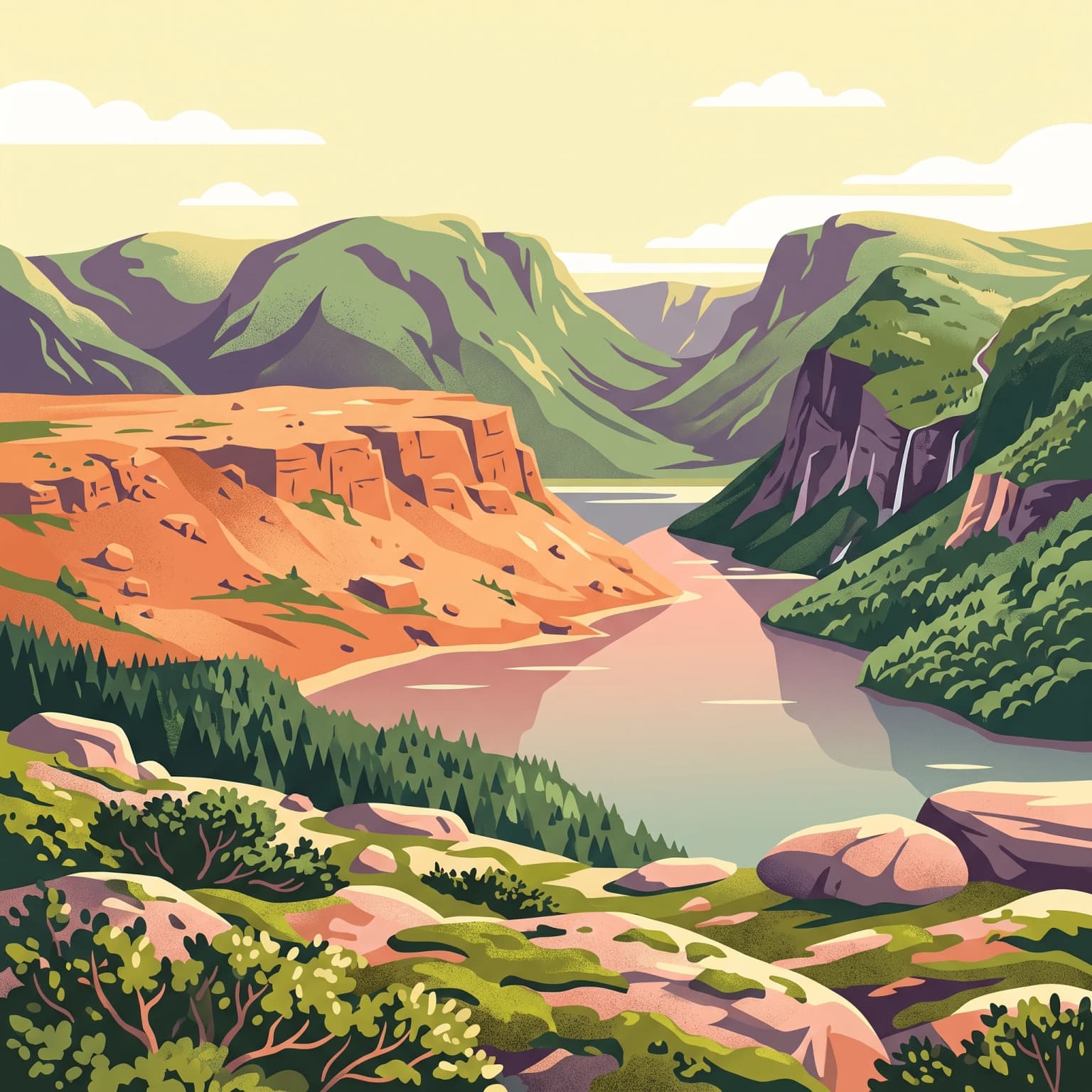
The landscape of Gros Morne National Park is defined by dramatic contrasts, from the windswept coastal cliffs of the Great Northern Peninsula to the alpine heights of the Long Range Mountains. The park's interior is characterized by mountainous terrain with elevations reaching 806 meters at Gros Morne Mountain itself, while the famous Tablelands present an almost alien terrain of rust-colored ultramafic rock that lacks the vegetation typical of surrounding areas. Western Brook Pond, a narrow fjord stretching 16 kilometers inland, sits flanked by steep cliffs and receives the dramatic Pissing Mare Falls, which cascades directly into the fjord. The coastline features rocky shores, beaches, and the sheltered waters of Bonne Bay. Throughout the park, the legacy of glacial activity is evident in the U-shaped valleys, erratics, and the general topography carved during the Pleistocene ice age. The landscape changes dramatically with elevation, from coastal heath through forest zones to alpine tundra on the highest peaks.
Gros Morne National Park ecosystems, habitats, and plant life
The ecological character of Gros Morne spans multiple habitat types including coastal marine environments, coniferous forests, open bogs, and alpine zones. The park's position on Newfoundland's west coast places it at the transition between different climatic influences, supporting diverse plant communities. The coastal areas feature shoreline vegetation adapted to salt spray and harsh conditions, while the interior supports forests dominated by black spruce and balsam fir. The extensive bog systems, which cover significant portions of the park, contain distinctive vegetation adapted to acidic, nutrient-poor conditions. The Tablelands present a unique ecological challenge due to the ultramafic bedrock, which produces soils deficient in essential nutrients and containing minerals toxic to most plants, resulting in sparse vegetation cover and specialized plant communities adapted to these extreme conditions. Marine ecosystems in the coastal waters support various fish species and invertebrates, particularly during the seasonal capelin run.
Gros Morne National Park wildlife and species highlights
Gros Morne supports remarkable wildlife populations, with moose being particularly prominent throughout the park. The moose population, introduced to Newfoundland from the Maritime provinces around 1900, has thrived in the park environment, with densities five to twenty times higher than comparable areas elsewhere in Canada according to Parks Canada studies. The park is home to Newfoundland's endemic caribou ecotype, a distinctive population adapted to island conditions, as well as the Newfoundland black bear subspecies. Canada lynx prey on the abundant snowshoe hare populations found throughout the forest and bog habitats. Coastal areas support harbour seals in St. Pauls Inlet, while offshore waters host diverse cetaceans including Atlantic white-sided dolphins, fin whales, harbour porpoises, humpback whales, minke whales, killer whales, and pilot whales, particularly during the early summer capelin migration. Birdlife is abundant, with rock ptarmigan and willow ptarmigan inhabiting alpine areas, while shorebirds and waterfowl utilize coastal and bog habitats throughout the seasons.
Gros Morne National Park conservation status and protection priorities
Gros Morne National Park holds exceptional conservation significance as both a national park and UNESCO World Heritage Site. The park was recognized by UNESCO in 1987 for both its geological history and exceptional natural beauty, representing a rare example of the process of continental drift where deep ocean crust and mantle rocks are exposed at Earth's surface. This geological significance was further acknowledged when the Mohorovičić discontinuity at Gros Morne was included in the International Union of Geological Sciences' assembly of 100 geological heritage sites worldwide in 2022. The Global Boundary Stratotype Section and Point defining the Tremadocian stage of the Ordovician system is located at Green Point within the park, marking this as a critical site for geological science. Beyond geology, the park protects significant ecological diversity across its terrestrial and marine environments, safeguarding populations of endemic Newfoundland species and critical coastal habitats.
Gros Morne National Park cultural meaning and human context
Gros Morne National Park is situated within the traditional territory of the Mi'kmaq people, the Indigenous peoples of Newfoundland's west coast. The park contains communities of Newfoundland settlers who have inhabited the area for generations, maintaining distinct cultural traditions tied to fishing, logging, and subsistence lifestyles. The park's surrounding communities, including Rocky Harbour, Trout River, and Woody Point, have developed alongside the protected area and continue to contribute to the region's cultural identity. The park itself hosts several cultural events and festivals, including the Gros Morne Theatre Festival, Writers at Woody Point, Gros Morne Summer Music, and Trails, Tales and Tunes, which celebrate arts and literature in this remarkable landscape. The James Callaghan Trail, named after the former British Prime Minister who visited in 1976 and contributed to conservation awareness, provides access to the park's interior through a challenging 16-kilometer hiking route.
Top sights and standout views in Gros Morne National Park
Gros Morne National Park's defining highlights include the Tablelands, where mantle-derived ultramafic rocks create a surreal barren landscape unlike anywhere else in eastern North America; Western Brook Pond, a pristine freshwater fjord with exceptional water clarity and the continent's highest eastern waterfall; the panoramic summit hike over Gros Morne Mountain along the James Callaghan Trail; and the Long Range Traverse, a multi-day backcountry route through the heart of the park's wilderness. The park's world-class geological exposures, which helped scientists understand plate tectonics, remain accessible through interpretive trails and viewpoints. Visitors can explore coastal trails, discover hidden beaches and sea caves, observe moose and other wildlife, and experience the distinctive culture of Newfoundland's west coast communities. The park's UNESCO designation recognizes both its scientific importance and outstanding natural beauty.
Best time to visit Gros Morne National Park
The summer months of July and August offer the most reliable weather for exploring Gros Morne's trails and coastal areas, with long daylight hours allowing extensive hiking opportunities. Autumn brings spectacular fall colors to the boreal forest and offers excellent wildlife viewing opportunities as moose become more active during the rutting season. Spring and early summer feature the capelin run along the coast, attracting diverse marine wildlife and providing unique viewing opportunities. Winter transforms the park into a snowy wilderness, though many trails are less accessible and services are reduced. The shoulder seasons of late May and September often provide a balance of accessible trails with fewer visitors, though weather can be more variable. Visitors should be prepared for Newfoundland's notoriously changeable weather regardless of season, with fog, rain, and wind possible at any time.