A small, historic Danube meander hill at the heart of Tuttlingen, protected as a landscape conservation area.
Honberg
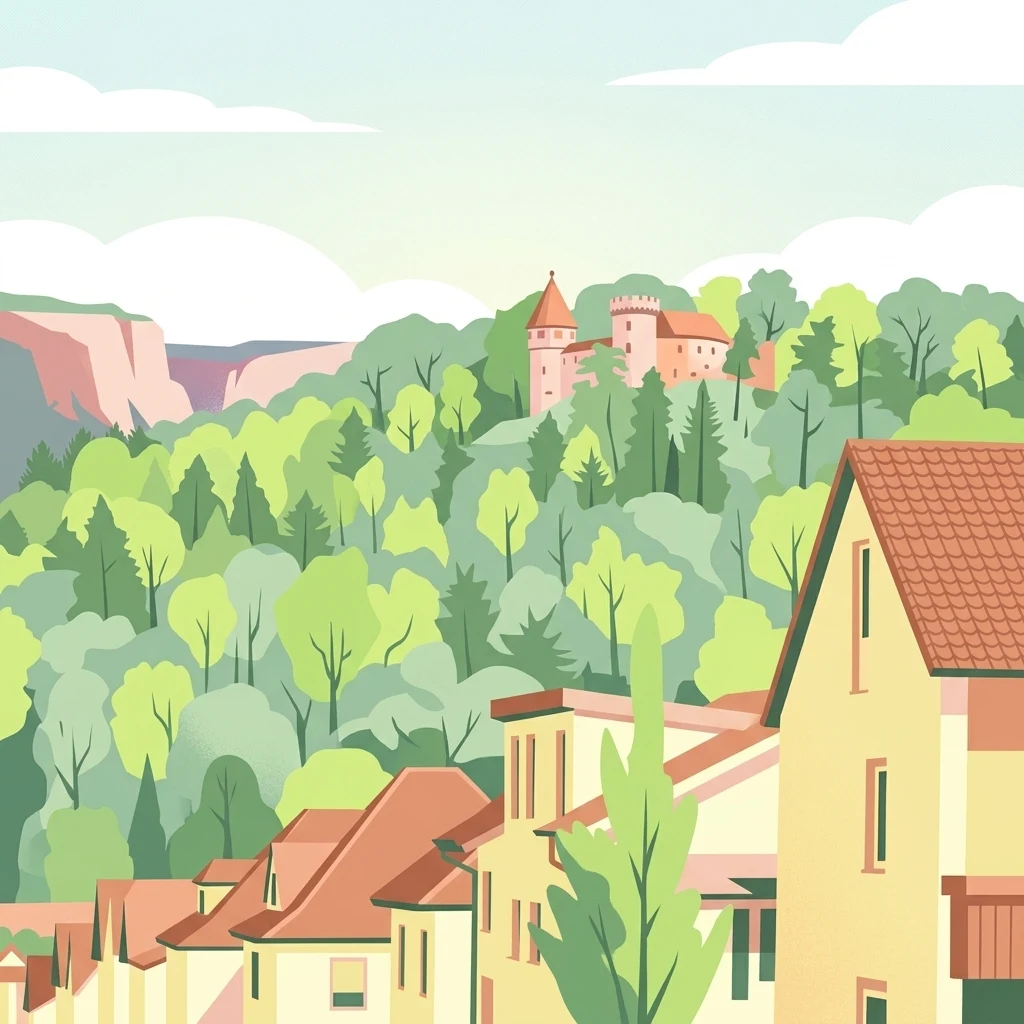
The Honberg is a protected landscape (Landschaftsschutzgebiet) centered on a small hill in the heart of Tuttlingen, in the state of Baden-Württemberg in southwestern Germany. Geologically, the hill is a Umlaufberg, an isolated ridge left behind as the Danube carved a new meander around it, leaving the older valley loop cut off as a standalone topographic feature. Today the hill sits entirely within the urban area of Tuttlingen, surrounded on all sides by the town, yet it preserves a recognizable mosaic of woodland, orchard meadow, pasture, and the ruins of the medieval Honberg Castle on its plateau.
Although now consumed by the surrounding city, the Honberg functions as a key local recreation area and as a visual and ecological landmark in the Danube valley. It lies within the natural region of Baaralb and Upper Danube Valley and is part of the broader Naturpark Obere Donau (Upper Danube Nature Park). Because of its geological interest, its mix of habitats, and its long history of human use, including medieval fortification, sheep grazing, and small-scale allotment gardening, the area was placed under formal landscape protection in February 1986.
Protection is administered by the Landratsamt Tuttlingen (Tuttlingen district office). The protected designation is intended to preserve the hill's combination of natural landscape character and historical cultural features, particularly the castle ruins and their associated park, against further loss to urban development. Although small in size, the Honberg is emblematic of how ancient Danube valley landforms survive, in compressed form, within modern German towns.