Mori Atlas logo
Nature reserveMiejski Bór Nature Reserve

Understanding the botanical significance, sandy upland terrain, and forest boundaries in the Krotoszyn region

Miejski Bór Nature Reserve: A Detailed Geographic Atlas of the Protected Woodland Landscapes

(Rezerwat przyrody Miejski Bór)

Miejski Bór Nature Reserve stands as a vital floristic protected area within the Greater Poland Voivodeship, specifically established to safeguard an unusual mixture of fresh pine forest and broadleaf species. This site serves as a botanical anchor within the broader Wysoczyzna Kaliska, showcasing a diverse canopy of oak, maple, and larch while preserving historical Bronze Age burial mounds. Our detailed atlas data maps the reserve's unique woodland composition and its role as a key conservation node within the Dąbrowy Krotoszyńskie protected landscape system.

floristic reservefresh pine forestlowland forestprotected plantsbronze age moundsactive conservation
A stylized digital illustration showing a mountain range with a waterfall descending into a flowing river through a pine and deciduous forest.

Miejski Bór Nature Reserve

Nature reserve

Park overview

Structured park overview, official facts, and landscape profile for Miejski Bór Nature Reserve

Miejski Bór Nature Reserve park facts, protected area profile, and essential visitor context

Review the core facts for Miejski Bór Nature Reserve, including designation, size, terrain, visitor scale, habitats, and operating context in one park-focused overview.

About Miejski Bór Nature Reserve

Miejski Bór Nature Reserve is a compact but ecologically focused protected area in the Wielkopolskie Voivodeship of west-central Poland. It lies near Krotoszyn, within the sandy uplands of the Wysoczyzna Kaliska and inside the larger Dąbrowy Krotoszyńskie Baszków-Rochy Protected Landscape Area, a region defined by oak-rich forests, dunes, and postglacial landforms.

The reserve was created in 1987 to protect a representative but unusually diverse patch of lowland forest. Its core value is a fresh pine forest, traditionally called bór świeży in Polish forest classification, which is the dominant community but is enriched by a wide range of broadleaf associates. Pedunculate oaks grow alongside red oaks, a species not native to the region, while sycamore maples, aspens, silver birches, and larches add structural variety. Together they create a multi-layered canopy far richer than a typical pure pine stand on sandy soils.

The botanical importance of Miejski Bór extends beyond the tree layer. The reserve protects populations of Daphne mezereum and Lonicera periclymenum, two protected plant species that are relatively uncommon in the Wielkopolska lowlands. Their sustained presence indicates a forest microclimate and soil history favorable to more demanding woodland flora, and it is one of the reasons the site was given strict protective status rather than being left as ordinary managed forest.

Cultural layers also enrich the reserve. Within its borders, archaeologists have recorded two Bronze Age burial mounds, known locally as kurhany, that belong to a wider cluster of prehistoric burial sites scattered across the Dąbrowy Krotoszyńskie forests. Nearby cultural and natural landmarks, including the monumental Dąb Rozdrażewskich oak and a glacial erratic boulder near Smoszew, complement the reserve and reflect the deep overlap between natural and human history in this part of Poland.

Today Miejski Bór is managed under active conservation, a legal category in Polish nature protection that allows targeted interventions to preserve or restore the desired forest character. Its small size, botanically rich understory, and location within a broader protected landscape make it a focused but meaningful component of regional biodiversity conservation.

Quick facts and research context for Miejski Bór Nature Reserve

Miejski Bór is a floristic nature reserve in gmina Krotoszyn, within the Krotoszyn County of the Wielkopolskie Voivodeship in west-central Poland. It was established in 1987 through a regulation of the Minister of Environmental Protection and Natural Resources and currently covers roughly 24 hectares under active conservation management.

The reserve sits on the Wysoczyzna Kaliska, a sandy upland mesoregion typical of the historical Dąbrowy Krotoszyńskie forest complex. It protects a fresh pine forest community enriched with broadleaf species and a small suite of protected plants. Its territory also includes archaeological features dating back to the Bronze Age.

Protection and recognition

Documented terrestrial conservation measures and recognition data

Miejski Bor Nature Reserve Protection Status and Governance

Miejski Bor Nature Reserve maintains a defined terrestrial protection status and management scope within its regional conservation framework. Documented administrative records outline the official designation parameters and conservation boundaries associated with the protected landscape.

Protection details

Protection scope
Terrestrial
Park context

Deeper park guide and search-rich context for Miejski Bór Nature Reserve

Miejski Bór Nature Reserve history, landscape, wildlife, and travel context

Explore Miejski Bór Nature Reserve through its history, landscape character, ecosystems, wildlife, conservation priorities, cultural context, and seasonal travel timing in a structured park guide built for atlas discovery and search intent.

Why Miejski Bór Nature Reserve stands out

The reserve is best known for protecting a fresh pine forest community, known ecologically as bór świeży, that is enriched by a notable mixture of broadleaf species including pedunculate oak, red oak, sycamore maple, aspen, birch, and larch. This mix of typically dry-site conifers with more demanding broadleaves gives the stand a distinctive character within the regional forest landscape. It is also recognized for sheltering protected plant species that are unusually uncommon in this part of Poland, including Daphne mezereum and Lonicera periclymenum. The presence of these taxa inside a small reserve makes Miejski Bór a botanically meaningful site rather than just a representative patch of regional woodland.
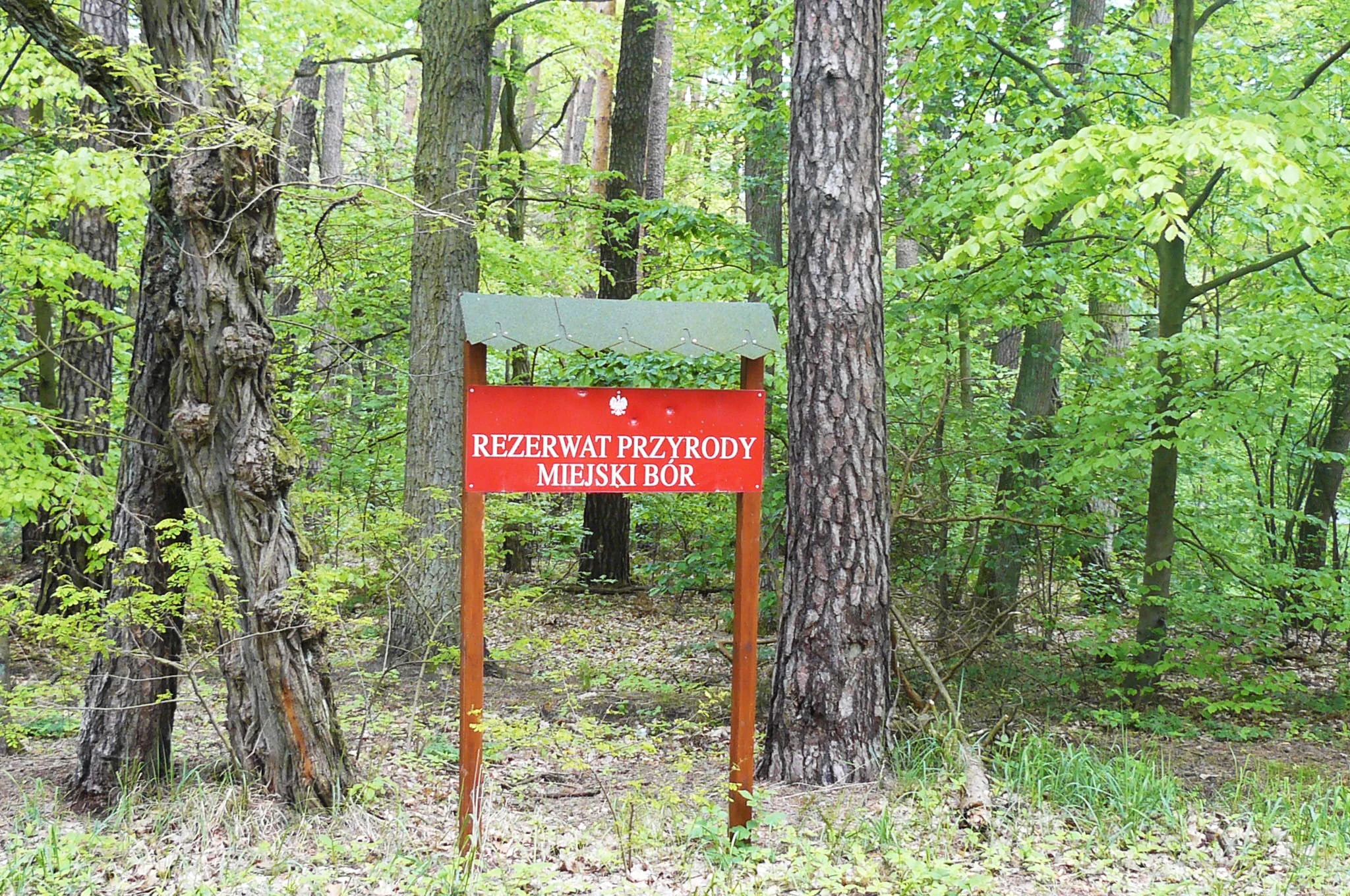
A red wooden sign on two posts in a forest, featuring white Polish text that reads REZERWAT PRZYRODY MIEJSKI BÓR.
Information sign at the entrance of Miejski Bór Nature Reserve.

Miejski Bór Nature Reserve history and protected-area timeline

The area that is now Miejski Bór Nature Reserve was brought under formal protection in 1987, when Poland's Minister of Environmental Protection and Natural Resources issued a regulation creating the reserve along with several others. The original founding act listed a slightly larger area of about 28.87 hectares, although the present protected area is approximately 24.36 hectares after later adjustments reflected in the legal record.

The reserve's designation was prompted by the combination of an ecologically valuable mixed forest stand and the presence of protected plant species that were considered vulnerable under Polish conservation rules at the time. The legal foundation was updated through an announcement by the voivode of Wielkopolska in 2001 and again by a 2015 order from the Regional Director of Environmental Protection in Poznań, which together confirmed the reserve's continued status and active conservation regime.

Long before modern protection, the area carried traces of much older human activity. Two Bronze Age burial mounds, the traditional kurhany characteristic of the Dąbrowy Krotoszyńskie region, lie within the reserve, indicating that prehistoric communities used these forests in ways that left lasting archaeological signatures. The reserve is therefore the product of a long layered history, from prehistoric land use through late twentieth century ecological designation to ongoing active management.

Miejski Bór Nature Reserve landscape and geographic character

Miejski Bór sits within the Wysoczyzna Kaliska, a sandy upland mesoregion shaped by Pleistocene glaciation and historically covered by extensive lowland forests. The terrain here is gently undulating, with sandy soils typical of the postglacial plains of west-central Poland, and the reserve's surface reflects this broader regional character rather than presenting dramatic relief.

The defining landscape feature of the reserve itself is its woodland cover. A fresh pine forest forms the backbone of the site, but the forest is notably enriched by broadleaf species such as birch, pedunculate oak and introduced red oak, sycamore maple, aspen, and larch. The resulting mixture gives the canopy a varied texture and seasonal palette unusual for a sandy-site pine community.

Around and beyond the reserve, the Dąbrowy Krotoszyńskie Protected Landscape Area extends the same forest matrix, embedding Miejski Bór in a much larger wooded region. Within this broader setting, other landscape features appear close to the reserve, including the celebrated Dąb Rozdrażewskich oak and a large glacial erratic near Smoszew, both of which help anchor the local identity of the area as a place where natural landforms, monumental trees, and protected forests meet.
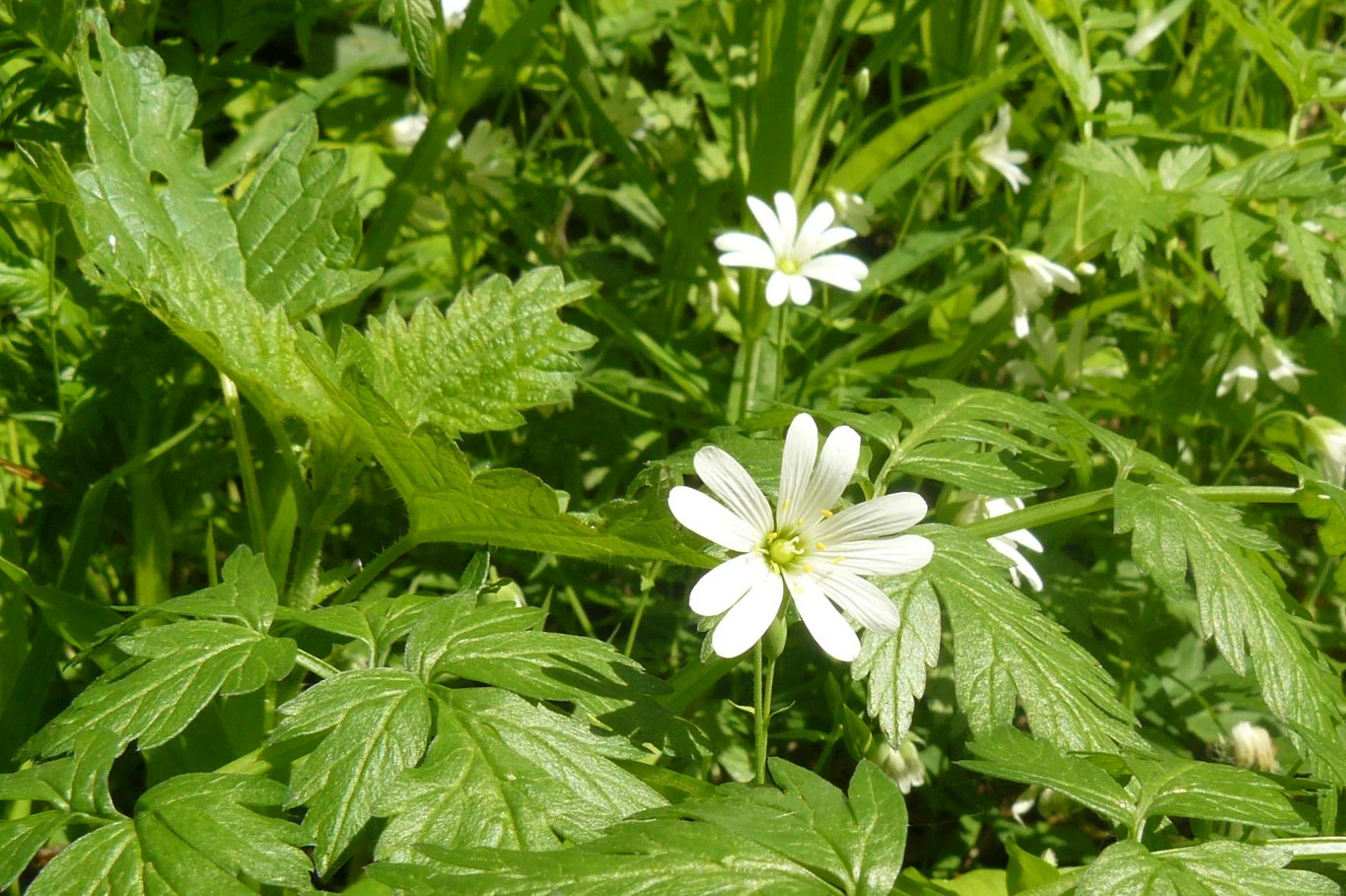
Close up view of small white wildflowers with elongated petals blooming amidst lush green foliage in a forest setting.
Wildflowers in the undergrowth of Miejski Bór Nature Reserve.

Miejski Bór Nature Reserve ecosystems, habitats, and plant life

Ecologically, Miejski Bór belongs to the lowland sandy-soil forest zone of western Poland, but it is more botanically diverse than its modest size would suggest. Its principal plant community is the fresh pine forest, known in Polish forestry as bór świeży, a habitat typically dominated by Scots pine on moderately moist but well-drained sandy soils.

What distinguishes the reserve's ecology from a textbook fresh pine forest is its unusually high share of broadleaf species. Pedunculate oak is joined by red oak, an introduced species that has become established in the stand, along with sycamore maple, aspen, silver birch, and larch. This mixture broadens the habitat structure, supports a richer shrub and herb layer, and gives the forest a distinctive multi-aged, multi-species feel.

The forest floor is the second major ecological highlight. The reserve harbors protected plant species including Daphne mezereum, whose early spring blooms are a particular rarity in Wielkopolska forests, and Lonicera periclymenum, a climbing honeysuckle more commonly associated with milder regions. Their continuous presence indicates that the woodland microclimate, soil, and history have together preserved conditions suitable for sensitive woodland flora.
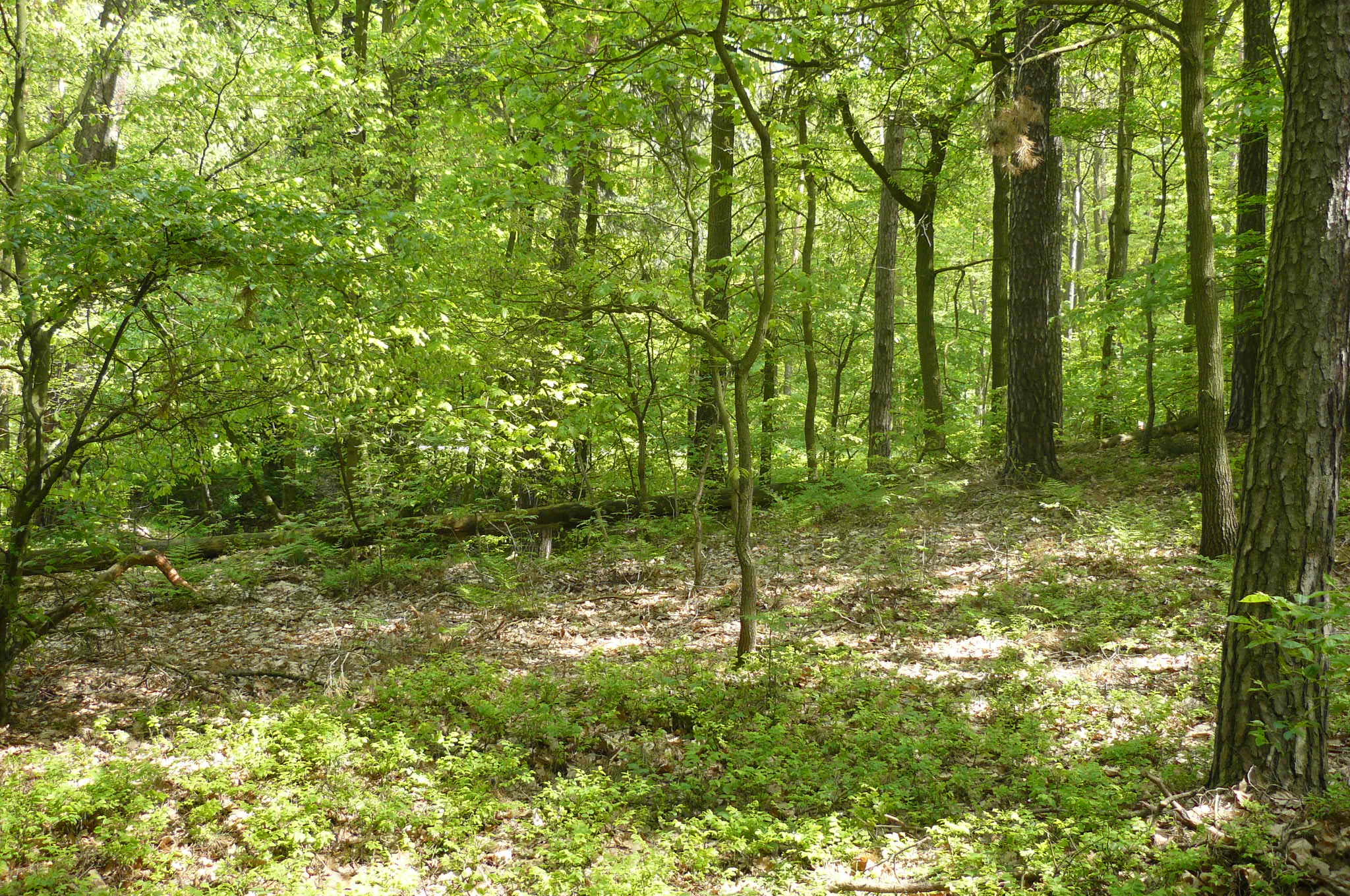
A view into a dense, sunlit temperate deciduous and coniferous forest with a leaf-covered floor and mossy patches.
The lush green interior of Miejski Bór Nature Reserve.

Miejski Bór Nature Reserve wildlife and species highlights

Miejski Bór is primarily valued for its floristic character rather than for charismatic large mammal populations, and the source material does not include a detailed mammal or bird inventory. What is clear is that its diverse mixed forest, with both coniferous and broadleaf elements, provides habitat structure suitable for a typical range of lowland forest fauna found across the Dąbrowy Krotoszyńskie.

The mix of mature pines, oaks, and other broadleaves creates varied nesting and foraging opportunities for woodland birds, while the shrub layer and decaying wood support typical small-mammal and invertebrate communities of the region. The protected understory plants, including Daphne mezereum and Lonicera periclymenum, also indicate a herb and shrub layer rich enough to sustain associated insect and pollinator communities.
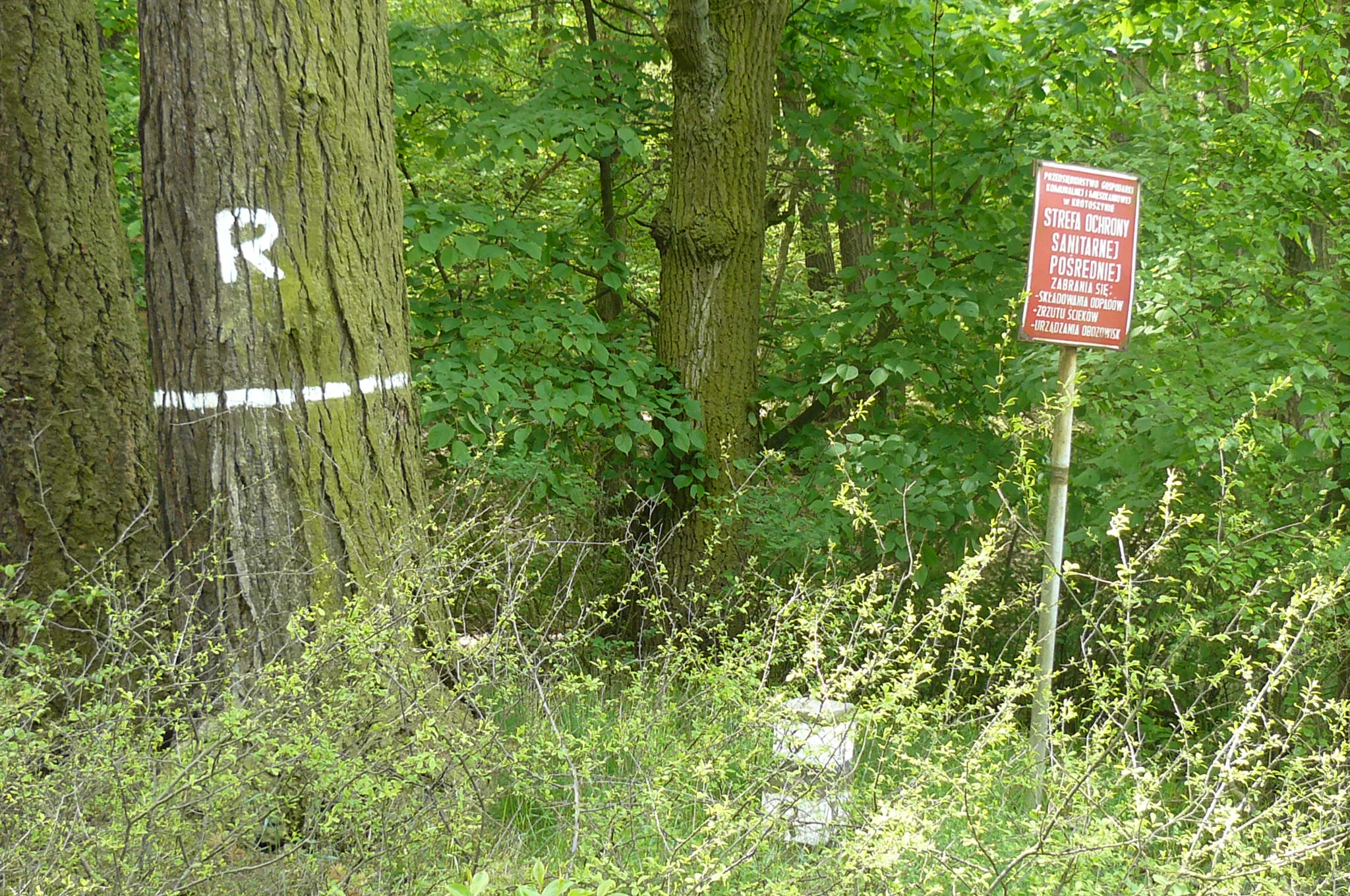
A red rectangular sign on a metal pole stands in a dense green forest, with a tree trunk in the foreground marked with a painted white letter R and a horizontal white stripe.
A boundary sign for the Miejski Bór Nature Reserve, accompanied by a white-marked tree indicating protected territory.

Miejski Bór Nature Reserve conservation status and protection priorities

The reserve's conservation value lies in its role as a small but carefully selected site for protecting a botanically distinctive forest community within a much larger regional forest landscape. By securing a fresh pine forest enriched with broadleaves and sheltering protected plant species, Miejski Bór safeguards a combination of features that would be vulnerable to ordinary forestry management.

It operates under active conservation, the Polish legal category that allows direct management action to maintain or restore the desired ecological character. This regime is appropriate for a site where the current tree composition is partly the result of past decisions, including the introduction of red oak, and where ongoing care is needed to keep the mixed structure and its associated flora intact.

The reserve is also part of the wider Dąbrowy Krotoszyńskie Baszków-Rochy Protected Landscape Area, which gives it a buffer of less strictly protected but still regulated land around it. Within this broader framework Miejski Bór functions as a focal point of botanical conservation, anchored in regional planning and connected to other protected natural and cultural features nearby.

Miejski Bór Nature Reserve cultural meaning and human context

The cultural dimension of Miejski Bór is closely tied to the long history of human presence in the Dąbrowy Krotoszyńskie forests. Two Bronze Age burial mounds are recorded inside the reserve, and they belong to a wider network of prehistoric kurhany across these woodlands, evidence that the forested landscape has been a lived-in environment for thousands of years rather than a purely natural wilderness.

In the modern era, the area takes its name and identity from the nearby town of Krotoszyn and from the surrounding oak-dominated forests that give the region's protected landscape its name. Local landmarks close to the reserve, such as the Dąb Rozdrażewskich oak and a glacial erratic near Smoszew, are woven into how residents understand the natural heritage of the area.

The reserve's establishment in 1987 also reflects the late twentieth century Polish approach of using small, focused nature reserves to anchor broader regional conservation. In this sense Miejski Bór is both a natural and a cultural artifact, a deliberately bounded space shaped by ecological science as well as by the older human history of the Krotoszyn forests.

Top sights and standout views in Miejski Bór Nature Reserve

The reserve's standout features include its unusually species-rich fresh pine forest, the protected populations of Daphne mezereum and Lonicera periclymenum, and its Bronze Age burial mounds set within an active conservation area. Its position within the Dąbrowy Krotoszyńskie Protected Landscape Area gives it additional context as a botanical anchor in a much larger regional forest system.

Best time to visit Miejski Bór Nature Reserve

The reserve is a forest site without major seasonal visitor infrastructure, so timing matters mainly for landscape and botanical interest. Spring is when the woodland understory is most visible, with Daphne mezereum typically flowering early in the season and the broader herb layer greening up beneath the canopy. Late spring and early summer also bring the broader flowering period for many forest plants and active birdlife in the mixed woodland.

Summer offers a fully leafed-out broadleaf component, giving the diverse oak, maple, and birch layers their strongest visual presence and casting dense shade across the paths. Autumn brings color variation from both the pines and the broadleaves, while winter exposes the forest structure most clearly, making it easier to appreciate the mix of conifer and broadleaf stems that gives Miejski Bór its distinctive character.

Monthly climate preview

Long term temperature ranges and precipitation rhythm across twelve months

Miejski Bór Nature Reserve Climate Normals and Monthly Weather Patterns

Representative point measurements for Miejski Bór Nature Reserve capture annual temperature progression and monthly precipitation totals spanning the nineteen ninety one to twenty twenty baseline. Detailed monthly data records provide deeper climate context through comprehensive temperature extremes and precipitation averages.
Annual mean9 °C
-2 °C21 °C
Jan-2°
Feb-1°
Mar
Apr
May14°
Jun18°
Jul21°
Aug20°
Sep15°
Oct
Nov
Dec-1°
Warmest month
July

20.6 °C

Coolest month
January

-2.3 °C

Wettest month
July

2.6 mm/day

Driest month
April

1.1 mm/day

Park location guide

Geography guide, regional context, and park location map for Miejski Bór Nature Reserve

Miejski Bór Nature Reserve park geography, regions, and map view in Poland

Understand where Miejski Bór Nature Reserve sits in Poland through a broader geographic reading of the surrounding landscape, nearby location context, and its mapped position within the national park landscape.

How Miejski Bór Nature Reserve fits into Poland

Poland, officially the Republic of Poland, is a Central European country spanning from the Baltic Sea in the north to the Carpathian Mountains in the south. It borders Germany, Czech Republic, Slovakia, Ukraine, Belarus, Lithuania, and Kaliningrad Oblast. The country has a temperate climate, diverse landscapes, and is known for its rich history, cultural heritage, and strong economic position within the EU.

Wider geography shaping Miejski Bór Nature Reserve in Poland

Poland occupies 312,696 km2 in Central Europe, extending from the Baltic Sea coast in the north to the Sudetes and Carpathian Mountains in the south. It borders Germany to the west, Czech Republic and Slovakia to the south, Ukraine and Belarus to the east, and Lithuania and Kaliningrad Oblast to the northeast. The landscape includes lowland plains, uplands, and mountain ranges.

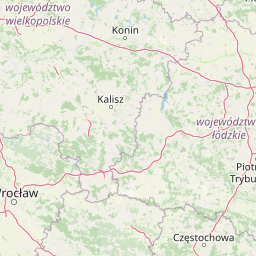
Map view of Miejski Bór Nature Reserve

Use this park location map to pinpoint Miejski Bór Nature Reserve in Poland, understand its exact geographic position, and read its mapped placement within the surrounding landscape more clearly.

Pigeon | © OpenStreetMap contributors

Location context for Miejski Bór Nature Reserve

Greater Poland Voivodeship

Visual reference for regional forest habitats, sandy upland terrain, and protected plant communities

Miejski Bór Nature Reserve Photos and Protected Forest Landscape Scenery

Visual documentation captures the fresh pine forest canopy and mixed broadleaf stands that define the protected landscape. Examining these field photographs reveals the distinctive botanical character and sandy upland terrain of the reserve.

A red wooden sign on two posts in a forest, featuring white Polish text that reads REZERWAT PRZYRODY MIEJSKI BÓR.

A close-up view of two small white flowers with pointed petals rising from a forest floor covered with brown fallen leaves and twigs.

Close up view of small white wildflowers with elongated petals blooming amidst lush green foliage in a forest setting.

A view into a dense, sunlit temperate deciduous and coniferous forest with a leaf-covered floor and mossy patches.

A red rectangular sign on a metal pole stands in a dense green forest, with a tree trunk in the foreground marked with a painted white letter R and a horizontal white stripe.

Park atlas

Compare adjacent lowland forests and connected protected landscapes across west-central Poland

Explore Parks Near Miejski Bór Nature Reserve and Regional Protected Areas

Continue your geographic exploration by browsing other protected areas situated near Miejski Bór Nature Reserve. Comparing adjacent lowland forests and regional habitats provides a clearer picture of the wider upland ecosystem.
A soft, painterly watercolor illustration showing a landscape with distant rolling hills, a green meadow, and a winding path in the foreground against a white background.
Nature reserveGreater Poland Voivodeship
About 4 km away#1 closest

Southeast

Dąbrowa Smoszew Nature Reserve: Mapped Geography and Protected Forest Landscapes

A key ecological node in the Greater Poland Voivodeship landscape

Dąbrowa Smoszew protects a compact fragment of mature oak forest, providing a natural refuge with 120 to 150 year old tree stands. Positioned within the Wysoczyzna Kaliska, the area maintains a complex mosaic of woodland flora and forest communities that function as a critical part of the regional conservation network, bridging local habitat history with contemporary Natura 2000 protected status.

Area
0.139 km²
Established
1963
Relief
Lowland
Scope
Terrestrial
A watercolor painting showing a soft landscape with trees, rolling hills, and a winding stream, rendered in light pastels.
Nature reserveGreater Poland Voivodeship
About 6.9 km away#2 closest

West

Rezerwat przyrody Mszar Bogdaniec: Geography and Protected Peatland Landscape Analysis

Explore wetland terrain within the Greater Poland Voivodeship.

Rezerwat przyrody Mszar Bogdaniec stands as a vital protected area in Greater Poland, featuring an elongated depression that supports transitional and raised bog elements. Enclosed by inland dunes, the reserve offers a compact study of Sphagnum-dominated micro-landscapes and wetland biodiversity that remains rare within the surrounding agricultural lowlands.

Area
0.22 km²
Established
1995
Scope
Terrestrial
Water
Major water bodies
Nature reserveWielkopolska Voivodeship
About 40 km away#3 closest

East

Rezerwat przyrody Majówka: Protected Nature Reserve and Woodland Geography

Geographic landscape mapping in Wielkopolska Voivodeship

Rezerwat przyrody Majówka offers a focused look at small-scale forest conservation in central-western Poland. Protecting approximately eight hectares of uneven-aged mixed woodland, the reserve serves as a vital ecological sentinel for silver fir and spruce populations, providing valuable data on lowland forest structure and regional biodiversity within the Kotlina Grabowska lowland mesoregion.

Area
0.08 km²
Established
1958
Relief
Lowland
Climate
Temperate
Watercolor painting of a calm pond with green trees on the banks, reeds in the foreground, and distant rolling hills.
Nature reservePoland
About 45 km away#4 closest

Northwest

Rezerwat przyrody Miranowo: Protected Peatland Ecosystem and Botanical Nature Reserve

A preserved wetland landscape in the Polish lake country

Located near the shores of Lake Dolskie Wielkie, Rezerwat przyrody Miranowo represents a significant protected area focused on the conservation of rare calcareous peatland habitats. The reserve sustains a dense collection of over 230 vascular plant species, offering a unique opportunity to study relict vegetation in a managed wetland environment within Poland.

Area
0.099 km²
Established
1972
Relief
Lowland
Climate
Temperate
A watercolor painting showing a soft, stylized forest landscape with gentle rolling hills in the background, leafy trees in the midground, and ferns and grasses in the foreground.
Nature reserveGreater Poland Voivodeship
About 46 km away#5 closest

West

Rezerwat przyrody Dębno: A Key Protected Nature Reserve in Greater Poland, Poland

Mapping lowland forest ecosystems and ancient oak habitats

Rezerwat przyrody Dębno provides a look into the lowland ecology of Greater Poland through its protected status and renaturation initiatives. This nature reserve, characterized by its ancient oaks and Magnocaricetum communities, highlights the importance of small-scale forest conservation and provides valuable insight into the regional geography of the Kotlina Żmigrodzka.

Area
0.08 km²
Established
1961
Relief
Lowland
Scope
Terrestrial
Nature reserveGreater Poland Voivodeship
About 46 km away#6 closest

Southeast

Rezerwat przyrody Jodły Ostrzeszowskie: Mapped Geography and Protected Forest Boundaries

Nature reserve study in the Greater Poland Voivodeship

Rezerwat przyrody Jodły Ostrzeszowskie functions as a critical floristic site in west-central Poland. Located in Ostrzeszów County, this protected area anchors a rare population of silver fir at the edge of its range. The site serves as a vital point for understanding lowland forest composition and range-limit ecology within the regional mosaic of the Kotlina Grabowska.

Area
0.087 km²
Established
1963
Relief
Lowland
Scope
Terrestrial
A soft watercolor painting of a serene wetland landscape with scattered deciduous trees, low grassy banks, and calm water, rendered in light green and muted earth tones against a white background.
Nature reserveGreater Poland Voivodeship
About 47 km away#7 closest

North

Dębno nad Wartą Nature Reserve: Geographic Profile and Protected Landscape Boundaries

Riparian forest sanctuary in the Warta river valley.

Located in the heart of the Greater Poland Voivodeship, this faunistic nature reserve protects a vital fragment of lowland floodplain forest. The site is defined by its complex oak, ash, and elm canopy, which supports rare invertebrate populations rarely found in the broader surrounding region. This atlas entry provides a detailed look at its protected boundaries, hydrologic landscape, and integral role within the Warta river corridor.

Area
0.217 km²
Established
1974
Relief
Lowland
Climate
Temperate
A horizontal watercolor painting depicting a wide river flowing through a lush landscape with distant rolling hills and a soft pink sky.
Nature reserveWielkopolska Voivodeship
About 49 km away#8 closest

Northwest

Ostoja Rogalińska: Protected Nature Reserve and Glacial Terrain in Wielkopolska Voivodeship

Mapped riparian corridors, moraine ridges, and bird habitats.

Ostoja Rogalińska offers a detailed look at lowland glacial morphology, featuring twelve mapped lakes, wandering inland dunes, and the extensive Warta River floodplain. This protected area within Wielkopolska Voivodeship preserves ancient pedunculate oaks alongside diverse wetland and forest ecosystems, providing a clear geographic view of one of the region's most important Natura 2000 bird sanctuaries.

Area
217.63 km²
Established
2007
Relief
Lowland
Climate
Temperate

Common questions about visiting, size, designation, and location context for Miejski Bór Nature Reserve

Miejski Bór Nature Reserve FAQs for park facts, access, geography, and protected area context

Find quick answers about Miejski Bór Nature Reserve, including protected-area facts, park geography, trail and visitor context, and how the park fits into its surrounding country and regional landscape.
MoriAtlas Explorer

Continue Your Protected Areas Search Across the Global Atlas

Deepen your exploration by continuing the structured search for national parks and protected areas worldwide. Utilize the comprehensive filtering capabilities to compare different conservation landscapes and refine your understanding of global park geography. Discover more about the distribution and characteristics of protected natural areas.

Global natural geography