Why Mount Hyland Nature Reserve stands out
Mount Hyland is best known for its temperate Gondwanan rainforest and its role as a refuge for threatened and supposedly extinct native wildlife. The high-elevation rainforest stand, dominated by common sassafras rather than Antarctic beech, represents a surviving fragment of the ancient forests that once covered Australia. The reserve gained wider scientific fame when the Hastings River mouse and a rare pouched frog, both thought to be extinct, were rediscovered here in the early 1980s, confirming Mount Hyland as an important biodiversity hotspot within the Gondwana Rainforests network.
Mount Hyland Nature Reserve history and protected-area timeline
Mount Hyland Nature Reserve was formally established in June 1984, when the New South Wales government set aside the area to protect its high-elevation temperate rainforest and associated wildlife from logging and other pressures. Its protection came at a time of growing scientific interest in the Gondwanan forests of eastern Australia and shortly before the broader recognition of these forests at an international level.
In 1986, the New England rainforest complex of which Mount Hyland is a part was inscribed as a UNESCO World Heritage Site under the name Gondwana Rainforests of Australia, formalising the global significance of the reserve's forests. The site was later added to the Australian National Heritage List in 2007, strengthening its recognition as a place of outstanding natural and scientific value at the national level.
A pivotal moment in the reserve's history came in the early 1980s, just around the time of its formal protection, when field surveys led to the rediscovery of the Hastings River mouse and a rare pouched frog on Mount Hyland. Both species had been believed to be extinct, and their surviving presence in the reserve helped justify and shape its future management as a strict nature reserve focused on conservation rather than public recreation.
Mount Hyland Nature Reserve landscape and geographic character
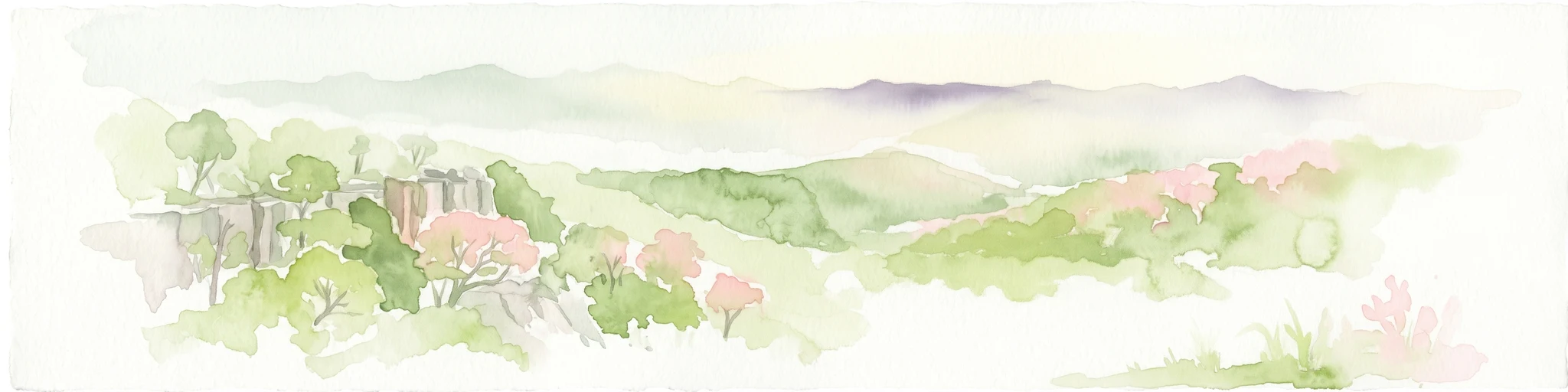
The landscape of Mount Hyland Nature Reserve is shaped by a triple-peaked mountain mass that stands several hundred metres above the surrounding plateau, with the highest summit reaching 1,434 metres above sea level. This elevation gives the reserve a cooler and wetter climate than the lowlands to the east, and it produces a rugged terrain of steep ridges, sheltered gullies, and deeply incised valleys typical of the New England Tablelands edge.
The mountain rises abruptly from more open plateau country, creating strong ecological contrasts between the exposed slopes above and the sheltered forest hollows below. Rocky outcrops, moisture-retaining soils, and frequent mist contribute to the conditions that have allowed temperate rainforest to persist on the higher elevations, while the surrounding matrix of plateau and valley supports different vegetation types. The overall scene is one of forested highlands, broken ridgelines, and a sense of remote, undisturbed terrain.
Mount Hyland Nature Reserve ecosystems, habitats, and plant life
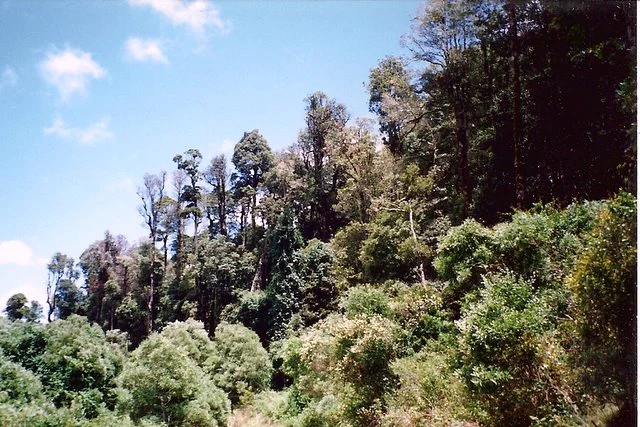
The reserve's natural significance centres on its temperate rainforest, a surviving remnant of the ancient Gondwanan forests that once cloaked much of eastern Australia. Unlike some other stands within the Gondwana Rainforests, the Mount Hyland rainforest lacks Antarctic beech, and instead the canopy is dominated by common sassafras along with other characteristic Gondwanan rainforest species adapted to cool, moist highland conditions.
These remnant forests are ecologically important because they preserve associations of plants that have existed on the Australian continent for millions of years and that share ancestry with the rainforests of New Zealand, New Caledonia, and southern South America. The reserve's mosaic of rainforest patches, rocky ridges, and highland valleys supports a complex understorey and contributes to habitat diversity across the New England landscape.
Mount Hyland Nature Reserve wildlife and species highlights
Mount Hyland is recognised as a remote hotspot of biodiversity, and its wildlife profile has been shaped by the reserve's isolation and the persistence of its forest cover. The reserve's most famous faunal moment came in the early 1980s, when the Hastings River mouse, a small native rodent long feared extinct, was rediscovered here, together with a rare pouched frog that had similarly been thought to have vanished.
The reserve also supports a diverse indigenous mollusc fauna, including species such as Triboniophorus graeffei, Terrycarlessia turbinata, Protorugosa alpica, Austrorhytida harrietae, Parmavitrina planilabris, Mysticarion porrectus, Brazieresta larreyi, Thersites novaehollandiae, and Austrochloritis species. This richness of land snails is itself an indicator of the reserve's intact, damp habitat conditions and its role as a refuge for moisture-dependent invertebrates.
Mount Hyland Nature Reserve conservation status and protection priorities
Mount Hyland Nature Reserve holds an unusually high conservation profile for its size. As a strict nature reserve (IUCN Category Ia), it is managed primarily for biodiversity conservation rather than recreation, under the oversight of the NSW National Parks and Wildlife Service. Its formal establishment in June 1984 reflected an explicit goal of protecting the area's Gondwanan rainforest and its associated fauna from habitat loss and degradation.
The reserve forms part of the New England Group of the Gondwana Rainforests of Australia UNESCO World Heritage Site, inscribed in 1986 and added to the Australian National Heritage List in 2007. These listings recognise Mount Hyland as part of one of the most significant surviving tracts of ancient rainforest in the world, and they tie its management to international standards of natural heritage protection.
Mount Hyland Nature Reserve cultural meaning and human context
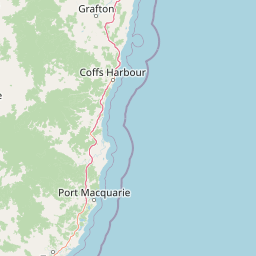
The Mount Hyland area is part of the New England region of New South Wales, a highland landscape that has long been remote and sparsely populated. The reserve's location inland of the coastal town of Dorrigo places it within a broader New England cultural geography shaped by pastoral use of the tablelands and by longstanding scientific interest in the region's distinctive flora and fauna. The reserve itself is primarily valued for its natural and scientific significance rather than for visible cultural or historical structures.
Top sights and standout views in Mount Hyland Nature Reserve
The reserve's most distinctive highlight is its temperate Gondwanan rainforest, dominated by common sassafras and preserved as a fragment of the ancient forests that once covered Australia. Equally significant is its status within a UNESCO World Heritage site and the Australian National Heritage List, which together recognise Mount Hyland as part of one of the continent's most important rainforest complexes.
Another defining highlight is the reserve's wildlife legacy: the rediscovery here of the Hastings River mouse and a rare pouched frog in the early 1980s cemented Mount Hyland's reputation as a refuge for threatened species. Combined with a rich indigenous land snail fauna, this makes the reserve a small but consequential stronghold of ancient biodiversity in northern New South Wales.
Best time to visit Mount Hyland Nature Reserve
Mount Hyland Nature Reserve is a remote, high-elevation reserve where weather and seasonal conditions strongly influence the experience of the landscape. Cooler and wetter conditions through the cooler months can bring mist, damp forest understorey, and rich conditions for viewing rainforest vegetation, while warmer months tend to be drier and offer clearer views of the surrounding plateau and ridgelines.
For visitors interested in the rainforest itself rather than broad panoramic views, the cooler, moister seasons can highlight the mossy, shaded character of the Gondwanan forest. Anyone planning a visit should keep in mind that this is a strict nature reserve focused on conservation, with limited public access and infrastructure compared with more developed national parks.