
Why Native Gap Conservation Reserve stands out
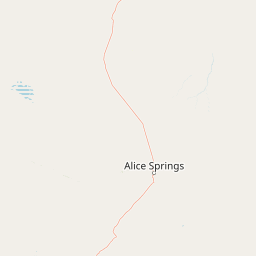
Native Gap is best known as the place where the Arrente name Arurlte Artwatye, meaning the gap across the shoulders of the neck, meets a real geological gap in the Hann Range. The reserve is also recognised for the 30-metre sandstone ridge that defines its skyline and for the traditional water source it once sheltered, which first drew European attention in 1872 during construction of the Overland Telegraph. The reserve is equally notable as a culturally anchored landscape: it sits at the junction of multiple Aboriginal creation stories and remains a sacred site for the Arrente and Anmatyerr peoples. Together, those qualities give Native Gap a significance disproportionate to its very small footprint.
Native Gap Conservation Reserve history and protected-area timeline
The modern history of Native Gap is closely bound to two overlapping stories: Aboriginal custodianship going back many generations, and the construction of the Overland Telegraph Line across central Australia in the 1870s. For the Arrente and Anmatyerr peoples, the site at the gap in the Hann Range had long been a sacred place where several creation stories meet, and the Arrente name Arurlte Artwatye captures the shape of that gap across the shoulders of the range.
The name 'Native Gap' entered European records in 1872, when W. W. Mills, one of the builders of the Overland Telegraph, reported to Charles Todd that the line had reached a gap in Hann's Range containing what he called a 'native well'. Within a few years, in 1880, workers on the telegraph returning to widen the gap for the route used explosives on the rock. In the process, they destroyed the natural water-holding structure that had made the gap significant both to Aboriginal people and to overland travellers.
Decades later, the site was formally recognised in the Northern Territory's protected-area system when Native Gap Conservation Reserve was established on 26 May 1980. Its management by the Parks and Wildlife Commission of the Northern Territory reflects the reserve's enduring status as both a cultural and a natural heritage site in central Australia.
Native Gap Conservation Reserve landscape and geographic character
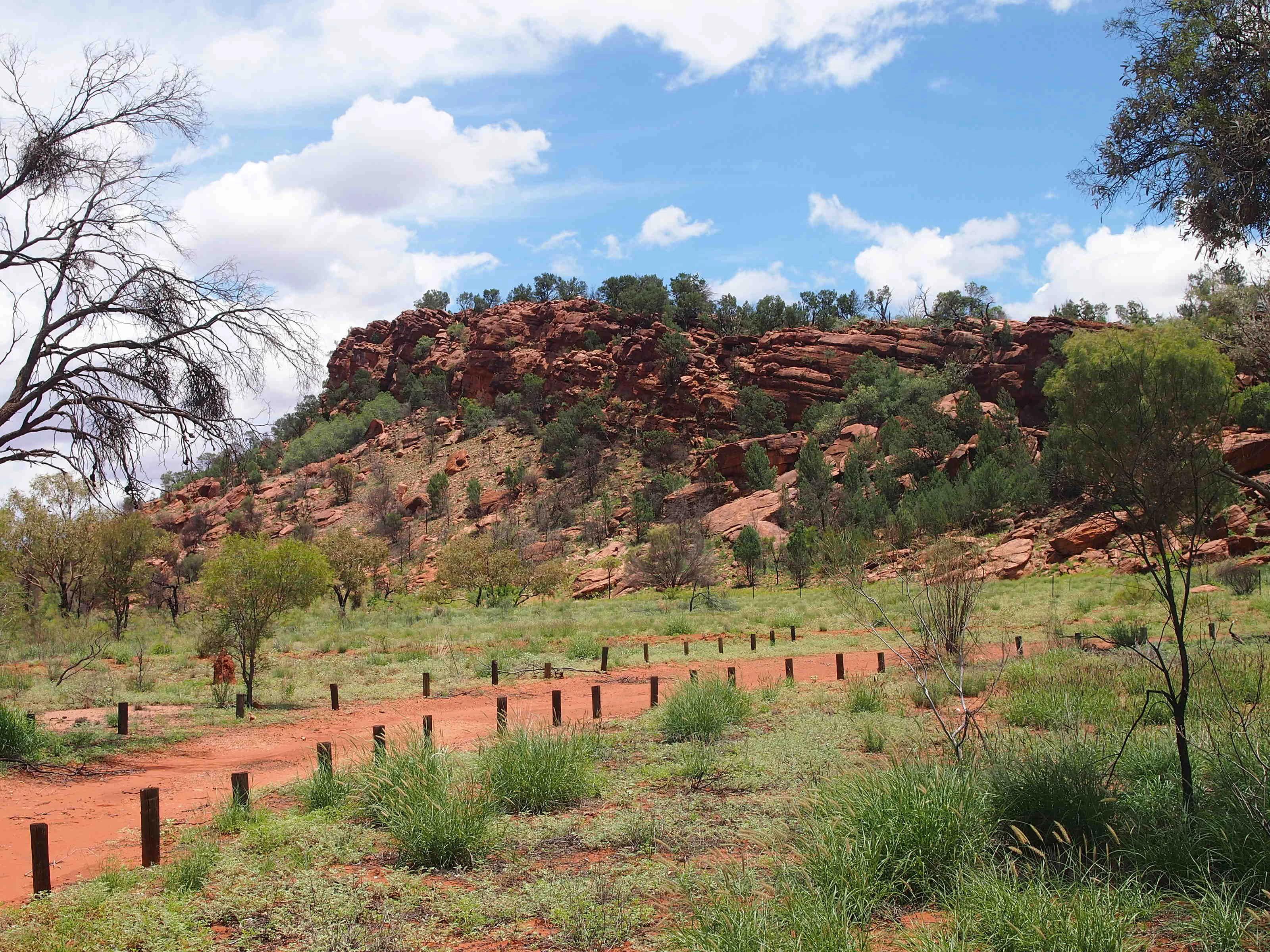
Native Gap's landscape is defined by contrast in a setting that is otherwise remarkably flat. The reserve centres on a 30-metre sandstone ridge that rises abruptly out of the surrounding Burt Plain, giving the site a sharp, recognisable silhouette. That ridge is the defining landform of the reserve and the source of its name, as the gap it forms in the Hann Range originally sheltered a natural water source used by Aboriginal people and later by telegraph workers.
Beyond the ridge, the surrounding terrain is a classic central Australian arid plain of sandy flats and open grassland, punctuated by low rises that lead into the broader Hann Range. The elevation change between the sandy lowlands and the exposed sandstone cap is enough to create markedly different habitat conditions across a very small area, which has a strong influence on the vegetation patterns that have developed within the reserve's boundaries.
Native Gap Conservation Reserve ecosystems, habitats, and plant life
The reserve supports a compact but ecologically diverse sample of central Australian arid-zone vegetation, structured largely by the geology beneath it. On the sandstone ridge itself, plants adapted to rocky exposure dominate, including white cypress pine, Acacia monticola, Acacia melleodora, Eucalyptus gamophylla, and Eucalyptus sessilis, which can persist even on the most exposed parts of the ridge. Native figs such as Ficus brachypoda take advantage of moister crevices and shaded positions on the rocky terrain.
The sandy flats and lower slopes present a different ecological character, with ironwood, desert bloodwood, and ghost gums forming a more open woodland over a ground layer of desert grasses and spinifex. After rain, these flats come alive ephemerally, with sundews (Drosera) appearing in damp patches and Grevillea wickhamii contributing to a more varied shrub layer alongside occasional Gossypium species. The result is a small reserve that nonetheless displays several distinct arid-zone vegetation types within a short distance.
Native Gap Conservation Reserve wildlife and species highlights
Despite its very small area, Native Gap supports a typical cross-section of central Australian arid-zone fauna, with birdlife being particularly conspicuous. Western bowerbirds feed on the native figs growing around the rock outcrops, while little woodswallows, dusky grasswrens among the spinifex, and brown quail in wetter periods are characteristic species of the site. The reserve also hosts whistling kite, rainbow bee-eater, willie wagtail, inland thornbill, variegated fairywren, mistletoebird, grey-headed honeyeater, and Torresian crow, reflecting the broader mix of birds typical of the central Australian ranges and plains.
Mammals recorded on the reserve include the short-beaked echidna, the euro (a widespread arid-zone wallaroo), and the black-footed rock-wallaby, which finds highly suitable shelter in the rugged sandstone of the ridge. The presence of species tied both to rocky terrain and to open spinifex plains gives the reserve a representative, rather than narrowly specialised, arid-zone fauna.
Native Gap Conservation Reserve conservation status and protection priorities
Native Gap Conservation Reserve is protected as an IUCN Category V landscape, a designation used for protected areas where cultural values and traditional land use are integral to the conservation outcome alongside natural features. Managed by the Parks and Wildlife Commission of the Northern Territory, the reserve is small but symbolically important in the Northern Territory's protected-area network because of how it combines ecological, geological, and cultural values in a single site.
Conservation significance here extends beyond habitat preservation. The reserve safeguards a sandstone ridge, a gap in the Hann Range, and surrounding arid-zone vegetation communities that illustrate the ecological contrast between uplands and sandy flats in central Australia. At the same time, its status as a registered sacred site for the Arrente and Anmatyerr peoples means that its conservation is also tied to the protection of Aboriginal cultural heritage and creation-story landscapes in the region.
Native Gap Conservation Reserve cultural meaning and human context
Native Gap is, fundamentally, a cultural landscape. For the Arrente and Anmatyerr peoples, the traditional owners of the area, the gap in the Hann Range is a sacred site where several creation stories converge. The Arrente name Arurlte Artwatye describes the gap in physical terms as the place where the shoulders cross across the neck, echoing how the Hann Range opens at this point in the landscape.
The site also carries a more visible, often-overlooked layer of colonial-era history. The 1872 naming of the gap by Overland Telegraph builder W. W. Mills and the 1880 blasting work that destroyed the water-holding rocks are reminders that the present-day landscape is the product of both Indigenous stewardship and the infrastructure projects that opened central Australia to European settlement. Together these strands give Native Gap a distinct cultural depth that continues to shape how the reserve is understood and managed.
Top sights and standout views in Native Gap Conservation Reserve
Native Gap is a small reserve with outsized significance, anchored by the 30-metre sandstone ridge that defines its landscape and the gap in the Hann Range that gives it its name. Its Arrente name, Arurlte Artwatye, captures both the physical shape and the cultural meaning of the site, which sits at the meeting point of several Aboriginal creation stories for the Arrente and Anmatyerr peoples.
Equally notable is the reserve's layered history: the 1872 'native well' recorded by Overland Telegraph workers, the 1880 blasting that destroyed the water-holding rocks, and the 1980 establishment of the protected area. Today, Native Gap stands as a compact example of how central Australian protected areas can combine arid-zone ecology, Aboriginal sacred-site values, and telegraph-era history within a footprint of just 11 hectares.
Best time to visit Native Gap Conservation Reserve
Because Native Gap is a small, low-elevation arid-zone site without developed visitor infrastructure, season matters primarily for landscape character rather than for access logistics. Cooler months from roughly April to September, when central Australian days are milder and nights can be cold, generally offer the most comfortable conditions for exploring the reserve and the surrounding Hann Range.
The warmer summer months bring higher temperatures and the possibility of dramatic rainfall events in the desert. After rain, the sandy flats can briefly support sundews and other ephemeral plants, and bird activity, including brown quail and other wet-season visitors, tends to increase. Visiting in either shoulder season or shortly after summer rains can therefore reveal different facets of the reserve's ecology.