Why Nelapattu Bird Sanctuary stands out
Nelapattu is best known as one of the most important inland breeding colonies of the spot-billed pelican in India, a species whose nesting numbers have declined sharply across much of South and Southeast Asia. Colonies of pelicans nesting in the canopy of the Barringtonia swamp forest give the sanctuary its identity. Equally important is the sanctuary's mixture of forested and aquatic habitats within a compact area. The juxtaposition of southern dry evergreen scrub on the surrounding ridges with seasonally flooded Barringtonia forest along the reservoir edge creates a distinctive dual-habitat setting that supports both breeding waterbirds and a diverse community of dry-country woodland species.
Nelapattu Bird Sanctuary history and protected-area timeline
Nelapattu Bird Sanctuary was formally established in 1976, giving formal protected status to a site that had long been valued locally for its birdlife. Its designation reflected growing awareness during the 1970s of the importance of inland wetlands for waterbird conservation in southern India, particularly for species such as the spot-billed pelican, whose breeding colonies had become increasingly scarce across the country.
Over time, the sanctuary has come to be recognized as one of the key inland strongholds for spot-billed pelican breeding in India. Conservation attention has focused on protecting the Barringtonia swamp forest around the Nelapattu tank, since the nesting trees used by pelicans are central to the site's reproductive output. The sanctuary continues to operate as a habitat and species management area under the IUCN protected-area framework.
Nelapattu Bird Sanctuary landscape and geographic character
The landscape of Nelapattu Bird Sanctuary is defined by the contrast between open water and dry forested uplands, an unusual pairing for an inland sanctuary in the Deccan. The central feature is the Nelapattu tank, a roughly 83-hectare reservoir that fills during the monsoon and gradually draws down through the dry months.
Surrounding the tank are low ridges and flats clothed in southern dry evergreen scrub, the characteristic vegetation of the East Deccan dry evergreen forests. This vegetation includes substantial reserved forest areas, notably the 288-hectare Kalluru Reserved Forest, alongside smaller patches of unreserved forest. The terrain is gently undulating rather than mountainous, giving broad visibility across the scrub and allowing large waterbirds to move easily between the wetland and the surrounding woodland.
The transition zone between the tank and the scrub is particularly distinctive. Here, Barringtonia acutangula forms a narrow but ecologically rich swamp forest that can tolerate months of standing water, producing a flooded woodland habitat rarely encountered in this region of India.
Nelapattu Bird Sanctuary ecosystems, habitats, and plant life
Nelapattu's ecological character arises from the close coexistence of two very different plant communities within a small protected area. The dominant community across most of the sanctuary is southern dry evergreen scrub, featuring trees and shrubs such as Manilkara hexandra, Maba buxifolia, Memecylon edule, Buchanania angustifolia, and Zizyphus xylopyrus. This vegetation is well adapted to the seasonally dry climate of the eastern Deccan and supports a community of woodland birds typical of the region.
Around the reservoir, however, conditions shift dramatically. The Nelapattu tank supports a freshwater swamp forest dominated by Barringtonia acutangula, locally known as Hijal. Although this species also grows on dry uplands elsewhere, the population at Nelapattu is remarkable for tolerating extended flooding of five to seven months, with saplings capable of surviving complete submersion during the highest water levels. This flood tolerance underpins the site's role as a heronry and pelicanry, since the trees provide both nest sites and protection from ground-based predators.
Together these two communities form a mosaic of dry scrub, swamp forest, open water, and seasonal marsh that sustains both resident species and visiting migrants through the year.
Nelapattu Bird Sanctuary wildlife and species highlights
Wildlife interest at Nelapattu centers overwhelmingly on birds, for which the sanctuary is internationally recognized. Around 189 bird species have been recorded, including roughly 50 migratory species that arrive during the winter months.
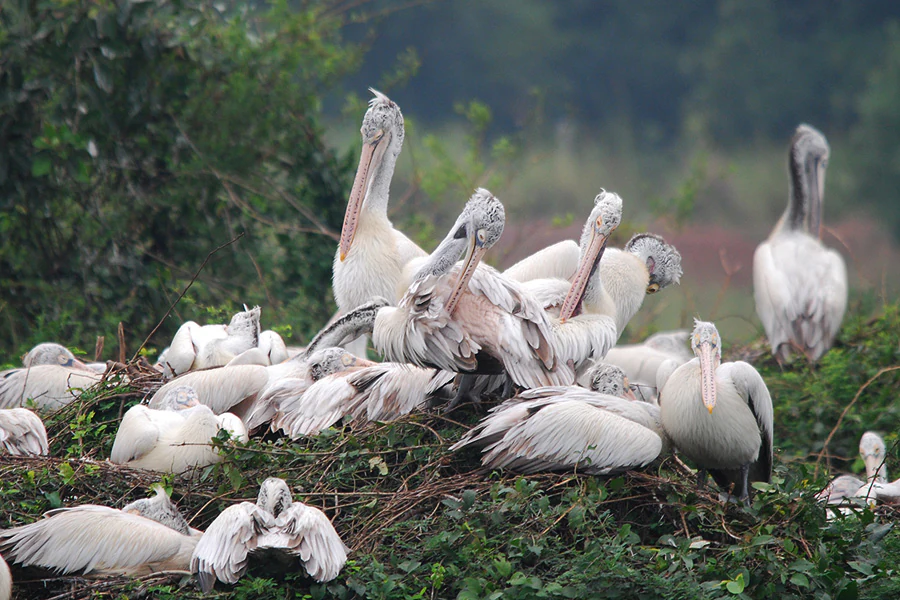
The sanctuary's signature species is the spot-billed pelican, which breeds colonially in the Barringtonia trees around the Nelapattu tank. The site is one of the most important inland breeding locations for this near-threatened species in India. Equally significant are breeding populations of black-headed ibis, Asian openbill, black-crowned night heron, and little cormorant, all of which share the swamp forest as their nesting habitat.
Migratory waterbirds add a strong seasonal character to the sanctuary during winter. Regular visitors include northern pintail, common teal, garganey, gadwall, northern shoveler, Indian spot-billed duck, little grebe, Eurasian coot, grey heron, Oriental darter, and black-winged stilt, expanding the site's ornithological importance well beyond its breeding season.
Nelapattu Bird Sanctuary conservation status and protection priorities
Nelapattu Bird Sanctuary plays an unusually focused conservation role for a relatively small protected area. Its principal significance lies in safeguarding one of the most important inland breeding colonies of the spot-billed pelican, a species whose population has declined sharply across parts of its range due to habitat loss, disturbance at nesting sites, and degradation of wetland feeding areas.
By protecting a large block of Barringtonia swamp forest around the Nelapattu tank alongside surrounding dry scrub habitat, the sanctuary preserves both the nesting trees that pelicans depend on and the broader landscape that supports their foraging and roosting behavior. The presence of multiple additional breeding colonial waterbirds, including black-headed ibis and Asian openbill, adds further conservation value by maintaining replicated nesting habitat under formal protection.
As an IUCN Category IV habitat and species management area, Nelapattu is also positioned to act as a regional reference site for monitoring the status of inland wetland bird communities in the southern Deccan and for designing interventions that benefit waterbirds sharing similar habitats elsewhere in Andhra Pradesh.
Top sights and standout views in Nelapattu Bird Sanctuary
Nelapattu's strongest highlight is its combination of pelican-friendly swamp forest and dry-country scrub within a single protected landscape. The 83-hectare Nelapattu tank and its surrounding Barringtonia trees form one of the most important inland breeding sites for spot-billed pelicans in India, and the same trees host mixed colonies of ibises, openbills, night herons, and little cormorants.
Beyond the breeding season, the sanctuary's mix of open water, flooded woodland, and southern dry evergreen scrub attracts roughly 50 migratory species, including northern pintail, garganey, common teal, and Oriental darter. Few protected areas in the eastern Deccan combine this range of breeding and wintering functions at such a compact scale.
Best time to visit Nelapattu Bird Sanctuary
Nelapattu offers a layered seasonal experience. The post-monsoon and winter months, broadly from late October through February, are typically associated with the largest numbers of migratory waterfowl and with comfortable weather for observation, making this the most rewarding window for seeing the full breadth of the sanctuary's bird list.
The breeding season, broadly coinciding with the months when the tank holds water and the Barringtonia canopy is in active use, is when the pelican and heron colonies are most visible. Visiting during this period offers the chance to observe colonial nesting behavior, while the later winter and early dry season tends to emphasize migrant diversity and gradually decreasing water levels.