Why Poleski National Park stands out
Poleski National Park is best known for its outstanding variety of peatlands, including raised, transitional and low bogs, as well as for the rich mosaic of kettle lakes such as Lake Moszne, Lake Łukie and Lake Długie. It is also renowned for its strong populations of birds typical of undisturbed marshlands, including the crane, the bittern, the aquatic warbler and the white-tailed eagle, and for harboring glacial relict plants and invertebrates that survived the last ice age far to the south of their main ranges.
Poleski National Park history and protected-area timeline
The idea of a national park on Polesie goes back to the 1930s. Polish botanist Władysław Szafer first proposed the creation of a park in the Polish part of Polesie in 1933. A further concept was advanced in 1954 by Tadeusz Wilgat, and a concrete plan for protecting water and peatland habitats around Wytyczno was put forward by Dominik Fijałkowski, who envisioned a small national park covering roughly 30 square kilometers.
During the 1960s and 1970s much of the surrounding Polesie was altered by drainage works associated with the Wieprz-Krzna Canal, and peat mining began in the Łęczyńsko-Włodawskie Lake District as part of the Lublin Coal Basin operation. Conservationists fought to safeguard the most valuable natural sites. Although the large Krowie Bagno complex was eventually drained and converted to grassland, four strictly protected nature reserves covering a combined area of nearly 1,800 hectares were established on today's park territory through Fijałkowski's efforts: Durne Bagno in 1966, Lake Moszne in 1974, Lake Długie in 1978 and the Orłówskie Peatland in 1982.
A formal proposal to create a national park was submitted to the Minister of Environmental Protection in 1987, and after the political opening brought by the Polish Round Table Talks, the Council of Ministers established Poleski National Park on 1 May 1990, on an initial area of roughly 4,800 hectares. In 1991 a project for enlargement was prepared, aiming to include additional catchment areas of the Piwonia and Włodawka rivers and the new Bagno Bubnów peatland reserve. On 1 February 1994 the park was expanded to about 9,648 hectares and given a buffer zone of more than 13,600 hectares, giving it the scale needed to manage the water relationships essential to its wetland character. The park later became a key component of the West Polesie Biosphere Reserve, which became transboundary in 2012 by linking with biosphere reserves in neighboring countries.
Poleski National Park landscape and geographic character
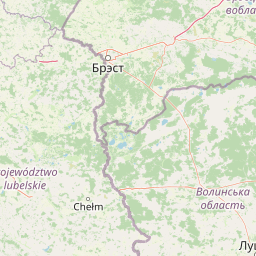
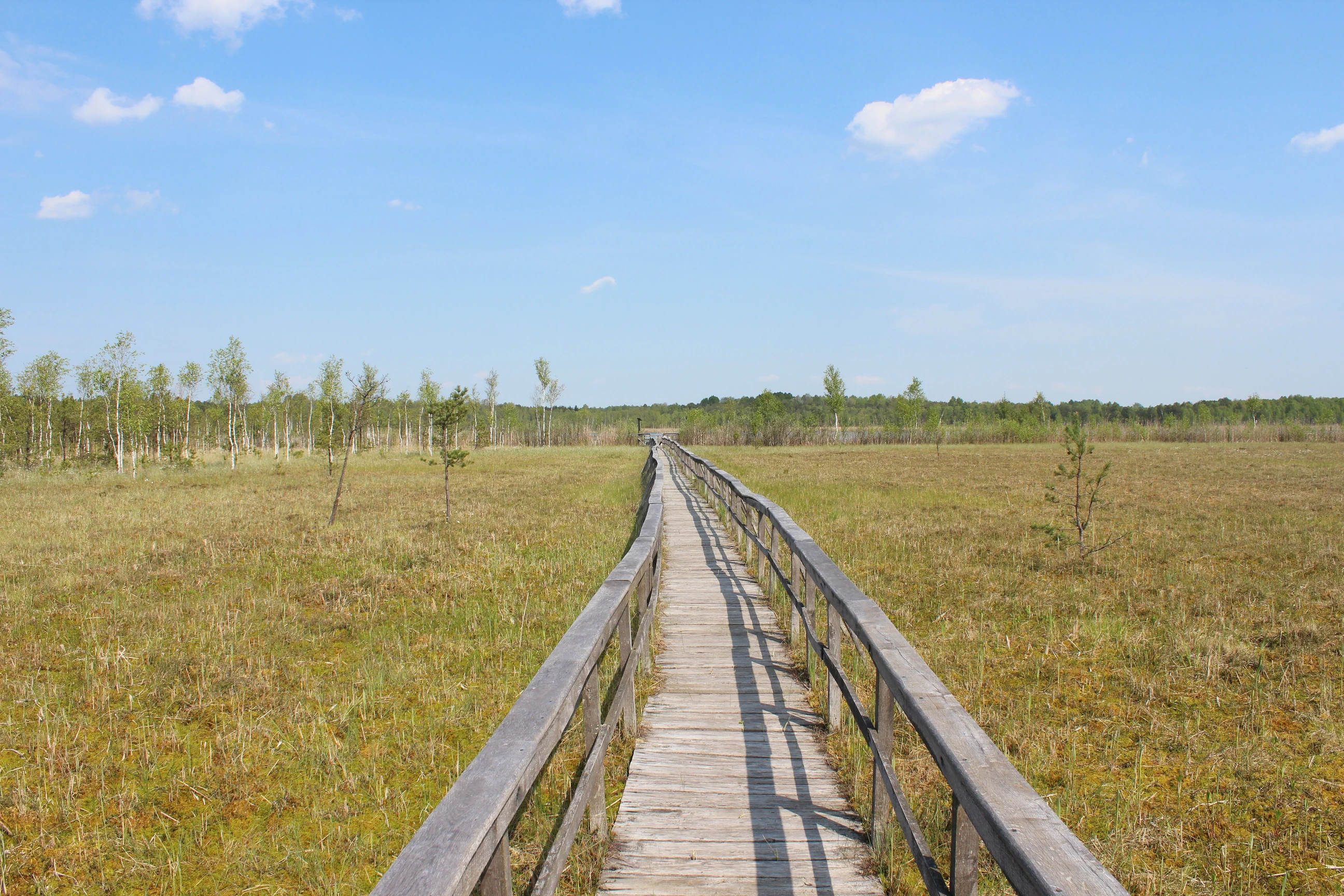
The landscape of Poleski National Park is famously flat. The entire park lies on the Równina Łęczyńsko-Włodawska, an extensive lowland where processes of river valley formation have barely begun. Most of the surface is made up of peat plains, broken only by small, low limestone and chalk hummocks near Wola Wereszczyńska and along the southern edge of the protected area, which separate the central part of the park from the Uściwierz Lake basin. The northern boundary is framed by a chain of moraines dating from the Middle Polish glaciation.
Water defines the terrain. Numerous lakes of glacial and kettle origin, including Lake Moszne, Lake Łukie and Lake Długie, are scattered across the peat surface, surrounded by floating mats of vegetation, reeds and sedge communities. Tiny pools, hollows and channels wind through the bogs. The combination of open peatlands, scattered lakes and stunted, sparse woodland gives the park a strong visual resemblance to the northern taiga and even to tundra, making it one of the southernmost landscapes in Europe where such a tundra or forest-tundra feeling can still be experienced.
In the central part of the park, low limestone hills rise slightly above the otherwise level terrain, while across most of the area the eye meets an unbroken horizon of bog, marsh and forest. These landscapes developed over thousands of years without significant human interference, so that the relief is shaped primarily by ice-age processes and the slow accumulation of organic deposits rather than by drainage or cultivation.
Poleski National Park ecosystems, habitats, and plant life
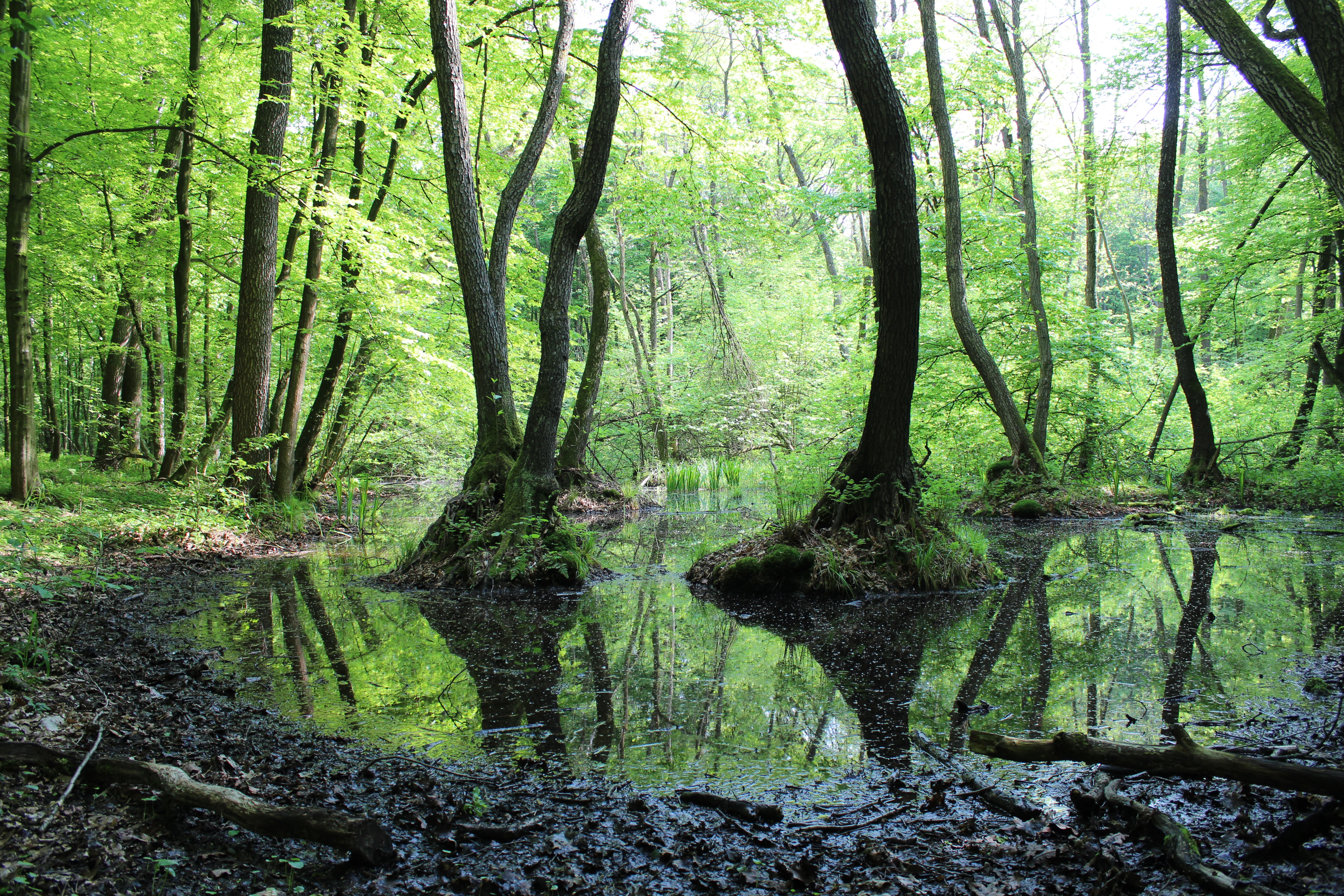
Poleski National Park protects an exceptional mosaic of wetland, aquatic and water-dependent forest ecosystems. Its ecological identity rests on three main peatland types: low bogs, transitional fens and raised bogs, supported by dystrophic lakes, marshy meadows and alder wetlands. More than two hundred distinct plant communities have been identified in the park, including thirty forest and shrub communities and around 178 non-forest formations, making it one of the most ecologically diverse protected areas in Poland for its size.
Forest cover in the park is unusual for lowland Poland. Instead of tall, species-rich deciduous woodlands, the forests here are dominated by marshy birches, sparse, poor pine stands on peat soils, and rich alder carrs along the lake edges. These are communities shaped primarily by water regime rather than by human forestry, and many represent habitats now rare throughout Central Europe.
The park is also notable for the survival here of glacial-relict plant species that retreated northward with the ice but lingered in the cool, waterlogged conditions of Polesie. These northern elements include dwarf birch, Lapland willow, cloudberry willow, marsh sedge and long-leaved sundew, joined by Atlantic relics such as whorled water-milfoil and common marsh pennywort that are unusually far from their main European range. Beyond its formally protected status, this combination of boreal relict and Atlantic plant elements gives the park a distinctive biogeographic identity within Poland.
Poleski National Park wildlife and species highlights
Poleski National Park is one of the richest sites in Poland for wetland-dependent birds, which dominate its wildlife profile. More than 200 bird species have been recorded, and around 150 breed in the park. The Eurasian crane, the park's symbol, is present in notable numbers, while white and little egrets, bitterns, white-tailed eagles and corncrakes are among the rarer or more striking breeding species. The aquatic warbler, a globally threatened species, maintains here one of its largest national populations, and a reintroduction program supports a viable population of black grouse.
Mammal diversity is also high, with around 48 recorded species. Large herbivores such as red deer, moose and wild boar are present in meaningful numbers, while European beavers, introduced here in 1992, have transformed parts of the wetland by their dam-building. Predators and smaller carnivores include otters in the lakes and rivers, and on dry ground pine martens, polecats, stoats and weasels. Among rodents, the park hosts typical species such as red-backed voles alongside more unusual ones like the northern water vole and muskrat.
Amphibian and reptile life is rich for a lowland area. The park holds thirteen amphibian species, including natterjack toads and fire-bellied toads among the rarer taxa. Reptiles include seven species, with the European pond turtle, a glacial relict and one of Poland's most endangered reptiles, being particularly significant. Invertebrate communities, although still incompletely studied, include protected species such as marsh fritillary butterflies and scarce narrow-bordered bee hawk-moths, alongside relict ant species with post-glacial biogeographic histories.
Poleski National Park conservation status and protection priorities
Poleski National Park is one of the key conservation sites for lowland peatlands in Central Europe. It safeguards a near-natural sequence of low, transitional and raised bogs, dystrophic lakes and marsh forests under a regime that combines strict protection, active management and landscape-scale buffering. The park's water-driven ecosystem depends fundamentally on maintaining natural hydrological relationships across a sufficiently large area, which is why it was progressively expanded in the early 1990s and surrounded by a substantial buffer zone.
The park is part of the West Polesie Biosphere Reserve under UNESCO's Man and the Biosphere Programme, and in 2012 the reserve became transboundary by joining forces with Polish and Belarusian sister reserves across the border. Its most important wetland complexes are listed as Ramsar sites, recognizing them as wetlands of international importance, and the area is integrated into the European Natura 2000 network of protected habitats and species. These overlapping designations show that the park is valued not only at national level but also as a cornerstone of European wetland conservation.
Within the park, conservation priorities include protecting peatland hydrology, supporting rare relict populations such as European pond turtle, aquatic warbler and black grouse, and monitoring the slow recovery of formerly drained areas. The reintroduction of the European beaver in 1992 illustrates how restoring missing ecological functions has become part of the park's conservation strategy, alongside education and research carried out at the Urszulin and Stare Załucze centers.
Poleski National Park cultural meaning and human context
The Polesie region has long been a distinctive cultural landscape on the Polish-Belarusian-Ukrainian border, characterized by scattered villages, traditional agricultural use of wet meadows, and a strong local identity tied to marshland resources. Within the park, small villages and former settlement sites are part of the wider cultural fabric, and the area's peat cutting and small-scale farming have shaped how the surrounding rural population has interacted with the wetland for generations.
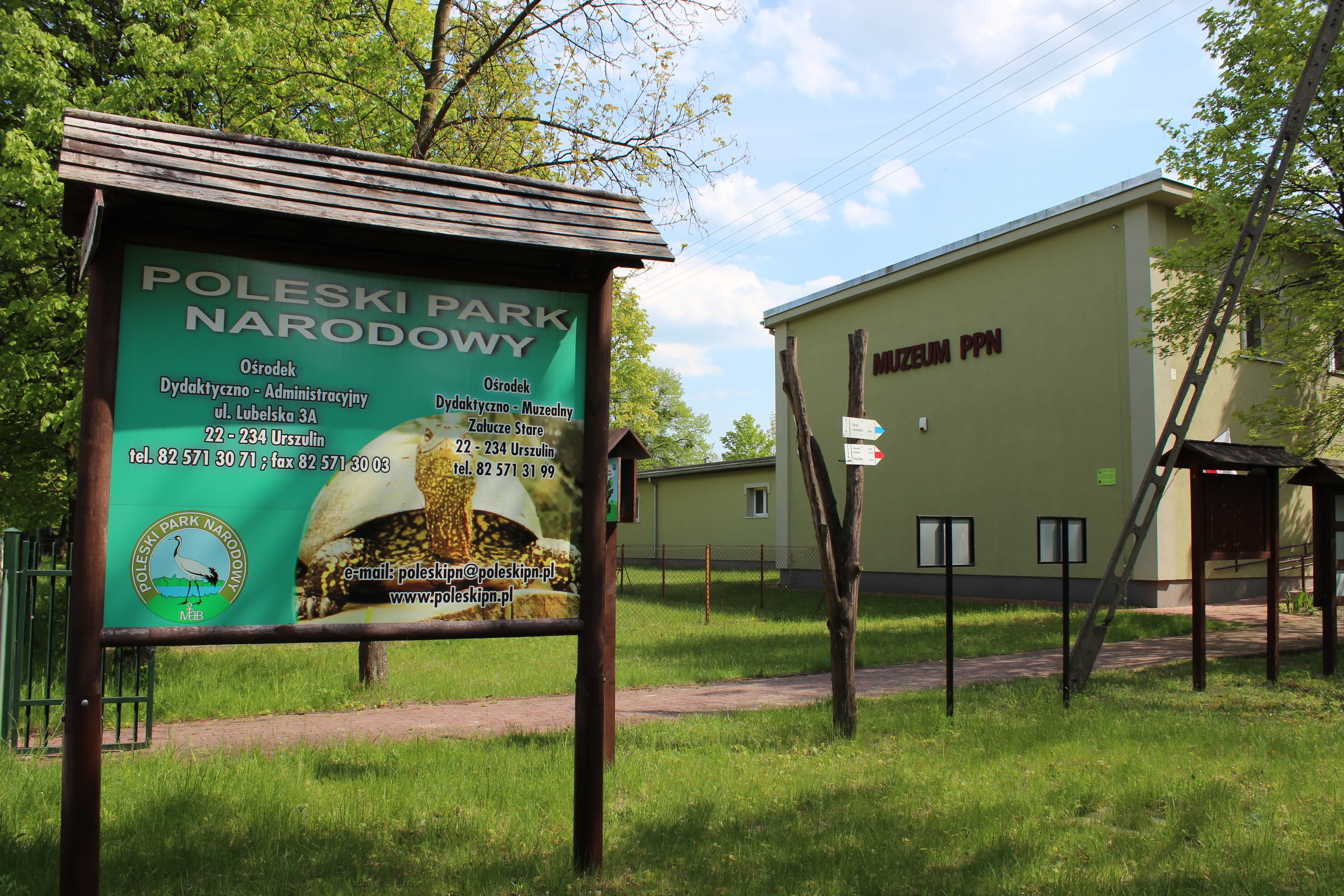
Local heritage institutions play a role in the park today. The educational and museum center at Stare Załucze and the administrative-educational center at Urszulin emphasize the relationship between human communities and the wetland. The Urszulin center also hosts a dedicated European pond turtle conservation facility, linking cultural infrastructure directly to species recovery. Together, these sites frame the park not just as a piece of untouched nature but as a meeting point between ecological protection and a long-standing regional culture of living with marshlands.
Top sights and standout views in Poleski National Park
Among the strongest highlights of Poleski National Park are the large, intact peatlands stretching across the central part of the territory, the chain of kettle and oxbow lakes such as Lake Moszne, Lake Łukie and Lake Długie with their floating mats of vegetation, and the dense populations of wetland birds led by the crane, the bittern and the aquatic warbler. The park is also distinguished by its glacial-relict flora, the survival within Polish borders of European pond turtle, and the conspicuous recovery of the European beaver following its 1992 reintroduction.
Best time to visit Poleski National Park
The character of Poleski National Park shifts strongly with the seasons, and each period offers a different experience of its wetland landscape. Late spring and early summer are the most rewarding for birdwatching, when cranes, bitterns and aquatic warblers are active and many waterbirds breed on the marshes and around the lakes; this is also when flowering plants, including relict sundews and various orchids, are easiest to observe in fen and meadow habitats.
Summer brings rich displays of water vegetation on the lakes and high chances of encountering dragonflies, amphibians and other wetland wildlife at the edges of bogs, though warm weather can also bring mosquitoes. Autumn is a quieter, more contemplative time, when cranes gather before migration, peatland plants take on russet colors, and the flat landscape becomes increasingly atmospheric; winter brings frost, snow and a hushed, minimalist scene across the bogs that highlights the park's taiga-like character, though access can be limited by weather conditions.