
Mori Atlas logo
Biosphere reserveReserva de Biosfera Estación Biológica del Beni

Mapping the ecological mosaic of forest islands and seasonally flooded savannas in northern Bolivia

Reserva de Biosfera Estación Biológica del Beni: A Distinctive Amazon Basin Protected Landscape

(Reserva de la Biosfera y Estación Biológica del Beni)

The Reserva de Biosfera Estación Biológica del Beni represents a vital protected landscape in the southwestern lowlands of northern Bolivia. Within the Llanos de Moxos ecoregion, this biosphere reserve preserves a striking archipelago of forest islands and corridors nested within a matrix of seasonally flooded grasslands and tropical wetlands. The mapped terrain showcases the complex interplay between terra firme forests, marshes, and river systems that define this Amazonian environment.

biosphere reserveLlanos de Moxosseasonally flooded savannaforest islandstropical wetlandNeotropical wildlife
A flat-design, stylized illustration depicting a waterfall dropping from high yellow and purple cliffs into a river below, with pine trees in the foreground and a pale blue sky.

Reserva de Biosfera Estación Biológica del Beni

Biosphere reserve

Park overview

Structured park overview, official facts, and landscape profile for Reserva de Biosfera Estación Biológica del Beni

Reserva de Biosfera Estación Biológica del Beni park facts, protected area profile, and essential visitor context

Review the core facts for Reserva de Biosfera Estación Biológica del Beni, including designation, size, terrain, visitor scale, habitats, and operating context in one park-focused overview.

About Reserva de Biosfera Estación Biológica del Beni

The Reserva de Biosfera Estación Biológica del Beni is one of the benchmark protected landscapes of the Bolivian Amazon. Located in the southwestern lowlands of the Beni Department, the reserve occupies a vast tract of flat alluvial plains that experience strong seasonal flooding. Ecologically, it is defined by the contrast between its tierra firme forests and the surrounding seasonally flooded savannas and wetlands of the Llanos de Moxos, a pattern that produces a landscape often described as an archipelago of forests set within a sea of grasses and marshes.

The reserve fits within a tropical climate regime with high temperatures year-round and a pronounced wet season, conditions that shape both its hydrology and its vegetation patterns. Its network of rivers, swamps, cyperaceous marshes, and shallow lagoons is fed by rivers such as the Maniquí, which connects the area to the larger Mamoré basin. This combination of forest, savanna, and wetland supports one of the most species-rich faunas in Bolivia and provides a natural laboratory for studying the dynamics of Neotropical floodplain ecosystems.

Beyond its ecological role, the Estación Biológica del Benin, as it is often abbreviated (EBB), is also one of Bolivia's longstanding centers for field research and conservation management. Its UNESCO biosphere status, integrated management committee, and overlap with Tsimane indigenous territory reflect a broad approach where biodiversity conservation, scientific study, and cultural recognition are pursued in parallel.

Quick facts and research context for Reserva de Biosfera Estación Biológica del Beni

The Estación Biológica del Beni lies in Bolivia's Beni Department, spanning parts of the Yacuma and General José Ballivián provinces, and belongs to the Sistema Nacional de Áreas Protegidas (SNAP). It was established by Supreme Decree 19191 on October 5, 1982, and was recognized by UNESCO's Man and the Biosphere Programme in 1987 as part of the World Network of Biosphere Reserves, which it remains a member of today.

The reserve is classified as an IUCN Category IV habitat/species management area. Its mosaic of forests, savannas, and wetlands preserves more than 800 recorded plant species and a similarly large number of animal species, including nearly 500 bird species and over 40 bat species. A portion of its territory is also recognized as indigenous Tsimane land, reflecting the reserve's integrated role in biodiversity conservation and cultural heritage.

Protection and recognition

Documented terrestrial protection scope, designation history, and administrative recognition data

Reserva de Biosfera Estación Biológica del Beni Protection Status and International Recognition

Reserva de Biosfera Estación Biológica del Beni maintains a documented terrestrial protection scope established in 1987. Structured records detail the official designation timeline and baseline conservation framing for this protected area.

Protection details

Protection scope
Terrestrial
Designated year
1987
Transboundary protection
No
Park context

Deeper park guide and search-rich context for Reserva de Biosfera Estación Biológica del Beni

Reserva de Biosfera Estación Biológica del Beni history, landscape, wildlife, and travel context

Explore Reserva de Biosfera Estación Biológica del Beni through its history, landscape character, ecosystems, wildlife, conservation priorities, cultural context, and seasonal travel timing in a structured park guide built for atlas discovery and search intent.

Why Reserva de Biosfera Estación Biológica del Beni stands out

The Estación Biológica del Beni is best known for its archipelago-like landscape, where islands and corridors of tropical forest survive within a wide matrix of seasonally flooded savannas and palm llanos of the Llanos de Moxos. This striking ecological mosaic has made the reserve one of the most important and best-studied sites in the Amazon basin for understanding the interplay between forests, grasslands, and wetlands in Neotropical lowlands. It is also valued as a refuge for emblematic Neotropical wildlife, including jaguar, harpy eagle, black caiman, and giant otter, while supporting some of Bolivia's richest bat and fish diversity. The reserve's long-running role as a biological station, combined with its indigenous Tsimane territory and UNESCO biosphere designation, gives it a distinctive identity as a place where conservation science, biodiversity, and traditional land use converge.
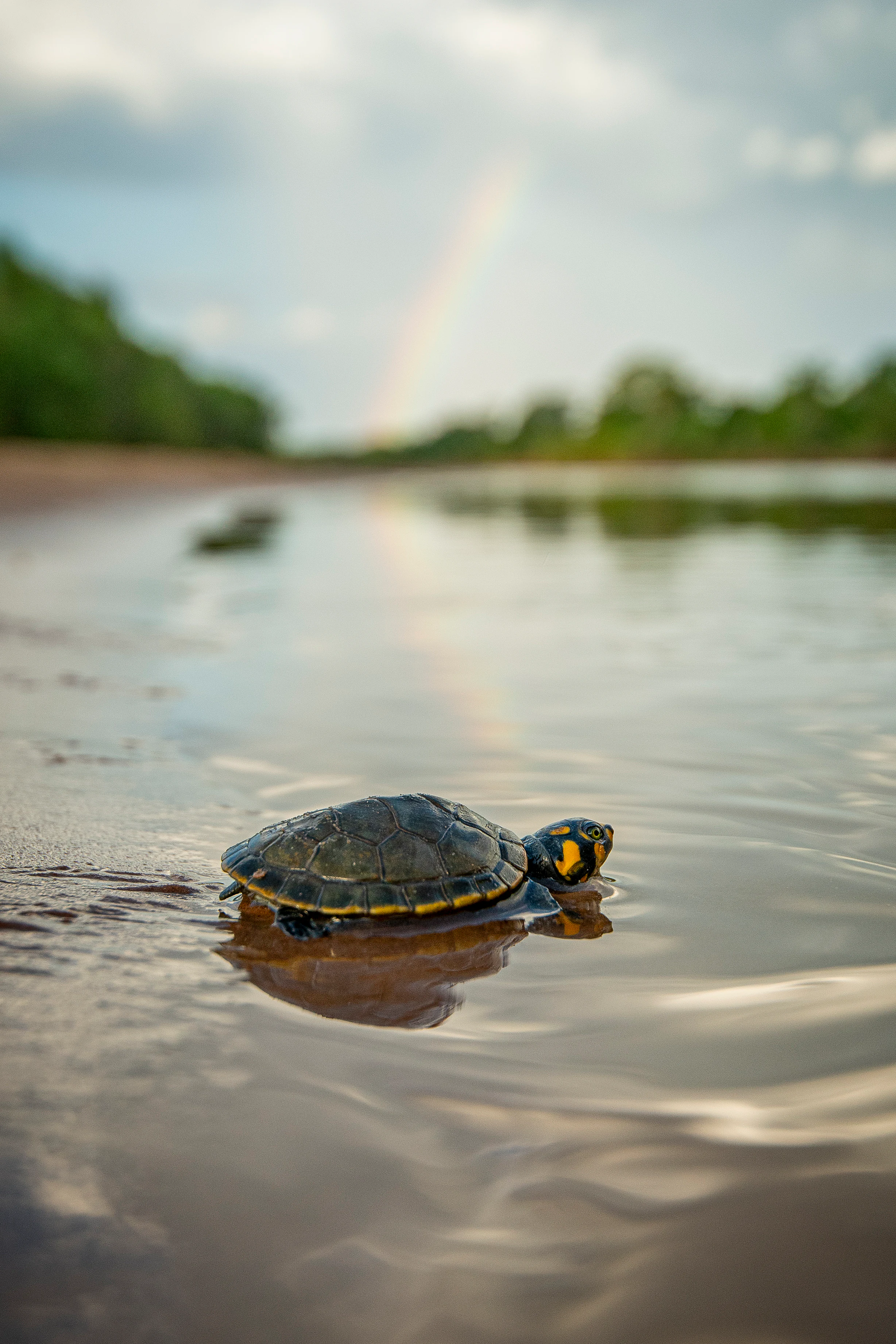
A small dark turtle with yellow markings on its head is crawling along the shallow edge of a riverbank, with a blurry rainbow visible in the sky above the water.
A small river turtle crawls toward the water at the Reserva de Biosfera Estación Biológica del Beni, beneath a faint rainbow.

Reserva de Biosfera Estación Biológica del Beni history and protected-area timeline

The Estación Biológica del Beni was formally created on October 5, 1982, under Supreme Decree 19191, as part of Bolivia's growing system of national protected areas aimed at safeguarding the country's biodiversity, waters, and natural resources. From the start, its purpose combined the protection of flora, fauna, and the region's distinctive forest-savanna mosaic.

In 1987, the reserve gained international recognition when UNESCO's Man and the Biosphere Programme incorporated it into the World Network of Biosphere Reserves, opening the door to broader research partnerships, baseline inventories, and international scientific collaboration.

A major turning point came in the 1990s, when approximately 30% of the reserve's area was formally recognized as Tsimane indigenous territory. This recognition reshaped the reserve's management approach, raising the need for policies that respect indigenous livelihoods and integrate local communities into conservation and administration. In more recent years, the reserve has also achieved an Area of Importance for the Conservation of Bats (AICOM) certification, joining a select group of Bolivian protected areas recognized for their significance for bat conservation.

Reserva de Biosfera Estación Biológica del Beni landscape and geographic character

The landscape of the Estación Biológica del Beni is overwhelmingly flat and low-lying, part of the wide alluvial plains that define the Llanos de Moxos. Topographic relief is minimal, and elevations across the reserve typically sit around 220 meters above sea level. This subtle topography, combined with strong seasonal flooding, has produced a highly varied landscape mosaic rather than a uniform plain.

The most distinctive visual impression comes from the contrast between forest and savanna. Woodlands appear as islands, strips, and corridors of tall tropical forest embedded in an open matrix of seasonally flooded grasslands, palm-dominated llanos, and palustrine wetlands. Where flooding is permanent or prolonged, swamps of Cyperaceae and other aquatic vegetation dominate, and shallow lagoons dot the terrain.

Hydrology is a defining element of this landscape. The Maniquí River traces part of the reserve's northwestern edge and links the local system to the broader Mamoré basin. Its flood pulses, together with seasonal rainfall, sculpt the wetlands, maintain connectivity between forest patches and savannas, and shape the cycles of water that drive the entire ecosystem.
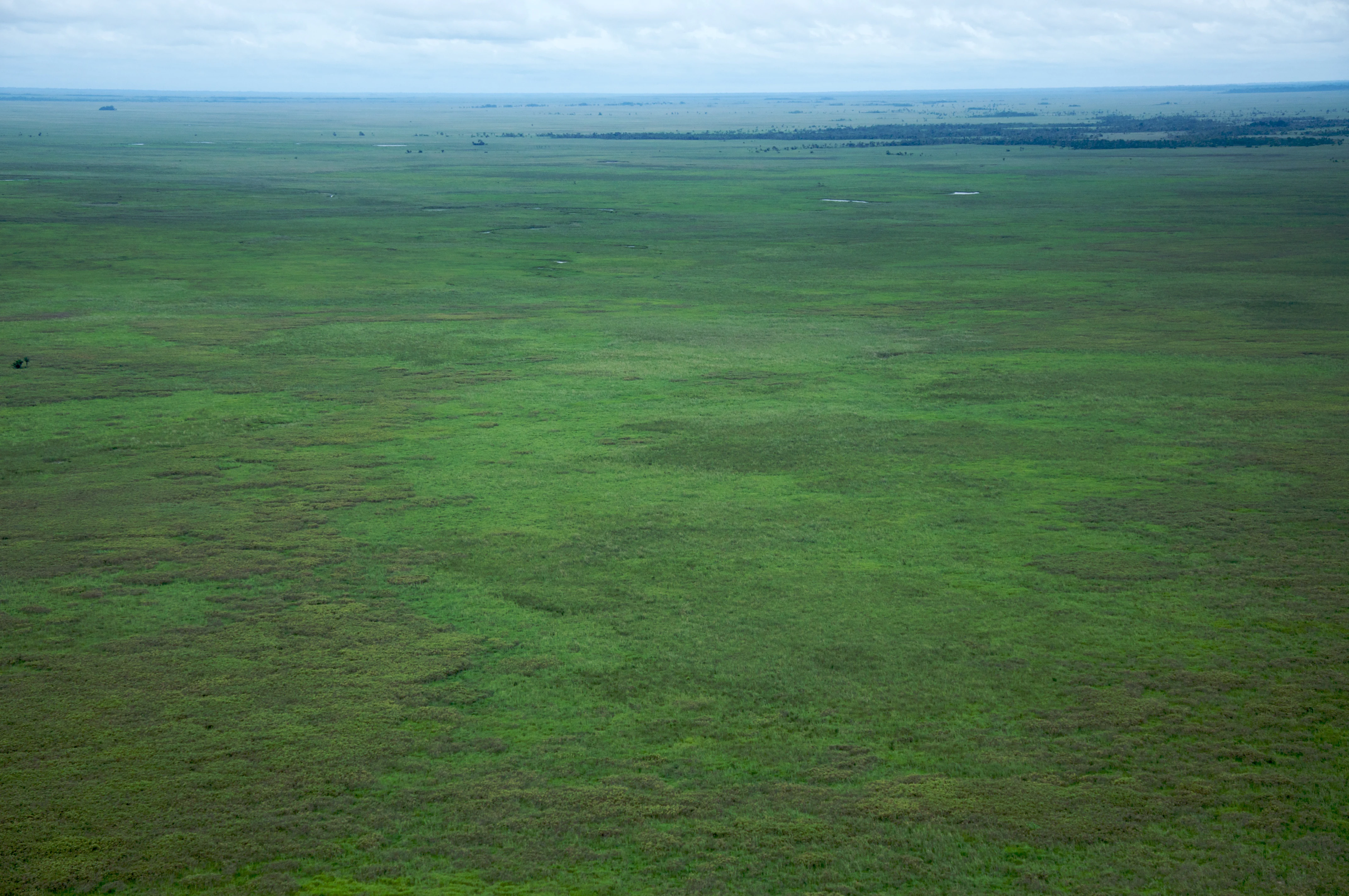
An expansive, flat green savanna landscape seen from an aerial perspective under an overcast sky.
An aerial view of the expansive Beni savanna in Bolivia.

Reserva de Biosfera Estación Biológica del Beni ecosystems, habitats, and plant life

Ecologically, the reserve is defined by a deeply interwoven mosaic of tropical forest, savanna, and wetland. The forests include both basal seasonally humid tierra firme forest and several types of flooded and swamp forests, each with distinct species compositions and structural characteristics. These woodlands form a network of patches and corridors rather than a continuous canopy, a pattern that strongly influences how species move, disperse, and interact across the landscape.

Surrounding and interspersed with the forests are seasonally flooded savannas, permanent marshes dominated by sedges of the family Cyperaceae, and shallow lagoons of variable size. Some of the lagoons have been shrinking in recent years, an ecological development that has raised concerns about hydrological change in the reserve. Palm communities, especially those dominated by species such as the pachiuva (Socratea exorrhiza), contribute to the structural diversity of both wet and transitional habitats.

Together, these habitats support a very high overall species richness. More than 800 higher plant species have been recorded, and estimates suggest that the flora may ultimately exceed 1,500 species, capturing the multiple biogeographic influences from the Amazon, the Chiquitania, and the savannas of the Beni Department.
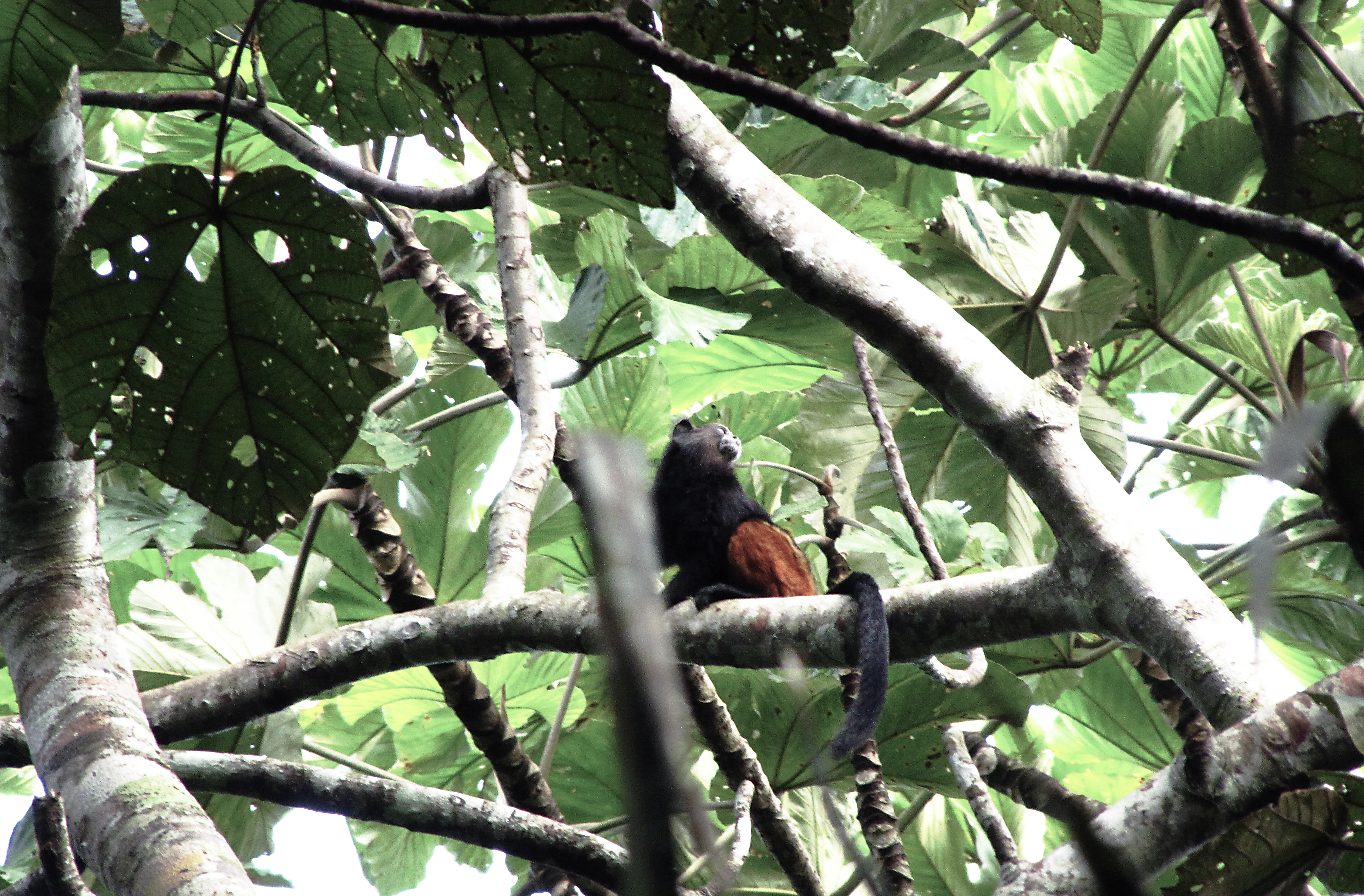
A red howler monkey sits on a tree branch, surrounded by large green leaves in a dense forest canopy.
A red howler monkey, known locally as a manechi colorado, perched in the canopy of the Beni Biological Station Biosphere Reserve.

Reserva de Biosfera Estación Biológica del Beni wildlife and species highlights

The Estación Biológica del Beni harbors one of the richest wildlife assemblages in Bolivia, reflecting the convergence of Amazonian forest species with open-country and wetland species typical of the Llanos de Moxos. Nearly 500 bird species have been identified, making the reserve one of the most important bird areas in the country.

Mammals include jaguar, puma, ocelot, margay, jaguarundi, giant otter, giant anteater, tamandua, black howler monkey, spider monkey, capuchin monkeys, marsh deer, lowland tapir, white-lipped peccary, collared peccary, capybara, and the giant armadillo. Arboreal species dominate within the forest patches, while herbivores such as marsh deer, capybara, and maned wolf-like canids range widely across the savannas.

The reserve is also exceptionally valuable for bats, hosting roughly 43 of the 138 bat species known from Bolivia, a richness that earned the area an AICOM (Area of Importance for the Conservation of Bats) certification. Reptiles include the black caiman, the yacare caiman, two dwarf caimans of the genus Paleosuchus, turtles of the genera Podocnemis, Phrynops, and Geochelone, and various snakes. Aquatic biodiversity is equally impressive, with about 248 fish species documented, including endemic Rivulidae such as species of Pterolebias and Simpsonichthys.

Reserva de Biosfera Estación Biológica del Beni conservation status and protection priorities

The Estación Biológica del Beni holds a central place in Bolivia's conservation system, both as an IUCN Category IV habitat and species management area and as a long-standing UNESCO biosphere reserve. Its ecological value lies in the protection of a rare and ecologically meaningful mosaic where forest patches, savannas, and wetlands coexist and support exceptional biodiversity, including high concentrations of endemic and threatened species.

Conservation relevance in the reserve extends beyond species protection to the preservation of ecological processes. Seasonal flooding patterns, forest-savanna connectivity, bat populations, reptile nesting habitat, and fish migration in the Maniquí and Mamoré corridors all depend on the integrity of the overall landscape. The AICOM certification underscores the reserve's growing importance for bat conservation across Latin America.

At the same time, the area faces significant pressures. Subsistence hunting threatens vulnerable species, seasonal burning of savannas alters vegetation dynamics, illegal logging removes mature trees from forest islands, and poaching continues to affect turtles, caimans, and snakes. Road expansion and the construction of a bridge over the Maniquí River have accelerated agricultural frontier expansion in the southern part of the reserve, making long-term management planning and governance critical to its future.

Reserva de Biosfera Estación Biológica del Beni cultural meaning and human context

The cultural landscape of the Estación Biológica del Beni is closely shaped by the Tsimane (also called Chimane) people, who have inhabited the region's forests and rivers for centuries. Historically, Tsimane and Movima communities practiced agriculture, hunting, fishing, and gathering in the area that is now the reserve. Today, around 200 Tsimane families still live within the reserve, distributed along the Maniquí, Rapulo, Maniquí Viejo, Maniquicito, and Curiraba rivers, while small ranching estancias occupy other parts of the area.

Since the 1990s, recognition of Tsimane territory within the reserve has reframed conservation policy around the dual goals of biodiversity protection and indigenous cultural survival. A Management Committee established in 1999 brings together national and departmental government bodies, municipal governments, Tsimane organizations, ranchers, farmer communities, and academic institutions such as the Academia Nacional de Ciencias de Bolivia and the Universidad Técnica del Beni. Mestizo-campesino and indigenous communities around the reserve, including those displaced by land reform to localities such as Puerto Méndez, Galilea, Santa Elena, and San Antonio, are also integral to the surrounding socioeconomic landscape.

Top sights and standout views in Reserva de Biosfera Estación Biológica del Beni

The Estación Biológica del Beni stands out for its exceptional ecological mosaic, where forest islands and corridors exist within a wider matrix of seasonally flooded savannas and wetlands, creating one of the most distinctive landscapes of the Bolivian lowlands. The reserve hosts a remarkable concentration of Neotropical wildlife, including jaguar, harpy eagle, giant otter, black caiman, marsh deer, and one of Bolivia's most important bat populations.

It is also distinguished by its combination of long-term scientific study, UNESCO biosphere status, indigenous Tsimane territory, and integrated co-management through a multi-stakeholder committee. These layers of recognition and management have made the reserve both a globally significant conservation area and a key reference site for understanding the dynamics of forest-savanna landscapes in the Amazon basin.

Best time to visit Reserva de Biosfera Estación Biológica del Beni

The reserve lies in a tropical climate where temperatures remain warm year-round, and the visit experience is shaped primarily by the alternation between wet and dry seasons. Wet-season months bring heavy rains that flood savannas and forests, expand wetlands and lagoons, and concentrate wildlife along river corridors and remaining dry ground, offering dramatic landscapes and rich aquatic bird observation.

Dry-season months bring lower water levels, more open savannas, and easier access by road and along lagoon edges, making wildlife easier to observe across the open llanos. Visitors generally favor the dry season for broader terrestrial mammal and bird viewing, while those interested in flooded landscapes and aquatic species often find the wet season more rewarding.
Monthly climate preview

Long term temperature and monthly precipitation averages recorded across representative coordinates

Reserva de Biosfera Estación Biológica del Beni Climate Normals and Weather by Month

Reserva de Biosfera Estación Biológica del Beni experiences a measured annual temperature and precipitation rhythm spanning warm monthly highs and distinct seasonal rainfall shifts. Exploring the full twelve month climate profile reveals comprehensive long term averages across temperature extremes and precipitation rates.
Annual mean26 °C
24 °C28 °C
Jan26°
Feb26°
Mar26°
Apr25°
May24°
Jun24°
Jul24°
Aug26°
Sep28°
Oct28°
Nov27°
Dec26°
Warmest month
October

28.2 °C

Coolest month
June

23.8 °C

Wettest month
February

9.9 mm/day

Driest month
August

1.4 mm/day

Park location guide

Geography guide, regional context, and park location map for Reserva de Biosfera Estación Biológica del Beni

Reserva de Biosfera Estación Biológica del Beni park geography, regions, and map view in Bolivia

Understand where Reserva de Biosfera Estación Biológica del Beni sits in Bolivia through a broader geographic reading of the surrounding landscape, nearby location context, and its mapped position within the national park landscape.

How Reserva de Biosfera Estación Biológica del Beni fits into Bolivia

Bolivia, officially the Plurinational State of Bolivia, is a landlocked country in central South America. It features diverse geography including the Andean mountain range, Amazonian plains, Gran Chaco, and the Pantanal wetland. The country has a population of approximately 11.4 million and is administratively divided into nine departments, with La Paz as the seat of government and Sucre as the constitutional capital.

Wider geography shaping Reserva de Biosfera Estación Biológica del Beni in Bolivia

Bolivia is located in central South America, bordered by Brazil to the north and east, Paraguay to the southeast, Argentina to the south, Chile to the southwest, and Peru to the west. The country is divided between a western Andean region and tropical lowlands to the east and north. It includes the Amazonian plain, Gran Chaco, temperate valleys, the high-altitude Altiplano plateau, and part of the Pantanal wetland along its eastern border.

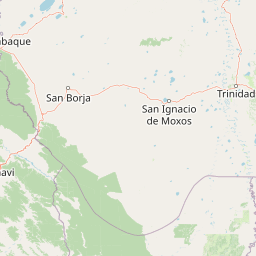
Map view of Reserva de Biosfera Estación Biológica del Beni

Use this park location map to pinpoint Reserva de Biosfera Estación Biológica del Beni in Bolivia, understand its exact geographic position, and read its mapped placement within the surrounding landscape more clearly.

Pigeon | © OpenStreetMap contributors

Visualizing forest islands, seasonal savannas, and wetland habitats across the reserve

Reserva de Biosfera Estación Biológica del Beni Photos and Landscape Scenery

Photographic records illustrate the distinctive mosaic of tropical forest islands and seasonally flooded savannas that define the reserve. Visual documentation reveals the flat terrain and wetland habitats that support diverse Neotropical wildlife across the lowlands.

A small dark turtle with yellow markings on its head is crawling along the shallow edge of a riverbank, with a blurry rainbow visible in the sky above the water.

A close-up view of a sloth with brown, shaggy fur clinging to a tree branch, surrounded by bright green leaves.

An expansive, flat green savanna landscape seen from an aerial perspective under an overcast sky.

A red howler monkey sits on a tree branch, surrounded by large green leaves in a dense forest canopy.

Park atlas

Compare adjacent lowland reserves and connected Amazon basin landscapes.

Parks Near Reserva de Biosfera Estación Biológica del Beni and Regional Protected Areas

Browsing other protected areas near Reserva de Biosfera Estación Biológica del Beni reveals broader ecological patterns across the surrounding Llanos de Moxos ecoregion. Continuing into adjacent lowland reserves provides valuable context for comparing tropical forest islands, seasonally flooded savannas, and regional wetland habitats.
Regional parkBeni
About 46 km away#1 closest

Southeast

Parque regional Yacuma: Geographic Overview and Protected Landscape Mapping

Riparian ecosystems and flooded savanna terrain in Beni, Bolivia

Explore the expansive floodplain mosaic of Parque regional Yacuma, where the Yacuma and Beni river systems create a vital refuge for lowland wildlife. The park offers an essential view into the seasonal transitions of northern Bolivia, bridging pre-Andean forests and inundated savanna plains that define this significant regional conservation corridor.

Area
1,200 km²
Established
1990
Water
Major water bodies
Nature reserveBeni Department
About 69 km away#2 closest

North

Reserva natural Barba Azul: A Protected Savanna Sanctuary in the Beni Department

Mapping flooded grasslands and gallery forest ecosystems

Reserva natural Barba Azul stands as a key protected area within the Bolivian Amazon lowlands. This nature reserve, centered in the Beni Department, preserves a rare mosaic of motacú palm forests and seasonal wetlands that serve as a critical stronghold for endangered parrots and migratory shorebirds within the larger Llanos de Moxos region.

Area
110 km²
Established
2008
Relief
Lowland
Climate
Tropical
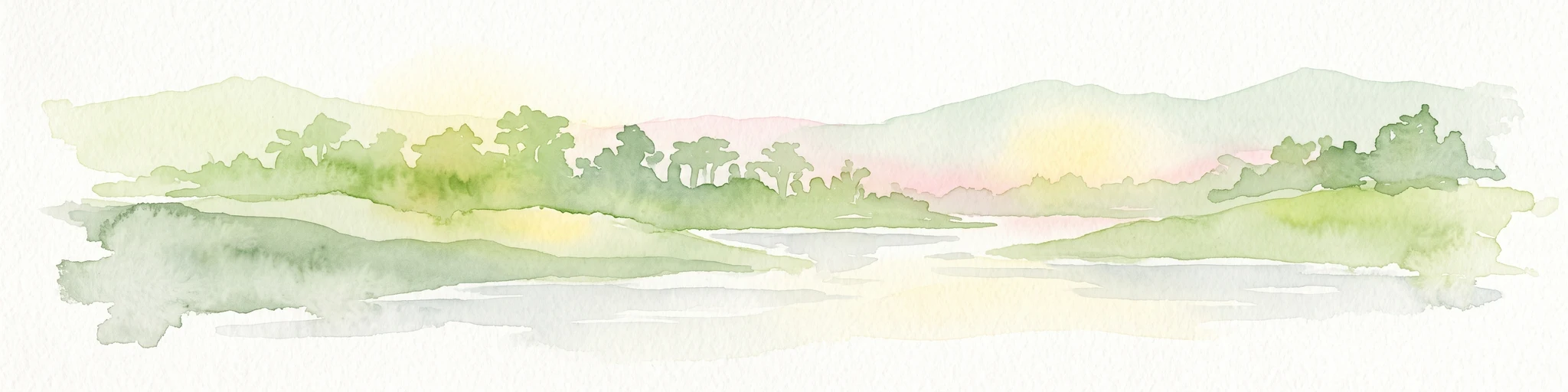
A horizontal watercolor painting of a river landscape with lush green vegetation in the foreground and soft, hazy hills in the background.
Protected areaBeni
About 74 km away#3 closest

Northwest

Área protegida municipal Pampas del río Yacuma: Protected Area and Wetland Geography

A large-scale municipal sanctuary in the Bolivian Amazon

This significant protected area encompasses the expansive floodable savannas of the Llanos de Moxos. Its mosaic of forest islands and riverine wetlands provides a critical refuge for endemic species and iconic Amazonian wildlife. The geography is shaped by the Yacuma River, creating a seasonal environment that bridges indigenous heritage with modern conservation land management.

Area
6,164.53 km²
Established
2007
Visitors
16K annual
Relief
Lowland
Protected areaBeni Department
About 126 km away#4 closest

West

Área Protegida Municipal Rhukanrhuka: Mapping Amazonian Biodiversity and Riverine Terrain

A transitional protected landscape in the Beni Department of Bolivia

Spanning a vast transition from Andean slopes to the Llanos de Moxos floodplain, Área Protegida Municipal Rhukanrhuka protects a dynamic mosaic of white-water rivers, gallery forests, and tectonic lakes. This significant municipal reserve serves as a refuge for threatened species and sustains indigenous Maropa communities within its borders, anchoring an essential conservation corridor in the northern Amazon.

Area
8,594.51 km²
Established
2019
Relief
Lowland
Climate
Tropical
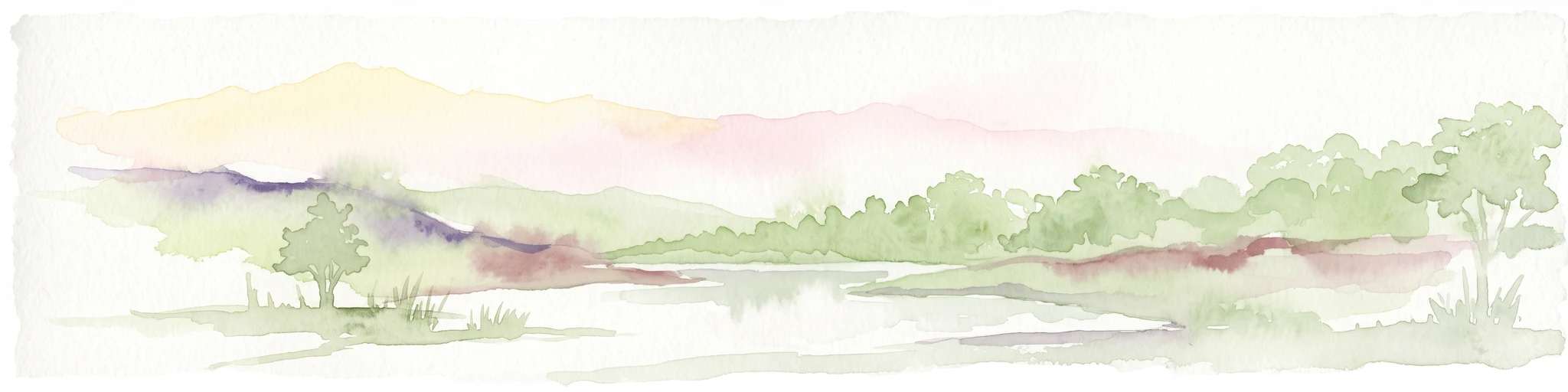
A watercolor painting showing a soft, atmospheric landscape with a winding river, green banks, trees, and distant low hills against a white background.
Protected areaBeni Department
About 129 km away#5 closest

East

Área Protegida Municipal Ibare-Mamoré: Geography and Protected Area Context

Riverine landscapes and wetlands in Bolivia's Beni Department

The Área Protegida Municipal Ibare-Mamoré encompasses a diverse range of ecosystems, from upland forests to open grasslands and shifting river channels. As a key conservation unit near the city of Trinidad, this area highlights the ecological importance of the Llanos de Moxos region through its interconnected aquatic and terrestrial habitats.

Area
256.08 km²
Established
2011
Relief
Lowland
Climate
Tropical
A pale, soft-toned watercolor illustration of a calm river landscape with rolling hills in the background and sparse trees along the banks.
Biosphere reserveBolivia
About 130 km away#6 closest

Southwest

Reserva de la Biosfera y Tierra Comunitaria de Origen Pilón Lajas Protected Landscape Atlas

Mapping the Andean Amazonian transition in northern Bolivia

Spanning from high mountain ridges to the river plains of the Beni, this protected area features a unique vertical gradient of ecosystems including cloud forests and terra firme. It represents a significant model for indigenous co governance and biodiversity protection within the broader Andean and Amazonian geographic context.

Area
4,000 km²
Established
1992
Relief
Mountain
Climate
Tropical
National parkLa Paz Department
About 171 km away#7 closest

West

Madidi National Park: National Park Protected Landscape and Geographic Atlas Entry

Explore mapped boundaries and regional context in La Paz Department.

Madidi National Park is a designated national park situated in Bolivia's La Paz Department. This detail entry offers a focused perspective on its protected landscape, its specific geographic setting, and its role within the larger atlas of natural areas. Understand the park's mapped boundaries and its contribution to the regional geography, providing a foundation for structured discovery of Bolivia's protected lands.

Area
18,957.5 km²
Established
1995
IUCN
II
Relief
Mixed relief
Protected landscapeBeni
About 177 km away#8 closest

Southeast

Parque Municipal y Área Natural de Manejo Integrado Gran Mojos: Regional Geography

Protected floodplain ecosystems in the Beni department of Bolivia.

Analyze the spatial distribution of this large protected area located in the Mamoré River basin. Learn about its dual-designation structure, bridging core municipal forests with integrated management zones that preserve vital lowland Amazonian habitats and endemic biodiversity within the Llanos de Moxos ecoregion.

Area
5,804.3 km²
Established
2017
Relief
Lowland
Scope
Terrestrial

Common questions about visiting, size, designation, and location context for Reserva de Biosfera Estación Biológica del Beni

Reserva de Biosfera Estación Biológica del Beni FAQs for park facts, access, geography, and protected area context

Find quick answers about Reserva de Biosfera Estación Biológica del Beni, including protected-area facts, park geography, trail and visitor context, and how the park fits into its surrounding country and regional landscape.
MoriAtlas Explorer

Continue Your Protected Areas Search Across the Global Atlas

Deepen your exploration by continuing the structured search for national parks and protected areas worldwide. Utilize the comprehensive filtering capabilities to compare different conservation landscapes and refine your understanding of global park geography. Discover more about the distribution and characteristics of protected natural areas.

Global natural geography